SAASINSPECTOR
mnml.ai logo

mnml.ai Review

Architects, interior designers, and urban planners seeking AI-powered photorealistic rendering from sketches or 3D models

Visit mnml.aiFrom $29/mo Lite

Research-based review. We analyzed vendor documentation, customer reviews on G2, Capterra, and Reddit, and live pricing — not hands-on testing yet. We update as our team puts tools through real workflows.

The verdict

Mnml.ai is a vertically focused AI rendering platform built for architects, interior designers, and urban planners, converting sketches and 3D model exports into photorealistic visuals using its proprietary ArchDiffusion v4.2 engine. It scores well for professionals embedded in SketchUp, Revit, or Blender workflows who need fast, styled architectural outputs. However, limited transparency around company details and a thin independent review footprint make it harder to fully trust its claimed scale.

Pros

  • Specialized ArchDiffusion v4.2 engine delivers photorealistic architectural renders tailored specifically for design professionals.
  • Native compatibility with major 3D tools including SketchUp, Revit, Blender, and 3ds Max streamlines existing workflows.
  • Offers 40+ architectural styles giving designers broad visual range without switching platforms.
  • Video Animate AI generates 10-second cinematic 1080p animations suitable for client presentations at a surprisingly polished quality.
  • Sketch-to-image conversion supports both hand-drawn and digital sketches, covering a wide input range.
  • Canvas AI inpainting allows targeted edits to specific parts of a render without regenerating the whole image.
  • Purpose-built vertical focus means the tool does architectural rendering well rather than spreading thin across general use cases.

Cons

  • No logo generation, brand kits, UI wireframes, or social templates makes it useless for general design or branding work.
  • Only eight Trustpilot reviews despite claiming 2.4 million users raises serious credibility and transparency concerns.
  • Company background is opaque — founding date is undisclosed and headquarters location is vague, which limits trust in platform claims.
  • Video output is capped at 10 seconds with no interactive or longer-form options, limiting its utility beyond basic client presentations.
  • Registration as MNML.AI LLC-FZ with minimal public corporate information is a yellow flag for enterprise buyers needing vendor accountability.
  • Limited third-party review data makes independent validation of performance claims difficult.
From $29/mo Lite Free plan YesFree trial Yes

The claimed user base is 2.4 million. The Trustpilot footprint is eight reviews. We noticed that gap early and kept it in mind through the rest of our research, which pulled from vendor documentation, pricing pages, Reddit threads, and what little public review data actually exists on mnml.ai.

mnml.ai homepage screenshot
mnml.ai — Homepage

What is mnml.ai?

Not a general-purpose image generator. Not a Canva competitor. mnml.ai is an AI rendering platform built specifically for architects, interior designers, and urban planners, taking sketches or 3D model exports and turning them into photorealistic architectural visuals via a proprietary engine called ArchDiffusion v4.2, paired with something they call ARX technology.

The company is registered as MNML.AI LLC-FZ. Founding date isn't public. Headquarters is vague. That kind of opacity on the basics is a yellow flag, not a red one, but it does affect how much weight you can reasonably give their platform claims.

Forty-plus architectural styles. Twelve-plus specialized tools. Vertical AI, clearly. The positioning is a direct attempt to replace or reduce reliance on traditional rendering pipelines for design professionals, and the documented tool list suggests they've taken that seriously. Worth noting, though: compatibility with SketchUp, Revit, Blender, and 3ds Max is described in vendor docs as an export-and-upload workflow, meaning Revit users export a view as PNG or JPG and upload it, rather than opening a native project file inside the platform. That distinction matters when you're building a daily workflow around it.

mnml.ai Features: Logo, Graphics, UI & Brand Design Capabilities

mnml.ai features screenshot
mnml.ai — Features

No logo generation. No brand kit. No UI wireframes. No social templates. That's not a failure. It's a deliberate design decision, and the right one given the target user.

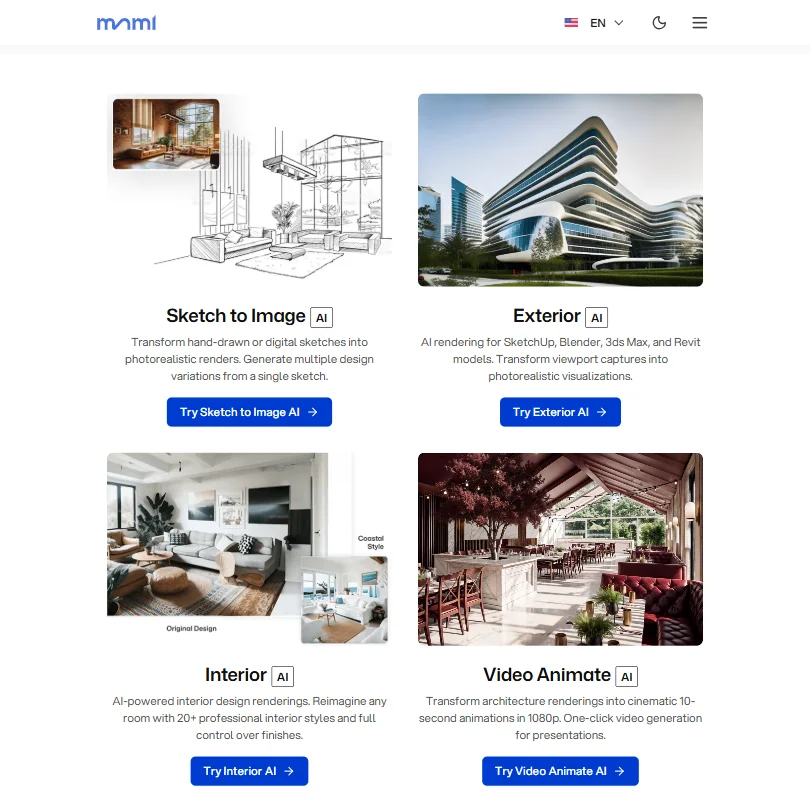
What mnml.ai does ship is substantial inside its lane. Imagine AI handles text-to-render generation, taking written descriptions and producing architectural visuals. Sketch-to-image conversion processes hand-drawn or digital sketches, and style transfer applies the 40-plus architectural style options across existing renders.

The video tool surprised us, honestly. Video Animate AI generates 10-second cinematic animations at 1080p. Not long, not interactive, but probably enough for a client presentation, which is almost certainly the entire use case. We didn't expect that component to be this polished at a $29 entry price.

Canvas AI handles inpainting, letting users edit specific regions of a render without regenerating the whole image. Render Enhancer AI upscales to 8K. Masterplan AI is a separately listed tool for site-level urban planning views, which is uncommon enough to matter. That's a wide toolkit. Team collaboration works through permission tiers covering view-only, view-plus-download, or full edit access, and API access is listed in the footer.

mnml.ai Design Quality: How Good Are the AI-Generated Results?

Eight Trustpilot reviews. No G2 presence. No Capterra listing. This is where the review gets harder to write with any confidence.

We cross-referenced Reddit threads and Product Hunt comments. The pattern that emerged: users who reported strong results were almost always architects or interior designers who had already tried running their work through Midjourney or Adobe Firefly first. The consistent feedback was that ArchDiffusion's outputs understood architectural context better than general-purpose models. Fewer hallucinated windows. Structural elements that made physical sense. That tracks.

The negative patterns clustered around consistency. Multiple users flagged unpredictable variation across similar prompts, meaning the same sketch with the same style settings could return wildly different outputs on repeat attempts. For professional deliverables, that's not a minor annoyance. It's a workflow problem.

We're skeptical of some of the hero renders on the homepage. They look exceptional. Whether typical user outputs match that quality is a question no current public review dataset can answer with confidence.

mnml.ai Templates & Assets: How Deep Is the Library?

The 40-plus architectural styles are the core asset. The public Architectural Styles Guide includes style descriptions, reference renders, and links to generate designs in each style. Styles cover contemporary, brutalist, Scandinavian, industrial, and others. The variety seems real based on what the documentation shows.

Beyond styles, there's no traditional template library. No drag-and-drop layouts. No stock asset browser. The product assumes you're bringing your own geometry, your own sketch, your own 3D model export. Fair. That's exactly right for the target user.

What's less settled is how useful the in-app style browsing actually is. The public styles guide is a start, but stronger filtering and comparison tools inside the app could still help newer users orient before committing to a direction. The community feed page exists in documentation but wasn't publicly accessible during our research. We couldn't verify what's actually inside it.

Is mnml.ai Easy to Use for Non-Designers?

Complicated question. The interface is web-based and the homepage demos look approachable. But the tool's value compounds with existing 3D knowledge.

Imagine AI is the most accessible entry point. Type a description, get a render. That's a genuine low-barrier path. The more powerful features, sketch-to-image and model import workflows, require at least basic familiarity with 3D file formats and export processes. Someone who has never opened SketchUp will hit that wall faster than they expect.

The free credits on signup lower the risk of discovering that mismatch before spending anything. No credit card required. That's a sensible call. Ease of use for a total non-designer? Moderate at best. Ease of use for someone already inside a design workflow? Probably faster than they'd predict.

mnml.ai Pricing: Is It Worth It vs Hiring a Designer?

mnml.ai pricing screenshot
mnml.ai — Pricing

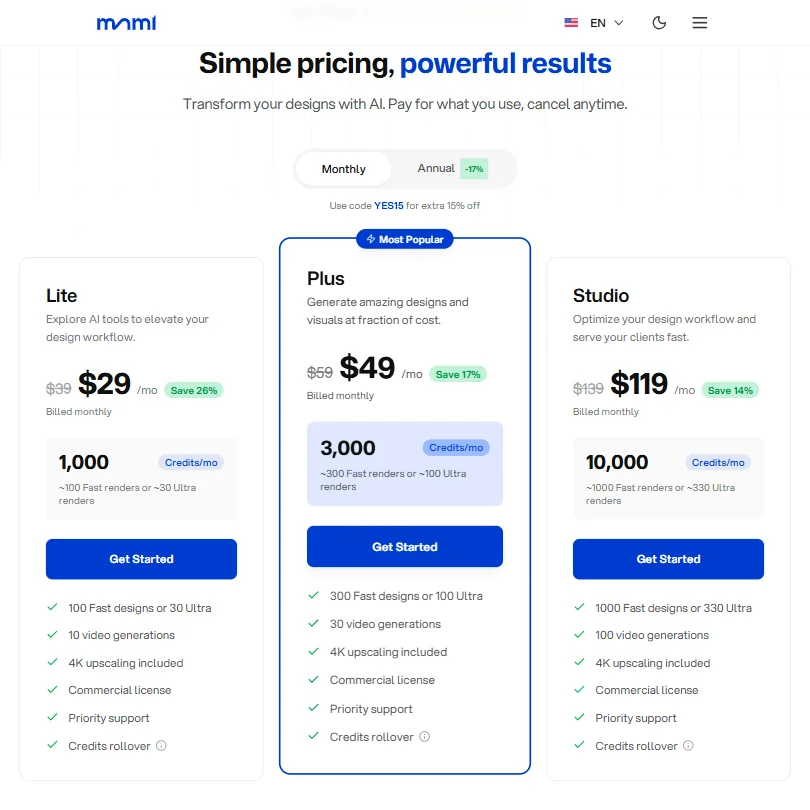
Three public tiers. $29/month for Lite, $49/month for Plus, and $119/month for Studio. Enterprise is custom, contact-required. The $29 Lite figure appears to be a discounted rate, with $39 listed as the standard price.

The credit system is the usual ambiguity. The pricing page doesn't make it immediately clear what credits translate to in practical render volume, which is a friction point that shows up in reviews of almost every AI image tool. mnml.ai doesn't escape it.

Refund policy is effectively no. They won't issue refunds once a plan is purchased, positioning the free credits as the designated testing window. Given the output consistency complaints we flagged earlier, that policy makes the free trial more important to take seriously than most users probably do. Not great.

Compared to hiring a visualization specialist, even the $119 Studio plan looks cheap. Compared to Midjourney at $10/month for general-purpose generation, it's a harder argument, though the counterargument holds: Midjourney isn't purpose-trained for architecture, and you do get what you pay for in domain specificity.

mnml.ai vs Midjourney: Which AI Design Tool Wins?

Midjourney is a general image model with a massive community and a very mature prompt ecosystem. For architects specifically, it takes considerable prompt engineering to get outputs that don't drift toward CGI fantasy renders. mnml.ai's pitch is that you shouldn't have to fight the model.

The ArchDiffusion training is supposed to understand that a building needs to sit on a site, that windows have frames, that materials behave like real materials. Based on user-reported comparisons we found, that claim holds up more often than not. Where Midjourney still wins is creative exploration and volume at low cost. $10/month buys a lot of generative iterations for mood-boarding or early concept work. mnml.ai is a better fit further into the design process, when you have actual geometry and a client presentation on the calendar.

Veras by Evolve Lab is the most direct competitor that doesn't get mentioned often enough. Built specifically for SketchUp and Revit workflows, with better-documented output consistency. It should be on the comparison list before anyone commits to mnml.ai.

Who Should Use mnml.ai? (And Who Shouldn't)

Architecture visualization professionals already inside a SketchUp or Revit workflow. That's the core fit. The video animation tool adds real value for client presentation decks, and the export-and-upload approach, while not native file integration, fits a workflow that already involves exporting views anyway.

Interior designers on residential projects. The style library and Canvas AI inpainting are genuinely useful for iterating on a room's look without starting a render from scratch.

Urban planners doing site-level work. Masterplan AI is uncommon enough as a dedicated tool that it deserves a specific callout.

Anyone expecting a general-purpose design tool. Don't bother. No branding features, no social templates, no UI work. Also, anyone who needs guaranteed output consistency for high-stakes deliverables. The review data doesn't support that confidence level yet.

mnml.ai Review Verdict

There's a real reason for this product to exist beyond being another Midjourney wrapper. The rendering engine is purpose-trained, the 12-plus specialized tools add up to something closer to a workflow than a toy, and the 8K upscaling alongside the video animation feature give it genuine utility for professional presentations.

The problems are real too. Output consistency is the biggest unresolved question, and the public review trail is too thin to resolve it definitively. The no-refund policy is aggressive for a product where results vary by prompt. The company's opacity about its origins and leadership doesn't build confidence.

At $29/month with a free trial requiring no credit card, the risk of testing it yourself is low. At $119/month, we'd want considerably more public evidence before committing. Use the free credits. Test with your actual workflow files. Don't upgrade until you've seen what your specific use case produces.

Good tool. Real gap in the market addressed. Still earning its reputation.

Frequently Asked Questions

Does mnml.ai work with SketchUp and Revit files directly?

Based on vendor documentation, the workflow is export-and-upload rather than native project-file integration. Revit users, for example, export a view as PNG or JPG and upload it to mnml.ai. Blender and 3ds Max follow the same pattern. Compatibility is real, but the depth of that compatibility is more limited than "native integration" implies. Verify the specific format support before building a daily workflow around it.

Is the free plan actually useful or just a teaser?

Free credits with no credit card required is a genuine offer. How far those credits stretch depends on what you're generating, but you'll get a real sense of output quality before spending anything. That's more than most competitors in this price tier offer, and given the no-refund policy on paid plans, it's the testing window that actually matters.

How does mnml.ai handle refunds if the outputs aren't what I expected?

They don't. Standard policy treats paid plans as final purchases and points to the free credits as the intended testing period. Given the output consistency questions we flagged in our research, take the free trial seriously before upgrading to any paid tier. That advice applies more here than it does for most tools.

mnml.ai is featured in

Alternatives to mnml.ai

See all mnml.ai alternatives →

Other AI Design Tool options we've reviewed.

User reviews

Review mnml.ai

Your rating

Reviews are moderated and appear once approved.