What is Copy?
Founded in 2020 and headquartered in Memphis, Tennessee, Copy.ai arrived during the GPT-3 writing assistant wave and built a user base fast. Over 17 million users at last count, a figure they push hard in their marketing materials. Whether that number reflects active paying customers or accumulated signups from earlier free-plan access is genuinely unclear, and the company doesn't break it down.
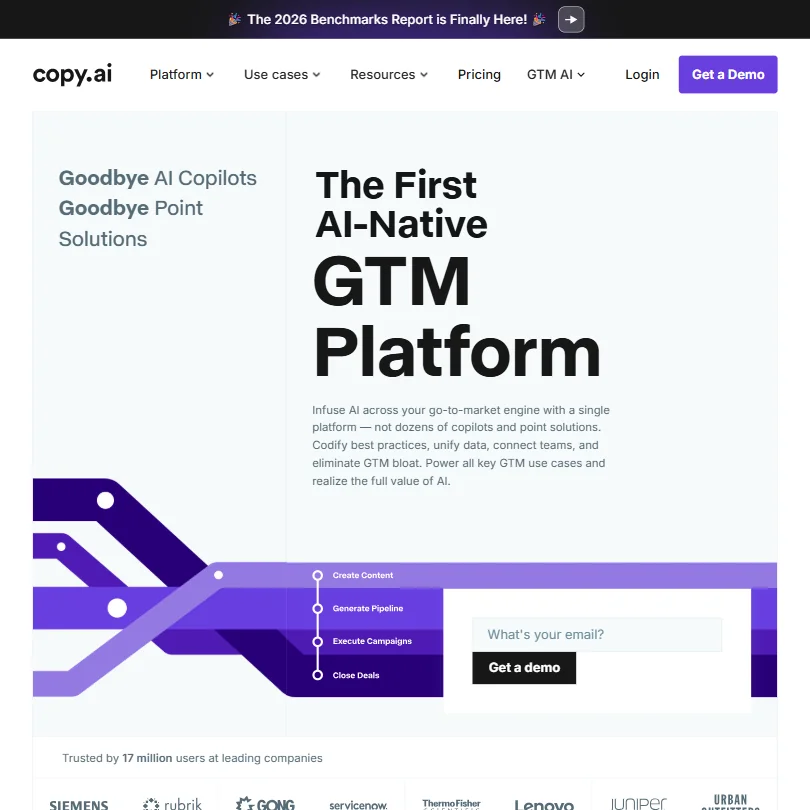
What's clearer is that the product has changed significantly. The current positioning as an "AI-native GTM platform" is a real departure from the copywriting tool most of those 17 million people signed up for. GTM meaning go-to-market. Sales, marketing, and operations consolidated in one place, rather than a collection of separate AI tools. Their docs and homepage now emphasize workflows, agents, account research, and CRM integrations far more than quick blog posts or ad copy variations.
The underlying AI isn't proprietary. Copy pulls from OpenAI, Anthropic, and Google Gemini depending on the task. Model-agnostic is how they frame it. Practically, that means output quality is tied to whichever model is running under the hood at any given moment, which is a dependency that matters more than their marketing acknowledges.
Copy Features: What You Actually Get
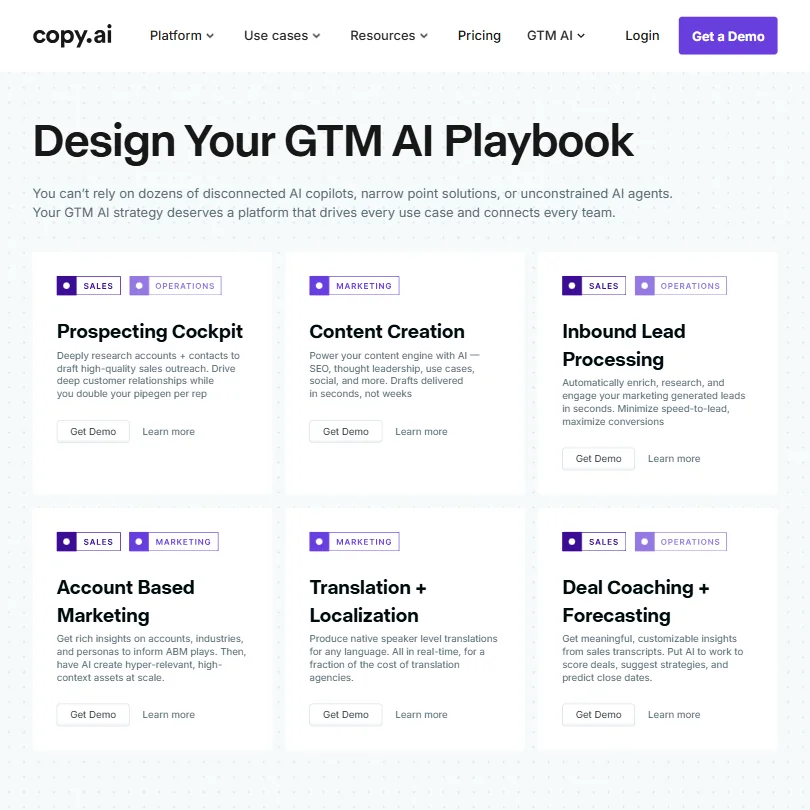
The feature set is genuinely wide. Possibly too wide. Hard to tell what's polished versus still rough from the outside.
On the content side, Copy handles long-form work including SEO articles and account plans, and short-form too, covering social posts and sales outreach copy. The Brand Voice feature is one of the more developed pieces of the product. Users define a brand's tone and personality, and the system carries that across outputs. G2 reviewers in marketing roles mention this favorably more than almost anything else in the product.
Bulk generation lives inside AI Workflows and Tables. Workflows lets users build automated sequences. Tables handles data-driven bulk content runs. For teams generating high volumes of sales or marketing assets, that's the core infrastructure.
There's also an Infobase feature for storing brand knowledge, essentially a knowledge base the AI draws from when generating content. Account and contact research are built into the platform too, which is where the GTM angle shows up in the actual product rather than just the marketing copy. Deal coaching and forecasting get mentions in the vendor docs. Honestly, those are hard to evaluate without hands-on time, and the documentation doesn't go deep.
Translation supports over 25 languages. Copy claims native speaker-level quality. Bold statement. We haven't seen enough independent user data to back that up, and we'd take it with real skepticism.
No image generation. No plagiarism checker. Grammar and style tools aren't mentioned in their public documentation. For teams migrating from a pure writing-tool background, those gaps will register quickly.
Integration coverage includes Salesforce and HubSpot, plus Zapier connecting to a wide range of other tools. API access exists, and a Chrome extension rounds it out. What's notably absent from the public docs: clear information on Google Docs or WordPress compatibility. That's a real omission for content teams that live in those environments.
Copy AI Output Quality: Is It Good Enough?
This is where user opinion fractures.
G2 aggregate sentiment across 182 reviews skews strongly positive, but aggregate scores can mask a lot of variance. We cross-referenced the written reviews with the star distribution and found a consistent pattern. Users doing sales outreach and short-form marketing content tend to be more satisfied than users who need polished long-form work.
The model-agnostic approach cuts both ways. Routing across OpenAI, Anthropic, and Gemini means Copy can theoretically match the best model to a given task. In practice, Reddit threads from 2025 describe output that reads as generic sometimes. Not broken, just unremarkable. That tracks with what we'd expect from a platform trying to serve a wide range of use cases without committing to one model's particular strengths.
Marketing teams that invest time in Brand Voice setup report noticeably better output consistency across nearly every review segment we read. Teams that skip that configuration get more vanilla results. Not a surprise, but worth flagging plainly for anyone evaluating the tool.
Where things get murkier is the GTM-specific features. Deal coaching, account research, forecasting. These are harder to assess from review data because the user base reporting on them is narrower. The G2 reviews skew toward marketers, not sales ops leads. We can't say with confidence how those features perform based on what's publicly available.
Is Copy Easy to Use?
The Chat interface is the main entry point for most users. By most accounts it's approachable, a ChatGPT-style front end with GTM-specific context layered in. Simple enough.
The Workflows builder is a different story entirely. Complexity scales fast. G2 reviewers split cleanly on this: people who've built automated systems before find it manageable, people newer to workflow tools find the learning curve frustrating. Not a dealbreaker, but something to factor into your evaluation timeline.
The Chrome extension matters for daily usability. Running Copy from inside whatever tab you're already working in reduces friction meaningfully. We don't have granular performance data on it, but its existence is relevant.
One signal that appeared consistently enough across our research to flag: onboarding. Newer users without prior GTM workflow experience reported feeling disoriented early on. The platform assumes familiarity with the underlying concepts, which makes sense given the stated target audience of mid-market and enterprise teams. For smaller teams or individuals testing the water, that assumed baseline creates a real gap in the early experience. Fair warning.
Copy Pricing: Is It Worth the Cost?
This is where we have the most frustration, and it's a structural issue rather than a feature complaint.
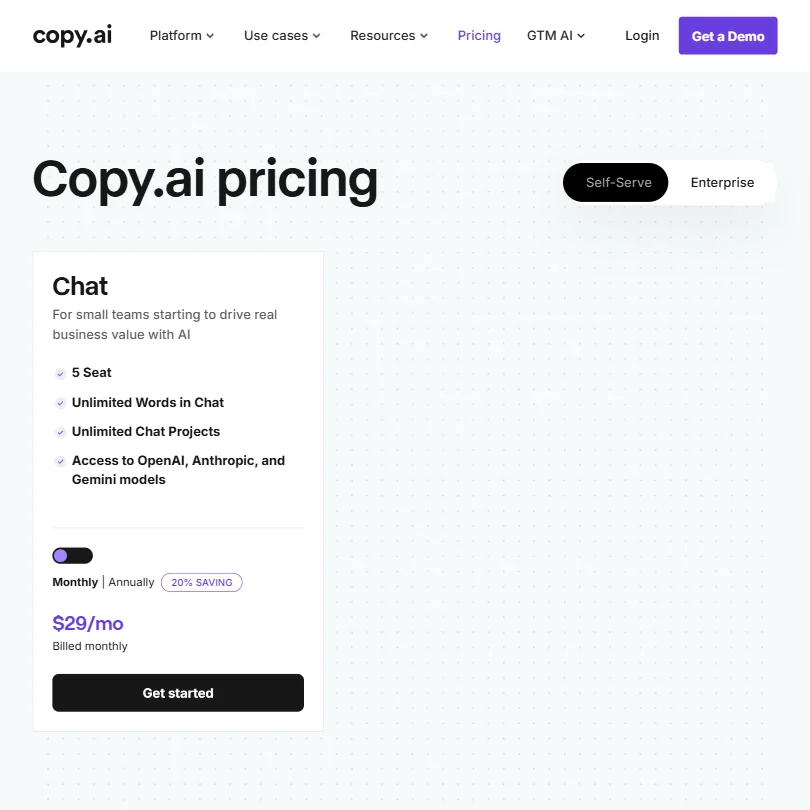
The Chat plan starts at $29 per month. That's the public-facing entry point following a September 2025 pricing restructure. The free plan that previously existed is gone, though the situation is messier than the main pricing page suggests.
Copy.ai's contact page still references a free plan with no credit card required and 2,000 free words per month. A 2026 official pricing article also lists Free as one of four plans. The main pricing page currently shows only paid tiers. That's a real inconsistency across their own pages, and we're not going to paper over it. We don't know which reflects current policy, and Copy.ai hasn't resolved the contradiction publicly.
The free trial situation is similarly murky. Copy.ai published an official free trial guide in April 2026, and they reference trial availability in multiple places. The duration and conditions aren't stated in their public documentation. Per their own terms, those details are supplied at signup. Not great.
Enterprise pricing requires a sales demo to access, which is standard for that tier but compounds the information gap for self-serve evaluation. We couldn't find a stated refund policy anywhere on the pricing page either. That matters. $29 isn't a large number, but committing to a recurring charge with no stated refund path and unclear trial terms is a real ask for a product this different from what many existing users signed up for.
Compared to Jasper AI, which also targets marketing teams and takes a similarly opaque approach at the enterprise tier, neither vendor wins on pricing transparency. We don't buy that's accidental.
Copy vs Jasper: Which Is Better?
This comparison surfaces constantly in reviews and Reddit threads. Makes sense. They've been in each other's orbit since the GPT-3 era.
Jasper positions around brand-consistent marketing content for larger teams. Copy has moved toward the GTM platform angle, a broader claim that touches sales workflows Jasper doesn't cover in the same depth. That framing difference matters when you're actually choosing between them.
On pure content generation quality, the gap isn't dramatic. Both pull from similar underlying models. Both offer brand voice management. G2 reviewers comparing the two tend to call output quality roughly equivalent and cite workflow depth or integration specifics as the actual deciding variable.
The sales-side features are where Copy makes a more specific claim. Account research, prospecting support, outreach copy generation, deal coaching. Jasper doesn't go there in the same way. For teams that need their AI writing tool to also touch the sales workflow, Copy is the more direct fit.
For teams focused primarily on content marketing without the sales-side GTM requirements, Jasper and Copy are closer substitutes than their respective positioning implies. Look at the specific workflows you'd actually use before committing to either.
Who Should Use Copy? (And Who Shouldn't)
GTM teams at mid-market companies. That's the sharpest fit. Sales and marketing working together, enough volume to benefit from Workflows and bulk generation, enough operational complexity to need Brand Voice management across multiple touchpoints.
Enterprise teams already running Salesforce or HubSpot and wanting AI to sit on top of those systems. Copy's integration depth makes that a realistic and documented setup.
Individual freelance writers and bloggers who need a simple drafting tool. Not the right fit anymore. The product has drifted decisively away from that use case, and nothing in the current feature set or pricing is designed for solo operators.
Small startups without existing GTM infrastructure will find the learning curve steep relative to the return. The platform rewards teams with processes already in place to automate. It's less useful as a starting point for building those processes from scratch. For SEO content at scale specifically, something like Koala AI is purpose-built for that workflow and won't ask you to navigate a GTM platform to publish a blog post.
Copy Review Verdict
The 2020 version that competed on quick copywriting is largely gone, replaced by something with real depth on the sales and marketing operations side. That's not a criticism. It's a different product for a different buyer.
The GTM platform angle is genuinely differentiated from most writing tools. Account research, AI Workflows, Brand Voice at scale, CRM integrations, bulk generation. For a mid-market revenue team frustrated with disconnected AI point solutions, this is a coherent answer. The strong G2 sentiment isn't manufactured. People who fit the target audience tend to like it.
But the friction points are real. Pricing transparency is a problem. Contradictory free plan information across their own pages, a free trial with undisclosed terms, no stated refund policy, and enterprise pricing locked behind a sales demo. That's fine for buyers with budget and a procurement process. It's a wall for everyone else.
Output quality is good, not exceptional. It depends on which model is running and how thoroughly you've configured Brand Voice and Infobase. Invest in setup and results improve. Skip it and you get average output. That dependency exists whether the vendor advertises it loudly or not.
The missing features matter too. No plagiarism checker. No built-in grammar tools. Unclear compatibility with Google Docs or WordPress. For teams whose content work lives in those environments, that's not a minor footnote.
We'd point Copy toward a specific kind of buyer. Well-resourced, GTM-focused, already running HubSpot or Salesforce, and willing to invest real setup time before expecting results. For that buyer, the platform likely pays off. For everyone else, there are simpler and cheaper tools that cover most of the same ground without the overhead.
Frequently Asked Questions
Does Copy.ai have a free plan?
Unclear, and that's a genuine problem with their current public presence. The main pricing page shows only paid plans, with the Chat plan at $29 per month as the lowest tier. The free plan was reportedly discontinued in a September 2025 restructure. However, Copy.ai's contact page still references a free plan with no credit card required, and a 2026 pricing article from the company lists Free as one of four active tiers. The contradiction hasn't been resolved publicly. A free trial is mentioned in a 2026 Copy.ai guide, but the duration and conditions aren't stated in their public documentation. Per their own terms, those details are provided at signup.
What makes Copy different from a standard AI writing tool?
The GTM platform framing is the clearest answer. Copy has moved beyond writing assistance into sales prospecting, account research, workflow automation, and CRM integration. That makes it a broader tool than a simple copywriting assistant, but it also means the learning curve is steeper and the value proposition is aimed squarely at sales and marketing teams rather than individual writers.
Is Copy good for SEO content?
It has an SEO content workflow and handles long-form writing, so the raw capability is there. That said, it's not built primarily for SEO teams the way dedicated tools are. Teams that need keyword optimization and SERP analysis baked into the drafting process will likely find purpose-built SEO tools a better fit. Copy handles SEO content as one use case among many, which is meaningfully different from treating it as a core specialty.