
Our research on Writesonic started with the vendor docs, then moved quickly to G2 and Capterra, then Reddit. The homepage is loud. The customer sentiment, across thousands of submissions on both G2 and Capterra, is genuinely strong. But when we cross-referenced those ratings with longer-form reviews and community threads, a more specific picture came through. This writesonic review is built on that aggregated research, not a hands-on trial.
The product has shifted considerably since its 2021 founding. What launched as a GPT-powered copywriting tool has repositioned itself, fairly aggressively, around AI search visibility. That pivot is real. Whether it holds up at the price points being asked is a different question.
What is Writesonic?
San Francisco-based, founded 2021, running on GPT-4 and proprietary models. Writesonic claims 10,000-plus marketing teams as customers, which tracks given the review volume we found.
The product used to compete directly with Jasper AI on copywriting. It still does. But the bigger bet now is on what the company calls Generative Engine Optimization, or GEO. The idea is that Google isn't the only discovery surface brands need to worry about anymore. AI platforms are part of the equation, and Writesonic wants to track and improve your visibility across those platforms specifically.
Interesting angle. We're not fully convinced the broader market understands what GEO even means yet, but the infrastructure behind it, a dataset of 2 billion-plus real AI conversations, is not something you'd assemble quickly or cheaply.
The tool runs across web, Chrome extension, API, and WordPress. No Google Docs integration. That's a gap, and it's one that matters for a lot of editorial teams.
Writesonic Features: What You Actually Get

Start with content creation. The AI Article Writer produces long-form articles from 3,000 to 8,000 words. There are 80-plus templates covering ad copy, FAQ blocks, comparison tables, and social content. Brand voice customization supports up to 10 distinct writing styles on the Growth plan, which is more than most comparable tools offer at that tier. Agentic workflow runs handle bulk generation, where the AI sequences research, drafting, and optimization without you managing each step.
Chatsonic is the real-time AI chatbot. It pulls live web data, which matters for anything time-sensitive. Most pure writing tools skip that entirely.
Writesonic includes an integrated plagiarism checker. Good to confirm. Writesonic also includes AI image generation through Photosonic. Both of those features getting confirmed in the docs puts them ahead of tools where similar capabilities are ambiguous marketing-page claims.
Now the GEO layer, which is the newer and harder-to-evaluate part. The pitch is roughly this: Writesonic tracks your brand's presence across 10 AI search platforms. It surfaces where competitors get cited and you don't. Then its AI agents help you build content and outreach to close those gaps. Google Analytics 4 and Google Search Console connect directly. Looker Studio too. The intended workflow runs from audit to published content inside one platform.
Honestly, that's a more complete loop than we expected to find.
The on-page editor lets AI agents rewrite sections directly for GEO. The research layer draws on that 2B-conversation dataset to surface brand and topic insights. The Starter plan at $99 per month on the monthly billing tracks ChatGPT, Gemini, and Google AI Overviews, with 50 prompts and 50 answers tracked daily. Growth, at $499 per month billed monthly (or $399 annually), pushes that to 200 prompts and 600 answers tracked daily, adds sentiment analysis, the full Action Center, and agentic workflows. Basic sits between them at $249 per month billed monthly, or $199 annually.
Grammar tooling still isn't clearly documented. We'd want that confirmed before treating it as a given.
Writesonic AI Output Quality: Is It Good Enough?
G2 reviewers in marketing roles consistently call the output solid for first drafts. Not publication-ready, but closer than expected. Capterra reviewers say the same. That kind of consistency across thousands of reviews doesn't happen by accident.
Reddit tells a messier story. We found threads where users noted output quality varies depending on how well prompts are structured. That's true of almost every GPT-4-based tool, so it's not a damning critique. It does mean the tool rewards people who already know how to write good prompts. Less useful if someone is hoping the AI carries all the weight.
The brand voice feature picks up specific praise. Users who invested time setting up voice profiles reported noticeably more consistent output. That tracks. Tools that let you lock in a voice produce better results when you actually use the feature, and 10 profiles on Growth gives agencies enough room to handle multiple clients without blending voices.
GEO-specific output quality is harder to assess from reviews alone. Most of what we found covers the copywriting side. We'd want that piece tested directly.
We've seen worse output from tools charging more. Fair.
Is Writesonic Easy to Use?
This is where things get complicated. The product has grown quickly and in multiple directions, from a writing tool to an AI search dashboard with agentic workflows, schema fixes, and citation gap analysis. That's a lot of surface area for one platform to carry.
G2 reviews trend positive on ease of use, but several flag a learning curve once you move past the basic article writer. One pattern we kept seeing in longer reviews: users who stuck to template-based tools found the experience straightforward. Users who tried to use the full GEO suite needed more time and patience to get value out of it.
The Chrome extension helps by keeping the tool close to where writers are already working. WordPress integration works. But without Google Docs, teams are copy-pasting more than they'd want to.
Support structure is worth flagging. No live chat is confirmed. Email support comes standard on Starter. Priority email starts at Growth, which runs $399 a month annually. For a tool positioning itself toward agencies and mid-size marketing teams, that gap is noticeable at the lower tiers.
Writesonic Pricing: Is It Worth the Cost?
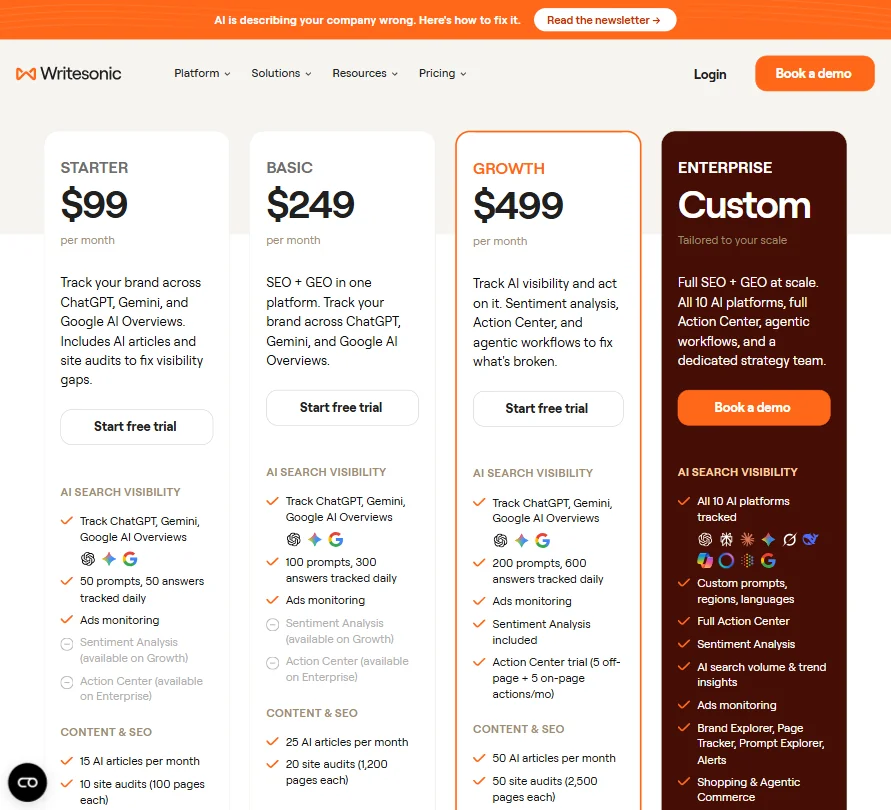
Annual billing brings Starter to $79 per month, Basic to $199, and Growth to $399. Monthly billing runs higher: Starter at $99, Basic at $249, Growth at $499. Enterprise is custom, with a dedicated strategy team included. A 7-day free trial exists and doesn't require a credit card. Right call.
The refund policy isn't publicly stated, at least not anywhere we could find it clearly. That's a problem. For a $399-per-month decision, ambiguity around refunds is not a minor detail.
The jump from $79 to $399 annually is steep. Jasper AI's comparable team plans sit in a similar range, so Writesonic isn't wildly out of step. But Jasper is primarily a content tool. Writesonic's Growth plan is trying to be an AI search platform, a content tool, and an agency-grade operation simultaneously. Whether the price reflects that value depends entirely on how much of the GEO layer actually gets used.
Starter probably isn't enough for a real agency workflow. That's our concern, and we'd want users to go in with that expectation set.
Writesonic vs Semrush: Which Is Better?
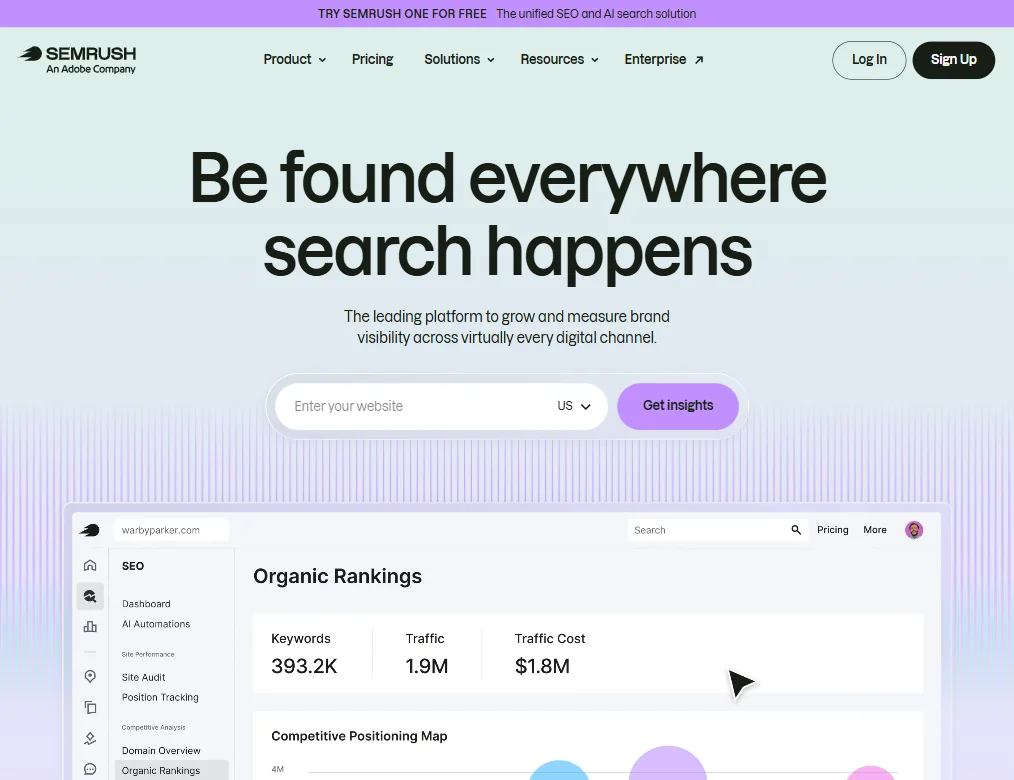
Not really a head-to-head. Semrush is a mature SEO platform with keyword research, backlink auditing, competitive analysis, and site health tools developed over years. Writesonic is an AI content and GEO platform that connects to Google Search Console and GA4.
They overlap in one place: helping content teams identify SEO gaps and act on them. Writesonic's angle is faster, more content-focused, and specifically pointed at AI search visibility. Semrush doesn't track your brand's presence inside ChatGPT or Perplexity. Writesonic claims to, and the infrastructure behind that claim looks substantive.
For teams already deep in the Semrush ecosystem, Writesonic isn't a replacement. It's a potential add-on if the GEO tracking delivers. For smaller teams who don't need Semrush's full stack, Writesonic's combination of content generation and AI search monitoring is more integrated than stitching together separate tools.
Surfer SEO is the closer comparison on content optimization. Neither Surfer nor Ahrefs are chasing the GEO angle the way Writesonic is. That's the real differentiator, for now. Whether it holds as larger platforms catch up is a legitimate question we can't answer yet.
Who Should Use Writesonic? (And Who Shouldn't)
Marketing agencies managing multiple clients. The brand voice depth handles client separation, and the GEO tracking gives them something concrete to surface in reports.
SEO professionals watching AI search. This is the group Writesonic is building toward most aggressively. If your clients are asking why they're not appearing in ChatGPT results, Writesonic is one of the few tools trying to answer that with actual data and a workflow attached.
Content teams who live in Google Docs. Don't bother. The copy-paste friction adds up fast and doesn't go away.
Solo freelancers on tighter budgets. $79 a month is a real spend. Koala AI handles solid long-form content at a lower entry point if the GEO features aren't relevant to the work.
Enterprise teams with complex brand governance needs should get specific clarity on what the custom plan actually covers before assuming it handles everything. The support structure on lower tiers doesn't set a high bar.
Writesonic Review Verdict
The GEO repositioning is the most interesting thing about Writesonic right now. Not just a marketing reframe. The multi-platform tracking across 10 AI search platforms, the agentic workflows connecting audit to content to published output, the 2B-conversation dataset underneath it all, these are substantive features. Not vaporware.
The content creation side is solid. Reviews back that up consistently across G2, Capterra, and Trustpilot. Eight-thousand-word article output and 10 brand voice profiles give agencies real room to work. The GEO layer is harder to validate from our research position, but the infrastructure looks real and the feature depth is greater than what competitors are currently showing.
The pricing jump from Starter to Growth is the biggest friction point. Three hundred and twenty dollars more per month annually is a significant ask. The refund policy ambiguity makes that risk harder to absorb. Support at Starter doesn't inspire confidence for teams who'll hit problems mid-workflow.
If the GEO layer delivers what it claims, Writesonic sits ahead of most direct competitors on that specific problem. The content creation features alone don't separate it from the pack at this price. The AI search visibility angle might. We'd want to see those claims tested hands-on before fully committing to that conclusion. The research says the product is credible. Whether it earns the Growth price tag depends on features we haven't run ourselves.
Frequently Asked Questions
Does Writesonic have a free plan?
No free plan. There's a 7-day free trial that doesn't require a credit card, which is the right way to handle it. But don't expect an ongoing free tier. Some competitors offer that. Writesonic doesn't.
Is Writesonic good for SEO?
Depends what you mean by SEO. For traditional search optimization, it has keyword tools and integrates with Google Search Console and GA4. The more distinctive angle is AI search optimization, tracking where your brand surfaces across platforms like ChatGPT and Perplexity. If that's the problem you're solving, Writesonic is one of the few tools building a real workflow around it rather than just mentioning it on a features page.
How does Writesonic compare to Jasper AI?
Both target marketing teams. Both run on GPT-4. Jasper focuses on content creation and brand consistency. Writesonic has a comparable content base but adds the GEO layer on top. At similar price points, Writesonic covers more surface area. Whether that's an advantage depends on whether your team actually uses the AI search tracking or just needs a writing assistant. If it's the latter, Jasper is simpler. If it's the former, Writesonic is the more specific tool.