Vendor docs first. Then the pricing page, then a slower crawl through whatever customer reviews exist publicly. That's how our research into Chatbase started, same as most of these. What we found is a product that launched in 2023, moved fast, and built something genuinely broader than most no-code chatbot tools in this category. Whether it holds up under pressure from established players is a different question.
What is Chatbase?
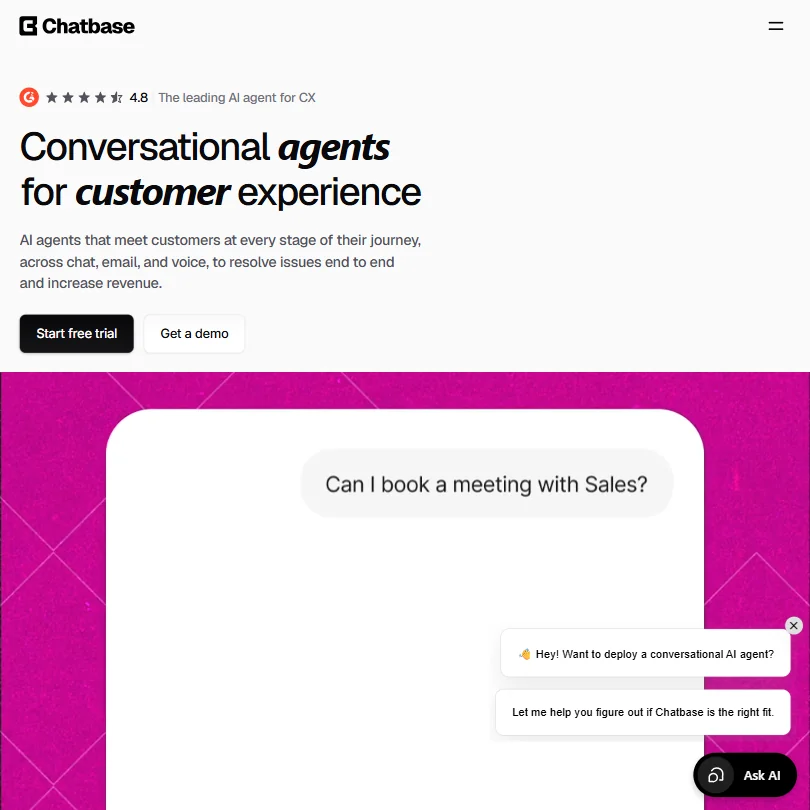
Chatbase is a no-code AI agent platform built for customer-facing teams. Support, sales, product guidance. It handles all three, or claims to. The idea is that you train an agent on your own data, set some guardrails, and deploy it across whatever channels your customers use. Chat, email, voice, WhatsApp. The agent runs around the clock without a human in the loop unless you configure one.
Founded in 2023 and headquartered in San Francisco, it's a young company walking into a crowded room. Intercom has been here for over a decade. Zendesk longer. Chatbase's pitch isn't that it's better at everything. It's closer to "we do more from one place, without requiring an engineer." That's a reasonable bet for a market segment that still has room for it.
What stands out on paper is the model flexibility. Most tools lock you into one AI model. Chatbase lets you pick from GPT, Claude, Gemini, DeepSeek, and a few others. Honestly, that's genuinely unusual in this category. Whether most customers ever switch away from the default is another matter entirely.
Chatbase Features: Chatbot, Helpdesk & Support Automation Breakdown
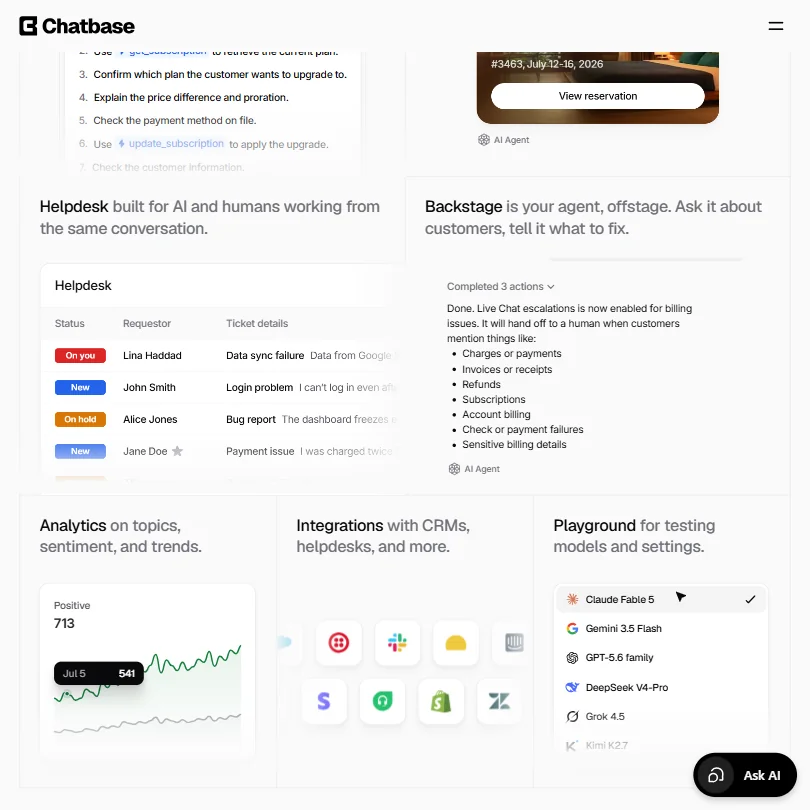
The core product breaks into three areas. There's the AI agent builder, where you connect your data and define behavior. Then there's the helpdesk layer, where AI and human agents share the same conversation thread. Then there's the email automation piece, which handles inbound support emails without anyone touching a keyboard.
The built-in helpdesk with ticket management is the detail worth pausing on. Most chatbot tools treat human handover as an afterthought. Chatbase baked it into the same interface. Ticket status, requestor details, conversation history, all in one place. We'd want to test how that actually performs against a live support queue, but the architecture is sensible.
Training works by connecting data sources directly. Upload files, point to a URL, or paste in content. Auto-retrain is available on higher plans so the agent picks up changes without manual pushes. Fair. That's a useful feature for teams whose knowledge base shifts frequently.
The analytics module covers topics, sentiment trends, and resolution patterns. Not deep BI tooling, but enough to tell you if something's going wrong. On integrations, the ones that matter most are Shopify and Zendesk, and there are a few others including Stripe and HubSpot. API access unlocks on the Standard plan at $150 per month, not the $40 Hobby tier. Worth knowing before you assume it's included.
Chatbase Bot Quality: How Well Does It Handle Real Customer Queries?
Reddit threads and Product Hunt comments were our main sources here. Product Hunt crowds skew positive and early-adopter. Not representative. The operations manager dealing with a ticket backlog at a 200-person company isn't posting there.
Reddit is more useful, and threads from 2024 and early 2025 suggest the bot performs well on tightly scoped tasks. Give it a narrow knowledge base and clear guardrails and users report accurate, on-brand responses. Push it toward edge cases or ambiguous queries and accuracy drops. That's true of every tool in this category, but it's worth naming.
The multi-model flexibility is the variable most users won't touch. Chatbase defaults you into one model configuration. Switching to Claude or DeepSeek is possible, but we didn't find many reviewers mentioning they actually did it. The feature exists. Practical use is unclear.
We're skeptical of the "resolves complex queries" framing on the homepage. That's doing a lot of work. Complex for a chatbot still means well-documented, well-scoped problems. The tool is genuinely capable on those. Anything requiring judgment calls or cross-system lookups will still need a human in the seat.
Chatbase Channel Coverage: Which Platforms Does It Support?
Channel coverage is where Chatbase makes its strongest argument against point solutions. Most chatbot tools do web chat. Some add WhatsApp. Few touch email, phone, and Slack in the same product.
Chatbase covers web chat and WhatsApp. Messenger and Instagram are also there. Email and voice are included, which is the more interesting part. Voice support via phone is becoming a real differentiator in this category, and most competitors haven't built it natively. Tidio doesn't have it. Crisp doesn't have it natively either.
Deploying across all those channels from a single agent configuration is the real value proposition. Build once, train once, push everywhere. That's a legitimate time-saving argument for a small team managing chat alongside inbound email without wanting two separate tools for each.
That said, we couldn't confirm from public sources how mature the voice and email channels are relative to the chat product. New features on a 2023-founded platform sometimes mean "technically available." Hard to say without hands-on testing. Not great.
Is Chatbase Easy to Set Up and Manage?
The no-code claim holds up in our reading. The setup flow is connect data sources, define the agent's role, set guardrails, then deploy. No engineer required. Reddit threads from users at small companies consistently mention getting something live in an afternoon. That tracks with what the docs describe.
The auto-retrain feature on higher-tier plans removes one of the more tedious ongoing support tasks, which is keeping the bot's knowledge current. Point it at your help center or product docs and it updates itself. Genuinely useful for teams without a dedicated ops person maintaining the thing manually.
Managing the ongoing agent is where some friction shows up. Users in Reddit threads mention that tuning guardrails takes iteration. You'll get it wrong the first time. The agent might be too restrictive or answer things it shouldn't. Not a Chatbase-specific problem, but it's real work that the "ready in minutes" framing doesn't fully acknowledge.
The help documentation is solid. Docs, changelog, a guide section. No community forum, which is a gap. When you're stuck, you're on email support or searching Reddit yourself.
Chatbase Pricing: Is It Worth It for Support Teams?
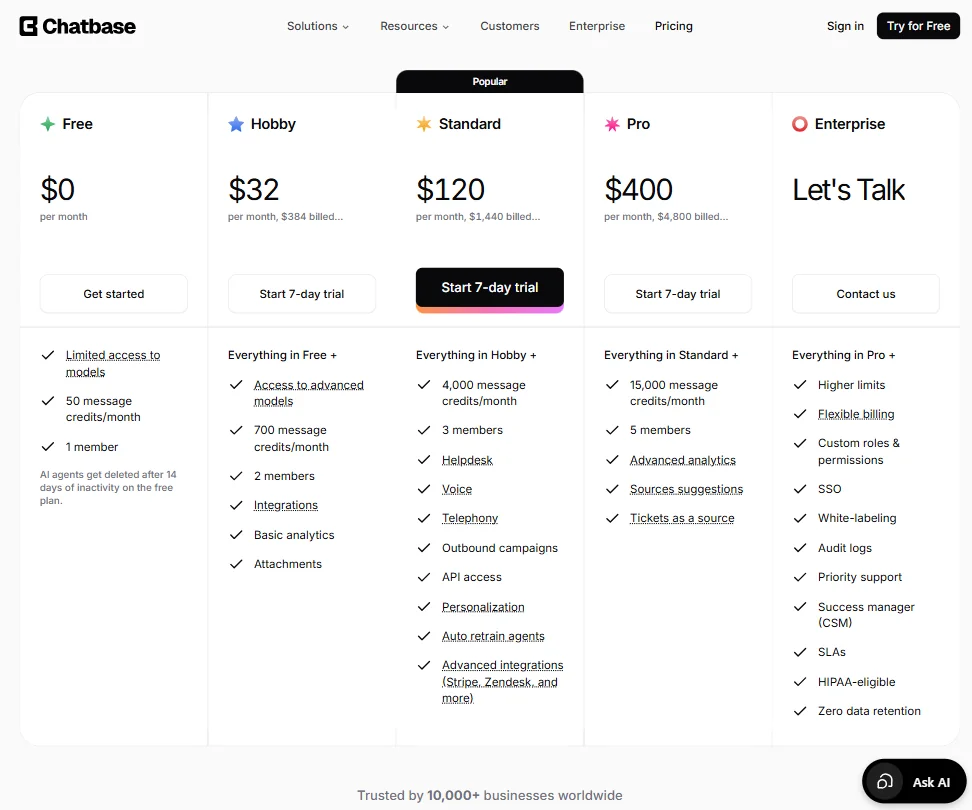
Five tiers. Free, Hobby at $40 per month (or $32 annualized), Standard at $150 per month, Pro at $500 per month, and Enterprise at custom pricing.
The Free plan gives you 50 message credits per month and one member. The agent gets deleted after 14 days of inactivity. That's not a generous evaluation tier. It's closer to a demo than a genuine trial. The 7-day free trial on Hobby, Standard, or Pro is the more useful path if you're seriously evaluating a purchase.
At $40 per month, Hobby gets you 700 message credits and two members. No API access at that tier. The real product for a support team is probably Standard at $150 per month, where API access, advanced integrations including Stripe and Zendesk, and auto-retrain kick in. That's a meaningful jump from Hobby.
The $500 per month Pro plan adds 15,000 message credits, five members, and advanced analytics alongside sources suggestions and tickets as a source. White-labeling is listed separately in our research as an add-on for agencies or resellers who need it, and that's a notable line item to factor in before assuming Pro covers everything.
Refund policy isn't publicly stated anywhere we could find. That's a problem. We don't buy the "contact us" approach for something that basic, especially when you're being asked to commit to an annual billing cycle.
Chatbase vs Intercom: Which Customer Service AI Wins?
Intercom is the obvious comparison. Both cover chat. Both are pushing hard into AI agents. Both have human handover built in.
The difference is depth versus breadth. Intercom has a decade of product maturity. The reporting is deeper, the integration ecosystem is larger, and the ticket workflows are more established. Chatbase is broader on channels, specifically the voice and email pieces, and it's cheaper for smaller teams at lower volumes.
Intercom's pricing scales aggressively as usage grows. Chatbase's pricing is more predictable at lower volumes. A team of two or three handling a few hundred support conversations a month will find Chatbase less painful on the invoice. A 20-person support team with complex routing requirements probably needs Intercom or Freshdesk, not a 2023 platform still building out its Enterprise tier.
The multi-model flexibility also goes to Chatbase. Intercom is locked into its own AI stack. Whether that flexibility matters in practice depends on how opinionated your team is about AI providers. Most aren't, but compliance teams sometimes are.
Who Should Use Chatbase? (And Who Shouldn't)
SMBs running lean support operations. That's the fit. One or two people managing customer queries across web chat and email, without budget for an enterprise helpdesk platform.
E-commerce teams are another strong match. The Shopify integration is there, and the voice and email automation genuinely reduce repetitive ticket handling. A damaged-order query at 2am gets handled. Nobody wakes up for it.
Teams that need SLA reporting. Not the fit. SLAs are Enterprise-only, which means custom pricing conversations before you get access to them. Teams needing audit logs or SSO are also looking at the Enterprise tier. Anyone with complex routing logic and a mature support operation will outgrow the Standard plan faster than the pricing suggests.
Chatbase Review Verdict
Chatbase built something real, and it built it fast. The channel coverage, the helpdesk integration, the model flexibility. On paper, it stacks up well against tools that have been around much longer.
The review trail is thinner than we'd like for a platform claiming 10,000-plus business customers. G2 and Capterra have listings and verified reviews now, and Trustpilot has a Chatbase profile with a modest number of reviews visible. But the volume is still low relative to competitors at a comparable stage. You're leaning on vendor claims more than you would with Intercom or Tidio. The refund policy silence compounds that concern.
At $150 per month for Standard, the value is reasonable if the bot quality holds in your specific use case. At $500 per month for Pro, you'd want to push hard during the 7-day trial before committing. The Hobby tier at $40 is fine for poking around, less useful for actually stress-testing a production deployment.
Confident buy for the right team. That confidence comes with the caveat that "right team" means small, scrappy, and comfortable betting on a newer platform. Not a risk-averse procurement committee with a 12-month contract on the table.
How Chatbase compares
Chatbase scores 7.9 out of 10 among the AI chatbot builders we rate. These three do the same job and are the closest to it, compared on what each vendor publishes.
Botpress
Chatbase starts at $40 a month; Botpress's cheapest paid plan is $189 a month, though both offer a free tier first. Botpress hosts a customer facing help center from its Plus plan up; Chatbase has no help center, only a built in help desk for tickets. Chatbase answers in 95 languages, and removing its branding costs $99 a month as an add on.
Pick Botpress if you want a hosted help center as part of the plan.
Pick Chatbase if price and built in ticketing matter more than a help center.
DocsBot
DocsBot answers in 100 languages against Chatbase's 95, but Chatbase is cheaper at $40 a month versus DocsBot's $49 a month. Chatbase has a built in help desk with ticket creation and SLA policies on its Enterprise plan; DocsBot has no ticketing, SLA or automation rules of its own, leaning entirely on the helpdesk you already run. Chatbase also connects to Gorgias and Intercom, which DocsBot does not list.
Pick DocsBot if language coverage matters more than price or ticketing.
Pick Chatbase if you want ticketing, SLAs and a lower starting price.
Dante-ai
Chatbase and Dante-ai both start at $40 a month with a free plan before you pay. Chatbase's AI drafts replies for your human agents; Dante-ai's does not, and Dante-ai has no email channel yet, only live chat, voice and WhatsApp. Chatbase connects natively to Zendesk, Freshdesk and Gorgias; Dante-ai's only listed integration is Zapier, reaching other tools through that instead.
Pick Dante-ai if budget is tight and you do not need email support.
Pick Chatbase if you want AI that helps your agents and more integrations.
Frequently Asked Questions
Does Chatbase offer a free plan?
Yes, but it's limited. You get 50 message credits per month and one member, and the agent gets deleted after 14 days without activity. It's enough to see how the builder works. Not enough to test real conversation volume or evaluate production behavior. The 7-day free trial on Hobby, Standard, or Pro is the better path if you're serious about the purchase.
Which AI models does Chatbase use?
The platform supports multiple models. GPT and Claude are the headline ones. DeepSeek, Gemini, and a few others are also available, and you select at the agent level. Most users we read about stuck with the default rather than switching, but the option exists if your team has specific preferences or compliance requirements around particular providers.
How does Chatbase handle the handoff from AI to a human agent?
The handoff runs through the built-in helpdesk, where both AI and human agents share the same conversation thread. Guardrails in the agent configuration can trigger escalation automatically based on topic or query type. That's a cleaner setup than tools that route users to a separate inbox or ticketing system. Whether it works smoothly against a live queue is something we'd want to test before vouching for it fully. We haven't.