Our research on Rev AI started where it usually does, with the vendor's own claims. Then we went looking for the cracks. We pulled from G2 reviews, Reddit developer threads, vendor documentation, and public pricing data. Founded in 2010 and headquartered in San Francisco, Rev AI has been around long enough that real-world feedback is plentiful. What we kept seeing was a product that's genuinely strong at one specific thing and largely uninterested in being anything else.

What is Rev AI?
A speech-to-text API. That's the whole business. No voice generation, no cloning, no music. Audio goes in, text comes out, with word-level timestamps and speaker labels attached.
The company grew out of Rev.com, which started life as a human transcription service. That lineage matters more than it might seem. Their AI model was trained on over 7 million hours of human-verified audio, and that's the claim they lean on hardest when talking about accuracy. We cross-referenced it against G2 review patterns, and the accuracy reputation holds up better than most competitors in the same category. The G2 comments are consistent enough that we take them seriously.
Narrow product. But narrow products done well are often worth more than broad ones done badly. That's our read going in.
Rev AI Features: Voice, Music & Audio Capabilities

No text-to-speech here. No music generation, no noise removal. Those features don't exist in Rev AI's stack, and they're not pretending otherwise.
What they do ship is real-time streaming transcription alongside batch processing for pre-recorded files, and both hold up reasonably well in developer reviews. The batch side handles scale. The streaming side gets mentioned frequently in call center and live captioning workflows.
Speaker diarization is included. Custom vocabulary is too, which lets you push domain-specific terminology into the model before it runs. Word-level confidence scores come with the output, and sentiment analysis plus topic extraction are listed on the homepage, though we kept seeing those described as secondary features in G2 comments rather than primary selling points.
The API is REST-based with SDKs for Python and Node.js, and a few others. Webhooks are supported. Documentation is thorough, and that last point matters more than it sounds when you're running something in production.
On the model side: Rev AI's changelog confirms that Whisper Fusion support was added on January 6, 2025. The current API documentation lists Fusion as a transcriber option, describes it as combining multiple models for stronger results especially on rare words, but doesn't list separate Whisper Medium or Whisper Large options. So the Fusion integration is real and documented. The individual Whisper variant access is less clear-cut. Developers considering this should read the current API docs before assuming full Whisper model flexibility.
Rev AI Audio Quality: How Natural Does It Sound?
Wrong question, technically. Rev AI doesn't produce audio. Accuracy is what you're measuring here, not naturalness.
Their published claim is industry-leading Word Error Rate (WER) across accents, genders, and demographics. We're mildly skeptical of superlatives as a rule, but the G2 data mostly backs this up. Developers handling medical, legal, and financial audio consistently praise the accuracy in their reviews. One pattern we kept seeing: users migrating from Google Speech-to-Text reported noticeable improvement on accented speech and noisy source material.
That tracks with the training data story. 7 million hours of human-verified audio, oriented toward real-world variety rather than clean studio recordings, is a credible foundation. Not a guarantee. Credible.
The Global Voice Recognition expansion added support for 57-plus languages with a global accent model. Meaningful update. Multi-language performance reviews are thinner than English-only ones in the data we found, so we can't say with confidence how far the quality holds outside English. Worth testing on your specific language before committing.
Rev AI Voice Cloning & Customization: How Deep Does It Go?
It doesn't.
Rev AI does not offer voice cloning. Speech generation isn't part of the product at all. If that's what you need, you're shopping the wrong tool entirely. ElevenLabs covers that side of the market in considerably more depth. Rev AI's customization lives on the input side only: custom vocabulary, confidence thresholds, and model selection.
Honestly, we're not going to treat a short section here as a weakness. Doing one thing and not pretending to do everything else is a reasonable product decision, and we'd rather say so plainly than pad it out.
Is Rev AI Easy to Use?
Depends entirely on who's asking.
Developers find it well-documented. SDK support means setup isn't a nightmare, and the free trial requires no credit card, which removes the usual friction from initial evaluation. G2 reviewers in engineering roles describe the integration process as straightforward, and that comes up consistently enough that we believe it.
Non-developers. No interface for you. No drag-and-drop, no desktop app, no mobile app. The product is an API, full stop. If you can't send HTTP requests or work with their SDKs, you're not the intended user and Rev AI isn't going to meet you halfway.
We noticed a handful of G2 reviewers flagging the learning curve for teams without dedicated developer resources. Expected, not a bug in the traditional sense. But worth being direct about if your team sits on the business side rather than engineering.
Rev AI Pricing: Is It Worth It for Creators & Businesses?
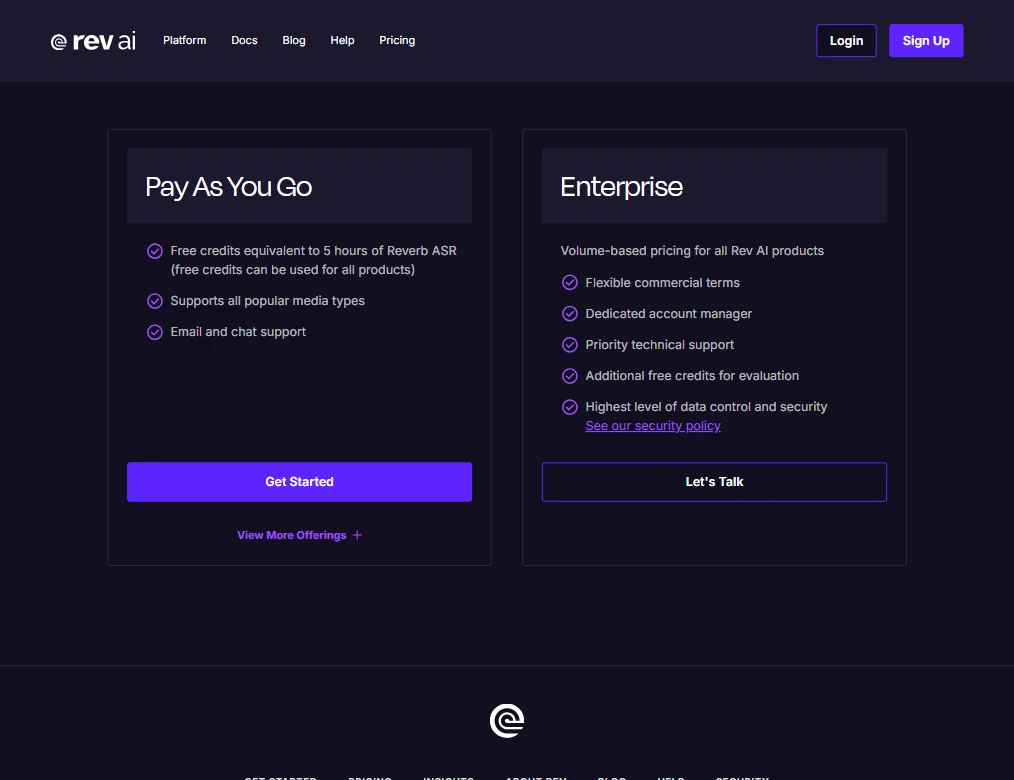
Pay-per-use. You pay per minute of audio processed, which is sensible for variable workloads but can get unpredictable at scale without careful monitoring.
The free tier exists. Limited credits, no credit card required. Reasonable entry point for evaluation.
The problem is that pricing beyond the free tier is largely opaque. We went through the pricing page and couldn't find a clear per-minute rate published prominently. Enterprise pricing is contact-sales-only, which is standard practice and still annoying. The refund policy isn't publicly stated anywhere we could find either.
Reddit threads from developers in 2024 compare Rev AI's rates unfavorably against Deepgram on pure cost at volume. Some noted the accuracy difference justifies the premium for high-stakes use cases like medical transcription. Others didn't find the tradeoff worth it for general-purpose work. We can't give you a firm dollar number because Rev AI won't publish one clearly.
That's our concern. Not great.
Rev AI vs AssemblyAI: Which AI Audio Tool Wins?
These two come up together constantly in developer conversations. AssemblyAI is the closest direct comparison in terms of target audience and product philosophy.
Both are developer-first APIs. Both prioritize accuracy. AssemblyAI tends to get more attention for its broader NLP feature set, things like auto chapters and entity detection that go beyond raw transcription. Rev AI gets the nod more often for raw transcription accuracy, particularly on accent diversity and difficult audio conditions.
G2 reviewers who've used both tend to put Rev AI slightly ahead on transcription quality and slightly behind on surrounding intelligence features. Real tradeoff. For pure speech-to-text in production, Rev AI is the more defensible choice when accuracy is the hard constraint. For teams building richer voice applications that need summarization or intent detection baked in, AssemblyAI comes up more often.
Google Speech-to-Text and AWS Transcribe enter the conversation mostly as cost baselines. Neither gets strong accuracy reviews for accent coverage in 2024 threads we found. OpenAI Whisper is the wildcard: free, capable, but requires infrastructure to run at real scale and you're on your own for reliability.
Who Should Use Rev AI? (And Who Shouldn't)
Developers building transcription into production software. That's the fit.
Call center platforms, legal tech, media monitoring, accessibility tooling. These come up repeatedly in Rev AI's G2 review base, and the accuracy story resonates most when the cost of errors is actually high.
Non-developers. Elsewhere, please. The product won't meet you where you are, and that's not going to change. Content creators wanting a quick podcast transcript should look at consumer-facing tools built for that workflow.
Teams with tight budgets needing scale at the lowest possible per-minute rate are probably comparing Deepgram and Rev AI directly, and the answer depends on whether accuracy or cost is the harder constraint. We can't resolve that without knowing your specific error tolerance and use case economics.
Rev AI Review Verdict
Rev AI is a focused, well-executed API for teams that need accurate speech-to-text and have the technical resources to use one properly. The accuracy reputation is real. The developer experience is solid. The free trial entry point is fair.
The weaknesses are real too. Pricing transparency is genuinely poor for a product asking you to build a production system on top of it. The feature set outside core transcription is limited by design, which is fine until you need something else. Non-developers have nowhere to go here.
For accuracy-critical transcription built into a production system, Rev AI is in the conversation at the top of the category. The narrowness is a feature, not an oversight. Just make sure it's narrow in the right direction for what you're actually building.
Frequently Asked Questions
Does Rev AI offer a free plan?
Yes. There's a free tier with limited API credits, and no credit card is required to start. That's a reasonable way to test accuracy against your own audio before committing to anything financially.
How many languages does Rev AI support?
57-plus languages following the Global Voice Recognition update. English accuracy reviews are strong and consistent across the G2 data we found. Multilingual performance is less documented in public reviews, so we'd recommend testing your specific language on real samples from your actual use case before building around it.
Is Rev AI only for developers?
Effectively, yes. The product is an API with SDKs and documentation aimed at engineering teams. No consumer-facing interface exists for casual users. If you need transcription without a developer in the loop, Rev AI isn't the right starting point. Their parent company Rev.com offers a more accessible service built for that use case.