UiPath is an AI automation tool for enterprise process work, pairing robotic process automation with newer agentic orchestration.

Across a few hundred G2 and Capterra reviews, our research kept turning up the same split. Enterprises that had fully committed to the platform were enthusiastic. Teams that had underestimated the setup complexity were not. That gap matters more than any feature comparison, and it shapes everything else in this UiPath review.
UiPath has been around since 2005, which is ancient in automation terms. Founded in Romania, now headquartered in New York. The "agentic" pivot is recent, but the RPA core underneath it isn't, and that history is relevant when you're deciding whether this thing will hold up in a real enterprise environment.
What is UiPath?
It started as a robotic process automation company. Software robots that mimic human screen actions, clicking buttons, filling forms, moving data between systems. That was the original pitch. Enterprises adopted it at scale.
Now they're calling themselves an agentic automation platform. The shift isn't just marketing. They've genuinely layered in AI agent capabilities, process mining, and an orchestration layer on top of the original RPA foundation. Robots handle repetitive structured work, AI agents handle decision-heavy unstructured work, humans step in for the stuff that needs judgment. That's the loop they're selling.
Their user base sits at over 10 million community members. The platform runs on web, Windows desktop via Studio, cloud, and on-premise. UiPath acquired WorkFusion in February 2026, which strengthened their financial-services automation portfolio, specifically financial-crime compliance, AML, KYC, and sanctions screening operations. That tracks. Financial services is where a lot of their G2 reviews originate. UiPath was also named a Leader in The Forrester Wave: Document Mining and Analytics Platforms, Q2 2026, and separately received a Leader designation in The Forrester Wave: Autonomous Testing Platforms, Q4 2025. Worth keeping those two straight.
UiPath Features: Workflows, AI Agents & Automation Capabilities
The feature list is long. We'll be selective, because listing everything doesn't help anyone make a decision.
Studio is where most of the work happens. Visual workflow designer, drag-and-drop functionality, low-code in the sense that basic automations don't require writing code. Anything serious will touch C# or VB.NET eventually. Python is supported too, so developers aren't locked out of anything meaningful.
Orchestrator is the management layer. It handles scheduling, execution logs, audit trails, and robot management. In our cross-referencing of user reviews and official docs, Orchestrator came up constantly, usually positively, occasionally with complaints about the configuration learning curve.
The Action Center is the human-in-the-loop piece, routing to a human when an agent or robot hits something it can't resolve autonomously, then picking up from there. Not unique to UiPath, but the way it's built into the broader orchestration layer is more mature than what most competitors offer at this point.
Error handling covers retry logic, exception handling, and escalation paths. Self-healing automation exists, but it's Enterprise tier only. The integration library runs to 1,000+ connectors via the UiPath Marketplace and Integration Service. The headline integrations are SAP and Salesforce, and a few others including Microsoft 365 and ServiceNow. The API is documented and public at docs.uipath.com/orchestrator/reference. A real API, not a stripped-down one.
UiPath Automation Power: How Complex Can Your Workflows Get?
This is where UiPath earns its reputation. The platform was built for complexity. Not around it.
Trigger options cover schedule, webhook, event-based, API, and a few others. Most enterprise workflows have at least two of those in play simultaneously. UiPath handles that combination without needing workarounds. Conditional branching inside Studio is full-featured. Data Service rounds out the structured data management layer.
Automation Hub is the collaboration piece, used for identifying and tracking automation candidates across an organization. G2 reviewers in operations roles specifically called it out as genuinely useful for governance, which is a sign it's actually being used rather than just licensed. That distinction matters more than most vendors admit.
The process mining capability lets you analyze existing processes to find automation candidates first. That's a real differentiator from something like Make or Zapier. Those tools assume you already know what you want to automate.
Honestly, for sheer automation depth, nothing we've reviewed in this category comes particularly close.
UiPath AI Agent Capabilities: What Can It Actually Do Autonomously?
The Agent Builder is newer than the RPA core, and it shows a little. Not in a broken way. More in a "this is still maturing" way.
Maestro is the orchestration layer that sits above everything, coordinating agents, robots, and humans across a workflow. The design logic is coherent. Agents think, robots execute, humans approve.
For AI model access, UiPath connects to third-party LLMs via AI Center and Integration Service, including OpenAI, alongside their own proprietary AI layer. When we cross-referenced their docs with user reports on Reddit, we didn't find the usual complaints about AI features being bolted on without actually working. That's notable.
What we did find was that the agentic capabilities are still enterprise-heavy in their assumptions. Building agents requires meaningful technical depth. The visual builder helps, but it doesn't make this point-and-click easy. Teams expecting to spin up AI agents in an afternoon will be disappointed. Fair.
For companies already deep in enterprise AI workflows and comparing multi-agent orchestration options, CrewAI is worth looking at alongside UiPath. Different architecture, different assumptions about who's building the agents.
Is UiPath Easy to Set Up Without Code?
No. Not really.
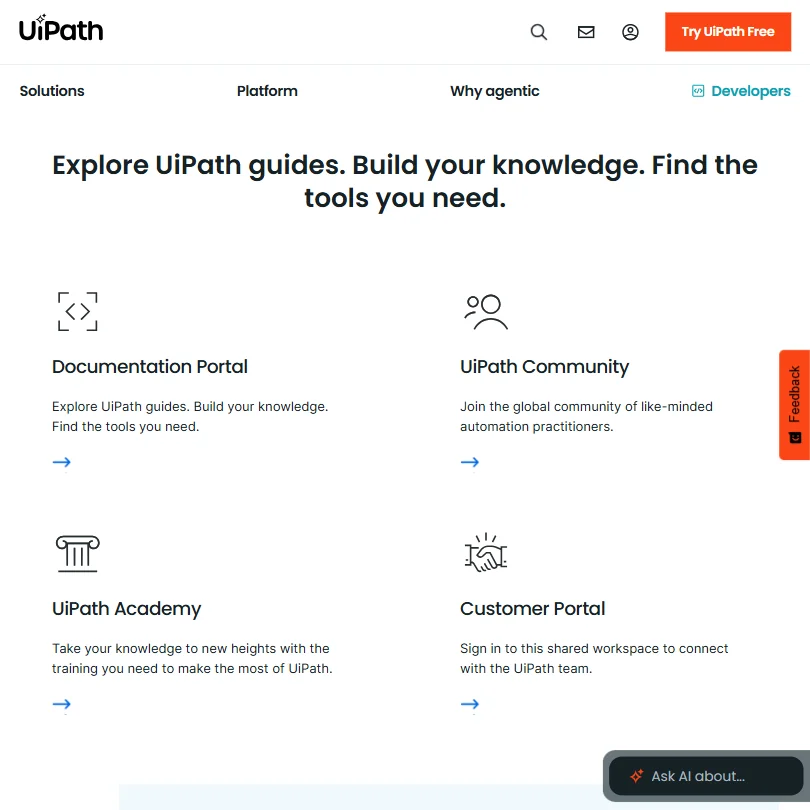
That's not a fatal flaw. It's just honest. UiPath is built for enterprises with technical teams. Studio is powerful and visual, but the learning curve is steep for non-developers. UiPath Academy offers certifications and structured learning, which is genuinely useful. But "there's a certification program to help you use it" is not the same as "anyone can set it up."
Reddit threads from 2024 and 2025 surfaced the same complaint consistently: onboarding takes longer than expected, especially for teams without prior RPA experience. The complexity of Orchestrator configuration came up repeatedly. G2 reviewers in IT roles rated setup highly. G2 reviewers in business operations roles were more mixed.
The low-code framing on the homepage is technically accurate. It's also the kind of technically accurate that requires an asterisk. Basic automations don't need code. Anything serious will eventually touch C# or VB.NET, or require someone who has done this before.
We're not skeptical of UiPath's capability here. We're skeptical of the framing. Teams expecting a Zapier-like experience will have a bad time.
UiPath Pricing: Is It Worth It vs Zapier or Make?

Pricing is where things get murky fast.
There's a Basic plan at $25 per month. That exists. It covers building and running basic personal automations, limited scale on users and robots, hosting in their European region, 99.9% service uptime, and UiPath Bronze Support. The number is public. The specifics on what "limited scale" translates to in practice are less clear without a sales conversation.
Standard and Enterprise are both contact-sales. No public numbers. That's a pattern across enterprise automation tools and it's always frustrating. We'd prefer transparency, and so would most buyers.
The Standard tier adds the ability to build, test, run, and share enterprise automations including Agents. It also adds document classification and extraction at scale, enhanced governance controls, the option to bring your own Identity Provider, and no limits to scale, hosted in your chosen region or on-premise. Enterprise adds self-healing UI automation, bring-your-own-model for AI products, bring-your-own encryption keys, and CI/CD pipeline options, among a few others.
Compared to Zapier, the value equation is almost impossible to compare directly. Zapier is priced by tasks and designed for business teams who want fast no-code automation. Paying $25 a month for what UiPath's Basic tier offers is genuinely reasonable, assuming Basic does what you need. For most enterprise use cases, it won't. The real cost conversation happens at Standard or Enterprise, and no one outside a sales call knows those numbers.
The refund policy isn't publicly stated. Worth knowing before you commit to an annual contract.
UiPath vs Automation Anywhere: Which Automation Platform Wins?
These two have been head-to-head for years. Both came up from RPA, both are pivoting to agentic AI, both sell primarily to large enterprises.
Automation Anywhere's strength is in cloud-native architecture. They built for the cloud earlier, and it shows in deployment flexibility. UiPath's strength is in the depth of Studio and the maturity of Orchestrator. Complex on-premise systems with automation requirements are where UiPath's track record is longer and the tooling is more battle-tested.
On AI agent capabilities, both are building fast. UiPath has Maestro. Automation Anywhere has its own orchestration layer. Neither is obviously dominant yet. Not great, for buyers trying to make a long-term bet.
The differentiator that actually matters in practice is the integration ecosystem. UiPath's 1,000+ connectors give it a practical edge for organizations running complex multi-system environments. Automation Anywhere is more competitive on pure cloud deployments.
Blue Prism is the third name in this conversation historically. Less relevant now. Microsoft Power Automate is the budget alternative, especially for organizations already deep in the Microsoft 365 ecosystem. Workato and MuleSoft come up in iPaaS comparisons more than pure RPA discussions.
Who Should Use UiPath? (And Who Shouldn't)
Large enterprises with dedicated automation teams. That's the fit. Organizations running complex multi-system workflows across SAP, Salesforce, or ServiceNow. Teams that need on-premise deployment alongside cloud. Regulated industries, especially financial services and healthcare, where the governance and compliance tooling actually gets used rather than licensed and ignored.
The WorkFusion acquisition in February 2026 specifically deepened financial-crime compliance capabilities. Banking teams that need automation with serious AML and KYC controls are probably landing here regardless of what the evaluation process turns up.
Small teams without technical resources. Startups that need automation running in a day. Anyone expecting a fast setup. Those aren't the fit, and the $25 Basic plan won't change that reality.
Mid-market companies sit in an awkward position here. Enough complexity to need UiPath's depth, not always enough technical staff to configure it well. That's where we'd suggest pressure-testing the evaluation process carefully before committing to a contract.
UiPath Review Verdict
Twenty years of platform maturity. A genuine RPA foundation. A maturing agentic layer with Maestro. Governance tooling that holds up in regulated environments. Enterprises that deploy it properly get real value from it, and the G2 and Capterra reception reflects that consistently.
The concerns are also real. Pricing opacity is frustrating. Setup complexity is consistently underestimated, especially by teams coming from lighter tools. The agentic capabilities are newer and still finding their footing. The $25 Basic plan is more of a trial wrapper than a genuine starting point for most enterprise use cases.
For any organization with real automation complexity and the technical resources to run it, UiPath is hard to argue against. The platform depth is there. The ecosystem is there. The governance is there. Smaller teams, or teams that want automation running without a specialist in the room, should look elsewhere first. The platform will outlast your patience for configuring it.
Not a knock. Just a warning about fit.
How UiPath compares
UiPath scores 8.8 out of 10 among the workflow automation tools we rate. These three do the same job and are the closest to it, compared on what each vendor publishes.
n8n
UiPath restricts bringing your own model or key to its Enterprise tier; n8n allows it more broadly, through Ollama for self-hosted models or your own credentials in provider nodes. UiPath claims HIPAA compliance, which n8n does not, and hosts across seven regions including the US, UK, Canada, Australia, India and Japan, where n8n hosts only in the EU. Both price their cheapest paid plan close together, UiPath at $25 a month against n8n's $25.92 a month.
Pick n8n if you want to bring your own model on any plan.
Pick UiPath if you need HIPAA compliance and hosting across more regions.
Retool
Retool's cheapest paid plan costs $11.88 a month per builder seat; UiPath's cheapest paid plan is $25 a month. UiPath restricts bringing your own model or key to its Enterprise tier, while Retool offers it more broadly. UiPath claims HIPAA compliance, which Retool does not, and it names seven hosting regions including Canada, India and Japan. Retool adds email support alongside community, where UiPath offers only community.
Pick Retool if you want a lower monthly cost and email support.
Pick UiPath if you need HIPAA compliance and hosting in more regions.
Workato
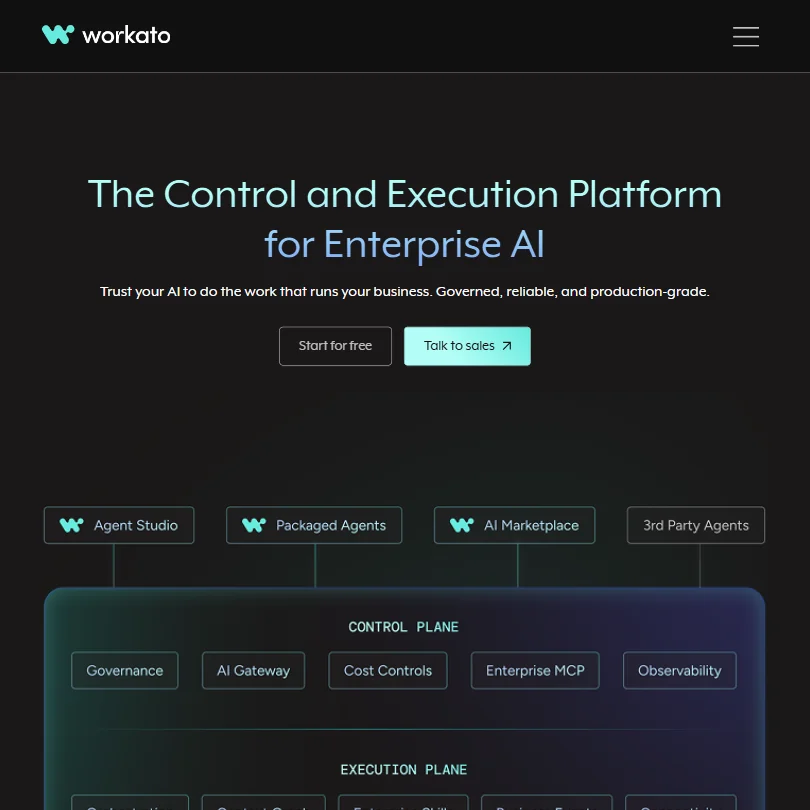
UiPath can be self-hosted via Automation Suite on Linux or Kubernetes; Workato has no self-hosted edition, keeping everything in its own cloud. UiPath also includes agent evaluation, scoring output 0 to 100 across evaluation sets, where Workato's Agent Studio has no evaluation feature for its genies. UiPath hosts across seven regions including Canada, India and Japan, two more than Workato's five. Both hold HIPAA compliance.
Pick Workato if you need 14,000 app connectors and agent orchestration.
Pick UiPath if you want self-hosting and built-in agent evaluation.
Frequently Asked Questions
Does UiPath have a free plan?
There's a "Try It Now" free access option, and a Basic paid plan starting at $25 per month. The free access is real but limited in what you can run at scale. It's useful for exploring the platform before committing, not for running production automation. The Basic plan adds Bronze Support and a 99.9% uptime commitment, but scale remains restricted on users and robots.
What's the difference between UiPath Studio and Orchestrator?
Studio is where you build automations, a Windows desktop environment with a visual workflow designer and support for custom code. Orchestrator is where you manage, schedule, monitor, and audit what's running in production. You need both for any serious deployment. Most of the setup complexity that comes up in user reviews is on the Orchestrator side, not the Studio side.
Is UiPath only for large enterprises?
Technically no. Practically yes for most teams. The platform's depth is designed for enterprise-scale complexity, and smaller teams without dedicated technical resources will find the setup and maintenance overhead disproportionate to the value they get out of it. Mid-market organizations with at least one experienced automation architect can make it work. It takes real investment to get there.