Mootion's homepage is doing a lot of heavy lifting. We pulled vendor docs, scanned the Reddit threads that exist, and cross-referenced the feature claims against what public reviewers are actually saying. Fair warning: the review trail is thin. Mootion launched in 2024, is headquartered in Hong Kong, and is making a swing that's bigger than most tools at this stage. That context matters when you're weighing what we found.

What is Mootion?
The pitch is a single workflow that takes almost any input and produces a finished cinematic video. Text, a script, an image, a link. The output is supposed to include synced voice, AI-generated music, and matched visuals without the user touching an editing timeline. That's the core claim.
Version 3.0.22, released September 24, 2025, added Image-to-Video. That's a real capability addition, not a patch. Version 3.1.0 followed on November 21, 2025, updating the base animation model, adding the Max plan, and extending character input limits for customised styles. The product is moving. Two meaningful releases in under three months is a real signal.
The platform runs on web, desktop for Windows and Mac, and mobile or tablet. An API is listed in the navigation, which suggests developer use cases are at least on the roadmap. The five million creator figure on the homepage is interesting. We'd genuinely like to know how they're counting that. Downloads, signups, monthly actives? We don't know. Worth flagging early.
Mootion Features: Voice, Music & Audio Capabilities

The loop is straightforward. You put something in, Mootion builds a storyboard, assigns scenes, adds voiceover, drops in music and effects, and renders. One pass.
Voice synced to individual scenes is the part that actually matters for anyone who's tried manually stitching audio to video cuts. AI-generated music and sound effects are included and timed to the edits, not just layered over the top. Multiple voice styles are confirmed, covering different emotional registers. Ten-plus languages are supported, though the specific languages aren't named in public-facing docs. Direct publishing to TikTok and YouTube is listed.
Honestly, for a tool that launched in 2024, that's a reasonable feature set. Whether the execution matches the spec sheet is the harder question, and we can't answer it without hands-on testing.
Voice cloning isn't confirmed anywhere in the public documentation. That's a gap, especially against tools like ElevenLabs, which has built its entire identity around cloning.
Mootion Audio Quality: How Natural Does It Sound?
Thin. Really thin. G2 shows one review at a perfect score. One. Capterra has nothing. Trustpilot isn't in the picture.
We're not going to pretend one data point tells us much about audio naturalness at scale. What it tells us is that Mootion hasn't been around long enough to accumulate the kind of real-world feedback that makes a quality assessment possible. That's not a death sentence for the product. It is a genuine problem for anyone trying to make a confident buying decision right now.
Vendor documentation describes voice output as synchronized and professionally rendered. We'd accept that it's competent. We'd want considerably more public reviews before calling it natural in any meaningful sense.
Mootion Voice Cloning & Customization: How Deep Does It Go?
Short answer: we don't know. Voice cloning isn't mentioned in the public documentation. Multiple voice styles are confirmed. Emotional register control is referenced. Those are not the same thing as cloning.
The absence of any cloning documentation is a real gap for creators who need consistent brand voice across a content library. It's also the kind of feature that tends to surface quietly inside higher-tier plans. We looked at the pricing structure, specifically the Pro plan at $50 per month and the Max plan at $200 per month, and found nothing confirming it either way.
We're skeptical deep voice customization is there yet. This feels like a generation before that capability arrives for this particular tool.
Is Mootion Easy to Use?
The design philosophy is clearly "put anything in, get a video out." Multi-modal input means you're not locked into a single workflow, which is genuinely useful for solo creators managing everything themselves.
Hundreds of templates are listed across marketing, social, and education formats. The storyboard layer lets you make scene-level edits without touching a timeline. That's the right abstraction for non-editors, and it's one of the more sensible UX choices we've seen at this price point.
We cross-referenced the FAQ section and tutorials with what users mention publicly. The Discord community is active enough to be listed as official support. That's something. Not a lot, but something.
Mootion Pricing: Is It Worth It for Creators & Businesses?
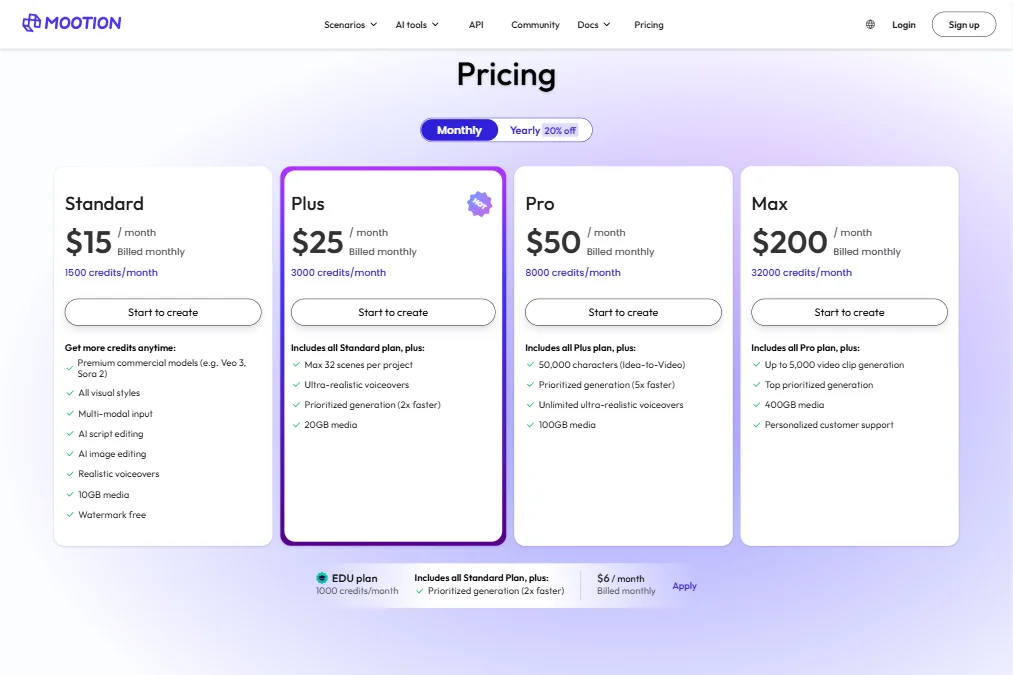
Four plans. Standard at $15 per month, Plus at $25, Pro at $50, and Max at $200, all billed monthly. Credits scale accordingly: 1,500 per month on Standard, 3,000 on Plus, 8,000 on Pro, and 32,000 on Max. The Max plan was added in the November 2025 release, alongside updated model support.
Differences compound as you climb. Plus adds ultra-realistic voiceovers, a cap of 32 scenes per project, and 20GB media storage. Pro unlocks 50,000 characters for Idea-to-Video, prioritized generation at 5x speed, unlimited ultra-realistic voiceovers, and 100GB storage. Max adds up to 5,000 video clip generation, 400GB storage, top-priority generation, and personalized customer support. That last one is notable because it implies the lower tiers are getting something considerably less attentive.
There's also an EDU plan at $6 per month with 1,000 credits and prioritized generation. Fair. A free plan and free trial terms are not confirmed anywhere in the public documentation, which makes it hard to test before buying.
We don't see a public refund policy either. For a tool targeting solo creators on tight budgets, that's a friction point worth naming before someone puts a card in.
Mootion vs Runway: Which AI Audio Tool Wins?
Runway is the default name in AI video. Years of public use, findable pricing, and a track record in professional workflows. Mootion's counter-argument is that it collapses the entire production into one shot. Runway gives you more granular control over individual steps. Those are genuinely different propositions.
Kling AI and Pika Labs are in the same text-to-video conversation. Neither bundles audio synchronization inside the same workflow the way Mootion claims to. That's the actual differentiator worth testing against real output.
For anyone who needs voiceover quality as the primary deliverable rather than the video, Mootion probably isn't the right frame at all. Murf AI is worth looking at instead.
Who Should Use Mootion? (And Who Shouldn't)
Social media creators who want a finished video without a post-production step. That's the clearest fit. The single-workflow approach trades precision for speed, and for short-form content that trade is often fine.
Educators building multilingual explainer content. The template library plus 10-plus language support is a practical combination, and mobile access makes it more flexible than desktop-only alternatives.
Enterprise teams needing contract-backed commercial rights or SLA-level support. Not the right tool. Documentation doesn't confirm commercial rights explicitly, and the support stack is email plus Discord. That's a startup setup.
Anyone who needs to verify what they're paying before committing. The pricing page now exists, which is progress. The free trial question still isn't answered publicly.
Mootion Review Verdict
Collapsing a multi-step video production into a single input-output workflow is worth taking seriously as an idea. Two meaningful releases between September and November 2025 suggests the product team is actually building. The Max plan at $200 per month targets a different buyer than the $15 Standard tier, and the credit scaling is at least legible now.
The gaps are still real. Voice cloning remains unconfirmed, the public review trail is nearly empty, and free trial terms are nowhere in the documentation. For a tool asking creators to trust it with their content pipeline, those are material open questions, not minor ones.
We'd watch this one. We wouldn't commit to it yet.
Frequently Asked Questions
Does Mootion offer a free plan or free trial?
Neither is confirmed in the public documentation. Plan pages show Standard at $15 per month as the entry point, with an EDU option at $6 per month for eligible users. Free tier terms and trial conditions aren't stated, which makes it genuinely difficult to test before buying. We'd recommend contacting them directly before assuming either exists.
What languages does Mootion support?
Vendor documentation lists 10-plus languages. Specific languages aren't named in the public-facing materials, which is an odd omission for a tool leaning on multilingual support as a selling point. Whether voice quality holds consistently across all supported languages is something we can't answer from the current review trail. Not great.
How does Mootion compare to other AI video tools?
The core claim Mootion makes against tools like Runway or Pika Labs is that audio synchronization happens inside the same workflow rather than requiring a separate step. That's the pitch. Whether it executes better than the competition on actual output quality, either video or audio, is something we'd need hands-on testing and a deeper review pool to confirm. We don't have either yet.