What is Klaviyo?
Founded in 2012 out of Boston, Klaviyo started as email infrastructure for online stores and kept adding things. SMS. A customer data platform. Now two named AI agents, a helpdesk, and social marketing. The thing has genuinely grown into something different from what it started as.
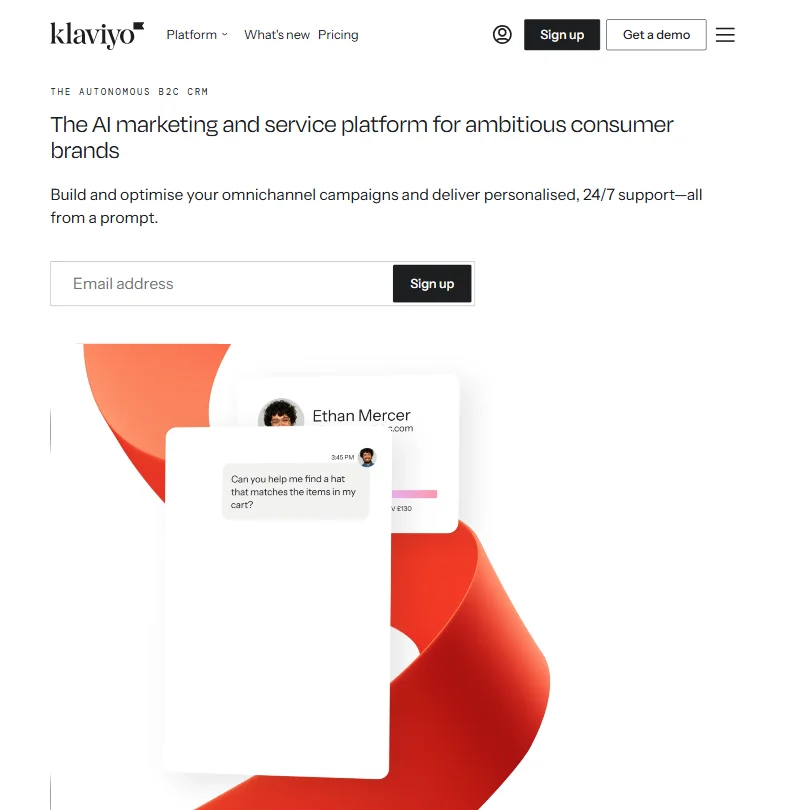
The company calls it an "autonomous B2C CRM." That phrase is doing a lot of work. What it actually means, in practice, is a platform combining email and SMS marketing, behavioral automation, a unified customer data layer called the Klaviyo Data Platform, AI-driven campaign tools, and customer service under one roof. Over 196,000 brands use it across more than 100 countries. Not a rounding error.
Built specifically for consumer brands. Not B2B SaaS. Not agencies running generic automation. That focus is a feature, not an oversight, and you feel it throughout the product.
Klaviyo Features: Flows, AI Agents and Segmentation
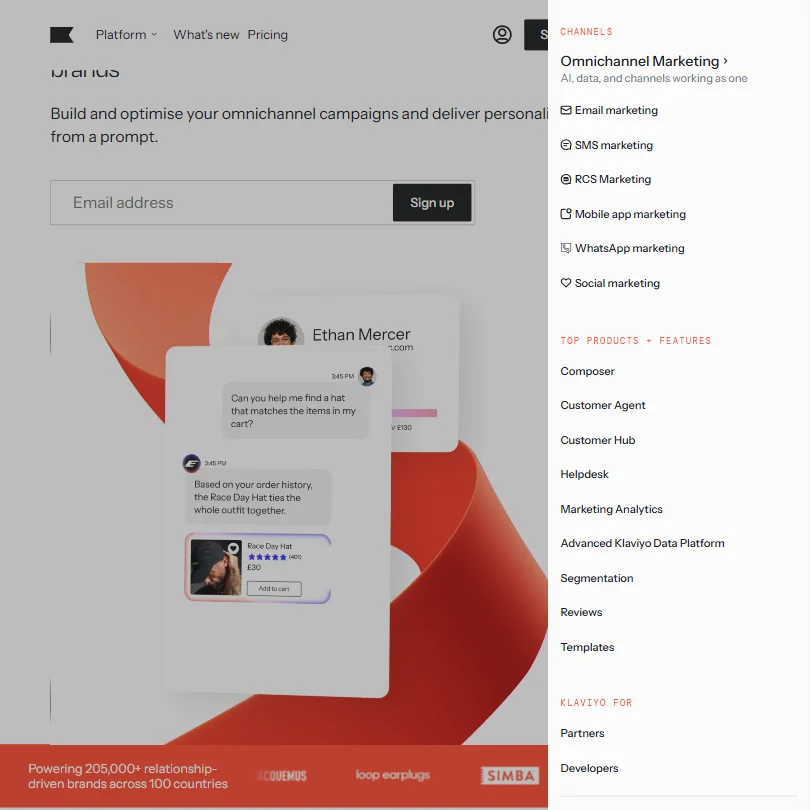
The surface area here is wide. Email and SMS are the foundation, but layered on top you've got mobile push notifications, WhatsApp marketing, reviews, RCS for Business, and a shared customer service inbox. That's a lot of channels for one platform to own.
Automation runs through a visual drag-and-drop flow builder. Trigger types cover behavioral events and purchase activity. Web browsing activity, email engagement, form submissions, scheduled sends, and webhook-based triggers all work. The branching logic handles conditional splits, time delays, and A/B testing inside flows. Complex scenarios are supported. Not bolted on.
The Composer AI agent is the headline feature right now. Describe a campaign goal in a prompt and it audits your existing flows, segments, and forms, then builds the campaign. That's the pitch. We're cautiously optimistic, though the hands-on reality depends almost entirely on how clean your historical data is.
Customer Agent is the other named agent. It handles inbound customer service questions around the clock and Klaviyo claims it resolves 65% of questions without a human touching them. That figure comes from their own marketing. Take it accordingly.
350-plus integrations. Shopify is the tightest one. WooCommerce and Magento slot in well, and a few others cover the major ecommerce platforms. REST API and webhook support round it out for custom builds.
Klaviyo Flows: How Complex Can Your Automations Get?
Honestly, this is where Klaviyo earns its reputation. The flow builder isn't window dressing.
Multi-branch logic responding to purchase history, lifetime value, engagement recency, and predicted behavior is all supported. The Klaviyo Data Platform processes behavioral and transactional data in real-time, which means your segments and triggers aren't working off yesterday's snapshot. That matters for abandoned cart flows. It matters even more for win-back sequences where timing is everything.
Custom code is supported inside email templates via HTML and CSS. Full API access lives at developers.klaviyo.com. For brands with technical resources, the ceiling is genuinely high.
What we kept seeing in user forums is that the complexity becomes its own challenge. Reddit threads from 2024 and 2025 show a recurring pattern: mid-sized brands that outgrew Mailchimp and moved to Klaviyo hitting a steeper learning curve than they expected. Not a fatal flaw. But don't plan a one-week onboarding.
Flow error handling and deliverability monitoring are included. Execution logs cover campaign performance, revenue attribution, and engagement dashboards. The architecture here is solid.
Klaviyo AI Agent Capabilities: What Can It Actually Do Autonomously?
Two agents. Composer and Customer Agent. That's it right now, and honestly, that's the right call. Narrow beats broad when agents are involved.
Composer is the marketing one. Give it a prompt describing your goal and it audits your account data before generating a campaign. Not just copy. It looks at existing segments, flow structure, and forms before deciding what to build. When we cross-referenced their documentation with what early users posted in the Klaviyo Community forum, the consensus was clear: Composer works best when your account has real data to work from. New accounts with thin history get thinner results. That tracks.
Customer Agent handles 24/7 support, pre-trained on your brand from day one using your product catalog and help content. You extend it with what Klaviyo calls "skills," essentially custom behaviors and response rules you define. The human escalation path is there. The 65% autonomous resolution figure is plausible for a store with well-documented FAQs. For anything with unusual edge cases, that number is probably optimistic. We're skeptical of it as a universal claim.
The 10,000 Composer credits per month on the free plan is a meaningful number. Enough to properly evaluate the feature before committing to paid.
Is Klaviyo Easy to Set Up Without Code?
For a brand already on Shopify, setup is genuinely fast. Product catalog syncs, order data flows in, and the pre-built flow templates get you a working abandoned cart sequence in under an hour. That's not marketing copy. Multiple user accounts confirm it.
Outside of Shopify, the experience varies. WooCommerce works. Magento works. Custom platforms push you toward the API, and at that point the no-code surface starts to thin out.
The free plan includes a drag-and-drop email editor, the flow builder, built-in reporting, and access to Customer Hub. That's a real free tier. Up to 250 profiles and 500 emails per month. Fair.
Klaviyo Academy, the Help Center, and the Community forum are all available and substantial. We've seen worse support ecosystems from tools at twice the price. Live chat support only unlocks on paid plans, which is a known frustration for free-tier users. Email support is available for the first 60 days on the free plan, then ongoing on paid.
Klaviyo Pricing: What You'll Actually Pay
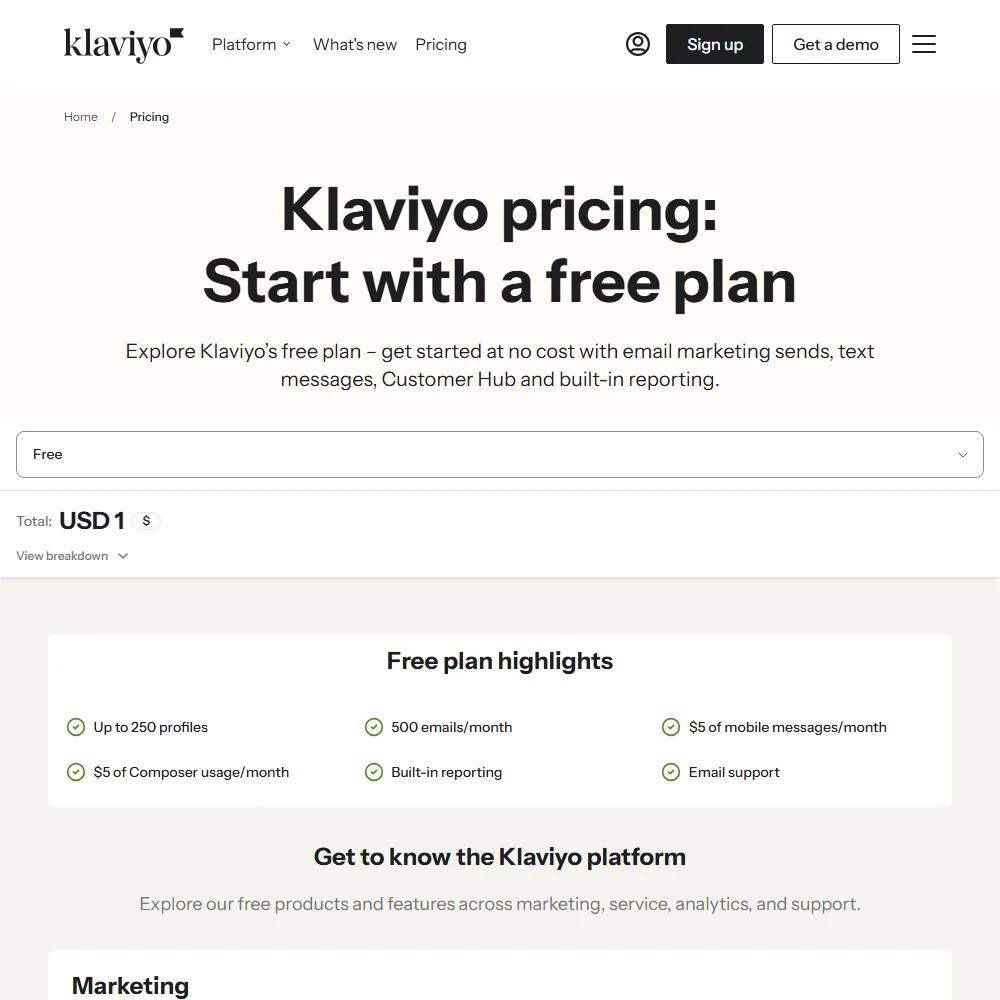
This is where it gets tricky. Klaviyo doesn't publish a clean pricing table with specific dollar amounts. Paid plans scale by profile count, and you have to input your list size to see what you'd actually pay. We dug through their pricing page and came up empty on anything resembling a public rate card beyond the free tier.
Klaviyo's plan structure covers marketing plans, data and analysis plans, a service plan that includes the AI agents and helpdesk, and enterprise. The separation means you can end up paying for multiple plan types to get the full picture. Worth thinking through before you commit.
Comparing Klaviyo to Zapier or Make is genuinely apples-to-oranges. Zapier and Make are general automation builders. Klaviyo is a vertical platform built specifically for consumer marketing. The right question isn't which tool costs less. It's whether you need an ecommerce-native platform or a generic connector. For most DTC brands, Klaviyo's integrated data layer alone justifies the price. For a B2B team building cross-app workflows, it doesn't make sense at all.
The lack of pricing transparency is a real frustration, and it surfaces repeatedly in community threads. Users reported bill shock as their list grew, particularly around the jump from one contact tier to the next. Not unique to Klaviyo. Still a problem worth naming.
No refund policy is publicly stated. Worth knowing before you put a card down.
Klaviyo vs Mailchimp: Which Wins for Ecommerce?
Not a close fight for ecommerce brands. Klaviyo wins.
Mailchimp has name recognition and a gentler onboarding. Pricing is more transparent. For a simple email sequence or a small newsletter, it does the job. But Klaviyo's behavioral segmentation, real-time data layer, and flow complexity are in a different category. Mailchimp can't match them at scale.
The integration depth with ecommerce platforms is where the gap is widest. Klaviyo was built for this. Mailchimp was built for email generally, with ecommerce added on later. That origin story shows in the product.
Attentive is a real competitor on the SMS side. Postscript too. For brands where SMS is the primary channel rather than a secondary one, both are worth evaluating seriously. Klaviyo's SMS is good. Whether it beats a dedicated SMS platform depends on how much of your budget and attention actually lives there.
For Klaviyo SMS marketing, the channel sits directly alongside email in the same automation layer, meaning your flows can trigger across both without building separate parallel sequences. That's a genuine operational advantage. It's also why switching away once you're embedded gets complicated.
Who Should Use Klaviyo? (And Who Shouldn't)
DTC brands on Shopify. That's the clearest fit, and the product shows it. The integration is tight, the templates are relevant, and the data model assumes you're selling products to real consumers.
Mid-market ecommerce teams scaling past basic email automation will find the flow builder and segmentation engine genuinely capable. The AI agents add real value once there's enough account data to work from.
Not the right call for B2B companies. The entire platform assumes consumer relationships, repeat purchases, and ecommerce data signals. Account-based marketing or complex B2B sales sequences will feel misaligned here. Go look at Salesforce Marketing Cloud instead.
Small brands just starting out can use the free plan to test. 250 profiles isn't much, but it's enough to build a working flow and see how the tool behaves before paying anything.
Agencies managing multiple client accounts sometimes run into friction. Multi-account management in Klaviyo isn't as clean as dedicated agency platforms, and this comes up repeatedly in user community reviews as a genuine workflow problem. Not great.
Klaviyo Review Verdict
Klaviyo is a serious platform for consumer brands. Not a Mailchimp competitor with a bigger price tag. Something genuinely different for ecommerce teams that need behavioral data, multi-channel automation, and AI capability under one roof.
The AI agents are new enough that the long-term track record isn't there yet. Composer shows real promise. Customer Agent's 65% autonomous resolution claim is plausible but unverified. We'll watch how both mature.
Pricing opacity remains the worst thing about the experience. No public rate card, no stated refund policy, contact-tier billing that can surprise you as your list grows, and a plan structure that may require purchasing multiple tiers to unlock the full platform. That's a pattern in this category, but it's still a problem.
The platform earns strong marks across automation power and data capability, sitting above the median among the AI automation tools we've reviewed. The free plan is real and usable. The integration depth with Shopify is as good as anything we've tracked in the ecommerce marketing category. For the right kind of company, this is the platform you build on.
Brands outside ecommerce should look elsewhere. That's not a knock. It's just not built for you.
Frequently Asked Questions
Does Klaviyo have a free plan?
Yes, and it's not fake-free. You get up to 250 profiles, 500 emails per month, access to Customer Hub, 10,000 Composer credits, and built-in reporting. It stays free indefinitely. The main catches are that email support only lasts 60 days on the free tier, and live chat is locked to paid plans.
What is Klaviyo AI and what can it do?
Klaviyo AI powers two named agents. Composer is the marketing agent, taking a natural language prompt and building a campaign by reviewing your existing flows, segments, and form data. Customer Agent handles inbound customer service questions around the clock, resolving routine queries without a human involved. Both agents are included on the platform, not sold separately as add-ons.
How does Klaviyo ecommerce automation compare to general automation tools?
The comparison doesn't map cleanly. Klaviyo is purpose-built for consumer marketing, with a data model designed around purchase history, browsing behavior, and customer lifetime value. General automation platforms handle cross-app logic well, but they don't carry the same ecommerce-native segmentation or the pre-built channel integrations Klaviyo ships with. For an online store, that depth is hard to replicate by stitching a generic workflow builder together with a separate email tool.