Thirty-thousand-plus users leave a trail. We followed it through G2, Capterra, Reddit threads, and vendor documentation before writing a word here. No hands-on login, no live test. That comes separately. What we aggregated paints a picture of a platform that's grown considerably since 2016 and repriced itself in ways that actually make sense now, though some rough edges survived the glow-up.

What is Frase?
Boston, 2016. Frase started as a content brief and SERP research tool. That core hasn't disappeared. It's just been buried under a lot of additional surface area.
The current positioning is a full content loop: research, draft, edit, publish, then watch what happens to that content over time. The monitoring piece is newer and, frankly, more interesting than we expected. AI Visibility tracking across ChatGPT, Perplexity, Claude, and Gemini puts Frase ahead of most competitors on GEO coverage right now. Most tools in this space are still treating AI search as a checkbox feature, not a workflow. Frase is not doing that.
The model setup is multi-provider. Claude and Gemini integrations are confirmed in their docs. Not locked to one API. Sensible given how fast things are moving.
Frase Features: SEO & Content Tools Breakdown
Long feature list. That's not automatically good, but here it mostly holds together without feeling like a feature graveyard.
The SEO Research module runs on live SERP data, not cached snapshots. Competitor benchmarking and entity research pull from what's actually ranking at the moment you run the query. Everything else in the platform builds from that base.
Brief generation is automatic off that SERP data. It maps entity and topic coverage from top-ranking pages and builds a structured brief. G2 reviewers in content strategy roles mention this more than anything else when asked what they'd miss. That tracks with what the tool originally existed to do.
Content Guard monitors existing content for ranking drops and traffic decay. Honestly, that's a feature most content teams have been duct-taping together from separate tools for years. The AI visibility layer feeds into it too, so you're watching both Google rankings and AI answer surfaces at the same time. Topic Clusters maps keyword clusters across a full content scope. We've seen similar things in MarketMuse, though the implementation differs.
Backlink analysis is limited to a link-gap and outreach tool, not a full backlink explorer. Worth knowing before you cancel Ahrefs.
Frase Keyword Research: How Deep Does It Go?
SERP-outward, not database-inward. That's the philosophy, and it's a defensible one.
The SERP-driven keyword and entity research gives you a current picture of what's ranking for the query you care about. Keyword volume and difficulty are shown, but a large keyword database to explore, the kind Semrush or Ahrefs provides, isn't here. Different use case entirely. For content teams writing now against live competition, that's often more useful than aggregate volume estimates from three months ago. For agencies doing large-scale keyword gap analysis against a client's domain, that's a genuine constraint.
Questions research pulls People Also Ask data and query variations around a topic. Writers consistently praise this across G2 and Capterra. We cross-referenced several of those reviews against plan tiers and most of the enthusiasm comes from Professional plan users at $103 a month on annual billing.
Multilingual support exists in their docs. Reviews from non-English markets are sparse and often cautious. We're skeptical of that claim in practice. Treat it as English-first until there's stronger evidence otherwise.
Frase Content Creation: AI Writing Quality Tested
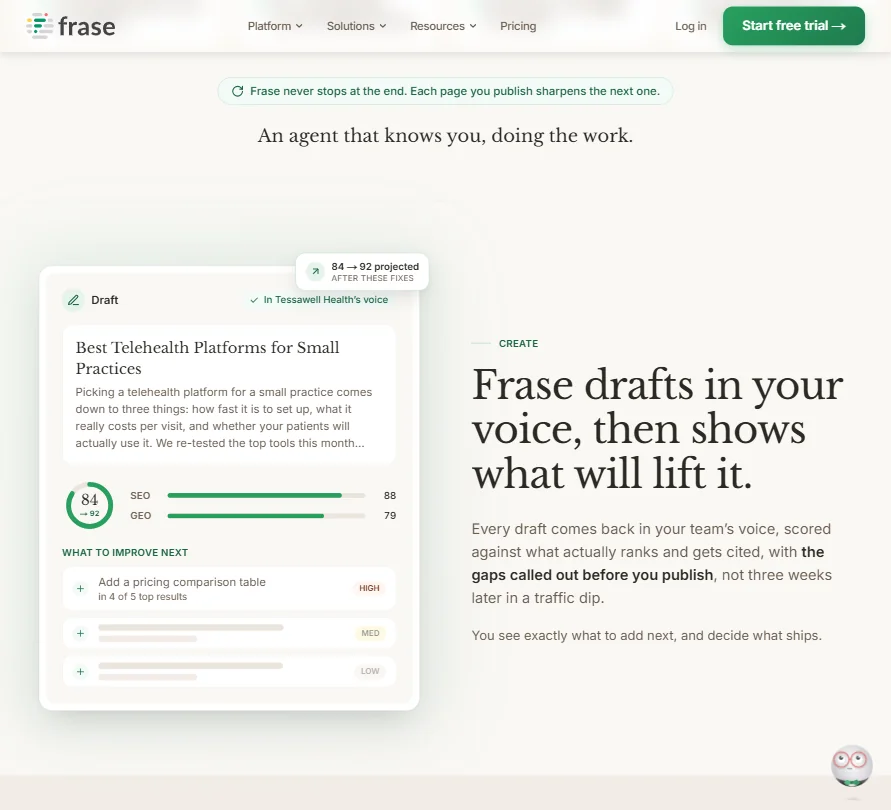
The AI Agent writes full articles. It carries a Brand Voice profile through draft, editor, and optimization suggestions. That's the differentiator they push hardest here. Not just an AI that writes, but one that writes inside a voice you've defined and stored.
Cautiously positive on the concept. The execution depends entirely on what you feed the brand profile. Marketing agency users on G2 tend to be satisfied. Solo operators with very specific voices flag homogenization. That split makes sense.
Reddit threads from 2025 showed a consistent pattern: most users treat the AI output as a first draft they heavily rewrite. That's the right use case. Anyone expecting to publish raw output without editing will be disappointed, though that's not a Frase problem specifically.
The content editor shows an SEO score and a GEO score side by side, updating as you write. Not a final-pass checker. Gap suggestions during the edit. We've seen worse implementations of this in tools that cost more. Images get drafted in as part of article creation too. We didn't find detailed complaints about image quality in reviews, which usually means it works well enough to stay quiet about.
Is Frase Easy to Use?
Not immediately. That's the honest read.
The platform does a lot, and when you're new, the flow between modules isn't obvious. G2 reviewers who work mostly inside the editor report general satisfaction. Users managing the full research-to-publish workflow across multiple modules report a steeper ramp-up. Both groups are probably right about their own experience.
Publishing directly to WordPress is one of the cleaner implementations we see mentioned, and the path from draft to publish is genuinely straightforward once it's configured. Webflow gets positive mentions too. Sanity and Wix users are quieter, which could mean fewer of them or could mean friction that isn't surfacing loudly yet.
The MCP server, CLI, and API access surprised us. Most content platforms don't bother with developer tooling at that level. Fair. Teams that want to pipe Frase data into their own systems have real options here, not just a webhook and a prayer.
Support is email only. No user community forum. For a platform this complex, that's a gap. We kept seeing review comments asking for a place to share templates and workflows. The absence of one means users are left to onboard themselves harder than they should have to.
Frase Pricing: Is It Worth It vs Free Alternatives?

The 2025 and 2026 restructure renamed the tiers from Solo, Basic, and Team to Starter, Professional, and Scale. Cleaner structure than before.
Starter is $49 a month billed monthly, $39 on annual. Professional is $129 monthly, $103 annual. Scale is $299 monthly, $239 annual. Enterprise is custom and scoped to the org. All three paid tiers offer a 7-day free trial with no credit card required. That's the right way to do it.
No publicly stated refund policy. Not unusual for SaaS, but ask before committing to annual billing. We noticed it.
Free alternatives exist for narrow use cases, on-page optimization, basic content scoring. Frase isn't competing on price against those. It's competing on loop completeness. The GEO tracking included on all plans is legitimately good value right now. Most competitors charge more for AI visibility monitoring or skip it entirely.
Starter is a trial tier in practice. Document and query limits will push regular users to Professional fairly quickly. $103 a month for a content workflow tool is reasonable for teams producing content consistently. Less so for teams publishing sporadically. Clearscope starts higher and offers less on the writing side. Surfer SEO lands in similar territory at comparable tiers. On feature-per-dollar, Frase holds up well at Professional.
Frase vs Surfer SEO: Head-to-Head Comparison
These two get compared constantly. The overlap is real, so the comparison is worth being specific about.
Surfer SEO goes deeper on technical on-page optimization. Its content score and SERP analysis are more granular for competitive ranking work, and it has a larger established community with more third-party tutorials and templates. That community advantage is real and compounds over time.
Frase is ahead on the research-to-brief workflow. Query to researched brief in fewer clicks. If brief production is your bottleneck, that matters.
On AI visibility monitoring: Surfer now offers comparable multi-platform AI visibility tracking, although its scoring and workflow differ from Frase's. Worth evaluating both directly if GEO tracking is a priority for your team, since the implementations aren't identical.
Content Guard has no direct Surfer equivalent. For teams managing large existing content libraries watching for decay, that's meaningful. Publishing integrations are broadly similar, though Frase's list includes Webflow, Sanity, Wix, and FraseCMS for native hosting. Not great. Not bad. Surfer leans more on third-party connectors.
Surfer wins on community, scoring refinement, and brand recognition in the content SEO space. Frase wins on the full loop, brief workflow, and the depth of its Content Guard decay monitoring. The decision is about which workflow you actually live in daily.
Who Should Use Frase? (And Who Shouldn't)
In-house content and SEO teams with ongoing production volume. That's the core fit. Ten or more pieces a month is when the full loop starts paying for itself.
Agencies managing content across multiple clients. Brand voice profiles per client, separate research-to-publish workflows, Professional plan as the entry point. The onboarding friction for new team members is real though. Plan for a ramp-up period before expecting full throughput.
Freelancers focused on content strategy and brief delivery. The brief generation alone justifies Starter at $39 a month if that's your primary output.
Teams that need full backlink analysis or large-scale keyword database exploration. Not this tool. SearchAtlas covers more of that territory if site-wide SEO audits are the priority.
Early-stage startups publishing sporadically. Value per dollar drops fast at low volume. A simpler tool at lower cost probably wins that comparison.
Frase Review Verdict
Eight years of development shows. The research and brief workflow is genuinely good. The AI visibility tracking across multiple AI search platforms is ahead of most competitors at this price point. Content Guard, the brand voice integration across the full document lifecycle, the MCP server and API access for technical teams. These are real features, not marketing bullets.
The rough edges survived the repricing though. Learning curve is steeper than it should be. No user community slows onboarding unnecessarily. Multilingual support is on paper but not well-evidenced in practice. The refund policy opacity is annoying.
Professional at $103 a month is fair for teams producing content regularly. Starter is a trial. Scale at $239 a month warrants scrutiny before committing annual billing.
We'd point this at teams serious about managing the full content lifecycle and tracking both Google and AI search visibility. Not a beginner tool. Not the right call if you only need one piece of the workflow. But for teams where the whole loop is the actual problem, Frase is one of the more complete answers we've aggregated across this category.
How Frase compares
Frase scores 7.5 out of 10 among the content optimisers we rate. These three do the same job and are the closest to it, compared on what each vendor publishes.
Surfer
Frase costs $49 a month on Starter, under Surfer's $59 on Discovery, and adds a technical site audit and backlink analysis, features Surfer does not have. Surfer answers with live chat support and a Chrome extension; Frase's support is email only and it has no browser extension. Frase supports content in 70 languages against Surfer's 18. Both write full articles and connect to WordPress.
Pick Surfer if you want live chat and a Chrome extension.
Pick Frase if you want a technical audit and backlink data.
Clearscope
Clearscope charges $129 a month for Essentials, well above Frase's $49 for Starter, and has no technical site audit, a feature that ships with every Frase plan. Clearscope counters with unlimited seats on every plan and a real Google Docs add-on; Frase gives one seat on Starter and only exports to Docs rather than integrating with it. Frase also includes API access from its cheapest plan, 5,000 requests a month, where Clearscope has none. Both write full articles and score drafts against the SERP.
Pick Clearscope if unlimited seats and a Google Docs add-on matter.
Pick Frase if you want a technical audit and API access.
MarketMuse
MarketMuse has a genuine free plan with keyword research included; Frase has no free tier, starting at $49 a month on Starter. Frase writes full articles and runs a technical site audit and backlink analysis, none of which MarketMuse offers since it retired full-draft writing. MarketMuse counters with topic clustering built into every tier, including free. Both give one seat on their cheapest paid plan.
Pick MarketMuse if you want to try keyword research for free.
Pick Frase if you want full AI drafts and a technical audit.
Frequently Asked Questions
Does Frase have a free plan?
No free plan. A 7-day trial requires no credit card, which is the clean way to test before committing. Starter begins at $39 a month on annual billing if you continue past the trial.
How does Frase's AI visibility tracking work?
Frase monitors how content appears in AI-generated answers across platforms like ChatGPT, Perplexity, and Google AI, alongside standard Google ranking data. It's included on all plans now, which is a relatively recent change. Most competitors either skip this feature or charge separately for it. Factor that into any comparison with Surfer SEO or Clearscope specifically.
Is Frase good for agencies?
It can be. Professional at $103 a month supports higher document and query limits, and brand voice profiles allow separate voice configurations per client account. Agency users on G2 rate the brief generation and research workflow consistently well. The main friction we saw in those reviews is onboarding new team members into a multi-module platform. Budget for the ramp-up time.