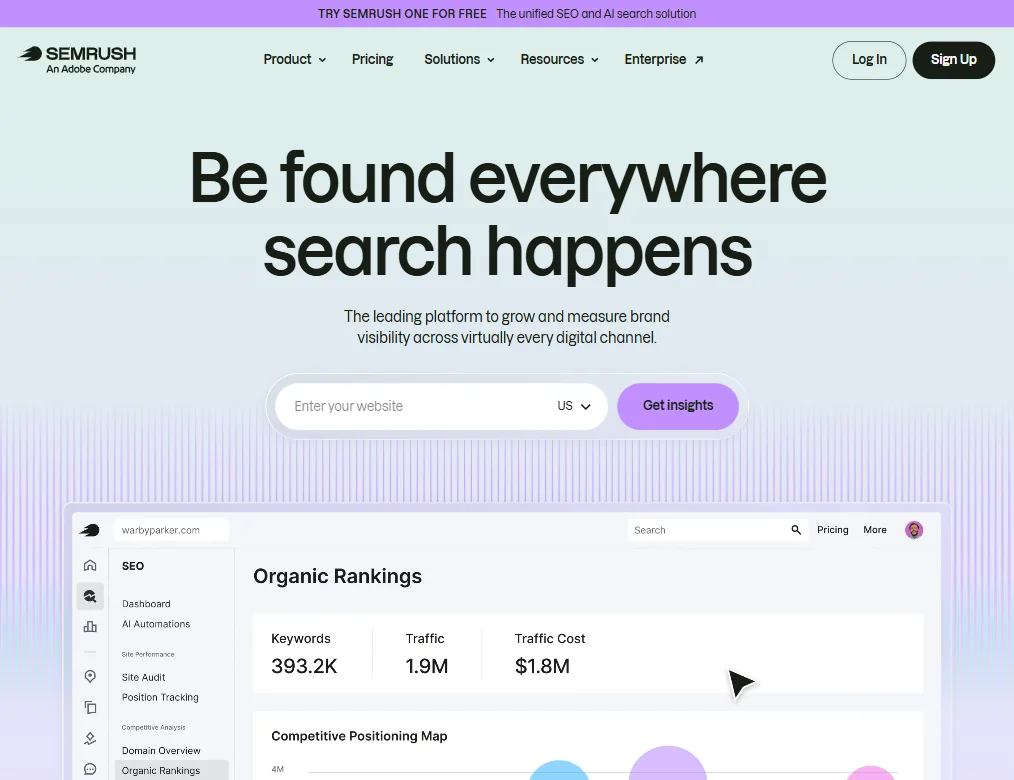
Our research into Semrush started the usual way. Vendor docs first, then G2 write-ups, Capterra reviews, Reddit threads, and a fair amount of Trustpilot venting. What came back was a complicated picture. This is a tool that genuinely does a lot, maybe too much, and the gap between what it promises and what it delivers depends almost entirely on how much you're paying. Before you hand over $139.95 a month, a proper Semrush review is worth your time.
What is Semrush?
Founded in 2008 and headquartered in Boston, Semrush has been around long enough that most SEOs have a strong opinion about it before they even sign up. It started as a keyword research tool. Over 17 years it accumulated backlink analysis, rank tracking, site auditing, content optimization, social media management, and most recently, AI visibility monitoring. The Adobe acquisition closed April 28, 2026, which is either exciting or alarming depending on how you feel about enterprise software parents.
The core pitch is a single platform covering traditional search and what they're now calling AI search. They track over 317 million LLM prompts to see whether your brand is showing up when people ask ChatGPT or Perplexity something relevant. That's a newer capability, and their documentation has shown the prompt count shifting as the product matures. Worth noting that Semrush One, the unified platform combining traditional SEO with AI visibility features, was announced October 29, 2025. Their own materials are sometimes imprecise about which launch date applies to which specific toolkit component, and we've seen that conflation in other coverage too.
10 million users. 28 billion keywords. 43 trillion backlinks. Those numbers come directly from Semrush, and we can't independently verify them, but nothing in the user reviews suggests the data is thin. Complaints tend to go in a different direction entirely.
Semrush Features: SEO & Content Tools Breakdown

The toolset is genuinely wide. Site Audit handles technical SEO. Position Tracking handles rank tracking with daily updates and multi-location options. The Keyword Magic Tool sits on top of a 28-billion-keyword database. Content tools cover brief generation and a live optimization editor. Backlink analysis and competitor research round out the core, with PPC tools and social scheduling also in the mix.
That's a lot of surface area. Honestly, it's almost too much. G2 reviewers in agency and marketing roles consistently flag the learning curve before they say anything positive. The tools are there. Knowing which ones to use, in what order, for what workflow, takes weeks.
The AI-ready Site Audit is newer. It's supposed to flag issues specific to how AI crawlers read your site, not just Google. We dug into what users were saying about it and found mostly cautious optimism. Nobody's calling it essential yet. A few Reddit threads from 2025 described it as "still maturing."
The content side includes the SEO Writing Assistant and an AI-driven content brief tool. We'd describe the content tooling as capable but not specialized. If content optimization is your primary use case, Clearscope is worth a look alongside this.
Semrush Keyword Research: How Deep Does It Go?
The Keyword Magic Tool is the product most people sign up for. 28 billion keywords is a big number. In practice, G2 reviewers consistently describe the keyword data as solid for English-language markets and noticeably thinner for smaller or non-English ones. Semrush claims support for 25-plus languages. The quality gap across those languages is real, based on what we kept reading.
Keyword clustering and cannibalization analysis are available, but not on the base plan. You'll need Pro+ at $299 a month to get those features. That's a meaningful gap if clustering is part of your workflow.
Competitor keyword analysis works well by most accounts. The domain profile database covers 808 million domains, which means most competitive research pulls up clean results. We didn't find many complaints about missing competitors in the data. A few edge cases around niche or regional sites, but that's expected.
The SERP feature tracking is a genuine differentiator. Knowing whether a featured snippet or a People Also Ask block is sitting on top of your target keyword matters for prioritizing effort. Semrush shows you that data at scale. That tracks.
Semrush Content Creation: AI Writing Quality Tested
We haven't run their AI writing tools hands-on. What we can do is tell you what users report. The SEO Writing Assistant gets a lot of use. It integrates with Google Docs via an add-on and with WordPress via a plugin, which is genuinely convenient. The optimization scoring and real-time suggestions are the part users actually talk about positively.
The AI copywriting and content generation features are newer. The AI PR Toolkit launched in October 2025. User feedback on it is sparse because it's recent, but the premise is using AI to generate press outreach and earned media assets. We're a little skeptical of the execution there. AI-generated press pitches have a bad reputation for a reason.
Briefs are described by Capterra reviewers as useful starting points, not finished products. That's fair for any brief tool, but several content marketing users said recommendations felt generic when the topic was competitive. The tool pulls from SERP analysis, which is the right approach. Whether the output is good enough depends heavily on the keyword.
Long-form writing support exists but doesn't seem to be what Semrush users lean on. Most positive reviews around content tools are about optimization, not generation.
Is Semrush Easy to Use?
Short answer: not immediately. Longer answer: it gets easier, but the onboarding asks a lot of you upfront.
The interface has improved over the years. That comes up repeatedly in G2 reviews from users who've been on the platform two or more years. For new users, the experience is different. There are 40-plus tools inside a single account. Navigation involves a sidebar that branches into more sidebars. Finding the right tool for a specific task requires either prior knowledge or patience with the Academy resources.
The Academy is legitimately good. Certification courses, webinars, a knowledge base. Semrush invests in education in a way that not every platform does. Honestly, they kind of have to, given how complex the product is.
Mobile apps exist on iOS and Android. We didn't find many reviewers praising the mobile experience. The product is clearly built for a desktop browser. The Chrome extension is more useful than the app for most users.
The setup time before you're getting value is probably two to three weeks for a typical marketing team. Not unusual at this price point, but worth factoring in before you start a trial clock.
Semrush Pricing: Is It Worth It vs Free Alternatives?

This is where things get uncomfortable. Four plans visible in the current pricing layout. The base SEO plan runs $139.95 a month. Starter sits at $199. Pro+ is $299. Advanced is $549. None of those numbers are secrets, but the way features are distributed across plans is deliberately uncomfortable.
API data integration only unlocks on the Advanced plan at $549, though that's not the only path to API access. Semrush's standalone SEO Toolkit Business subscription, currently $499.95 monthly, also includes Standard API access, after which API unit packages must be purchased separately. Certain Local APIs have their own access rules on top of that. So API access is more complicated than the plan comparison chart implies. Not great.
On GSC integration, the picture is similarly nuanced. Base Reports, which include Google Analytics and Google Search Console connections, cost $10 per additional report per month, but paid Semrush toolkit subscriptions automatically include three Base Reports. Free accounts get one. So most paying users won't hit an extra charge for GSC unless they need more than three reports. The framing in some coverage that GSC always costs extra isn't accurate.
The free plan is real but limited in a way that makes it a demo more than a product. The 7-day free trial is the more honest starting point.
Trustpilot complaints are almost exclusively about billing and cancellation. Charges after cancellation requests, difficulty reaching support for refunds, renewals users say they weren't warned about. The refund policy isn't publicly stated anywhere visible, which is a problem. We'd recommend reading the cancellation terms carefully before starting a trial. Reddit threads from 2025 and 2026 surface this repeatedly.
Against free alternatives, the comparison isn't really fair. Google Search Console and Google Keyword Planner are free and thin. Semrush does far more. Against paid competitors like Ahrefs or SE Ranking, the value question is tighter.
Semrush vs Ahrefs: Head-to-Head Comparison
This is the comparison that comes up most in our user research. Both platforms cover keyword research, backlink analysis, rank tracking, and site auditing. The differences are real but not dramatic on the core SEO side.
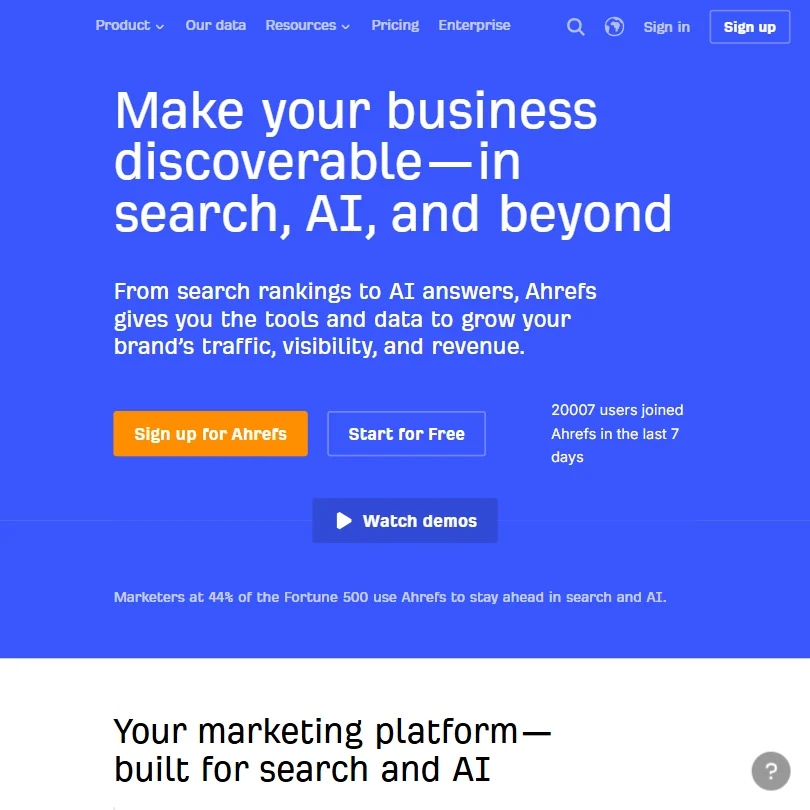
Ahrefs has a stronger reputation for backlink data accuracy among technical SEOs. Semrush claims the largest backlink database at 43 trillion links, but several Reddit discussions from 2025 push back on that, saying Ahrefs surfaces more actionable link data in practice. We can't adjudicate that without hands-on testing.
Semrush is wider. More content tools, more AI visibility features, more social and PPC tooling. Ahrefs is more focused, and a chunk of SEOs prefer that. The general pattern in SEO communities seems to be: use Semrush if you need the full marketing stack, use Ahrefs if SEO is your primary job.
On AI visibility tracking, Semrush has been moving fast. Their prompt database sits at 317 million-plus. Ahrefs's Brand Radar now cites over 405 million search-backed prompts, so Semrush isn't actually ahead on raw database size at this point. The two products also define and collect prompts differently, so direct comparison is tricky. We'd be cautious about taking either figure at face value without understanding what's actually being counted.
Pricing at entry level is roughly comparable. Ahrefs starts at $129 a month versus Semrush at $139.95. The gap widens at higher tiers where Semrush's feature set grows faster.
Who Should Use Semrush? (And Who Shouldn't)
SEO agencies running multiple clients. That's the strongest fit. The multi-project management, depth of competitor analysis, and reporting tools are built with agencies in mind. G2 reviews from agency owners are generally more positive than reviews from solo users.
In-house marketing teams at mid-size to enterprise companies also show up consistently in the positive reviews. The breadth of the platform means one subscription covers more ground than two or three point solutions.
Solo freelancers are a harder case. The $139.95 base plan is a lot to justify when you're billing one or two clients. Some make it work. A few Reddit threads describe pulling in a Semrush trial when deeper data is needed and running SE Ranking or Mangools day-to-day. That's not unreasonable.
Small businesses running their own SEO with no technical background should be cautious. The complexity is real, and paying $139.95 a month while spending three weeks figuring out the interface isn't a great outcome. Simpler tools exist for that situation.
Semrush Review Verdict
Semrush is one of the few tools where the complexity is actually justified by what's underneath it. The data is deep. The AI visibility features are ahead of many competitors, even if the prompt database size comparison with Ahrefs is now closer than Semrush's marketing implies. The keyword and backlink databases are large enough that you're unlikely to hit obvious gaps in mature markets.
The problems are real too. Billing complaints aren't noise. The cancellation experience is a documented issue, and it's been a documented issue long enough that Semrush deserves to be called out for it. The pricing structure rewards heavy users and punishes anyone trying to get value from a base plan. Gating clustering and cannibalization analysis behind Pro+ at $299 is a choice, and not a generous one.
The Adobe acquisition is a wildcard. Enterprise parents tend to push pricing up and slow product velocity. Semrush has moved quickly over the past two years, launching AI tools and expanding the LLM monitoring database. Whether that pace continues under Adobe is an open question. We're watching.
For agencies and larger in-house teams, Semrush earns its place in the stack. The breadth is hard to match. For solo operators or small teams with tight monthly budgets, the calculation is messier. Start the 7-day trial, go in with a specific workflow to test, and read the cancellation terms before you put in a card number.
How Semrush compares
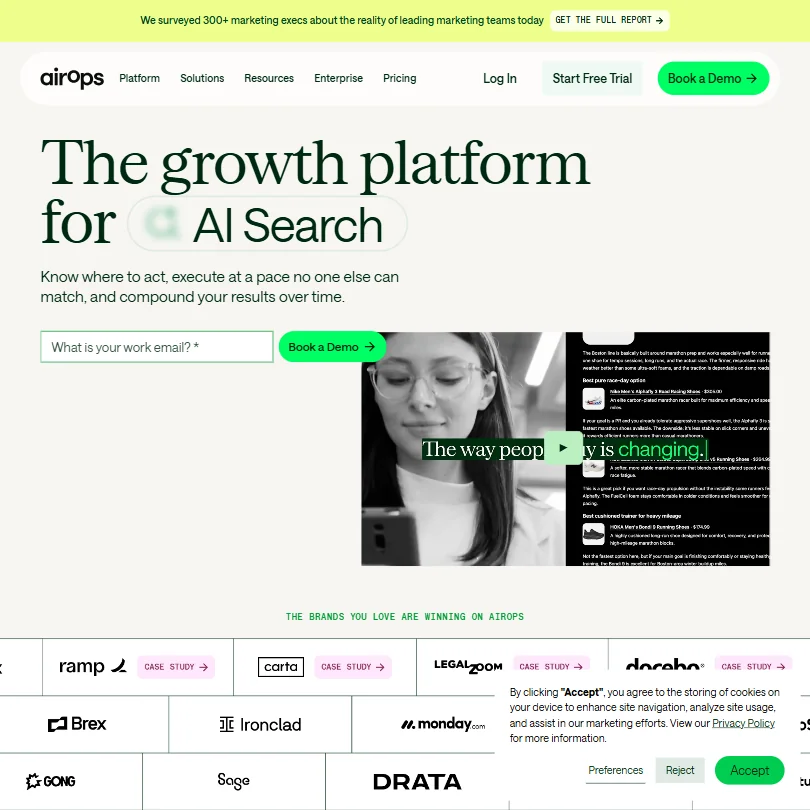
Semrush scores 8.3 out of 10 among the SEO platforms we rate. These three do the same job and are the closest to it, compared on what each vendor publishes.
SearchAtlas
Writing full articles inside Semrush requires a separate Content Toolkit subscription at $60 a month; SearchAtlas includes 30 AI article credits directly in its $99 a month Starter plan. Semrush costs more at the entry level, $139.95 a month against SearchAtlas' $99, though Semrush also offers a free account with 10 report requests a day. SearchAtlas also offers live chat support, where Semrush's support is a contact form with no live chat.
Pick SearchAtlas if you want full article writing and live chat included.
Pick Semrush if backlink depth matters more than a bundled article writer.
SE Ranking
Semrush's SEO plan costs $139.95 a month against SE Ranking's $129 Core plan; SE Ranking includes live chat support where Semrush's is a contact form only. SE Ranking's Core plan also bundles 25 articles, content briefs and local SEO for 3 locations; Semrush sells those separately, articles and briefs through a $60 a month Content Toolkit and local SEO at $30 a month per location. SE Ranking's Content Editor lists 8 languages against Semrush's 7, though SE Ranking's own AI Writer is limited to English.
Pick SE Ranking if you want articles, briefs and local SEO bundled together.
Pick Semrush if you prefer separate specialised toolkits over one bundled plan.
Ahrefs
Ahrefs starts at $29 a month, far below Semrush's $139.95 SEO plan, and both have a free account: Ahrefs Free includes Site Explorer and Site Audit with 5,000 monthly crawl credits, Semrush Free gives 10 Analytics report requests a day. Semrush can write full articles through a separate $60 a month Content Toolkit; Ahrefs has no full-draft writer, only an AI Content Helper that rephrases and grades what you write. Ahrefs offers live chat support, while Semrush's support is a contact form only.
Pick Ahrefs if budget matters and you don't need a bundled article writer.
Pick Semrush if you want full articles written without leaving the platform.
Frequently Asked Questions
Does Semrush have a free plan?
Yes, there's a free account tier. It's limited in ways that make it more useful for exploring the interface than doing real work. The 7-day free trial on a paid plan gives you a better read on whether the tool fits your workflow before committing to $139.95 a month or more.
Is Semrush worth it for small businesses?
Depends on how much SEO work you're actually doing. At $139.95 a month, the base plan is hard to justify if you're running a handful of keywords and publishing a post a month. The tool is built for volume. Small businesses with active content programs and competitive SEO goals can make it work. Everyone else should look at lighter options first.
How does Semrush handle AI search visibility?
The AI Visibility Toolkit tracks whether your brand or content shows up in responses from large language models. The database covers over 317 million LLM prompts as documented in current Semrush materials. The feature set rolled out across 2025 as part of Semrush One. The data scale is competitive, though Ahrefs now cites a larger prompt figure for Brand Radar. The two products collect and define prompts differently enough that the raw numbers aren't a clean comparison. Fair to say both are building fast in this space.