AirOps has 134 reviews on G2 sitting at 4.7 out of 5, which contradicts older writeups claiming it has no meaningful review presence.
What we kept seeing across those G2 reviews and community threads is that AirOps lands completely differently depending on the problem a team brings to it. Teams chasing AI citation visibility are enthusiastic. Teams expecting a conventional content brief tool come away confused about what they actually bought. That split is informative.
What is AirOps?
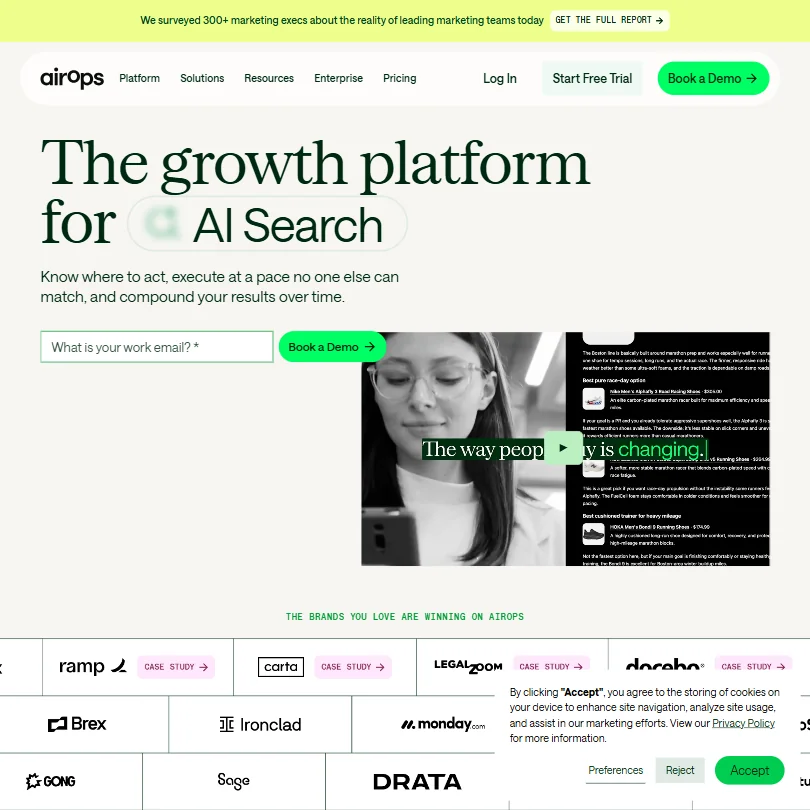
One core bet drives this product: AI search engines like ChatGPT, Perplexity, and Gemini are reshaping how brands get discovered, and most teams have no framework for tracking or influencing that. AirOps tries to solve both sides of that problem at once.
The execution layer runs through something they call the Quill AI agent. You feed it brand context and strategy. It handles content refreshes, new content creation, and internal link updates. The design is meant to close the loop: act, measure impact in AI search results, feed data back in, repeat. Honestly, that's a more complete feedback cycle than most tools we've reviewed in this category bother building.
The framing is answer engine optimization as much as content. Deliberate choice. They're not selling keyword rankings. They're selling share of voice across AI-generated answers, which is a different product for a genuinely different kind of buyer.
The platform runs on web with MCP integrations connecting to Claude and Cursor. Basic CMS and SEO tool connections come with Solo, with full integrations on Pro. It also monitors what happens offsite, which is unusual. More on that in a moment.
AirOps Features: SEO & Content Tools Breakdown
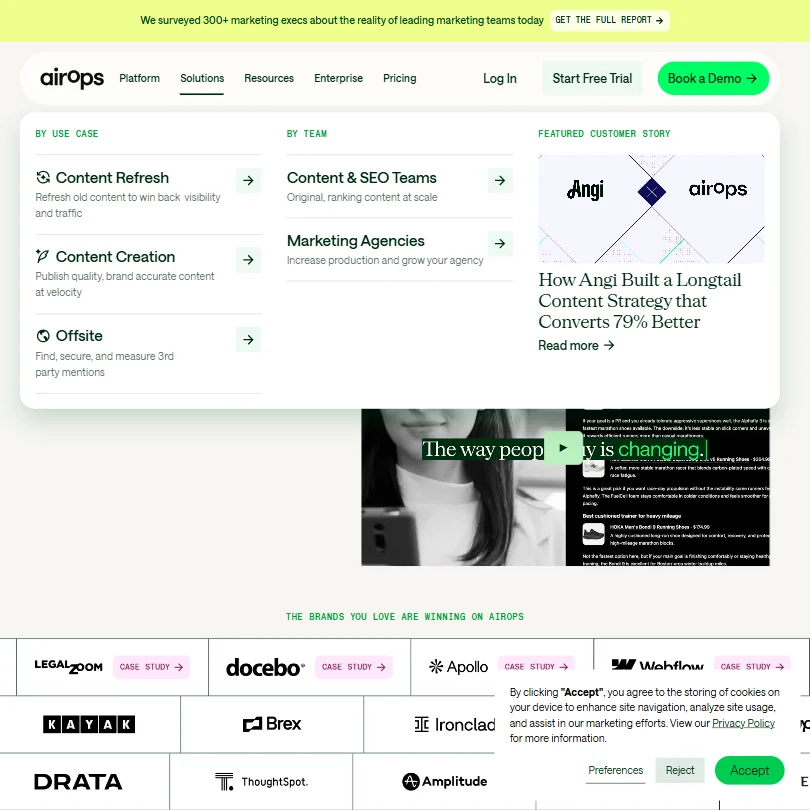
The feature set splits into two buckets. Visibility and execution.
On the visibility side, citation tracking runs across ChatGPT, Claude, Gemini, and Perplexity. Share of voice monitoring covers all of them, alongside competitor intelligence pulling from the same underlying data. That's the dashboard layer, the part that tells you where you stand before Quill does anything.
Execution is Quill's territory. Brief generation and long-form content creation are both supported. Human approval gates sit inside the Studio editor so nothing publishes without a human review step. We'd expect that at the enterprise end of any content platform. We've seen tools skip it entirely, so its presence here is noted, not celebrated.
The offsite monitoring feature is where things get genuinely unusual. AirOps claims that a significant share of AI visibility comes from content you don't own, so the platform tracks third-party sources that influence how AI engines perceive a category. Semrush and Ahrefs don't do that in any meaningful way right now. We're cautiously interested, not convinced. The specific figures they cite come from their own research, which should be read accordingly.
Content gap monitoring runs continuously. API access and CSV export exist, but only on Enterprise. Worth knowing before you build a workflow around data portability assumptions.
AirOps Keyword Research: How Deep Does It Go?
Pump the brakes here. AirOps isn't a traditional keyword research tool. Volume, CPC and difficulty data come through DataForSEO and Moz tools inside Playbooks, not a standalone explorer, and conflating the two will set expectations wrong fast.
The platform tracks and groups prompts across AI search platforms for opportunity identification. It surfaces content gaps. That's closer to prompt universe mapping than keyword research, and it requires a different mental model to evaluate. Coming from Semrush expecting a standalone keyword explorer and SERP feature tracking, you'll land somewhere unfamiliar.
Teams already thinking in AEO terms will find this clicks reasonably fast. Teams still measuring success in blue-link rankings will need to reframe before the product makes sense. Not a flaw. Just a real adjustment.
We cross-referenced the documentation with marketing community discussions, and the reframing curve shows up consistently. Not as a complaint exactly. More as a "wait, what am I looking at" reaction that takes a few weeks to work through.
AirOps Content Creation: AI Writing Quality Tested
What the documentation describes is Quill generating content from strategy inputs and brand context, with long-form writing and brief generation both in scope. The Studio editor has approval gates. Nothing ships without a human check. That's the model.
The real question is how Quill performs against the underlying models it integrates with, specifically ChatGPT and a few others, and whether it meaningfully improves on using those models directly for content production. Independent G2 commentary specifically about output quality is thin. The volume of reviews is there now. The specificity on this particular question isn't.
One claim appears prominently in their marketing: content less than three months old is significantly more likely to get cited in AI search. We can't verify that independently. Directionally useful framing, not a number to build a business case around.
Is AirOps Easy to Use?
Complicated question. Not because the interface is reportedly difficult, but because the product is genuinely more complex than most content tools.
The approval gate workflow inside Studio should be familiar to anyone who's managed an editorial review process. That part isn't hard. The strategy layer is where more investment is required. You're defining the inputs Quill executes against. Teams without a clear strategy going in won't extract much from the product regardless of how clean the UI is.
For onboarding, AirOps points to their Academy, Community, and Cohort Trainings, with 1:1 Expert Onboarding available at Enterprise. The Pro plan also includes Live Cohort Trainings as a listed feature. That support structure is more developed than we'd expect from a tool at this stage of market maturity. Live chat support exists on Solo and Pro. Better than most tools at this price point manage.
Ease of use is a function of organizational readiness more than UI design. Fair. Saying it plainly because most reviewers won't.
AirOps Pricing: Is It Worth It vs Free Alternatives?
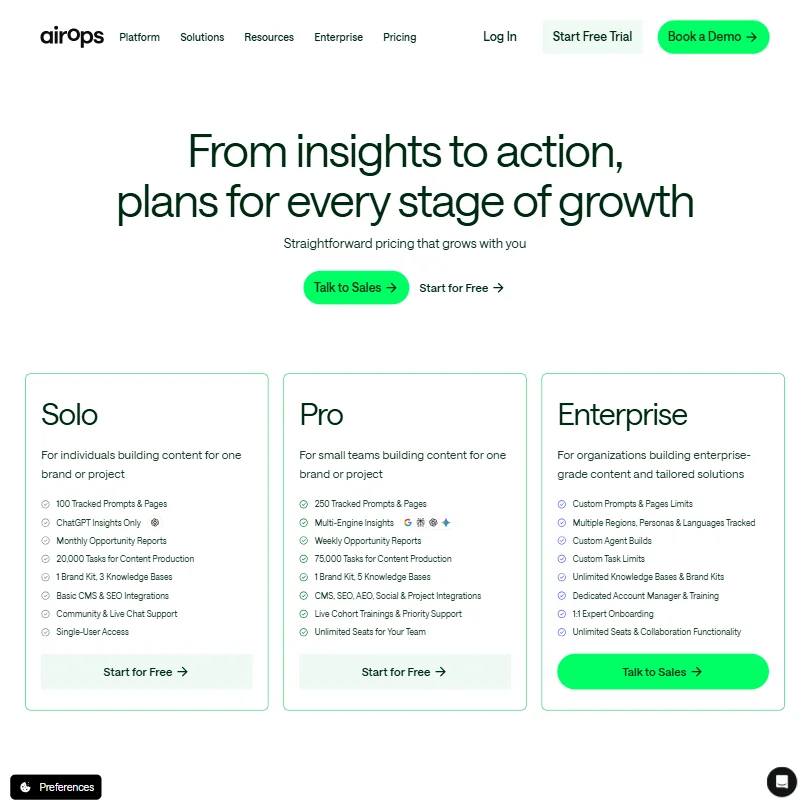
The Solo plan has no published price, and its 'Start for free' button leads to a 14-day free trial. It includes 100 tracked prompts and pages, 35,000 tasks for content production, and ChatGPT insights only. One brand kit and three knowledge bases are included. That's the floor. Enough to understand what the monitoring layer does, not enough to run a real content operation.
Pro carries the same 'Start for free' trial button, with no published price. It expands to 250 tracked prompts and pages, 75,000 tasks, multi-engine insights across Google, Bing, and a few others, and five knowledge bases. Unlimited team seats are included at Pro. That's a meaningful differentiator if you're managing a team and don't want per-seat pricing.
Enterprise is custom pricing, which is expected. Custom prompts and pages limits, unlimited knowledge bases and brand kits, and dedicated account management and training are all listed at that tier. API access and CSV export live here too.
The Pro-to-Enterprise jump is hard to assess without a sales call. That cliff is real and the pricing page doesn't resolve it. Some teams will find that annoying.
Against using Claude or ChatGPT directly for content creation, the value proposition is the tracking and monitoring layer, not the writing itself. The agent execution with approval gates and the offsite visibility data are what eventually justify the cost. Teams focused on on-page SEO optimization rather than AI citation tracking would likely land better with something like Clearscope, where the pricing model is legible from the start.
AirOps vs Semrush: Head-to-Head Comparison
Not the same product. Worth stating clearly before the comparison becomes misleading.
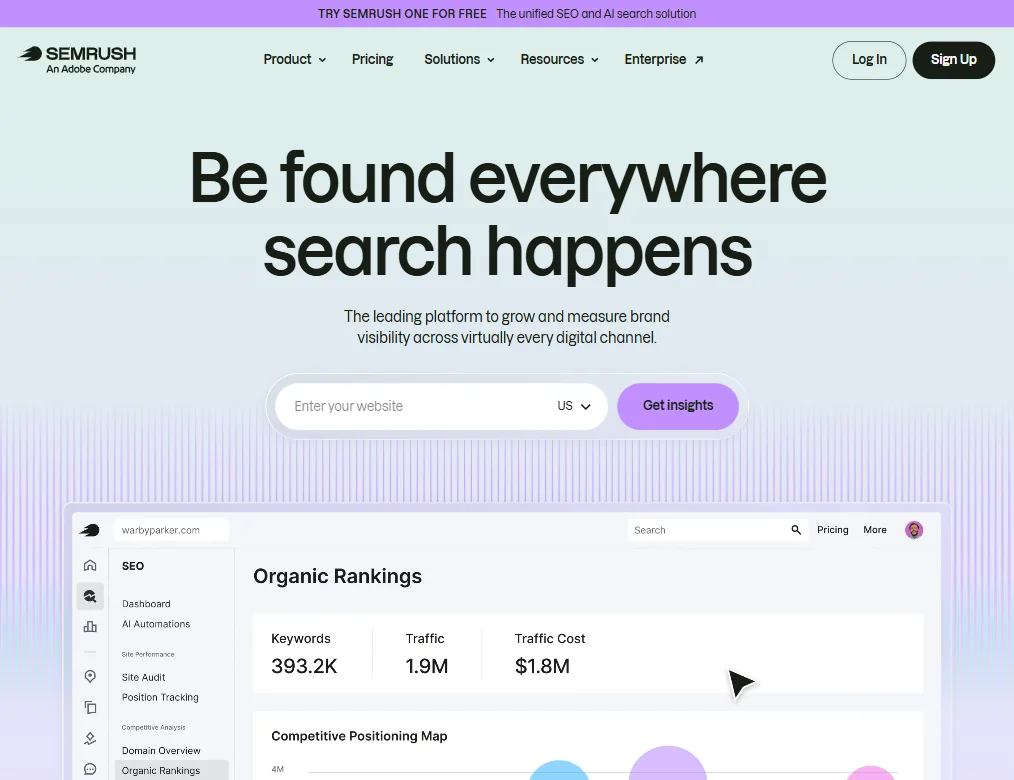
Semrush is a mature, broad-spectrum SEO platform. Backlink analysis, rank tracking, SERP analysis for traditional search, competitive research across a decade-plus of data. It's been doing this since before AI search was a category.
AirOps is narrower and more forward-looking. It doesn't prioritize traditional SERP rankings. It cares whether Perplexity cites you when someone asks a question in your category. That's the bet. Most teams running serious SEO programs today arguably need both lenses, not one or the other. AirOps watches AI-generated answers. Semrush watches Google.
Semrush's backlink and keyword depth is deeper, by a significant margin. AirOps' offsite monitoring is conceptually distinct. It's not tracking referring domains. It's tracking which publications and third-party sources influence how AI models respond to queries in a category. Different data entirely.
Teams choosing between them are usually making a bet on where search is heading. Teams not ready to make that bet will default to Semrush. That tracks.
Who Should Use AirOps? (And Who Shouldn't)
Content and SEO teams at growth-stage companies or agencies that have started thinking seriously about AI search. That's the fit. Teams that have watched branded queries surface differently in ChatGPT answers and want actual data on it.
Marketing agencies managing multiple clients across AI search platforms. The monitoring layer is genuinely useful at that scale. Enterprise marketing operations teams with enough content volume to justify Quill's execution capacity will get the most from Studio.
Freelancers and solo operators. Not the fit. The Solo plan exists, but the product architecture is built around team volume. A solo consultant managing two clients doesn't need an AI agent with approval gates and a continuous learning loop. They need a good brief template and a quiet afternoon.
Teams still measuring success entirely in Google rankings should look elsewhere. Not because AirOps is wrong, but because it answers a different question than the one they're currently asking.
AirOps Review Verdict
Genuinely specific. Largely unique in the category. The combination of AI citation tracking, offsite visibility monitoring, and agent-driven content execution with human approval gates isn't matched in this configuration by other tools in the category.
The 134 G2 reviews at 4.7 give a clearer picture than older assessments allowed. The sentiment is positive. Detail on output quality and long-term performance is still thin.
Pricing transparency could be better. The Pro-to-Enterprise jump requires a sales conversation before the budget math is knowable. And the product demands organizational readiness that not every team claiming to want it actually has. Not great, on both counts.
The offsite monitoring angle is the most provocative feature on the platform, and also the hardest to evaluate. If the underlying data holds up, it's a meaningful capability that traditional SEO platforms aren't close to replicating. If it doesn't, you're paying for a framing exercise.
Against a category median where most tools are retrofitting AI labels onto traditional SEO workflows, AirOps is building from a different starting assumption. That matters. The direction is right. The evidence base for full confidence isn't quite there yet.
Frequently Asked Questions
Does AirOps work for traditional Google SEO, or is it only for AI search?
Primarily built around AI search visibility. Citation tracking across ChatGPT, Perplexity, and Gemini, alongside Google AI-generated answers, is the core use case. Traditional keyword rank tracking in Google's standard results isn't the focus. Teams that need both will likely run a second tool alongside it.
Is the AirOps Solo plan actually useful, or is it just a demo?
The Solo plan includes 100 tracked prompts and pages, 35,000 tasks, and ChatGPT insights only. One brand kit and three knowledge bases round it out. That's enough to understand the monitoring layer and run a limited content workflow. It's not enough to run a real content operation at any meaningful scale. Extended trial is the accurate framing, not sustainable free tier.
How does AirOps compare to using Claude or ChatGPT directly for content?
The underlying models overlap, but the product does something the raw models don't. Quill wraps execution with brand context and approval gates, then ties output to actual AI search performance data. Using Claude alone means writing without visibility into how that content performs in AI-generated answers. AirOps closes that loop, at least in theory. Test whether the closed loop performs as described before committing.