Our research on POP started with a simple question: does a tool built around a proprietary algorithm actually deliver better on-page results than the broader content-optimization pack it competes with? We pulled vendor documentation, dug through Reddit threads, and cross-referenced what POP's homepage promises against what real users report. The short version is that POP is more focused than its competitors give it credit for, but that focus cuts both ways. This is our pageoptimizer pro review, and we'll get specific about what that means.

Founded in 2018, PageOptimizer Pro has spent approximately eight years doing one thing: on-page SEO. Headquartered in Hampton, Victoria, Australia. That's not a complaint. That's the pitch.
What is POP?
POP, short for Page Optimizer Pro, is an on-page SEO platform built around something called the Rank Engine™. The vendor claims this engine was trained on data from 400+ peer-reviewed SEO experiments. We can't independently verify that number, but the reviews we read suggest the recommendations feel grounded in something more disciplined than a generic competitor-content scrape.
The tool analyzes 300+ on-page factors for any given page, then produces specific instructions: word count targets, keyword placement guidance, NLP term suggestions, and schema recommendations. Not a general AI writing assistant. A very focused optimization machine.
That's either exactly what you need or completely beside the point, depending on what you're shopping for. Fair.
POP Features: SEO & Content Tools Breakdown
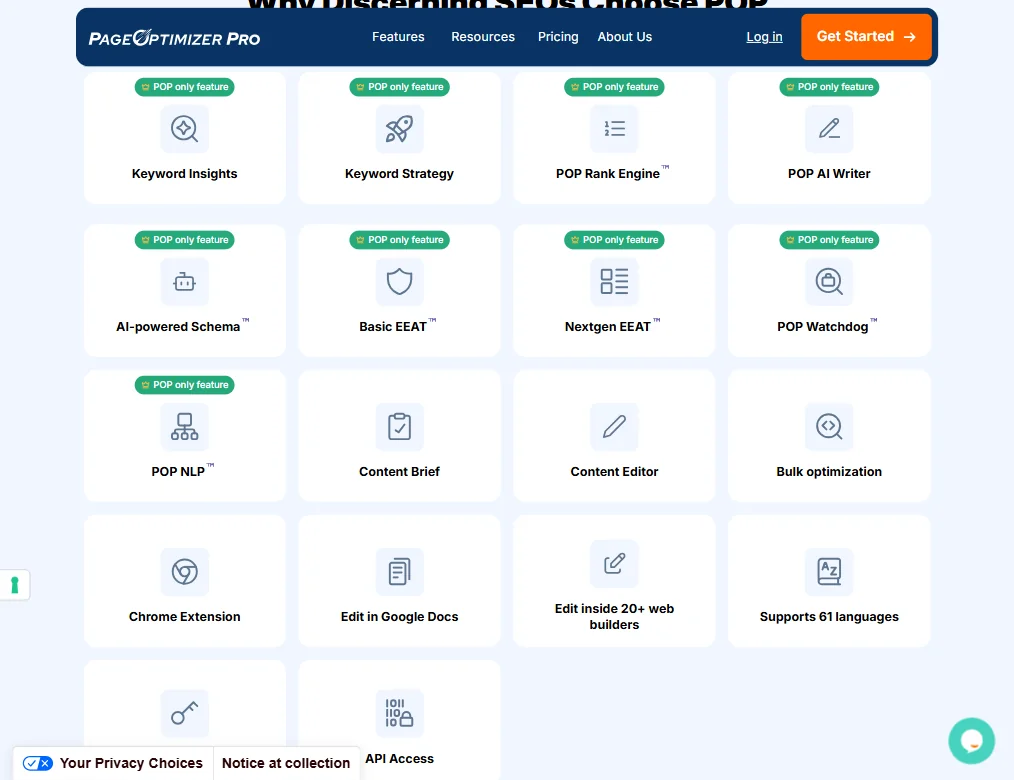
The core workflow is straightforward. You input a target keyword, POP pulls the top-ranking competitors from the SERP, and the Rank Engine™ generates a weighted brief. From there, you can write inside POP's editor or use the Chrome extension to work in Google Docs, WordPress, or one of the web builders they support.
The content editor is functional. Nothing flashy. You get an optimization score as you write, climbing as you incorporate POP's keyword and NLP suggestions. The AI Writer can generate a full long-form draft, and POP claims it targets a 99%+ optimization score by default. We're mildly skeptical of that framing, but users in forums generally confirm the AI output is well-structured for on-page purposes, even if it needs editing before it sounds like a human wrote it.
There's also a POP Watchdog monitoring feature, which flags when a previously optimized page starts drifting from its targets. Useful for agencies maintaining large content libraries. The E-E-A-T recommendation layer is newer and less developed, but it shows up across all three self-service plans.
Schema is a stronger-than-expected feature. POP supports 70+ schema types and generates markup based on SERP analysis. That's genuinely competitive with tools that charge more. Honestly, the feature density here sits well above what the price point suggests it should.
POP Keyword Research: How Deep Does It Go?
POP isn't Ahrefs. Get that expectation out of the way first.
The Keyword Insights Tool and Keyword Strategy feature offer clustering and difficulty scores. The clustering logic uses AI to group terms into topical silos. Serviceable. For users living inside on-page work who don't want to bounce between five tools, having basic keyword research built in is genuinely useful. But the data depth isn't there for serious keyword discovery at scale.
Users on Reddit doing competitive keyword research consistently pointed back to dedicated tools for that layer. POP's keyword features feel like a companion, not a replacement.
The topical cluster builder is the most useful piece here, helping structure content plans around a pillar page in a way that connects directly to how POP's briefs work downstream. That integration is tighter than what you get from tools that bolt these features together loosely. That tracks with how POP has been built overall: depth over breadth, in a narrow lane.
POP Content Creation: AI Writing Quality Tested
We haven't run POP's AI Writer ourselves. What we did do is read through a significant number of user reports across forums and review threads.
The pattern is consistent. POP's AI output is optimized. That's the point. It hits keyword targets, incorporates NLP terms, and stays within the structural parameters the brief sets. What it doesn't always do is sound natural.
Several users flagged that the AI drafts work best as scaffolding. You take the structure, hit the optimization targets, then edit for voice. Users running content agencies find this workflow efficient. Solo writers with a strong editorial voice find it more friction than help.
The BYO API key option for OpenAI is a practical decision that shows up positively in user feedback more often than you'd expect. You pay OpenAI directly and control the spend, rather than burning through plan credits. The 10+ custom prompt options in the AI Writer add flexibility, but they're not going to replace a skilled writer. They'll replace a mediocre brief-follower. That's still valuable.
Is POP Easy to Use?
Not immediately. That's the consistent finding across reviews we cross-referenced.
New users report a learning curve on the first few briefs. The interface is dense. The Rank Engine output gives you a lot of numbers, and understanding how to prioritize them takes time. POP does offer a demo without requiring sign-up, which is a reasonable way to stress-test the interface before committing.
The Chrome extension helps. Running POP's analysis directly in your browser while working in a CMS is smoother than copying content back and forth. Working in Google Docs through the extension gets mentioned positively by freelancers and agency writers.
Support is 19 hours a day via live chat, human chat rather than a bot. We don't have independent confirmation on response quality, but the availability window is better than what a lot of similarly priced tools offer.
POP Pricing: Is It Worth It vs Free Alternatives?

Four plans, three of them self-service. Basic at $40/month includes 20 EEAT, NLP, Watchdog, and AI credits. Unlimited at $72/month bumps that to 50 credits, adds unlimited POP reports and Watchdog reports per month, and includes keyword tools. Teams at $143/month brings the credit count to 120, supports up to 100 sub-accounts starting at five, and adds seats for $12/month or $120/year. White Glove starts from $555 a month and is a done-for-you on-page SEO service with a dedicated account manager, custom content audit, and SEO content planning. Book a meeting territory.
All three self-service plans carry a 7-day refund guarantee. No free plan exists.
$40/month for a tool built around 300+ on-page factors and 70+ schema types is not expensive. That's the honest read. Surfer SEO's comparable entry plan runs higher. NEURONwriter covers some of the same on-page ground at lower price points, but the Rank Engine's experiment-backed methodology is a real differentiator if that matters to you.
Where pricing gets murkier is AI usage. POP publishes plan allocations and most action costs, although its pages currently conflict over whether 1,000 AI-written words cost three or four credits. That inconsistency in the documentation is worth clarifying directly with support before you commit to a plan, especially if AI drafting is central to your workflow. Not great.
POP vs Surfer SEO: Head-to-Head Comparison
Surfer SEO is the obvious comparison. Both tools generate on-page briefs from SERP data. Both have content editors and track an optimization score.
The differences matter. Surfer leans into content production at scale, built for teams writing a lot and wanting a fast brief-to-publish flow. POP leans into optimization depth. The Rank Engine's 300+ parameter analysis is more granular than what Surfer surfaces by default, and POP's pricing at comparable tiers is lower.
Surfer has broader third-party integrations and a larger public review presence. What we kept seeing in threads where users had tried both: Surfer won on workflow, POP won on precision. Writers preferred Surfer. Technical SEOs preferred POP. That's a reasonable split and it's held consistently across the threads we reviewed.
Neither tool handles backlink analysis. For that layer, you're going elsewhere regardless.
Who Should Use POP? (And Who Shouldn't)
Technical SEOs and on-page specialists. That's the primary fit. POP was built for people who care about entity optimization, NLP term coverage, and schema more than they care about AI-generated content volume.
Content agencies running optimization audits on existing pages will find the POP Watchdog monitoring and brief generation genuinely useful. Freelancers doing on-page SEO work for clients can cover a lot of ground at $40 or $72 a month.
Content teams whose primary need is fast AI drafting at volume should look elsewhere. POP's AI Writer is an optimization tool wearing writing clothes. Not built for speed publishing.
Solo bloggers who want a simpler interface and don't want to sit through a learning curve should consider whether Clearscope fits better. It's more approachable, though it trades some of POP's on-page depth for usability.
POP Review Verdict
POP earns its reputation in a specific lane. On-page SEO optimization, done with more rigor than most tools bother with.
The weaknesses are real. The learning curve is steeper than competitors at this price. The keyword research features are supplementary, not serious. AI content output needs editing. And the credit documentation inconsistency is a small but irritating sign that some housekeeping has been skipped. Public reviews are thinner than we'd like, which makes independent validation harder.
But the pricing is honest. The schema coverage is genuinely good. The BYO API key option shows practical thinking. And for technical SEOs who want a tool that treats on-page optimization as a discipline rather than a content checklist, POP is worth the time to learn. We'd want cleaner documentation on credit costs before recommending it without caveats. Not a dealbreaker. Just friction.
How POP compares
POP scores 6.1 out of 10 among the content optimisers we rate. These three do the same job and are the closest to it, compared on what each vendor publishes.
Surfer
POP's Basic plan costs $40 a month against Surfer's $59 for Discovery, but keyword research and clustering only unlock on POP's Unlimited plan; Surfer includes both from Discovery. Surfer also publishes directly to WordPress, where POP works only through its Chrome extension overlay, copying text into the editor by hand. Both write full articles on every plan and offer live chat support, POP for 19 hours a day and Surfer 24 hours on weekdays.
Pick Surfer if you need WordPress publishing and keyword research.
Pick POP if you want full articles at the lowest price.
Clearscope
POP's Basic plan costs $40 a month, well under Clearscope's $129 for Essentials. POP ships a Chrome extension on every plan; Clearscope has none, working instead through a Google Docs add-on that POP does not offer. POP also reaches white-label reporting on its $143 a month Teams plan, something Clearscope does not provide at any price. Both write full articles and score drafts against top-ranking pages.
Pick Clearscope if you want unlimited seats and a Google Docs add-on.
Pick POP if you want a Chrome extension and white-label reports.
MarketMuse
MarketMuse has a free plan with keyword research and clustering included; POP has no free tier, starting at $40 a month on Basic, where keyword research and clustering are not even included until the Unlimited plan. POP does write full articles from Basic, a feature MarketMuse retired. POP also ships a Chrome extension on every plan, something MarketMuse does not offer.
Pick MarketMuse if you want keyword research and clustering for free.
Pick POP if you want full AI drafts and a Chrome extension.
Frequently Asked Questions
Does POP offer a free plan?
No free plan exists. POP offers a no-sign-up demo so you can test the interface before committing, and the paid plans come with a 7-day refund guarantee. That's a fair substitute, but if you need an ongoing free tier, POP doesn't have one.
How is POP different from Surfer SEO?
POP is built around the Rank Engine™, which prioritizes optimization precision. Surfer SEO has a smoother workflow for teams producing content at volume, with broader integrations and a larger public review footprint. POP tends to win with technical SEOs who want more granular on-page data. Surfer tends to win with content teams who want faster brief-to-draft pipelines.
Is the AI writing in POP any good?
Depends on what you're using it for. POP's AI Writer is designed to hit optimization targets, and it does that well. The output is structured and keyword-aware. What it isn't is naturally written prose. Most users treat it as a starting draft that needs editorial work before publishing. The BYO OpenAI API key option helps keep costs predictable if you're running a lot of AI-generated content through the tool, and it's one of the more practical design choices POP has made.