Our research into MarketMuse started, as it usually does, with the pricing page. That experience set the tone for everything that followed. This marketmuse review pulls from G2, Capterra, Reddit threads, vendor documentation, and third-party coverage to give you a cleaner picture than the homepage provides. MarketMuse has been around since 2013, longer than most of its competitors. That history shows in the product. It also shows in some of the friction.

What is MarketMuse?
Founded in Boston and acquired by Siteimprove in late 2024, MarketMuse is an AI-powered content planning and optimization platform. The core idea is topical authority. Instead of giving you generic keyword difficulty scores based on broad industry data, their patented AI looks at your specific site's existing content inventory and tells you where you're strong, where you're weak, and what to write next.
That's genuinely different from what Surfer SEO or Clearscope do. Those tools optimize the piece you're already writing. MarketMuse is trying to tell you which pieces to write in the first place. Different job. Different value proposition.
It's built for content strategists and SEO teams who are thinking at scale. Not someone writing one blog post a week.
MarketMuse Features: SEO & Content Tools Breakdown
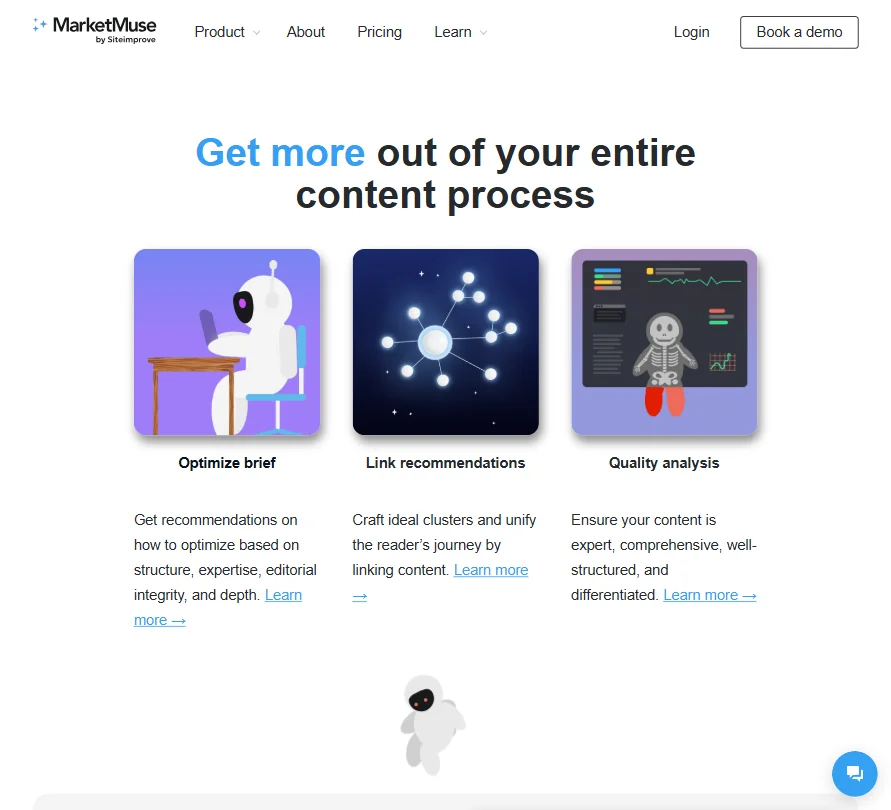
The feature set here is wide. Keyword research, topic cluster identification, SERP analysis, content briefs, on-page optimization, rank tracking. Most of the table stakes are covered.
The SERP X-ray and SERP Heatmap are the more interesting tools. They let you see how competing pages are structured and where topical gaps exist. G2 reviewers in content strategy roles flag these as legitimately useful, not just pretty visuals.
The Content Brief Generator supports up to nine brief types, including standard Article Briefs. That range is more than most competitors offer. The Optimize feature goes beyond keyword stuffing reminders. It gives structural guidance, flags depth issues, and pushes for editorial integrity in a way that feels more considered than a basic content score.
Tracked Topics runs from 100 topics on the lower plan up to 10,000 on Strategy. That spread tells you something about who this product is really designed for. Honestly, the sheer volume of features can feel like a lot to navigate before you've oriented yourself in the platform.
MarketMuse Keyword Research: How Deep Does It Go?
The Keywords feature does more than surface-level volume data. It generates associated keywords and pulls question variations, which is useful for building out a content plan around a topic rather than just a single target phrase.
The real differentiator in the keyword workflow isn't the keyword data itself. It's the personalized difficulty scores. A generic difficulty score tells you how hard it is for any site to rank. MarketMuse adjusts that based on your site's existing topical coverage. Two sites targeting the same keyword get different difficulty assessments. That's the claim, and based on what we saw in user reviews, it generally holds up.
G2 reviewers in SEO roles call this out as the reason they chose MarketMuse over Frase or Clearscope. A few noted it changed how they prioritized content calendars. We're not going to oversell it, but that's a meaningful data point.
One thing we didn't find clear documentation on: the depth of the underlying keyword index compared to dedicated tools like Ahrefs. MarketMuse is not a keyword research replacement for a full SEO platform. It's better understood as a content strategy layer on top of one.
MarketMuse Content Creation: AI Writing Quality Tested
The content editor includes quality analysis, optimization recommendations, and link suggestions. The AI writing assistance sits inside this editor and is positioned as a support tool, not a ghostwriter.
We cross-referenced vendor documentation with user reports and found a consistent pattern. Reviewers don't love the AI writing output as a standalone product. What they value is the context the platform provides around it: the topic model, the competitive gaps, the brief structure. The writing assistance is more useful as a scaffold than as a finished product.
That's not a knock. It's just honest about what the tool is. The content briefs are where MarketMuse earns its reputation, not the raw AI copy.
Reddit threads from 2024 surfaced a few users who felt the AI-generated content suggestions were generic when pulled out of context. That tracks with what we'd expect from a tool that's primarily a strategy and research platform, not a content generator.
Is MarketMuse Easy to Use?
This is where reviews get complicated.
Newer users on G2 consistently flag a steep learning curve. The platform packs in a lot. Topic modeling, inventory management, content scoring, SERP analysis. Each of these has its own logic, and understanding how they connect takes time.
The help center is comprehensive. Email support is available. What's absent, based on our research, is a real community layer. No forum, no user group. When you're stuck at 9pm trying to figure out why your topic cluster looks wrong, that gap matters.
Experienced SEOs and content strategists who reviewed the tool tend to rate usability better. They already speak the language. For someone newer to topical authority concepts, the onboarding gap is a real friction point. Not insurmountable. Just real.
We've seen worse onboarding situations. But for the price point, you'd expect more hand-holding.
MarketMuse Pricing: Is It Worth It vs Free Alternatives?
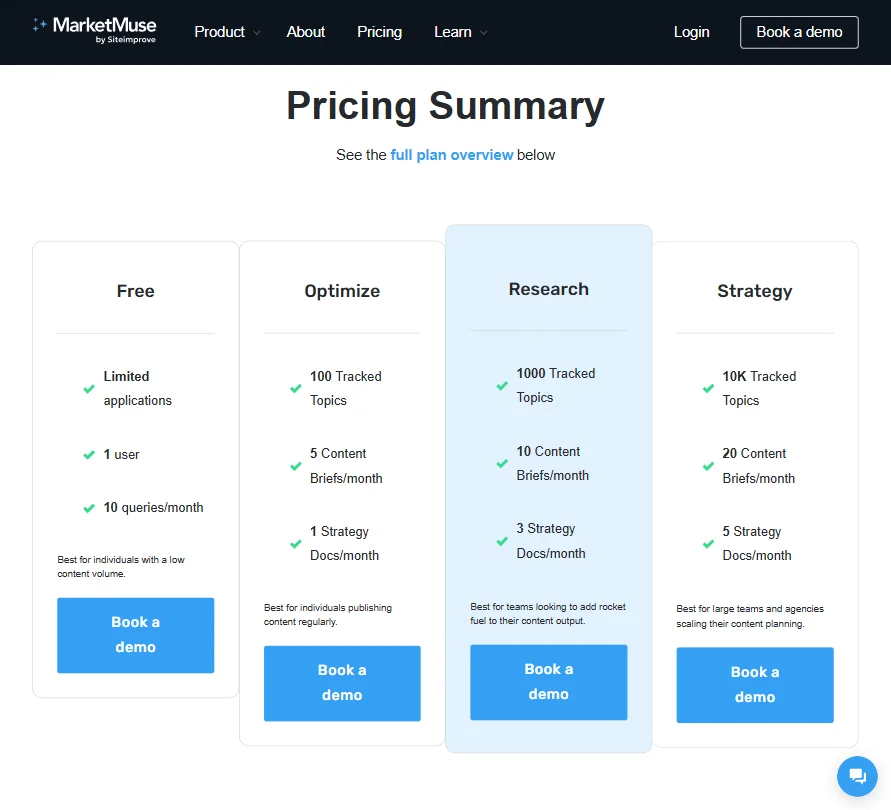
Bluntly: the pricing page doesn't tell you what MarketMuse costs.
Plan names are listed. Optimize, Research, Strategy. Features are listed per plan. Actual prices are not listed. You have to contact them or start a trial to find out what you'll pay. For a tool competing against Surfer SEO (which publishes prices clearly) and Frase (same), this is a notable choice.
There is a free plan. There is a free trial. What the paid plans cost is apparently a conversation you need to have with their sales team.
This is a common complaint in the G2 reviews we read. Multiple reviewers mentioned it directly. One noted it made budgeting difficult when trying to justify the tool internally. That's a real operational problem for anyone who needs to get sign-off from a manager or finance team.
We dug through the pricing page twice. Nothing. We're skeptical this helps them convert the buyers who are most price-sensitive, which tends to be the mid-market teams this tool is well-suited for.
MarketMuse vs Clearscope: Head-to-Head Comparison
These two get compared constantly. They're not the same product.
Clearscope is focused on the optimization side. You give it a keyword, it analyzes the top-ranking content, and it tells you what terms to include in your piece. The workflow is tight and the output is clean. Reviewers who prefer it tend to value simplicity.
MarketMuse works upstream from that. It's asking what topics you should build authority in based on what your site already covers. The topic cluster identification and personalized difficulty scoring are built for a different decision: not "how do I optimize this post" but "what should I be writing about over the next six months."
For a team managing a large content inventory across dozens of topic areas, MarketMuse has more strategic depth. For a team that knows what it's writing and just wants to optimize each piece, Clearscope is cleaner and probably cheaper once you factor in MarketMuse's hidden pricing.
The acquisition by Siteimprove in late 2024 is worth watching. Platform integrations and roadmap direction could shift. We don't know enough yet to call it good or bad. Worth keeping an eye on.
Who Should Use MarketMuse? (And Who Shouldn't)
Content strategists managing large sites. That's the core fit. The topic modeling and inventory analysis pay off most when there's real complexity to manage.
SEO agencies running content programs for multiple clients could get value, especially from the Strategy-tier tracked topics volume. The brief generation alone saves real time at scale.
Smaller teams or solo writers building early-stage sites. The fit is weaker. The personalized difficulty scoring needs an existing content base to be meaningful. A brand-new site doesn't have topical authority to analyze yet. You'd be paying for a strength the tool can't yet deploy for you.
Budget-conscious teams who need pricing transparency before committing. Not the right process here.
MarketMuse Review Verdict
MarketMuse built something genuinely differentiated. The site-specific topical authority modeling is not something most competitors do, and the reviews back up that it works as described. The SERP analysis tools are solid. The content brief quality is consistently praised across G2 and Capterra.
The frustrations are real too. Pricing opacity is the biggest one. A tool at this level of sophistication, aimed at teams that need to justify spend internally, shouldn't require a sales call to get a number. The learning curve is real and the community support gap doesn't help.
The Siteimprove acquisition introduces uncertainty. Whether that leads to better integrations or slower product development, we don't know. Check back in 12 months.
For the right team at the right scale, MarketMuse is worth a serious look. For everyone else, the math doesn't quite close.
How MarketMuse compares
MarketMuse scores 5.0 out of 10 among the content optimisers we rate. These three do the same job and are the closest to it, compared on what each vendor publishes.
Clearscope
MarketMuse's paid tiers have no published price, but its free plan gives 10 queries a month with keyword and SERP tools included; Clearscope has no free plan at all, only a 14 day trial before $129 a month begins. MarketMuse clusters keywords into topics on every tier; Clearscope's Topic Explorations do the same, so both compete evenly there. Clearscope writes full articles and gives unlimited seats on every plan; MarketMuse retired full-draft writing and caps its cheapest paid plan at one seat.
Pick Clearscope if unlimited seats and full AI drafts matter.
Pick MarketMuse if you want to start free before committing.
Frase
MarketMuse's free plan gives keyword research and SERP tools at no cost; Frase has no free tier, starting at $49 a month on Starter. Frase writes full articles and runs a technical site audit and backlink analysis, all missing from MarketMuse since it retired full-draft writing. MarketMuse answers with topic clustering built into every tier, including free, and a competitor content gap view. Both give one seat on their cheapest paid plan.
Pick Frase if you want full AI drafts and a technical audit.
Pick MarketMuse if you want to try keyword tools for free.
Surfer
MarketMuse has a free plan with keyword and SERP tools included; Surfer has none, starting at $59 a month on Discovery after a 7 day trial. Surfer writes full articles and publishes to WordPress, neither of which MarketMuse offers since it retired full-draft writing and never built a WordPress plugin. Surfer also connects to Google Search Console; MarketMuse does not. MarketMuse counters with content briefs and topic clustering on every tier, including free.
Pick Surfer if you want full AI drafts and WordPress publishing.
Pick MarketMuse if you want to try keyword research before paying.