What is SearchAtlas?
Four plans, one login, and an AI that's supposed to do the actual work. That's the pitch SearchAtlas leads with, and it's direct enough that we wanted to understand where it holds and where it doesn't. This review pulls from G2, Capterra, Trustpilot, Reddit threads, and the vendor's own documentation. We haven't run OTTO SEO on a live client site.

Founded in 2020 and based in New York, SearchAtlas moved from a keyword research tool into something that now touches technical SEO, content creation, local SEO, backlink analysis, and paid ads. All of it under one subscription. That's either a consolidation win or a warning sign, depending on how much you trust platforms that try to cover everything at once.
The core engine is called OTTO SEO. The positioning is that OTTO monitors your site continuously, identifies issues, and applies fixes autonomously without a human approving each one. Connected to Google Search Console, running in the background, not waiting for you to schedule an audit. That's the claim. Whether it delivers consistently is what the reviews actually debate.
The platform also includes Content Genius, a keyword research suite, backlink analysis, rank tracking, Google Business Profile management, and white-label reporting. A December 2025 upgrade to Content Genius added agentic AI features. SearchAtlas now frames OTTO as an agent, not a script running rules, which is a meaningful distinction if you're deciding whether to trust it on client sites.
SearchAtlas Features: SEO & Content Tools Breakdown

Start with OTTO SEO, because that's the real separation from Ahrefs or Moz. Most SEO tools surface a problem and stop. OTTO is supposed to close the loop by applying on-page fixes directly, reading live search data, identifying gaps, and patching them without someone clicking approve on each task. Technical issues, on-page optimization, content updates. Continuously, not on a user-defined schedule.
Honestly, that surprised us when we first read it. The category has trained everyone to expect a list of recommendations and a blank stare.
Content Genius handles briefs, full article drafts, NLP content scoring, and a content planning calendar. The Topical Maps feature generates topic cluster strategies, which maps onto how Google currently evaluates site authority. Daily rank tracking ties into GSC. The backlink tools include a dedicated analyzer, a link building module, and press release distribution.
The platform also covers Local SEO through Google Business Profile management and connects to Google Ads and Meta Ads. That last part is genuinely unusual for an SEO tool. We cross-referenced the documentation and it appears to be a real integration, not just a spend dashboard. Whether it's operationally useful or just surface-level is something we'd want to test hands-on before saying more.
Looking at the plan structure in the pricing data, the Starter tier at $99/mo includes Atlas Agent, Website Studio, one AI SEO project via OTTO, Smart Ads, Universal CMS Publishing, Automatic CMS Publishing, GBP Audit, and one user seat. Growth at $199/mo bumps that to two OTTO projects and three user seats. Pro at $399/mo gets four OTTO projects and five seats. Agency at $999/mo includes ten OTTO projects, ten user seats, and white-label capabilities. Each tier unlocks more, but the architecture is the same across all four.
SearchAtlas Keyword Research: How Deep Does It Go?
The keyword research suite includes a Site Explorer, daily rank tracking tied to GSC, and SERP analysis with competitive intelligence. The Topical Maps tool generates clusters rather than individual keyword lists. That distinction matters if you're building a content strategy from scratch rather than chasing single terms.
What we kept seeing in G2 reviews from marketing agency users is that the keyword data volume is solid, though a handful of reviewers noted the database feels smaller than Ahrefs or SEMrush at the extremes. Nobody called it inaccurate. The concern was about depth at scale.
SearchAtlas uses "live" and "real-time" language across its marketing pages when describing GSC-connected data. Worth being precise here. The reporting documentation describes daily refreshes, not instant updates. More to the point, Google itself states that Search Console performance data is typically available only after two to three days, which means no third-party tool can serve genuinely real-time GSC performance data that Google hasn't released yet. SEMrush also integrates with GSC and describes that connected data in similar terms. The distinction between daily-refresh data and truly live data matters if you're evaluating this against a vendor's own positioning.
We're not ready to call it an Ahrefs replacement at the keyword research level. But it's clearly not a lightweight tool dressed up with automation either.
SearchAtlas Content Creation: AI Writing Quality Tested
Content Genius V3 is the writing engine. It generates content briefs and full long-form articles. The Agency plan at $999/mo lists the highest capacity for AI content output. Lower tiers get fewer credits and fewer projects.
Across G2 and Capterra, we kept seeing a consistent split. Users praised the brief quality and the NLP optimization guidance. The AI writing itself got more mixed responses. Some found it publication-ready with light editing. Others described it as solid structure with flat prose that needed a real writer to finish.
That tracks. Most AI article generators are in that same position right now.
The Atlas Agent, available across all four plans according to the pricing data, is supposed to handle multi-step content tasks without a user prompting each step. We'd treat that as early-stage. The positioning is ahead of what reviewers have had time to stress-test in production environments.
Pure content optimization without the full SEO platform around it is a different use case entirely. Clearscope is the narrower, more focused comparison worth reading before you decide which direction fits your workflow.
Is SearchAtlas Easy to Use?
This is where the reviews get honest fast. The platform has a lot of surface area. OTTO SEO alone touches multiple systems. Add keyword research, content planning, backlinks, local SEO, and paid ads, and you've got a dashboard with real density.
G2 reviewers in agency roles generally said onboarding took time. Not weeks, but more than a day. The support team gets consistently positive mentions. Live chat is available.
The learning curve is the most common complaint across all review platforms. Not bugs. Not broken features. Just the sheer number of things to configure before the automation is actually working.
Trustpilot is the outlier. Their aggregate sits noticeably below the scores on G2 and Capterra. Trustpilot skews toward customers who show up angry, and that's a real selection bias worth accounting for. Even with that caveat, the gap is worth knowing about. Billing and cancellation questions surface in the lower reviews. SearchAtlas's refund policy allows a refund request through live chat within 48 hours of billing, a tight window regardless of how good the product is.
Not great. That's a fixable issue and they haven't fixed it yet.
SearchAtlas Pricing: Is It Worth It vs Free Alternatives?

Starter at $99/mo, Growth at $199/mo, Pro at $399/mo, Agency at $999/mo. A free trial runs seven days. No free tier.
The $99 entry point is aggressive for what's included. Even at Starter, you get OTTO SEO automation, rank tracking, content tools, and site auditing. Stitching together Ahrefs for backlinks, Surfer for content, and a separate rank tracker would cost considerably more.
The $999 Agency plan is where the consolidation math gets genuinely interesting for firms managing 10 or more client sites. White-label reporting, ten OTTO projects, ten user seats, and the highest content output capacity start to look like a platform play rather than just a tier upgrade.
The refund window is 48 hours from billing, requested through live chat. Seven days is a short trial for a platform this complex. If you're evaluating at $199/mo and need more time, that's a real constraint to plan around.
Free alternatives don't exist at this feature level. Google Search Console is free and integrated here. Nothing free does what OTTO claims to do.
SearchAtlas vs Ahrefs: Head-to-Head Comparison
Ahrefs is the obvious benchmark. It has a bigger backlink index, a larger keyword database, and a decade-plus head start on trust. Agencies that have built workflows around Ahrefs aren't switching because SearchAtlas has an AI layer.
But Ahrefs doesn't automate anything. It finds the problem and stops. SearchAtlas, through OTTO, is supposed to close the loop. That's a real operational difference.
On content, Ahrefs has no native AI writing. SearchAtlas has Content Genius. Ahrefs has a GBP Monitor for Google Business Profiles, still in beta. SearchAtlas has GBP automation. Ahrefs doesn't connect to Google Ads or Meta Ads. SearchAtlas at least reaches there.
Ahrefs wins on raw data depth, SearchAtlas wins on automation and scope. A team that needs a research tool should be looking at Ahrefs. A team that needs a system that acts on the research has a real reason to look here.
SEMrush sits somewhere in the middle. It's attempted automation but remains largely manual in practice. At the $99 to $199 range, SearchAtlas is a more compelling package than SEMrush Guru for teams that actually want the AI doing execution work, not just surfacing it.
Who Should Use SearchAtlas? (And Who Shouldn't)
SEO agencies managing multiple client sites. That's the primary fit. The white-label reporting, multi-site OTTO deployment, and the Agency tier's ten-project capacity are built for exactly that workflow.
Freelance SEOs who want to stop paying for five separate subscriptions are a real secondary market. $99/mo consolidating rank tracking, site auditing, keyword research, and AI content is a reasonable trade for that profile.
In-house teams at mid-size businesses needing ongoing technical SEO without a dedicated developer are the third group. OTTO deploying fixes autonomously is directly useful there.
Solo bloggers who just need keyword research. Overkill. The learning curve isn't worth it for that use case, and there are cheaper, simpler tools for the job. Pure content teams focused on writing quality without SEO infrastructure are also better served elsewhere.
SearchAtlas Review Verdict
Most SEO tools are still research dashboards that hand you a list and walk away. OTTO is positioned as the execution layer, not just the diagnosis, and that's a meaningful structural difference from how the category has worked for the past decade.
The early reviews support the claim more than we expected going in. Fair. That's a reasonable outcome for a four-year-old platform with this much surface area.
The weak spots are real. The Trustpilot gap, the 48-hour refund window, and the learning curve are all documented problems that haven't been resolved. The AI writing quality, while solid for structure and optimization, isn't replacing a skilled writer. The agentic features are new enough that we'd want more review volume before recommending them for high-stakes client work.
But for what it costs at Starter or Growth, the consolidation value is hard to argue with. One login replacing five subscriptions, with an AI that actually applies the fixes rather than just listing them. For agencies and established SEO practitioners, that's a real pitch. Everyone else should use the trial carefully and know exactly what they're buying before month two arrives.
How SearchAtlas compares
SearchAtlas scores 8.0 out of 10 among the SEO platforms we rate. These two do the same job and are the closest to it, compared on what each vendor publishes.
Ahrefs
SearchAtlas has no free plan and starts at $99 a month; Ahrefs starts lower, at $29 a month, and offers a free tier besides. SearchAtlas's Starter plan writes 30 AI articles a month and builds content briefs; Ahrefs has no brief generator, and its AI Content Helper does not write full drafts either. Ahrefs includes API access on every paid plan; SearchAtlas reserves its API for the Enterprise quote tier only.
Pick Ahrefs if budget matters or you want a free plan to start.
Pick SearchAtlas if you want full articles and content briefs from the Starter plan.
Semrush
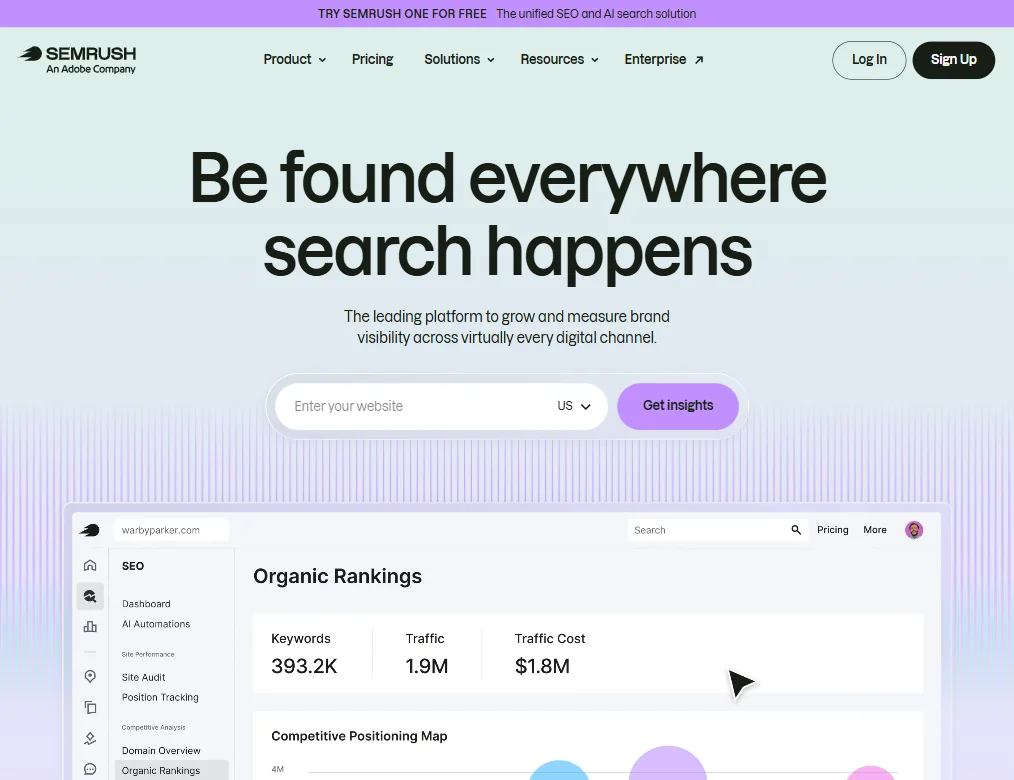
SearchAtlas costs $99 a month at Starter, cheaper than Semrush's $139.95 SEO plan, though Semrush also has a free account with 10 report requests a day that SearchAtlas does not offer. SearchAtlas includes local SEO and 30 AI article credits in its Starter plan; Semrush sells local SEO as a separate toolkit at $30 a month per location and its AI Article Generator lives in a separate $60 a month Content Toolkit. SearchAtlas offers live chat support, while Semrush's support is a contact form only.
Pick Semrush if you want a free account and don't mind separate toolkits.
Pick SearchAtlas if you want local SEO, articles and live chat in one plan.
Frequently Asked Questions
Is SearchAtlas good for beginners?
Depends how you define beginner. The tools themselves aren't impenetrable, but the platform has a lot of moving parts. G2 reviewers consistently flag that onboarding takes time, even for people with real SEO experience. Completely new to SEO and just want to publish content? Start somewhere simpler. Understand SEO basics and want automation handling the execution? The learning curve is manageable, but expect to spend time in the Knowledge Base before things click.
How does OTTO SEO actually work?
OTTO connects to your Google Search Console data and monitors your site continuously. When it identifies technical or on-page issues, it applies fixes directly rather than queuing them for a human to act on. The vendor documentation describes it as an autonomous AI engine rather than a rules-based script, though that distinction is one we'd want to verify through extended hands-on use. Users in G2 reviews describe meaningful time savings on repetitive technical tasks. We'd call that encouraging and leave it there for now.
Does SearchAtlas replace Ahrefs or SEMrush?
Not fully. Ahrefs has a deeper backlink index and a larger keyword database that SearchAtlas hasn't matched yet. What SearchAtlas adds is the automation layer, the AI writing tools, and the reach into local SEO and paid ads. For teams using Ahrefs purely as a research tool and doing all execution manually, SearchAtlas is a legitimate alternative worth testing. For teams whose workflows depend on Ahrefs' specific data depth, switching involves real trade-offs that deserve honest evaluation before anyone cancels anything.