Our research on Forethought started with the homepage and moved fast to the places vendors don't control. G2 threads, Reddit complaints, Capterra write-ups from support operations managers. What we kept seeing was a product with genuine depth and a buying experience that makes you work harder than it should to get basic information. This forethought review pulls that together as clearly as we can.
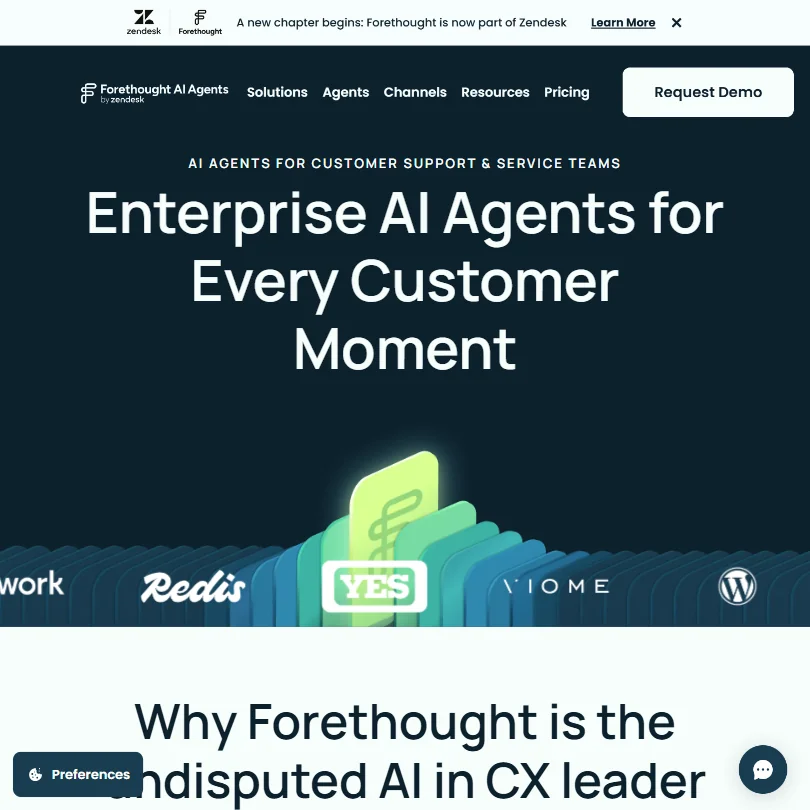
The big news first. Zendesk announced its acquisition of Forethought in March 2026 and completed the deal later that month. The homepage doesn't hide it. Whether that's reassuring or concerning depends entirely on your existing stack.
What is Forethought?
Founded in 2017, San Francisco. The core bet was simple: AI for customer support should close tickets, not just suggest replies. Forethought organizes around five agents. Solve handles omnichannel resolution across chat, email, and voice. Triage classifies and routes. Discover surfaces knowledge gaps and generates draft help articles. QA scores human agent conversations automatically. Copilot works alongside live agents in real time.
Most competitors pick one or two of those layers. Forethought is betting the full stack is the point.
Honestly, that's a coherent argument. Whether the execution holds up across all five is a different question.
Forethought Features: Chatbot, Helpdesk & Support Automation Breakdown

The Solve Agent is the front door. It runs across chat, email, and voice, and a headless API option exists for teams who want to embed AI into custom interfaces rather than use a third-party widget. Training pulls from past ticket resolutions and help center content, not just structured knowledge bases. That distinction matters. A lot of AI chatbots can only surface what's been formally documented. Pulling from historical ticket resolutions creates a contextual layer for messy, unpredictable queries that haven't been written up anywhere.
Triage handles classification and routing. Pre-built models and custom ones are both available. Sentiment analysis is built in. Not flashy, useful at volume.
The Discover Agent is the piece we'd watch most carefully. It flags missing content and apparently generates draft articles to fill the gaps. We cross-referenced vendor docs with user feedback and found that gap detection landed well in reviews, but article quality was mixed. Automated article generation still needs a human review pass before anything is worth publishing. Fair. Nobody claimed otherwise, but it's worth calibrating expectations.
QA scoring at scale is the feature most support operations teams won't find elsewhere in a single platform. Scoring every human agent ticket automatically, rather than a manual sample, is a meaningful capability. We're cautiously positive on it. We haven't seen enough independent verification of accuracy to call it a confirmed strength.
Multibrand support is available. Custom AI personality per brand is a real feature, not a color-scheme toggle. For enterprise teams running multiple customer-facing brands, that's not a small thing.
Forethought Bot Quality: How Well Does It Handle Real Customer Queries?
Forethought doesn't have a traditional G2 or Capterra listing, which made aggregation harder than usual. What we found came from Reddit threads and scattered review commentary. Thin dataset. We're noting that upfront.
The recurring pattern in positive accounts is that the AI performs noticeably better on support-specific queries than general-purpose tools. That tracks. Training on your own ticket history builds a contextual layer generic models don't have. Users in SaaS and fintech environments mentioned deflection rates improving meaningfully after deployment, though specific numbers varied and we'd treat vendor-cited benchmarks with the usual skepticism.
The recurring pattern in negative accounts is different. Performance depends heavily on data quality going in. Messy tickets, inconsistent tagging, low volume. The AI doesn't have much to work from. That's a category-wide constraint, not a Forethought-specific failure, but vendors don't always communicate it clearly before the sale.
Multilingual support is included across all plans. The vendor doesn't publish a specific language count. Minor irritant, but we'd want that number before committing at enterprise pricing.
Forethought Channel Coverage: Which Platforms Does It Support?
Chat and email are the core. Voice is listed as a live channel, which puts Forethought ahead of several competitors who treat voice as an afterthought. Slack is native on Professional and above. The headless API option lands on Enterprise, which is where teams building custom infrastructure will spend most of their time.
Named helpdesk integrations include Zendesk, Salesforce, Freshdesk, and ServiceNow, plus a few others. Forethought also publicly lists HubSpot as a supported CRM integration and publicly supports Shopify integration, with published customer stories describing Shopify connections used to access order and customer context. That's good news for ecommerce teams who were worried about the gap.
The Zendesk acquisition adds complexity here. Already on Zendesk, the integration story presumably gets simpler over time. Not on Zendesk, the question of where Forethought's independent roadmap ends and Zendesk's begins is a live one with no public answer yet.
Is Forethought Easy to Set Up and Manage?
Not plug-and-play. That's not a knock. It's just the reality of agentic AI that trains on your specific data.
Setup requires connecting your helpdesk, feeding in historical ticket data, and configuring each agent to match your workflows. Custom Autoflows, Forethought's term for configurable resolution paths, need deliberate setup. The Triage Agent's custom classification models require tuning. None of that is unusual at this product tier, but teams expecting to go live in a day will be surprised.
Support access is tiered by plan. Team gets standard support. Professional gets "Ask the Expert" access. Enterprise gets advanced support. We'd argue that a platform this complex should offer guided onboarding at minimum on the mid-tier. Whether that's included in practice is something we couldn't confirm from public documentation alone.
No free trial. No sandbox. That's a real friction point for teams doing serious vendor evaluation. Not great.
Forethought Pricing: Is It Worth It for Support Teams?

Custom pricing across all three tiers. Team, Professional, Enterprise. No numbers on the website, none anywhere we looked.
We don't love this. Custom pricing at enterprise scale makes some sense. Custom pricing at the Team tier feels like a gatekeeping choice more than a business necessity. You can't self-serve a ballpark figure to know whether to book a demo. The complete absence of public pricing is the single biggest friction point in the buying process, and we've seen it frustrate buyers in review commentary more than once.
What we can infer is that Forethought isn't cheap. The product targets mid-market and enterprise teams. The agent architecture and QA functionality point to a price point that would send small support teams elsewhere fast. If you want capable AI support with transparent pricing, Fin publishes its numbers and covers similar use cases at the mid-market level. Worth a look.
Refund policy isn't publicly stated. Annual contracts are the likely norm at this tier. Evaluate carefully before signing anything.
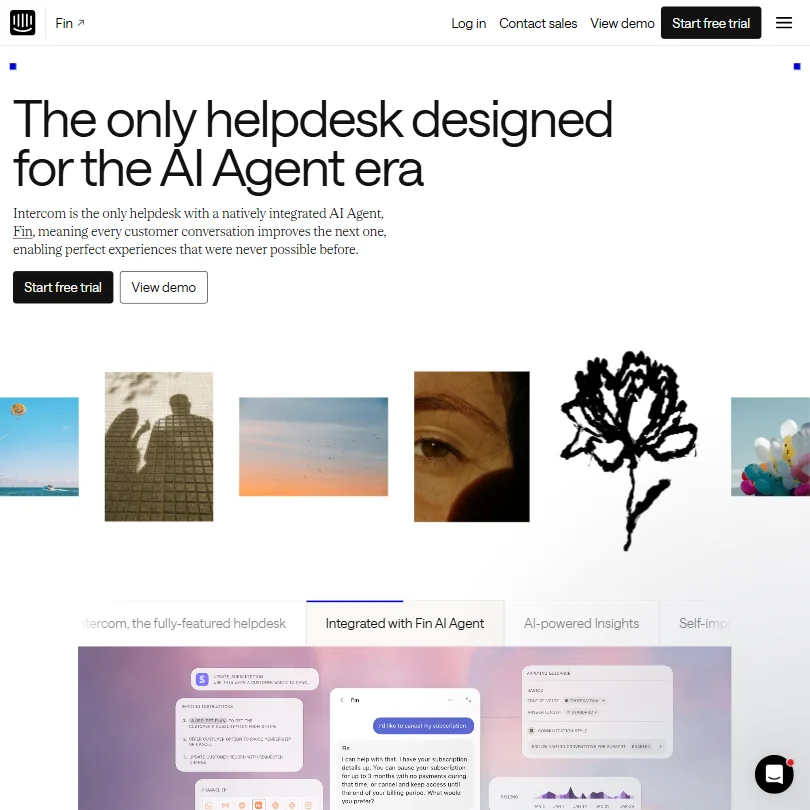
Forethought vs Intercom: Which Customer Service AI Wins?
Intercom was the most common comparison in review threads. The honest answer is that they're solving different problems.
Intercom built a full customer communications platform first and added AI on top. Forethought built AI for support first and added channels. Meaningful architectural difference. Intercom's Fin AI works well for teams already inside the Intercom ecosystem. Forethought is more portable, designed to sit on top of whatever helpdesk you already have.
Intercom tends to win on onboarding speed and pricing transparency. Forethought tends to win on ticket-trained AI depth and the Triage Agent's classification sophistication. High-volume support operations with complex query mixes tend to find Forethought's agent architecture more capable than what Intercom's AI layer currently offers. Teams that want simpler setup, or that use Intercom across sales and marketing too, often stick with what they have.
The Zendesk acquisition complicates the comparison further. If Forethought's capabilities get absorbed into the Zendesk platform over time, the comparison shifts significantly and we can't predict which direction.
Who Should Use Forethought? (And Who Shouldn't)
Enterprise and large mid-market support teams. That's the fit. Teams running thousands of tickets a month across multiple channels, with enough historical data to train the AI meaningfully.
SaaS and fintech support teams. They showed up most frequently in positive reviews. High ticket volume, complex queries, consistent need for triage at scale. Makes sense.
Small teams. Skip it. The setup overhead and likely price point make no sense under a few dozen support agents, and the no-trial policy makes due diligence on a budget genuinely painful.
Ecommerce brands should verify their specific stack requirements directly before getting too far into the buying process. Forethought publicly supports Shopify, but confirm the specifics of what that integration covers before committing.
Forethought Review Verdict
A serious product for serious support operations. The multi-agent architecture is genuinely differentiated, and most competitors offer one or two of the layers Forethought covers. The Discover and QA agents in particular address problems that most AI support tools ignore entirely.
The pricing opacity is genuinely bad. Not quirky. Bad. A product this complex needs a pricing page that gives buyers enough signal to know they're in the right ballpark before burning calendar time on demos.
The Zendesk acquisition is the wild card. Deeper integrations and better resources are the optimistic read. Forethought as a standalone product getting absorbed and losing flexibility is the pessimistic one. We don't know yet, and neither does anyone else.
For the right enterprise team, Forethought is one of the more capable AI support platforms available right now. The feature depth earns its positioning. The buying experience and the open questions around the Zendesk roadmap both give us pause. Evaluate seriously. Approach the contract conversation carefully.
How Forethought compares
Forethought scores 6.3 out of 10 among the AI support agents we rate. These three do the same job and are the closest to it, compared on what each vendor publishes.
Ada
Forethought answers in 100 languages against Ada's 60, and is ISO 27001 certified where Ada is not. Forethought trains on your support data by default with no opt out found; Ada only trains on your data if you explicitly agree first. Ada's Playbooks give you rule based automation; Forethought's Autoflows are AI reasoning steps instead, with no rule builder. Neither has a shared inbox, help center or SLA policies of its own.
Pick Ada if you want AI that only trains with your agreement.
Pick Forethought if you want more languages and ISO certification.
eesel AI
eesel AI charges $0.40 per ticket handled, with no platform fee; Forethought's per-resolution rate is not published. eesel does not train AI on your data; Forethought does, with no opt out found. Forethought holds SOC 2 certification, which eesel does not yet have, though eesel's audit is underway. Both connect to Salesforce, Zendesk, Intercom and Gorgias, and both draft replies for your human agents.
Pick eesel AI if you want per ticket pricing and AI that skips training on your data.
Pick Forethought if you need SOC 2 certification already in place.
CoSupport AI
CoSupport AI drops its fee as volume rises, starting at $0.19 per resolved ticket with unsolved tickets costing nothing; Forethought's per resolution rate is not published. CoSupport offers a 30 day trial run as a guided pilot; Forethought offers no trial at all. Forethought holds both SOC 2 and ISO 27001; CoSupport holds ISO 27001 only, with no SOC 2 claim on its site. Both connect to Salesforce, Zendesk, Intercom and Freshdesk.
Pick CoSupport AI if you want to pay only for resolved tickets.
Pick Forethought if you need SOC 2 certification alongside ISO 27001.
Frequently Asked Questions
Does Forethought offer a free trial?
No free trial, no free plan. Custom pricing across all tiers means your first real look at the product happens after you've booked a demo and started vendor conversations. That's a meaningful ask for teams doing broad market evaluations, and the frustration is legitimate. We saw it reflected consistently in review commentary.
Is Forethought still independent after the Zendesk acquisition?
Zendesk announced its acquisition of Forethought in March 2026 and completed the deal later that month. The product still operates and the website is live, but the long-term roadmap for how Forethought gets folded into Zendesk's broader platform isn't publicly clear. Teams evaluating today should ask directly about product independence and roadmap commitments before signing anything multi-year.
What helpdesks does Forethought integrate with?
Confirmed integrations include Zendesk, Salesforce, Freshdesk, and ServiceNow, among others. Forethought also publicly lists HubSpot as a supported CRM integration and publicly supports Shopify. If your stack sits outside those, verify compatibility directly with the vendor before getting deep into the buying process.