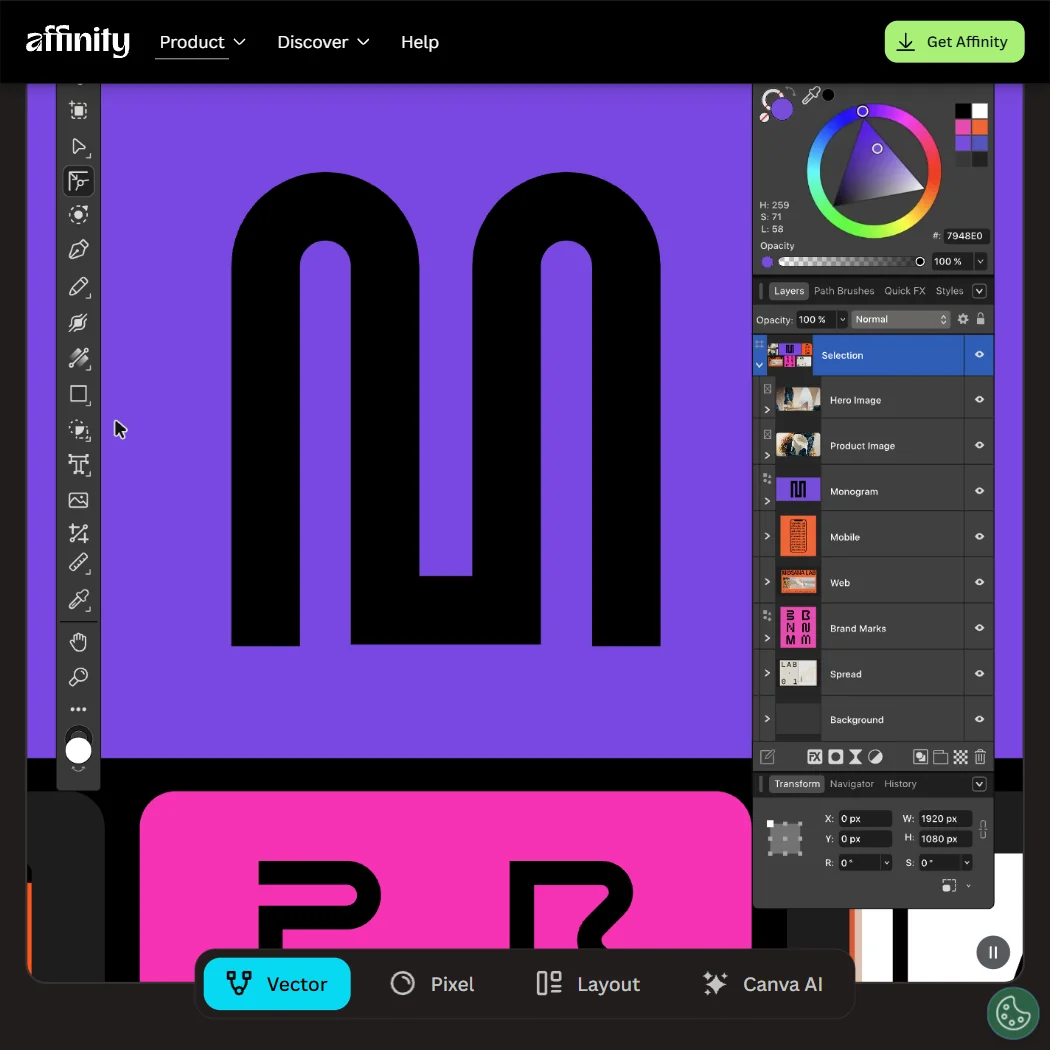
Affinity is now a single free desktop app, its Vector, Pixel and Layout studios in one file, owned and distributed by Canva. Every editing tool in it costs nothing, but its AI features live behind a separate paid Canva plan, so what you get depends entirely on whether you need those.
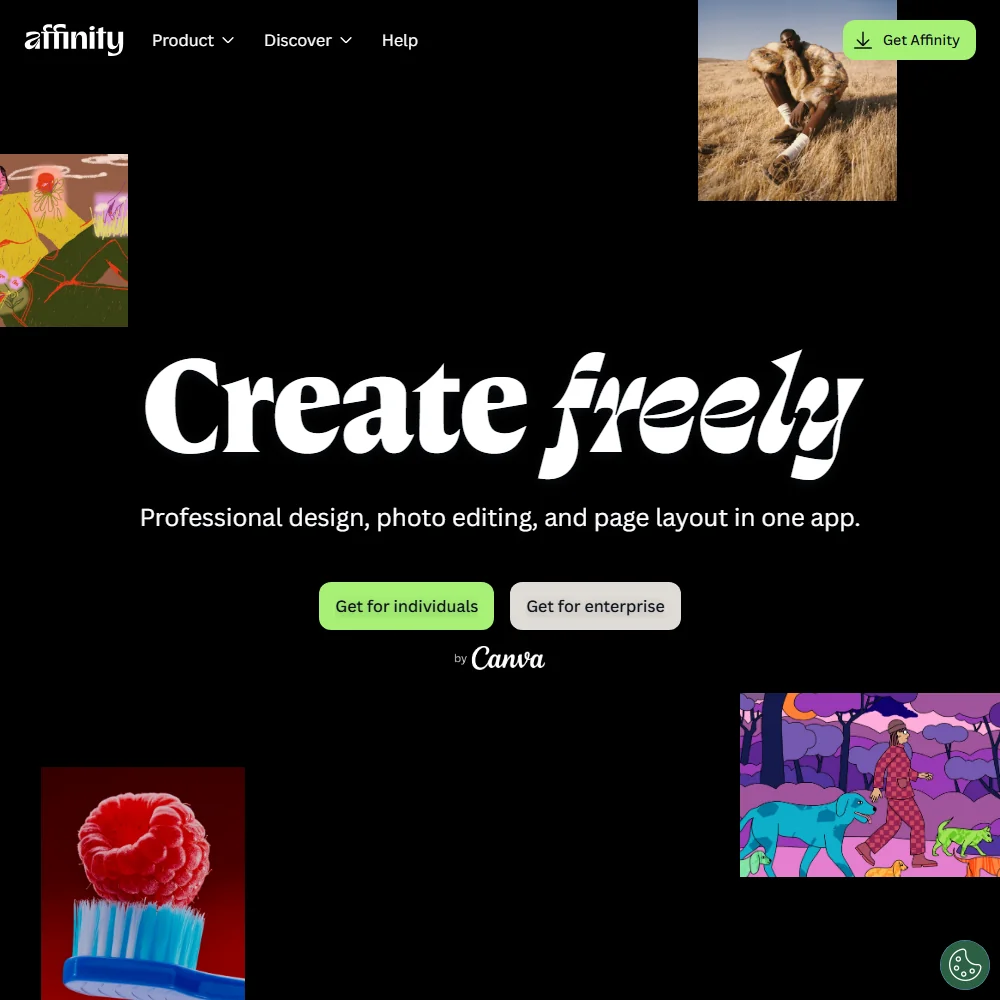
What is Affinity?
Affinity is made and distributed by Canva. It installs and runs on Windows and macOS, with iPad support described as coming later. Downloading it requires a free Canva account, and its AI tools run on Canva's servers rather than on your machine, so it is not a purely offline app even though the editing itself happens locally. It is free to use but proprietary, not open source.
Editing images in Affinity
Affinity opens layered PSD files with their layers, masks and groups intact, but there is no PSD export that keeps layers: exporting to Photoshop flattens the file to a PDF or PNG. Editing is non-destructive across layers, filters and adjustments, and RAW files get full editing with tone mapping and lens correction, all included in the free app.
Batch processing with recordable macros, HDR merge and panorama stitching are also part of the free app, as is print-ready output with CMYK, spot colours, preflight and bleed support. Pen pressure sensitivity works for tools like dodge and burn. Affinity does not support installable third-party plugins; instead it connects to named applications such as DaVinci Resolve and Capture One.
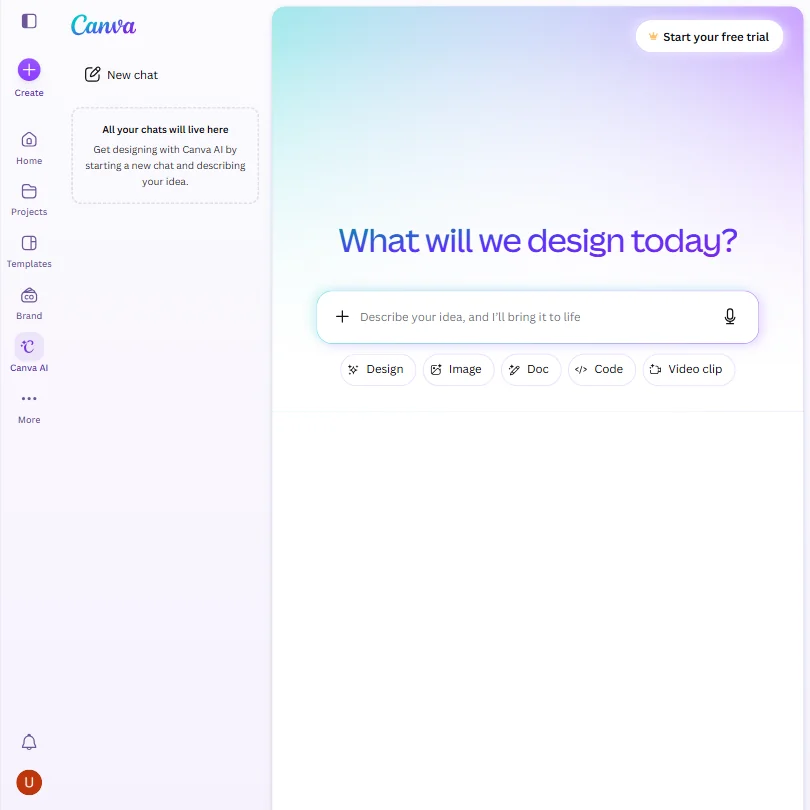
Affinity's AI tools are reached from inside the app but run as Canva AI Studio, and every one of them needs a paid Canva plan. That includes selecting a subject and erasing its background, generative fill that fills a selection, expands an image or adds something by prompt, generating images and editable vectors from a text prompt, upscaling with Super Resolution, and using a Canva brand kit inside Affinity. None of these work on the free app by itself. Separately, an AI Connector links Affinity to Claude for automating repetitive production workflows and custom scripting, which is free during its beta period.
Working with other people
Affinity has no real-time co-editing and no built-in comment or review workflow; sharing work with others means exporting it, typically to Canva. Beyond Canva itself, it connects to DaVinci Resolve, Capture One and Claude. It exports to PNG, JPG, SVG and PDF.
Affinity pricing: what each plan gives
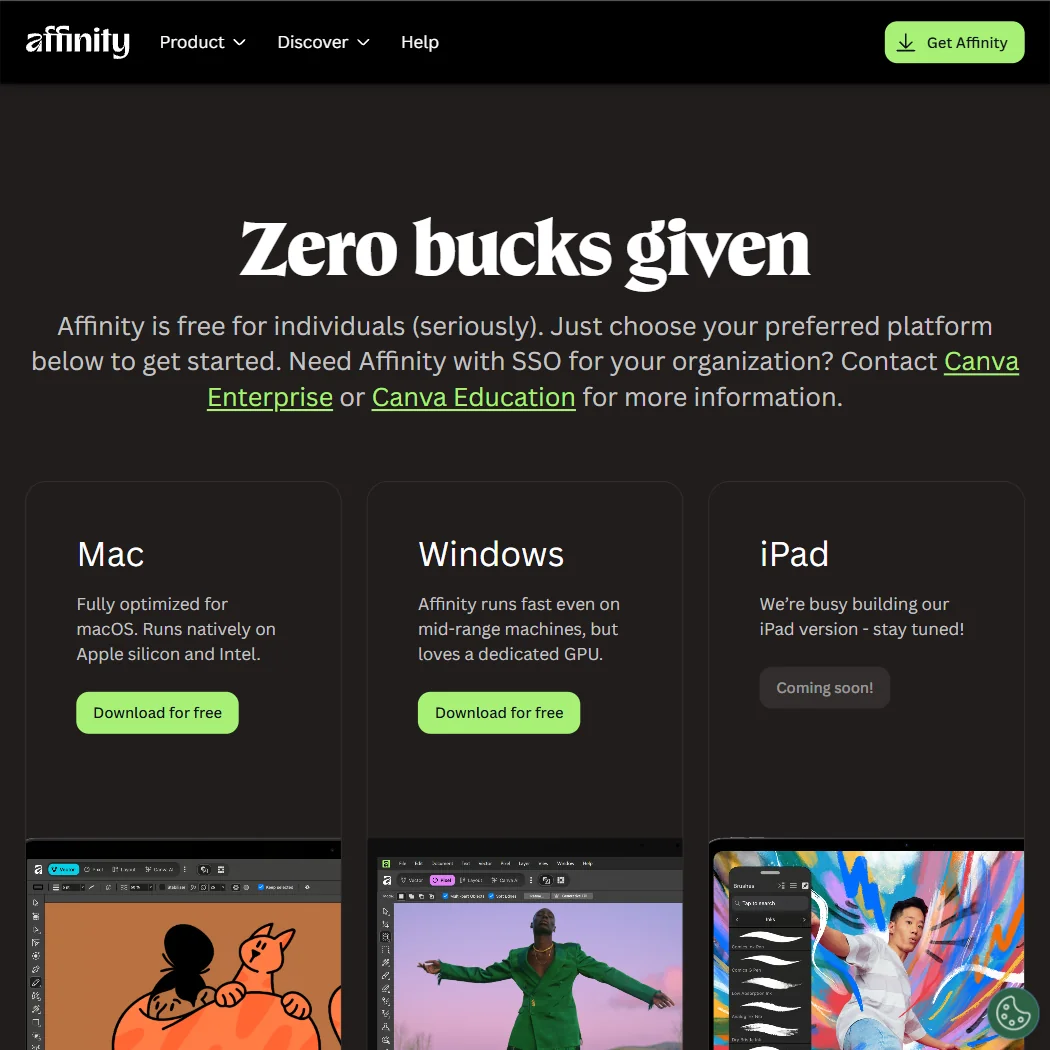
Affinity has no paid plan of its own. Every tool in the Pixel, Vector and Layout studios, plus the customization and export features, is free to use with no restrictions and no watermark on exports. There is no trial to offer, because there is no paid tier to trial.
Generative fill, background removal, upscaling, image and vector generation and the brand kit are Canva AI Studio features reached from inside Affinity, and every one of them needs a paid Canva plan, which starts at $18 a month, or $12 a month billed annually, on Canva's own site. There is no longer a perpetual licence to buy for Affinity itself, since the old separate Affinity Photo and Affinity Designer products have been retired.
Privacy and support
Because Affinity requires a free Canva account to download at all, Canva's privacy policy governs that account. Canva trains its AI models on your account activity, content and media uploads by default, and you have to switch this off yourself in your Canva privacy settings. Canva's own privacy policy states it processes personal data under the GDPR and UK GDPR, which covers the account Affinity forces you to hold.
Support is through Affinity's help centre and a Discord community; no email, phone or chat line is listed.
Who Affinity suits
Affinity suits anyone who wants a full desktop editor for photos, vector art and page layout without a subscription: raw editing, non-destructive layers, batch macros and print-ready CMYK output all come free, with no watermark and no time limit.
It suits less well anyone who wants its AI features, generative fill, background removal, upscaling, image and vector generation or the Canva brand kit, without paying for a Canva plan, since none of those work on the free app alone. It also suits less well anyone who needs real-time collaboration, a built-in comment workflow, or a PSD export that keeps its layers.
How Affinity compares
Affinity scores 6.9 out of 10 among the image editors we rate. These three do the same job and are the closest to it, compared on what each vendor publishes.
Adobe Photoshop
Every AI feature in Affinity, from generative fill to AI upscaling, sits behind a paid Canva plan, though Affinity itself costs nothing to use. Photoshop's Photography plan, which includes Lightroom, costs $19.99 a month and has those same tools built in without a second subscription. Affinity opens layered PSDs but exports them flattened; Photoshop opens and saves PSDs with layers intact. Affinity runs on 2 platforms against Photoshop's 5, with its iPad app still listed as coming soon.
Pick Adobe Photoshop if you want AI tools built in without a separate subscription.
Pick Affinity if you want a free app and don't mind Canva for AI.
Photopea
Photopea opens and saves layered PSD files without flattening them, while Affinity opens layered PSDs but exports only flattened versions. Affinity's AI tools, generative fill, background removal, upscaling, sit behind a paid Canva plan, while Photopea includes generative fill and background removal on its own. Photopea runs only in a browser, against Affinity's 2 platforms, and exports to 7 file formats compared with Affinity's 4. Affinity works in CMYK for print in its free app, and so does Photopea.
Pick Photopea if you need full PSD export or AI tools with no Canva plan.
Pick Affinity if you need pressure sensitive tablet support while you draw.
GIMP
Affinity is a free app, though its AI tools sit behind a paid Canva plan; GIMP is free too, open source, with no company behind it at all. GIMP opens and saves layered PSD files; Affinity opens them the same way but exports only a flattened version. Affinity works in a full CMYK colour space for print, while GIMP's CMYK editing is still in progress, showing only ink coverage. Both support pressure sensitive tablets, and GIMP's code is published under the GPL licence.
Pick GIMP if you want open source software you can extend with plug-ins.
Pick Affinity if you want CMYK support ready now instead of in progress.
Frequently Asked Questions
Is Affinity free?
Yes. The whole app, Vector, Pixel and Layout studios together, is free to use with no restrictions or payment, and Affinity has no paid plan of its own to buy.
Does Affinity open Photoshop files?
It opens layered PSD files with layers, masks and groups intact, but it cannot export a PSD that keeps its layers; exporting to Photoshop flattens the file to a PDF or PNG.
Does Affinity include AI tools like generative fill?
Generative fill, background removal, upscaling and image and vector generation are all present, but every one of them is a Canva AI Studio feature that needs a paid Canva plan; none work on the free app alone.
Does Affinity train on the files I work on?
Canva, whose account you need to download Affinity, trains its AI models on your uploaded content and account activity by default. You can turn this off in your Canva privacy settings.
Screenshots