SAASINSPECTOR
GIMP logo

GIMP Review

GIMP is an image editor with no company behind it, built and maintained as a free, open-source project. It supports pressure-sensitive tablets and can be extended with third-party plug-ins and scripts, and it has no AI features.

Visit GIMPFrom $0/mo

Research-based review. Features and prices are checked on the vendor's own website, and the score is worked out from those facts. We haven't tested it hands-on yet.

The verdict

GIMP suits photo editors who want a free, open-source image editor they can customize with their own scripts and plug-ins, without needing a subscription.

Pros

  • Free forever, with no paid tier, subscription or account required.
  • Open source under the GNU General Public License, with commercial use explicitly allowed.
  • Imports and exports PSD files with layers intact.
  • Batch processing from the command line, driven by Script-Fu scripting.

Cons

  • Full CMYK editing is not shipped; the project describes it only as a roadmap item.
  • No AI-based editing tools: no generative fill, AI upscaling, or automatic background removal.
  • Runs only as installed desktop software, with no web or mobile version.
From $0/moFree plan YesFree trial No
5.9/10

Spec Score

GIMP against 4 image editors
#4
of 4 image editors
-1.3
vs the average
100%
from published facts
Ahead of other image editors
Pricing+1.1Privacy and trust+1.1
Behind other image editors
What it adds beyond the basics-4.7Workflow and output-0.6
Every criterion
Tap a row for the facts
What it adds beyond the basics2.2
-4.7 vs 6.9 avg7.7 of 35 points
Opens and saves layered Photoshop filesyes1.7 / 1.7
Generative fill and expandno0 / 1.4
Generates images from a promptno0 / 1.2
Selects a subject or sky by itselfno0 / 1.2
AI image editing (erase, relight)no0 / 0.9
One-action background removalno0 / 0.9
AI upscalingno0 / 0.9
Works in CMYK for printno0 / 0.9
Pressure sensitivity from a tablet or stylusyes0.5 / 0.5
Template libraryno0 / 0.4
Why these numbers

Opens and saves layered Photoshop files: Both import (long-standing) and export (file-psd-export.html) exist, with layer/blend-mode handling discussed (some legacy-mode caveats noted on the export page).

Generative fill and expand: Checked release notes for prompt-based generative fill/expand; none found.

Generates images from a prompt: Checked release notes and FAQ; no image-generation feature.

Selects a subject or sky by itself: Checked 3.0/3.2 release notes and FAQ for automatic subject/sky/background selection; none found.

AI image editing (erase, relight): Checked FAQ and release notes for background removal, object erase/replace, expand; not present.

One-action background removal: Checked release notes and FAQ; no one-click background removal tool found (manual selection tools only).

AI upscaling: Checked release notes; no model-based upscaler, only standard scale/interpolation tools.

Works in CMYK for print: Full CMYK editing is explicitly still in progress, not shipped. The 3.2 CMYK Color Selector only shows total ink coverage for soft-proofing, and PSD/PS export can flatten to CMYK for output, but the editing color space is RGB.

Pressure sensitivity from a tablet or stylus: Pressure-sensitive tablet input via paint dynamics.

Template library: The Templates Dialog stores preset canvas sizes for New Image, not a library of ready-made designs.

Workflow and output6.0
-0.6 vs 6.6 avg13.2 of 22 points
File formats it exports6 export formats2.5 / 3
Where it runs2 platforms1.5 / 3
Third-party pluginsyes2 / 2
Apps it connects to0 integrations0 / 2
Why these numbers

File formats it exports: Counted from export_formats. "code" = export as C source (file-csource-export.html). Also exports many formats outside the checklist enum (TIFF, BMP, WebP, TGA, etc, not listed here).

Where it runs: Counted from platforms. Also available on GNU/Linux and other OSes, which are outside this checklist's platform enum (web/windows/mac/ios/android). No iOS/Android/web version.

Third-party plugins: Third-party plug-ins and Script-Fu/Python-Fu scripts can be installed.

Apps it connects to: Counted from integrations. Desktop app with no named third-party SaaS integrations listed; extensibility is via plug-ins/scripts, not integrations.

Pricing10.0
+1.1 vs 8.9 avg25 of 25 points
Cheapest paid plan, monthly$07 / 7
Commercial use allowedyes3 / 3
Why these numbers

Cheapest paid plan, monthly: Free, with no paid tier to price. No vendor, no price, no sales page. Checked homepage, about, and FAQ.

Privacy and trust7.5
+1.1 vs 6.4 avg13.5 of 18 points
Does not train AI on what you uploaddoes not applyn/a
SOC 2does not applyn/a
GDPRdoes not applyn/a
Source published under an open licenceyes2 / 2
Ways to reach support2 support channels1 / 2
Why these numbers

Source published under an open licence: GNU General Public License (GPL), OSI-approved.

Ways to reach support: Counted from support_channels. Community channels are forums (pixls.us, GNOME), IRC (#gimp on GIMPNet), Matrix, Discord, and mailing lists; help_center is the built-in F1 manual and docs.gimp.org. No vendor email/phone since there is no vendor.

yesnonot published average for image editors
How the Spec Score works

Scored from what GIMP publishes on its own site. Not a hands-on test.

Compared with 4 image editors. Facts checked 21 Sep 2026.

A fact the vendor does not publish gets half the points, or the typical value for a number, and says so. It never counts as a no. How we score.

GIMP is a free, open-source image editor for Windows and macOS, with no company behind it. It suits people who want a full raster editor without a subscription or an account, and it suits less well anyone looking for AI editing tools, since GIMP ships none.
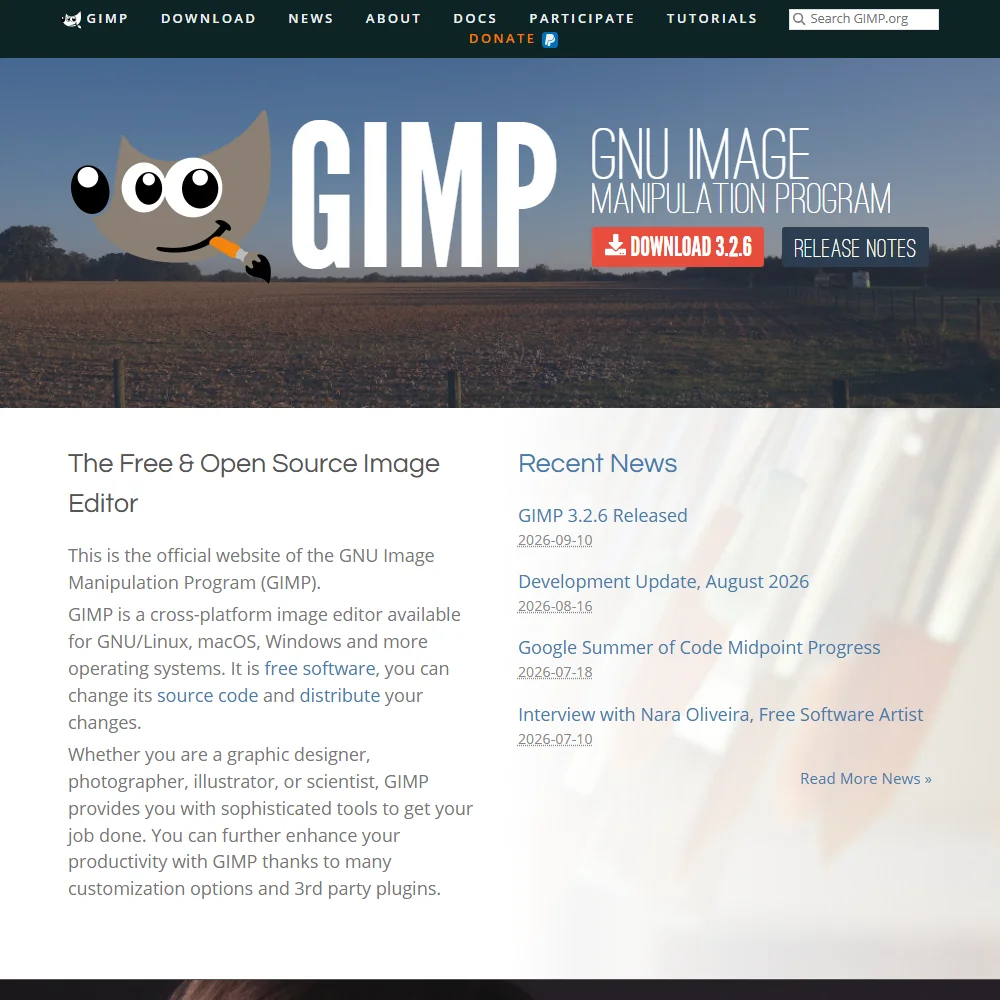
GIMP homepage screenshot
GIMP, Homepage

What is GIMP?

There is no company or foundation behind GIMP. It is built by a diverse group of volunteer contributors, and the project traces back to 1995. GIMP is an installed desktop application for Windows and macOS (also available on GNU/Linux), and it requires no account of any kind: nothing about your work is sent anywhere.

Editing images in GIMP

GIMP works natively in its own format but imports and exports PSD files, including layers, and its 3.2 release added non-destructive Link Layers and Vector Layers on top of its existing non-destructive text layers and filters. Raw camera files are handled through bundled or supported plug-ins such as darktable, RawTherapee and ART, rather than a built-in raw developer. Batch processing runs from the command line, driven by Script-Fu scripting, and pressure-sensitive tablet input is supported through paint dynamics. Third-party plug-ins and Script-Fu or Python-Fu scripts extend the app, and GIMP publishes a documented plug-in API (the PDB) for developers.

Full CMYK editing is not shipped. GIMP's own FAQ describes better CMYK support as something that has been on its roadmap for a long time, with initial groundwork done but not a complete CMYK editing workflow. GIMP also has no AI-based editing tools: no generative fill, no AI upscaling, no one-click background removal and no automatic subject selection.

Working with other people

GIMP is built for one person editing locally rather than a team co-editing a file; there is no real-time collaboration or comment workflow. In place of company support, the project runs on volunteer channels: forums, IRC, Matrix and Discord chat, and mailing lists, plus a built-in manual and documentation site for reference.

GIMP pricing: what it costs
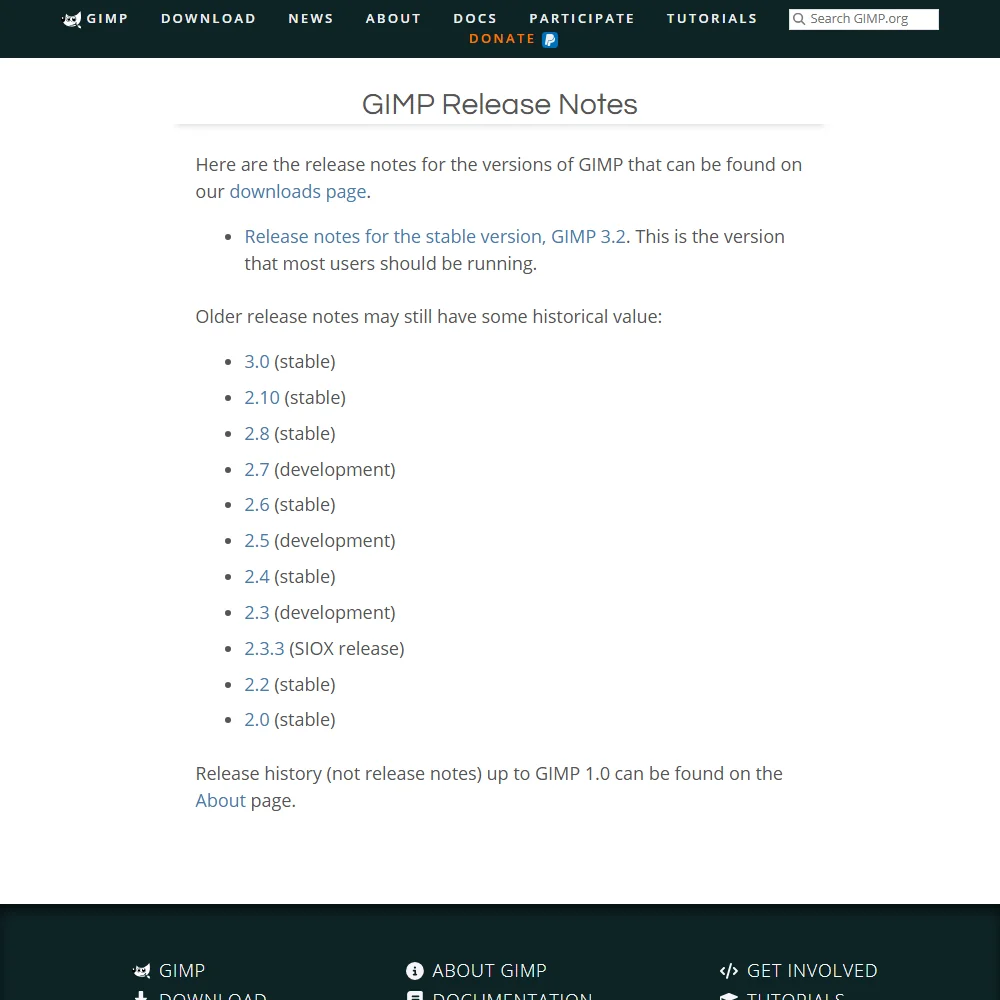
GIMP features screenshot
GIMP, Features

GIMP is free, with no paid tier of any kind. There is nothing to trial and nothing to subscribe to; the entire application is free software licensed under the GNU General Public License, and commercial use is explicitly allowed without restriction.

Privacy and support

Questions about training on your work, SOC 2 and GDPR do not arise for GIMP the way they do for a cloud service: it is installed desktop software with no account and no vendor server that your files pass through, so there is nothing collected to audit. Support runs through the volunteer community: forums, real-time chat, mailing lists and the project's own documentation and manual.

Who GIMP suits

GIMP suits anyone who wants a capable, free raster editor with layers, masks, PSD compatibility and scriptable batch processing, and who is comfortable with a volunteer-run project instead of a company with a support line. It also suits anyone who wants their files to never touch a server at all, since nothing is uploaded or requires an account.

It suits less well anyone who needs full CMYK editing for print production today, since that is still only a roadmap item, or anyone who wants AI tools such as generative fill, upscaling or automatic background removal built in, since GIMP has none of those.

How GIMP compares

GIMP scores 5.9 out of 10 among the image editors we rate. These three do the same job and are the closest to it, compared on what each vendor publishes.

5.9GIMP
vs
8.5Adobe Photoshop

Adobe Photoshop

No company stands behind GIMP, which is free and open source software. Photoshop's Photography plan, which includes Lightroom, costs $19.99 a month and adds generative fill, prompt based image generation and automatic subject selection that GIMP does not have. GIMP still opens and saves layered PSD files and supports pressure sensitive tablets. Photoshop works in a full CMYK colour space for print, while GIMP's CMYK support is still in progress, showing only ink coverage for soft proofing.

Pick Adobe Photoshop if you need generative AI tools and full CMYK editing.
Pick GIMP if you want free open source software with no subscription.

GIMP vs Adobe Photoshop →
5.9GIMP
vs
6.9Affinity

Affinity

Affinity's CMYK support works right away in its free app; GIMP's CMYK editing is still in progress, showing only ink coverage for now. GIMP opens and saves layered PSD files, while Affinity opens them but exports only a flattened version. Affinity's AI tools, including generative fill, need a paid Canva plan, while GIMP has no AI tools of any kind. Both support pressure sensitive tablets, and GIMP's code is published under the GPL licence.

Pick Affinity if you want CMYK support ready now instead of in progress.
Pick GIMP if you want open source software you can extend with plug-ins.

GIMP vs Affinity →
5.9GIMP
vs
7.6Photopea

Photopea

Photopea is not open source; GIMP is free and open source, with no company behind it. Photopea offers generative fill and expand, automatic subject selection and one click background removal, none of which GIMP has. GIMP supports pressure sensitive tablets for drawing, while Photopea does not. Photopea exports to 7 file formats against GIMP's 6, though GIMP runs on 2 platforms compared with Photopea's single browser based one.

Pick Photopea if you want generative fill and background removal in a browser.
Pick GIMP if you need pressure sensitive drawing or fully open source code.

GIMP vs Photopea →

Frequently Asked Questions

Is GIMP really free?

Yes. GIMP has no paid tier at all: the whole application is free software under the GNU General Public License, with no subscription, no account and no limits to work around.

Does GIMP open Photoshop's PSD files?

Yes, both importing and exporting PSD files with layers, though some legacy layer-mode handling is called out on export.

Does GIMP have AI editing features?

No. GIMP has no generative fill, AI upscaling, automatic subject selection or one-click background removal. Full CMYK editing is also not shipped yet, though the project describes it as a roadmap item.

Does GIMP collect or train on my files?

The question does not really apply: GIMP is installed software with no account and no server your images pass through, so nothing of yours is collected or sent anywhere.

GIMP is featured in

Alternatives to GIMP

Other AI Design Tool options we've reviewed.

Figma logo

Figma

Product teams wanting one shared workspace for design systems, prototypes and developer handoff

8.1
Rank #2 of 6 AI UI design tools
Best:Teams and platforms10
Weakest:What you can make7
Free plan: yesFree trial: noAPI: yes
Price not publishedFree plan
96% from published facts · checked 19 Sep
Canva logo

Canva

Small teams making branded social posts, print and video without hiring a designer

7.8
Rank #4 of 7 AI graphic design tools
Best:Teams and platforms10
Weakest:What you can make7
Publishes or schedules to social: yes
From $18Free plan
90% from published facts · checked 19 Sep
Visme logo

Visme

Brand teams producing polished decks and reports that export to almost any format

6.5
Rank #2 of 4 AI presentation makers
Best:Workflow and output7.2
Weakest:Privacy and trust5
Free plan: yesFree trial: noAPI: yes
From $29Free plan
92% from published facts · checked 20 Sep
Adobe Firefly logo

Adobe Firefly

Creative Cloud users who want generation inside the apps they already use, from a vendor that does not train on their content

7.0
Rank #4 of 7 AI image generators
Best:What it makes8.8
Weakest:Openness and support3
Does not train on what you make: yes
From $9.99Free plan
74% from published facts · checked 22 Sep
Krea logo

Krea

Designers who want one of the broadest model menus, plus a node canvas, an AI agent and an API

9.0
Rank #2 of 13 multi-model AI platforms
Best:For video10
Weakest:Pricing6
SOC 2: yesOffers Veo 3.1: yesOffers Nano Banana Pro: yes
From $35Free plan
93% from published facts · checked 19 Sep

Wix

Small business owners building a site and store themselves, with a phone line for help

8.0
Rank #1 of 6 AI website builders
Best:Teams and platforms9.5
Weakest:Pricing7
Generates images inside the builder: yes
From $17Free plan
85% from published facts · checked 19 Sep

User reviews

Review GIMP

Your rating

Reviews are moderated and appear once approved.