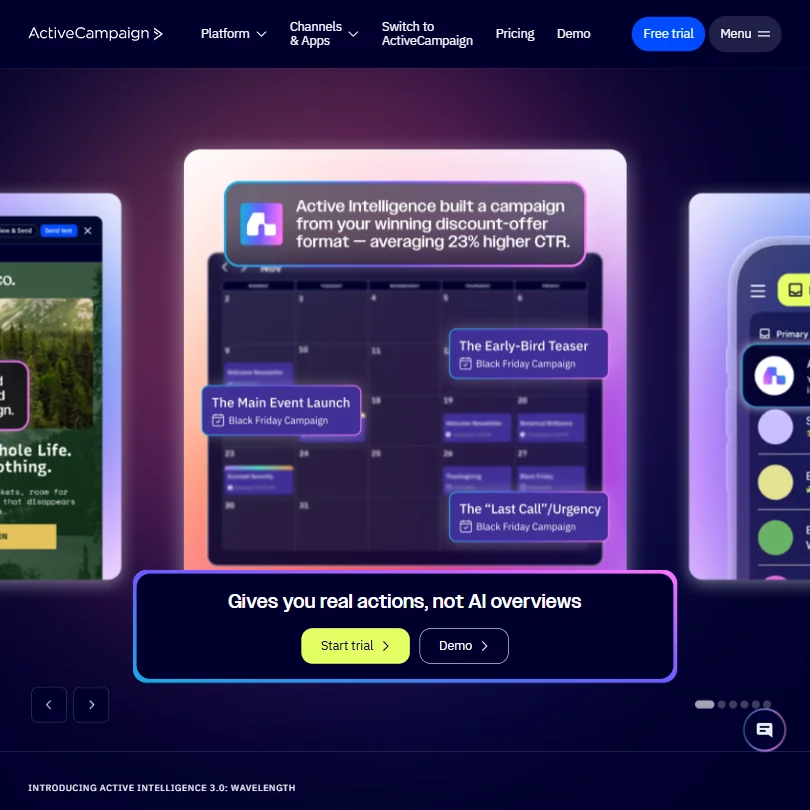
What is Active Intelligence in ActiveCampaign?
Active Intelligence 2.8 is ActiveCampaign's proprietary AI layer, designed to retain brand context across campaigns so your team isn't re-entering the same instructions every time. It includes four components as described in their docs: Memory, Custom Instructions, Brand Kit, and Campaign Reference. The idea is that the AI drafts from your best-performing past emails rather than starting blank. Whether that actually holds up in daily use at scale is a question we can't fully answer from docs and aggregated reviews alone. We're watching it.
Is ActiveCampaign good for ecommerce?
It's a reasonable fit, particularly for teams on Shopify or WooCommerce who need more than basic email. The native integrations for both platforms are well-documented, and the cross-channel automation across email, SMS, and WhatsApp gives it a real edge over Klaviyo in channel breadth. Klaviyo still has better revenue attribution reporting and a data model tuned specifically for ecommerce. The honest answer is that neither obviously wins. Depends on whether you need deep ecommerce analytics or wider channel reach.
What are the main differences between ActiveCampaign's pricing plans?
Three plans appear in their current pricing. Plus at $112 a month covers standard segmentation, unlimited automation actions, and a shared team inbox, but it's capped at one user. Pro at $142 a month unlocks advanced segmentation, predictive and conditional content, and expands to three users. Enterprise at $284 a month adds premium segmentation, custom objects, Single Sign-On, a dedicated account team, and five users. All prices are billed annually. Active Intelligence is available across plans, though Plus notes limits apply to that feature. The jump from Plus to Pro is smaller than it looks once you factor in the segmentation and user seat differences.
Now the full review.
ActiveCampaign has been around since 2003. That's not a small thing. Most of the tools we cover in this category didn't exist ten years ago, let alone twenty. That longevity shows up in the product, both as depth and as occasional weight you have to push through.
What is ActiveCampaign?
A marketing automation and CRM platform, Chicago-based, currently claiming 180,000+ customers. Not a small number. The pitch has shifted noticeably in recent years. Email automation was the original story. Now it's autonomous marketing via Active Intelligence 2.8, their proprietary AI layer built to retain brand memory, learn from past campaigns, and run cross-channel sequences without constant manual input.
Email remains the backbone. But WhatsApp automation, SMS, a visual workflow builder, and CRM functions have all been folded in. Coverage spans web, iOS, and Android. The interface is English-only, though you can write campaign content in other languages. Worth flagging for multilingual teams before they get too far into a trial.
Calling it just an email tool undersells it. Calling it a full AI agent platform probably oversells it. The truth sits somewhere between those two, and we'll get into where exactly.
ActiveCampaign Features: Workflows, AI Agents & Automation Capabilities
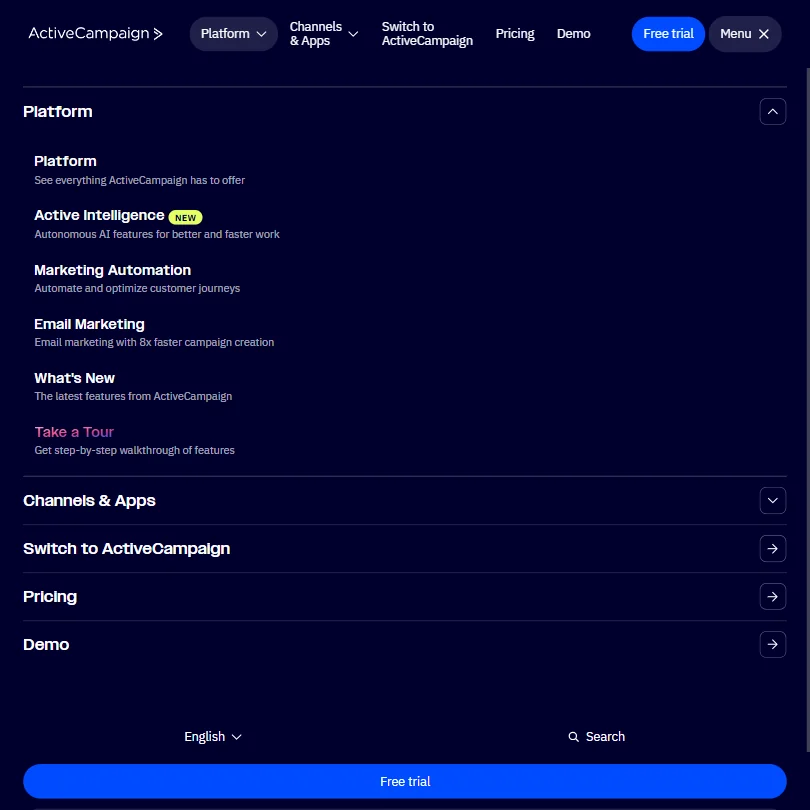
The feature surface is wide. We're not going to inventory all of it. What actually matters in practice is the visual automation builder, the Active Intelligence AI layer, and the multi-channel reach across email, SMS, and WhatsApp.
The visual builder handles automation without code. Triggers cover a lot of ground: webhook fires, form submissions, tag changes, and ecommerce events, among others. The conditional logic is real branching, not just basic if/then. Segmentation can actually respond to behavior rather than just static list membership.
Integration count sits at 1,000+ by their claim. Shopify and WooCommerce are the headliners for ecommerce. Salesforce and Zapier handle CRM and broader automation bridging. Most teams won't hit a wall here.
API access is full and documented at developers.activecampaign.com. Custom objects are supported. Webhooks work in both directions. The combination of a no-code visual builder and real API depth is genuinely what separates ActiveCampaign from tools that are email senders with a fancy name attached. Execution logs and error handling are built into the automation layer too. Not every competitor bothers. Fair.
ActiveCampaign Automation Power: How Complex Can Your Workflows Get?
Quite complex. That came up repeatedly across G2 reviews from marketing operations and growth roles. Multi-step, multi-branch flows stretching to 20 or 30 steps across different channels, without the system breaking down. That's the pattern we kept seeing in the detailed reviews, not the one-liner ones.
Native SMS, WhatsApp, and ecommerce event triggers mean you're not constantly routing everything through Zapier just to string a cross-channel flow together. That's a genuine difference from lighter tools in the category. Mailchimp doesn't get close here.
Goal tracking inside the automation layer lets you insert a human review point before a campaign sends. The docs don't describe a "human in the loop" capability. For teams that need compliance checks or manager sign-off built in, that's actually useful, not just a marketing line.
Predictive sending is in there too. The system tries to schedule emails for when a given contact is most likely to open. How much lift this delivers in practice varies. G2 reviews on this specific feature are split. Some users report meaningful differences. Others noticed nothing after enabling it.
Reddit threads from 2025 describe a recurring complaint: the automation builder has a learning curve that catches people off guard. It can do what they need. Figuring out how takes longer than the onboarding implies. G2 reviews say the same. Not great, but not disqualifying.
ActiveCampaign AI Agent Capabilities: What Can It Actually Do Autonomously?
This is the interesting part. Also the complicated part. Active Intelligence 2.8 is what ActiveCampaign is building its current marketing story around. The premise is that the AI builds a memory of your brand and your past campaigns, so you're not re-explaining your tone or your color palette every time you start something new.
The four components per their docs are Memory, Custom Instructions, Brand Kit, and Campaign Reference. Memory means workflows build on prior work. Custom Instructions are rules you set once that every campaign follows. Brand Kit bakes in your voice and visual identity. Campaign Reference means the AI drafts from your best-performing past emails rather than a blank page.
On paper, that's a smart design for small marketing teams. How well the "memory" piece functions over time is less certain. The documentation is confident, but customer reviews on this feature are thin, which usually means it's either too new to have enough users or too nuanced to rate cleanly. Probably both.
What we can say is that the AI layer is more marketing-specific than what you'd get from a general-purpose builder like Make. It's not trying to automate your whole business. It's trying to automate your campaigns. That focus is either exactly right or too narrow, depending on what your team actually needs.
ActiveCampaign's marketing doesn't say whether Active Intelligence runs on OpenAI under the hood or entirely on proprietary models. If that matters to you, ask before you buy.
Is ActiveCampaign Easy to Set Up Without Code?
Depends on what you mean by easy. Getting an account running and sending a basic email campaign is straightforward. The 14-day trial doesn't require a credit card, which gives you enough time to test the core without a financial commitment. No free plan exists, so once the trial ends, you're paying or you're out.
The visual builder is genuinely no-code for the basics. Form submissions, welcome sequences, behavior-based tagging, simple drip campaigns. A non-technical person can handle all of that. The help center is thorough. Video tutorials exist. The documentation is among the better ones we've encountered in this category.
Past the basics is where it gets harder. Building conditional flows with multiple triggers and real branching logic takes time. G2 reviewers in marketing manager and email strategist roles mentioned spending a week or two before they felt comfortable with advanced automation. That's honest. Not alarming, just not fast.
Custom objects and the API are developer territory. If you need data transformation beyond what the visual layer handles, you're writing code or hiring someone who does. True of every tool in this category at that complexity level.
Honestly, setup ease is the one area where ActiveCampaign is more average than its reputation suggests. The depth is real. Unlocking it takes effort.
ActiveCampaign pricing: what each plan gives
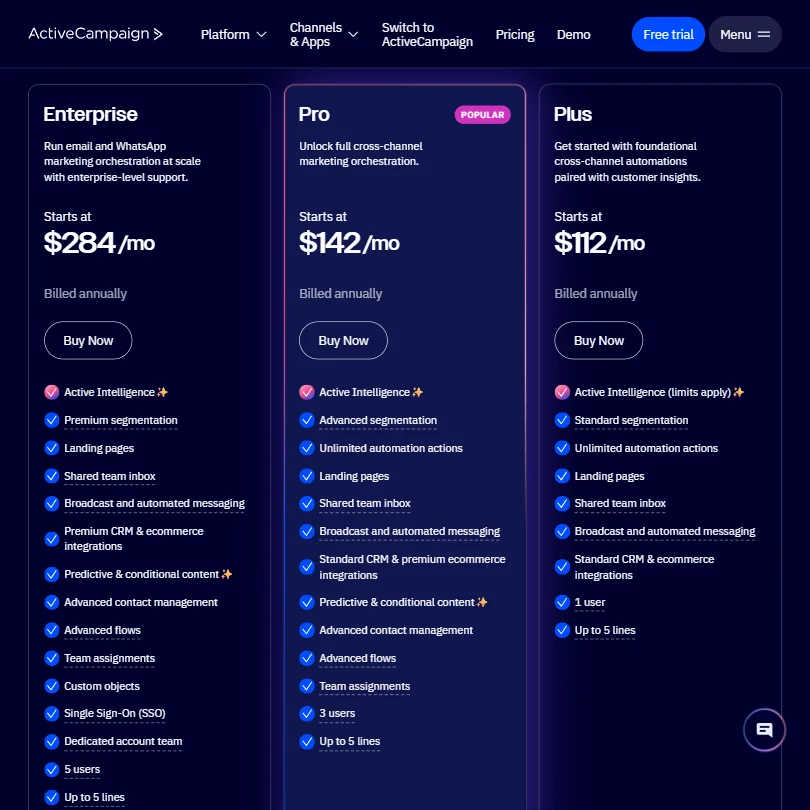
Three plans are currently visible in their pricing. Plus starts at $112 a month. Pro at $142 a month. Enterprise at $284 a month. All billed annually. A 14-day trial exists. No free plan.
Plus comes with standard segmentation, unlimited automation actions, and a shared team inbox, but it's capped at one user and up to five lines. Active Intelligence is available but with limits applied. Pro bumps to advanced segmentation, predictive and conditional content, and three users. Enterprise adds premium segmentation, custom objects, Single Sign-On, a dedicated account team, and five users. The jump from Plus to Pro is smaller than it first appears once you factor in what the segmentation and seat differences actually mean for a real team.
Comparing to Zapier is slightly apples-to-oranges. Zapier is a general workflow automation tool. ActiveCampaign is marketing-specific. Some teams run both. If you only need one, the question is what kind of automation your team actually does most. Marketing-first teams lean ActiveCampaign. Cross-system automation teams lean Zapier. Not complicated.
Compared to Mailchimp, ActiveCampaign is more expensive at equivalent tiers and significantly deeper on automation. For teams doing anything beyond basic newsletters, the price gap closes fast when you count what you'd have to patch together in the cheaper tool. Brevo is cheaper than both and less capable on the automation side. Worth knowing if price is the primary constraint.
ActiveCampaign vs Klaviyo: Which Automation Platform Wins?
This comparison surfaces constantly in G2 reviews, particularly from ecommerce roles. Close competitors. Hard to give a clean answer.
Klaviyo is built almost entirely around ecommerce. Shopify, WooCommerce, revenue attribution, product recommendation blocks. Its revenue-per-email reporting is more granular than what ActiveCampaign shows by default. If ecommerce is your whole world, Klaviyo's data model is tuned for it in ways ActiveCampaign's isn't.
ActiveCampaign wins on breadth. B2B lead nurturing, CRM workflows, multi-channel campaigns across email, SMS, and WhatsApp. Klaviyo's CRM is lighter. Its SMS product is real but more limited geographically. ActiveCampaign's trigger library is wider on the non-ecommerce side.
The AI angle is where things get murkier. Klaviyo has predictive analytics and some AI-assisted features. ActiveCampaign is betting bigger on Active Intelligence as an autonomous layer. ActiveCampaign looks ahead on the AI agent framing right now. Whether that advantage holds is a different question. Klaviyo moves fast.
Pricing is comparable at most tiers. Both bill based on contact count. A 50,000-contact list on either platform costs real money. Watch the contact-count math before you commit.
We don't buy the "one obviously beats the other" framing that dominates most comparison posts. Pure ecommerce with deep analytics needs, Klaviyo probably edges it. Mixed marketing and CRM work, ActiveCampaign has more to offer. That's as clean an answer as the evidence supports.
Who Should Use ActiveCampaign? (And Who Shouldn't)
SMBs running real marketing operations. That's the core fit. Teams that have outgrown Mailchimp but can't yet justify Salesforce Marketing Cloud or Marketo. The automation depth is real and the integration library covers most modern stacks without a lot of patching.
Ecommerce teams on Shopify or WooCommerce who need cross-channel automation. The WhatsApp automation in particular is a differentiator Klaviyo doesn't match well right now.
Solo marketers or small teams where the Starter-adjacent entry price is accessible and the AI features in Active Intelligence could reduce time spent on repetitive campaign work. G2 reviews in that segment were mostly positive. The main complaint was setup time, not missing functionality.
Technical teams looking for a general-purpose automation tool to connect arbitrary systems across finance, ops, and marketing. That's not what this is. ActiveCampaign is marketing automation with AI layered on top, not an AI agent platform for arbitrary business logic. n8n or Zapier are better starting points for that use case.
Teams already deeply invested in Klaviyo's analytics and segmentation. Switching costs are real. Unless the WhatsApp automation or Active Intelligence features are specifically what you're after, the case for moving isn't obvious.
ActiveCampaign Review Verdict
Twenty years is a long time to build a product. ActiveCampaign has used most of that time well. The automation builder is genuinely powerful. The trigger library is wider than most competitors bother with. The integration count is high enough that most teams won't run into a dead end.
The AI layer is the part we're still watching. Active Intelligence 2.8 is a smart design for marketing teams that run the same kinds of campaigns repeatedly. The memory and brand kit components make sense as a concept. Whether the "autonomous" framing holds up under real daily use is something we can't fully confirm from vendor docs and aggregated reviews alone. We've seen smarter-sounding AI features that didn't deliver in practice. Not saying that's the case here. Saying the independent evidence is still thin.
Pricing is fair. The Plus plan at $112 a month is a reasonable entry point for a team that actually needs the automation depth. The one-user cap at that tier is worth reading carefully before you buy. Pro at $142 adds meaningful segmentation features and expands to three users. Enterprise at $284 is a real product, not just a sales conversation, given what it includes.
No free plan is friction. The 14-day trial partially offsets that. The 30-day money-back guarantee on paid plans gives you an exit ramp if the setup complexity turns out to be more than your team bargained for.
ActiveCampaign rewards teams that put in the time and punishes the ones that don't. If you want something running in an afternoon, easier tools exist. If you're building marketing automation designed to run for years without constant rebuilding, the learning curve investment makes sense. It's a solid tool for the right context. Not overpriced for what it delivers. The AI story is interesting enough to take seriously, though it needs more independent confirmation before it counts as the thing that sets ActiveCampaign apart.
Frequently Asked Questions
Does ActiveCampaign have a free plan?
No free plan exists. There's a 14-day free trial with no credit card required, which gives you enough time to test the core automation builder and email features. After that, the cheapest paid option is the Plus plan at $112 a month, billed annually. Paid plans carry a 30-day money-back guarantee, which at least gives you an exit ramp if the tool doesn't fit after a proper run.
How does ActiveCampaign compare to Mailchimp for automation?
ActiveCampaign's automation builder is significantly deeper. Mailchimp handles basic drip sequences and simple branching reasonably well. It runs out of road fast when you need multi-branch conditional flows, behavioral