We pulled together vendor docs, G2 reviews, Reddit threads, and pricing data before writing this WellSaid review. What we kept seeing was a tool with a clear, narrow purpose and a level of audio output quality that genuinely holds up. It's not the flashiest AI voiceover platform, and it doesn't try to be. Founded in 2018 and based in Seattle, WellSaid built its entire product around one idea: real voice actors record the source material, the AI learns from those recordings, and the result is something that doesn't sound like a robot reading a spreadsheet.

That's the pitch, anyway. Whether it survives contact with actual user experience is worth digging into.
What is WellSaid?
WellSaid is a text-to-speech platform built for professional use. L&D teams, corporate marketing, creative agencies. Not hobbyists.
The model is proprietary, meaning no outside foundation model running underneath. Every AI voice is trained on licensed recordings from real people, which matters for two reasons. First, the output tends to sound less mechanical than generic TTS. Second, it gives WellSaid a defensible answer to the commercial rights question that some competitors can't as cleanly provide.
It runs on the web, plus integrations with Adobe Express and Adobe Premiere Pro. There's a developer-ready API that connects to LMS platforms and IVR systems. No mobile app. That's a gap, though probably not a dealbreaker for the enterprise audience WellSaid is after.
Honestly, the focus is unusually tight for a 2025 AI tool. No music generation, no transcription, no podcast editing. Just voiceover. That will frustrate some buyers and be exactly right for others.
WellSaid Features: Voice, Music & Audio Capabilities

The voice library sits at 280-plus options. That's a big number and the range is real: multiple speaking styles per voice, including Promotional, Narration, and Conversational. What WellSaid calls the AI Director sits on top of that, letting users adjust tone, pitch, pacing, and emotional delivery after the initial generation. That's more control than most pure TTS tools offer.
What's missing is worth naming plainly. No voice cloning. No music generation. No transcription. Those aren't oversights; they're deliberate choices. Murf AI bundles more of those features into a similar price range, so buyers chasing an all-in-one setup will find WellSaid frustrating. But for teams that only need professional-grade narration, the stripped-down feature set actually keeps the workflow clean.
Batch processing isn't publicly documented, which is a real question mark for large-scale production. The API handles real-time generation control, which should cover most enterprise volume needs. We'd want to confirm that before committing at scale. We couldn't.
WellSaid Audio Quality: How Natural Does It Sound?
This is where WellSaid earns its reputation. In our research across G2 reviews, quality came up constantly. Reviewers in L&D and marketing roles described the output as the closest thing to a real voice actor they'd found at this price point. Not every voice. A handful consistently get flagged as more natural than the rest, and users tend to stick with those.
The licensed-recording model matters here. WellSaid's approach of training on actual voice actor sessions rather than scraped audio is a real structural difference. Whether a listener notices in a polished corporate video is debatable, but the floor is meaningfully higher than you'd get from a generic synthetic voice.
One complaint surfaced enough to mention: some reviewers noted that certain pronunciations require manual overrides and that getting the cadence right on technical jargon takes more iteration than expected. That tracks for any TTS system. Just not eliminated here.
WellSaid Voice Cloning & Customization: How Deep Does It Go?
No voice cloning. Full stop.
That's a deliberate product decision, and WellSaid frames it around consent and ethics. Real voice actors own their recordings. The company doesn't offer a way to clone arbitrary voices, including your own. If that's what you need, ElevenLabs is the obvious alternative. It offers voice cloning on several plans and has a much broader feature footprint overall.
What WellSaid offers instead is style variation within a voice. Multiple delivery modes per voice. The AI Director for pacing and emotional tone. That's real customization for a narration workflow. It's just not the same category as cloning.
We don't buy the argument that this makes WellSaid less capable across the board. It makes it less capable for one specific use case. For everyone else, the 280-plus voice library with style controls is more than adequate.
Is WellSaid Easy to Use?
Paste a script, pick a voice, generate. That's the core loop. G2 reviewers in non-technical roles consistently described the learning curve as minimal. The interface is web-based and apparently clean enough that L&D teams can hand it to someone who's never used a voice tool and get usable output on day one.
The Adobe integrations add a wrinkle. Adobe Express and Adobe Premiere Pro connections expand where the audio ends up, which is useful for creative teams already in that ecosystem. Whether the integration works as described is something we couldn't verify firsthand. Review data on the integrations specifically is thin.
The AI Director controls are where the learning curve actually sits. Getting pacing and tone exactly right takes iteration. That's not a knock; any tool with that level of control takes time to learn. Just budget for it.
WellSaid Pricing: Is It Worth It for Creators & Businesses?
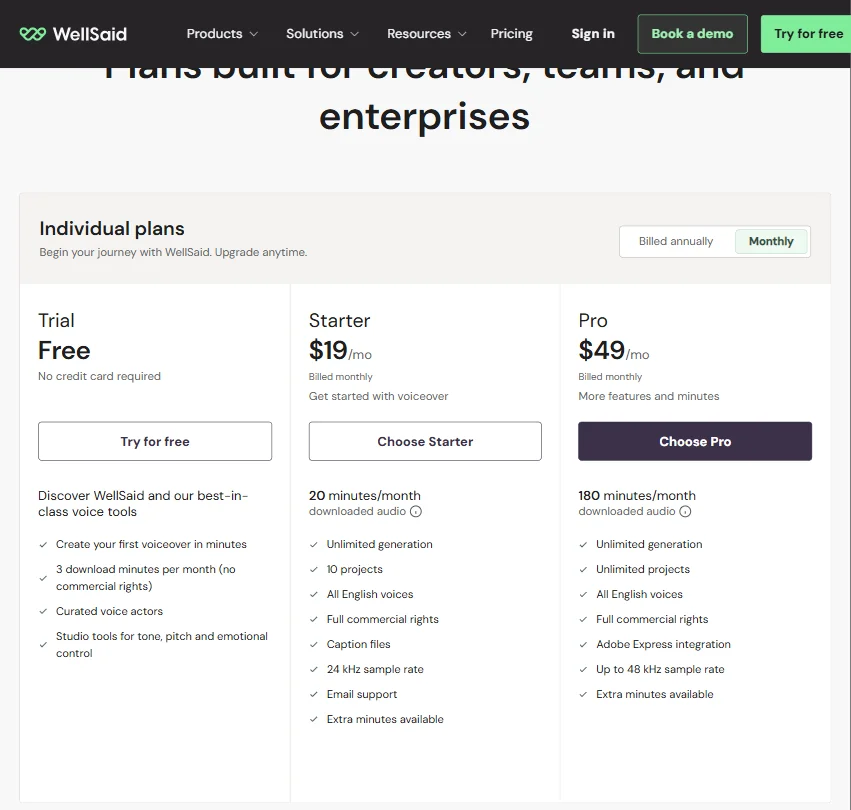
Four tiers. Starter at $10 a month, Pro at $33, Business at $160 per user, and Enterprise on custom pricing.
The free Trial plan includes 3 download minutes per month and no commercial rights. Enough to try the voices. Not enough to produce anything useful for work.
Commercial rights kick in on all paid plans. That's a meaningful point because some TTS platforms bury commercial licensing restrictions or charge extra. WellSaid doesn't.
The Business tier at $160 per user per month is where most professional teams will land, and it's expensive for small shops. That's the honest read. Live chat support with a 4-hour response SLA only unlocks at Business level. Lower tiers get email support. The Starter plan at $10 is almost a teaser, given that 3 download minutes per month on the free tier suggests you'll need to step up quickly once production starts.
Refund policy isn't publicly stated. That's a gap we noticed. For a $160/month commitment, that's worth asking about before you sign anything.
The Trustpilot score sitting at 3.0 out of 5 is worth flagging. The G2 score of 4.6 across 130 reviews tells a different story. Those two numbers don't usually diverge that sharply without a reason. We couldn't isolate it from available data, but it's something to watch.
WellSaid vs ElevenLabs: Which AI Audio Tool Wins?
Depends entirely on what you're building.
ElevenLabs offers voice cloning, a broader model, and more flexible pricing at the entry level. It's the more feature-complete tool. That's not really a debate.
WellSaid's advantage is narrower but real: the SOC2 and GDPR-compliant closed model is a genuine differentiator for enterprise buyers who can't let their scripts touch a shared training pipeline. L&D teams working with proprietary content, regulated industries, anyone who'd get nervous about where their data goes. That's a specific concern and WellSaid addresses it directly.
For creative freelancers and small teams, ElevenLabs probably wins on value and range. For a corporate L&D team at a healthcare company? The privacy architecture might make WellSaid the safer choice before any other consideration comes up.
Who Should Use WellSaid? (And Who Shouldn't)
Enterprise L&D teams. That's the core fit. Corporate trainers producing e-learning content at volume, where audio consistency and data privacy matter more than having 400 voice options.
Marketing teams at mid-to-large companies are a reasonable second audience. The Adobe integrations help. The commercial rights clarity helps more.
Solo creators and small agencies. Probably not the right tool. The price point at $33 for Pro and $160 for Business is hard to justify unless voiceover is a regular, recurring need at some scale.
Developers building IVR systems or LMS products should look at the API offering specifically. It handles real-time generation and integrates with those platforms. That use case is genuinely supported. Just verify the specifics before building on it.
WellSaid Review Verdict
WellSaid does one thing and mostly does it well. The audio quality is real. The privacy architecture is a legitimate selling point that competitors don't all match. The voice library at 280-plus options with style controls gives professional teams enough range to work with.
The gaps are real too. No voice cloning. No mobile app, limited lower-tier support, and pricing that escalates fast once you need more than basic access. The refund policy being absent from public documentation is a small flag that we'd want resolved before committing to Business tier.
The Trustpilot score at 3.0 doesn't align with the G2 data and we can't fully explain it. That ambiguity sits in our notes.
For what WellSaid is targeting, it's a credible tool. For teams where voiceover is genuinely central and data privacy is non-negotiable, it earns consideration. For everyone else, the math gets harder to make work.
Frequently Asked Questions
Does WellSaid offer commercial rights on all plans?
Yes, on all paid plans. The free Trial plan explicitly excludes commercial rights, but every paid tier from Starter at $10 per month and up includes them. That's a cleaner policy than some competitors who bury usage restrictions in the fine print.
Can WellSaid clone my voice?
No. WellSaid doesn't offer voice cloning on any plan. The product is built around a library of AI voices trained on licensed recordings from real voice actors, and the company has been deliberate about not offering arbitrary cloning. If that's a requirement, ElevenLabs handles it and should be on your shortlist instead.
How does WellSaid handle data privacy?
WellSaid operates on a closed model that is SOC2 and GDPR compliant. Your scripts don't feed into a shared training pipeline. For enterprise buyers in regulated industries, that's a meaningful structural difference from some competitors. It's the kind of detail worth confirming directly with their sales team before signing at the Business or Enterprise tier.