
Our research on SOUNDRAW started with a legal question, not a feature list. We cross-referenced their vendor documentation with Reddit threads, creator community forums, and what little review data exists across third-party platforms. The answer to that legal question is mostly yes. Everything else is more complicated.
SOUNDRAW launched in 2020, headquartered in Tokyo. It generates royalty-free AI music from scratch, customizable by genre, mood, tempo, and energy level. No voice synthesis. No transcription. Just beats and background tracks.
What is SOUNDRAW?
Pick a genre. Set a mood. Adjust the length. Get a track. That's genuinely the whole workflow.
What separates SOUNDRAW from most competitors is the training data. Their AI runs on music produced in-house, not scraped from third-party catalogs. That distinction has real consequences. Competing tools have faced copyright complaints precisely because their training data is murky. SOUNDRAW's isn't. You get a worldwide, perpetual commercial license, you keep every royalty, and you don't get copyright flags on upload.
Honestly, that matters more than most feature comparisons do.
The tool runs entirely in the browser. No mobile app, no desktop install. Web only, with English and Japanese support. The user base size isn't publicly disclosed, which is a minor irritation but common for tools at this stage.
SOUNDRAW Features: Voice, Music & Audio Capabilities
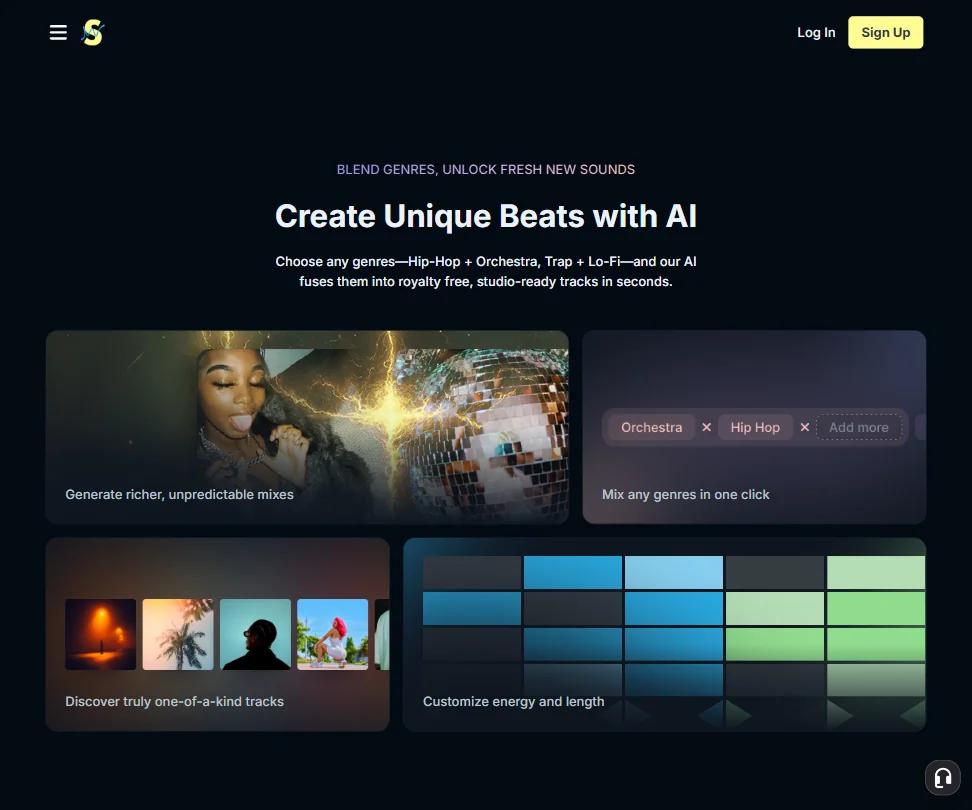
No voice cloning here. No text-to-speech, no transcription, no podcast editing, no noise removal. SOUNDRAW is a music generation tool and that's the entire scope.
Within that scope, it covers real ground. The generator spans 30-plus genres with blending options. You set mood and energy level, choose a track length, and the AI produces a full composition. From there, the browser-based Mixer lets you toggle individual instruments and mute layers. You can adjust intensity at the bar level, which is more useful than it sounds. Matching a track's build to what's happening in your video is exactly what editors need, and most tools don't offer it.
STEM exports are available on paid plans, meaning individual instrument tracks you can drop directly into a DAW. Not standard across the category. Fair.
API access exists for developers building for video platforms or ad tech. The documentation describes it as designed for teams integrating music into products, not creators generating individual tracks. That's a meaningful distinction.
What's missing is equally notable. No batch processing we could confirm. No Adobe Audition connection, no Zapier hooks. The integration story outside the API is thin.
SOUNDRAW Audio Quality: How Natural Does It Sound?
We dug through Reddit threads and creator community posts looking for consistent patterns. What we kept seeing was cautious approval. Users described the output as usable and professional-sounding for background music purposes. Nobody said it was indistinguishable from a studio session. Nobody called it a toy either.
The genre coverage is broad enough that YouTube creators, social video producers, and podcasters will probably find something that fits. The bar-level editing helps close the gap between "close enough" and "actually right."
Where users consistently pushed back was on variation. After generating several tracks in a similar genre and mood, patterns surface and things start sounding repetitive. That's not unique to SOUNDRAW. Suno carries the same complaint in its review threads regularly. But it's worth knowing going in.
SOUNDRAW Voice Cloning & Customization: How Deep Does It Go?
It doesn't. No voice cloning, no voice features at all. This section heading assumes a broader tool than what SOUNDRAW actually is.
Not a criticism. A scope clarification. Voice generation needs point elsewhere, and ElevenLabs is the obvious destination. SOUNDRAW isn't competing in that space and isn't trying to.
The customization that does exist sits in the music layer. Genre blending works reasonably well based on user reports. Mood and energy sliders give you enough range to shift a track from background filler toward something with more presence. The bar-level muting is genuinely useful for editors who know what they want from a composition. We don't buy that it replaces a music producer for anything complex, but for the use case it's designed for, it's more than most tools offer at this price point.
Is SOUNDRAW Easy to Use?
Pretty much, yes. The generation workflow is short and the interface asks very little of you. Most users in forum threads described reaching a usable track within a few minutes of landing on the tool. No learning curve worth mentioning.
The Mixer adds a small layer of complexity, but it's optional. Ignore it entirely and you still walk away with something decent. The people who actually use the bar-level editing tend to be video editors with a specific vision for how their audio should move. For everyone else, the generate-and-download loop is fast and low-friction enough that it doesn't get in the way.
The free plan deserves mention here. Unlimited generation is available without paying anything. Downloads are locked until you subscribe. That's a reasonable structure. You can spend real time with the tool, build a dozen tracks across different genres, and decide whether the output is worth $16.99 before entering a credit card.
SOUNDRAW Pricing: Is It Worth It for Creators & Businesses?

Three tiers, plus enterprise on request. Creator plan at $16.99 per month. Artist Starter at $29.99. Artist Unlimited at $50 per month.
What separates the tiers isn't fully transparent from the homepage. Digging into the pricing page, STEM downloads and higher usage limits live at the upper plans. The Creator tier is probably fine for someone generating occasional background tracks. The $50 plan is clearly aimed at producers pulling stems regularly.
The refund policy needs a direct look because it's not visible on the pricing page. Per the public Terms of Service, fees already paid are generally non-refundable. There is a limited exception: users can request cancellation within one week of an automatic renewal and receive a refund, but only if they haven't downloaded any music after that renewal date. We're skeptical that most users will catch that window in practice, and a $50 per month tool should surface that policy somewhere more visible than the Terms.
Compared to Mubert or Beatoven.ai, the pricing is competitive. Compared to Suno, it's a different positioning entirely. Suno is chasing lyrics and vocals. SOUNDRAW is background music and beats. Different tools, different needs.
SOUNDRAW vs Suno: Which AI Audio Tool Wins?
They're not really doing the same thing. Suno generates songs with vocals and lyrics. SOUNDRAW generates instrumental tracks for video and content production. Comparing them directly is a bit like comparing a ghostwriter to a stock music library. Both useful. Different contexts entirely.
Where they do overlap is the "give me music for this project" need. There, SOUNDRAW has a cleaner legal position. Suno's training data questions haven't fully settled. SOUNDRAW's have. The commercial licensing case for SOUNDRAW is genuinely stronger than what Suno can currently offer with confidence, and that gap matters for anything going into paid advertising or broadcast.
Suno wins on novelty. The "make me a song about my cat" use case is not SOUNDRAW's territory, and SOUNDRAW isn't pretending otherwise.
For background music at volume with commercial use in mind, SOUNDRAW is the more defensible choice. For creative experimentation and song-forward output, Suno has the edge.
Who Should Use SOUNDRAW? (And Who Shouldn't)
YouTube creators and video producers. That's the core fit. People who need 30 tracks a month and don't want to think about licensing. The free generation tier lets you pressure-test it without committing.
Indie game developers building audio into a product pipeline should look at the API. It's built for that workflow, not for individual track generation.
Music producers who want stems to remix or build on will find the STEM export at the higher tiers genuinely useful. Not universal, but useful.
Not the right fit: anyone who needs vocals, voice generation, or transcription. The scope is intentionally narrow. That's a choice, not an oversight, but it means a significant portion of the "AI audio tool" category won't find what they need here. Podcast workflows and spoken audio needs belong somewhere else entirely.
Also not ideal for anyone expecting tight DAW integration out of the box. The STEM export works, but there's no direct plugin connection to Audition or GarageBand.
SOUNDRAW Review Verdict
SOUNDRAW does one thing and does it with more care than most. The legal foundation is solid. The output quality clears the bar for professional content work. The Mixer and STEM exports push it meaningfully past the basic tier of competitors.
The gaps are real though. The refund policy is buried and narrow. Support documentation is thin. No mobile access. The review trail across G2 and Capterra is essentially empty, which makes independent validation harder than it should be at $50 per month.
For background music at volume with a clean commercial license, SOUNDRAW is one of the more honest options in this space. That's worth something. It's not the most exciting tool in the category. It doesn't need to be.