What is SEO Writing AI?
Web-based. One keyword in, article out. That's the core promise, and it's pretty much exactly what the tool delivers, for better and worse.

The company launched in 2022, location not publicly documented, which is common enough for small-team products that you stop thinking about it after a minute. They claim support for 48 languages, native WordPress integration that goes well past a basic plugin, and a Shopify app for ecommerce content teams. The WordPress piece is more serious than most people expect. There's a full MCP server and a bulk auto-posting workflow baked in. That's not a checkbox feature.
The pitch is speed. Feed it a keyword, get a publish-ready article, post it directly to your CMS without touching it again. Whether that article is genuinely good is a separate question. A fair one.
SEO Writing AI Features: SEO & Content Tools Breakdown
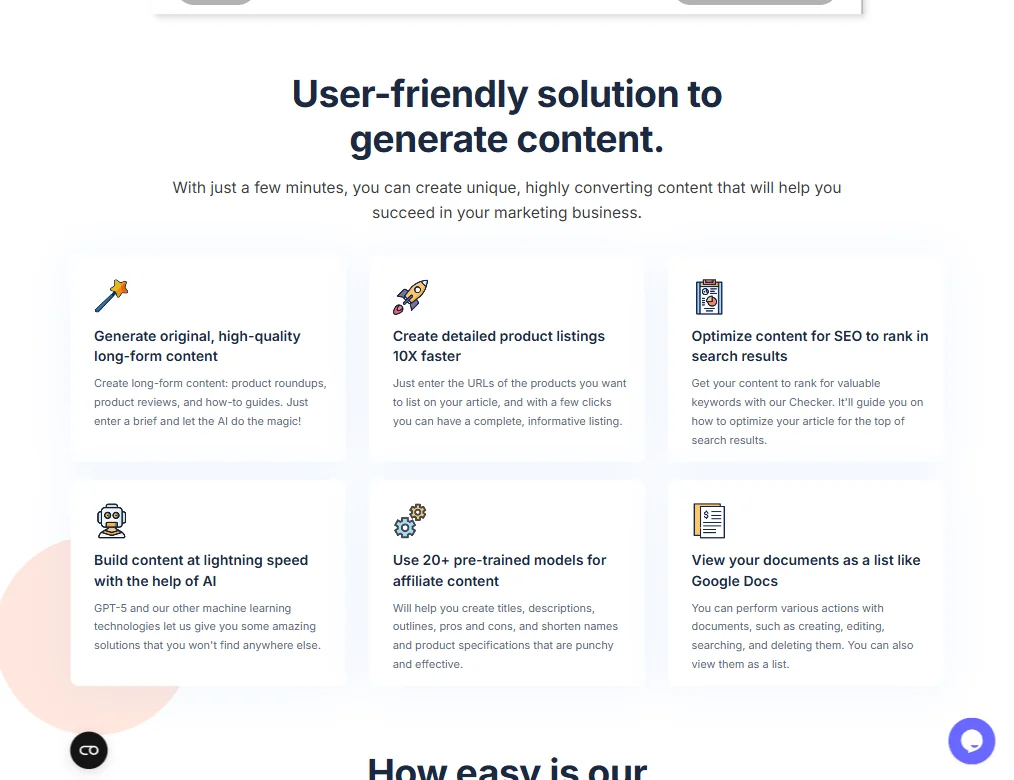
Wider than the price suggests. Real-Time SERP analysis runs automatically when you kick off an article, pulling in what's ranking for your target keyword and shaping the output around it. The Content Score checker then walks you toward 100, nudging on keyword placement and density. That's the core loop, and it's functional.
On the writing side, there are pre-trained models aimed specifically at affiliate content. Product reviews and comparison posts are the main formats. The Rewriter Tool shows up across paid plans, and the humanizer sits alongside it. Honestly, a tool that ships a humanizer as a core feature is telling you something about its intended user base. That's not a criticism. It's just accurate.
Bulk Generation is real, not theoretical. Up to 100 articles pushed directly to WordPress. Impressive or alarming, depending on your content philosophy. Probably both.
What it doesn't have: rank tracking, backlink analysis, Google Search Console integration. It writes content. That's the job.
SEO Writing AI Keyword Research: How Deep Does It Go?
Not very. Keyword optimization is the right word for what happens here, not keyword research. You arrive with a keyword. The tool analyzes SERP competition around it and helps you write something that targets it well. That's a real function. It's just not the same as discovery.
The Content Score mechanism handles keyword placement, frequency, and related term checks as you build. Useful, genuinely. But there's no keyword clustering, no standalone keyword explorer, nothing approaching a GSC integration. It reads more like a writing assistant that's keyword-aware than a research tool that also writes.
Teams that need the discovery layer before content generation starts should look at something like SearchAtlas. Different scope entirely.
SEO Writing AI Content Creation: AI Writing Quality Tested
We didn't generate articles. What we did was cross-reference user reports across G2, which currently sits at 4.6 from 84 reviews, and Capterra, which shows approximately 4.8 from 78 reviews. The vendor homepage appears to mix those figures with WordPress ratings, which explains some of the inconsistency you'll see cited elsewhere. Neither sample is tiny.
The pattern that kept surfacing from reviewers in affiliate and agency roles: the output holds up well for product roundups, how-to guides, and comparison posts. That tracks. The pre-trained models for those formats appear to do actual work, not just generate plausible-sounding text.
What reviewers flag more often is generic, middle-of-the-road prose on topics requiring nuance. Not a SEO Writing AI-specific problem. It's a reasonable ceiling for this category right now. The humanizer is meant to help. We're skeptical it closes the gap entirely, but reviewers seem to find it useful enough to keep paying for.
The newer claim, that the tool optimizes for AI search engines like ChatGPT and Perplexity alongside traditional search, is positioning worth watching. Whether the output actually performs in those contexts we can't verify from research alone.
Is SEO Writing AI Easy to Use?
From what we read, yes. Most reviewers across Capterra in particular call the interface clean and the learning curve low. Enter a keyword, adjust a few settings, let it run. The auto-posting workflow removes a step that most competing tools leave entirely to you.
The Amazon product URL import is a genuinely clever shortcut. Pull a URL, the tool reads the product data, writes around it. That saves real time for affiliate writers, and the reviews reflect it.
What's missing is worth noting. No Chrome extension, or at least none we could find in the documentation. No public API access from what the docs show. That limits how much you can fold this into a broader, more automated workflow. Fair limitation at this price point, but a limitation.
SEO Writing AI Pricing: Is It Worth It vs Free Alternatives?
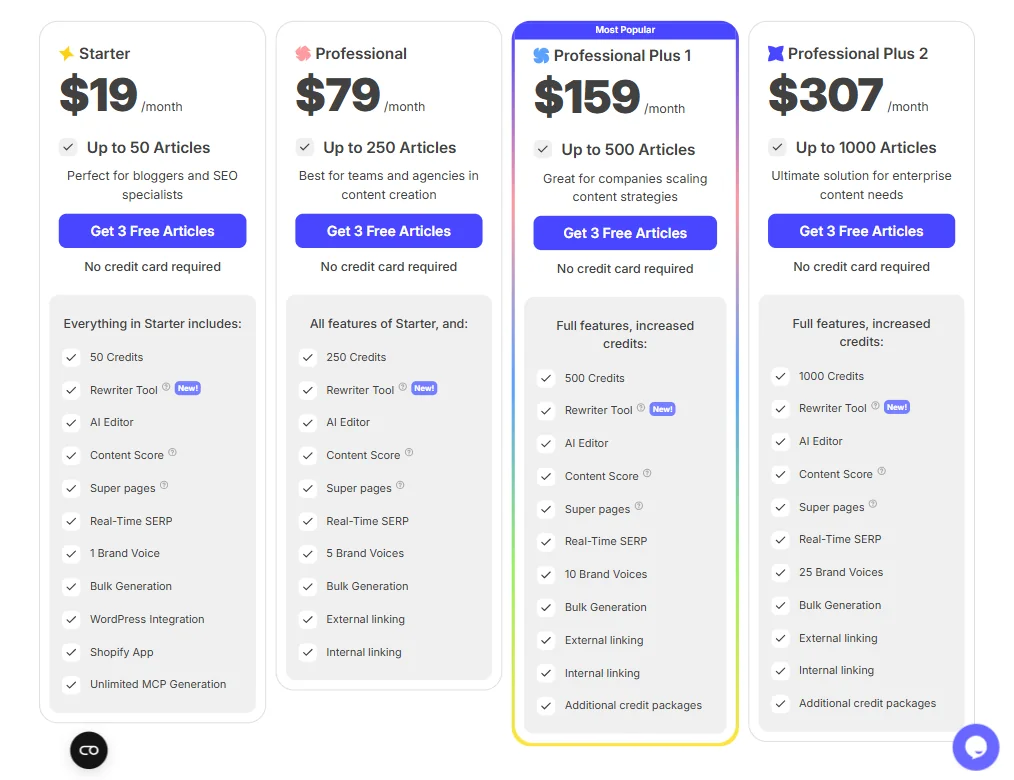
Four tiers, all publicly listed. Starter at $19 per month, Professional at $79, Professional Plus 1 at $159, and Professional Plus 2 at $307. Credits scale accordingly: 50 on Starter, 250 on Professional, 500 on Professional Plus 1, and 1,000 on Professional Plus 2. Brand Voices scale too, from 1 on Starter up to 25 on Professional Plus 2. External linking and internal linking don't appear until the Professional tier.
The free plan gives you 3 articles and a 25,000-word cap with no credit card required. That's a reasonable trial window.
Refund terms aren't surfaced on the pricing page, which is a gap worth flagging. They do exist in the Terms of Service: full refunds are available within 14 calendar days on initial purchases, provided you've used fewer than 50,000 words and five generations. After that window, refunds are generally unavailable, though individual requests may be considered. Anyone committing to an annual plan should read that before clicking.
No enterprise pricing is listed publicly either, so larger agencies will need to contact the team directly.
SEO Writing AI vs Surfer SEO: Head-to-Head Comparison
Price gap first. Surfer's current entry plan is Discovery at $49 per month billed annually. Its Standard plan runs $99 per month annually, and Standard is no longer the entry-level option. SEO Writing AI starts at $19. That spread matters for a lot of buyers, full stop.
Surfer is an editorial tool first. It assumes a human writer is doing most of the drafting and provides structured guidance around that process. SEO Writing AI assumes the AI drafts, then scores. Different philosophies, not one better than the other in every context.
Jasper competes more directly on the writing side, but at significantly higher price points. Frase sits in between, with stronger brief-building tools, less automated bulk output. For pure volume at the lowest entry cost, SEO Writing AI has a clear edge over both in that narrow comparison.
Not a knock on Surfer. Different tool for a different workflow.
Who Should Use SEO Writing AI? (And Who Shouldn't)
Affiliate marketers running content-heavy sites. That's the clearest fit. The pre-trained models for product content, the Amazon URL import, the Bulk Generation workflow. All of it points there.
Content agencies doing high-volume work at thin margins. The Professional plan at $79, if it handles the output volume needed, can compress per-article costs meaningfully.
Solo bloggers testing topics before investing in deeper tooling. The free plan is enough to form a real opinion.
Who shouldn't. Teams where a human writer owns each draft. This tool won't fit cleanly into that process. Also anyone who needs rank tracking or backlink analysis in the same platform. It's not here.
Content teams doing research-heavy work or brand-sensitive writing. The output is competent but not distinctive. For that work, something like Clearscope paired with a human writer gets you further.
SEO Writing AI Review Verdict
The tool does what it says. That's not a vague compliment. The review trail on G2, Capterra, and Trustpilot, which currently shows a 4.7 overall with a 4.5 TrustScore across 365 reviews, is unusually consistent for a product this young. The complaints cluster around output quality on nuanced topics, and that's a category-level issue, not a SEO Writing AI-specific failure.
The refund terms buried in the ToS are a real problem. So is the absence of any documented API access for teams trying to build automations around this.
At $19 per month, almost anyone doing content marketing has low enough risk to try the free tier and find out before spending anything. Three articles, no credit card, no time limit. That's a fair offer. Affiliate content at volume makes the Professional plan worth a harder look. Anything more complex than that, and the ceiling shows up faster than you'd want.
Not a perfect product. A useful one.
Frequently Asked Questions
Does SEO Writing AI work for languages other than English?
Forty-eight languages claimed. We didn't find detailed documentation breaking down quality differences across them, and English is almost certainly where the training data is strongest. Reviewers writing in English consistently report solid output. For non-English use cases, the free plan is the right way to pressure-test quality before committing money.
Is SEO Writing AI good enough to publish without editing?
Some users do, particularly on affiliate sites where volume matters more than voice. That's what the reviews suggest for product roundups and how-to posts. Anything that needs a distinctive point of view or careful sourcing needs a human pass. The humanizer helps with detection. It doesn't add judgment.
How does SEO Writing AI handle WordPress publishing?
It goes well past a basic export. The tool has a native WordPress MCP server and an auto-posting workflow that can push articles directly to your site in bulk, up to 100 at a time. For bloggers and agencies managing multiple WordPress properties, that's a meaningful time reduction compared to tools that leave CMS publishing entirely to you. Worth factoring into the value calculation.