
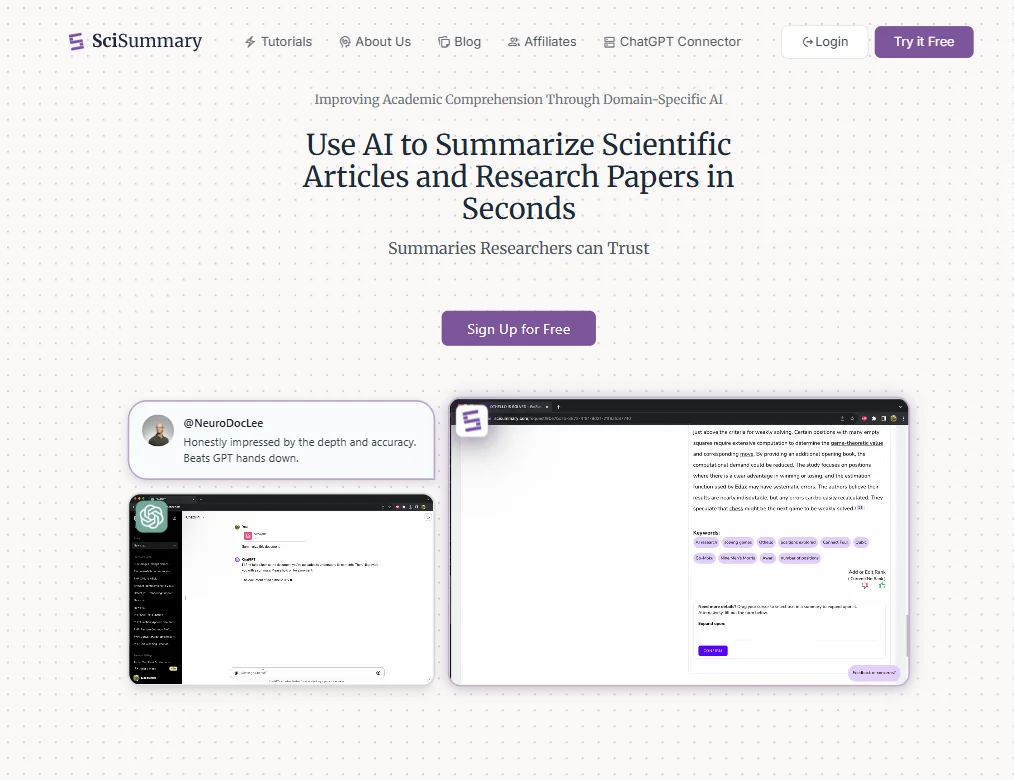
Our research on SciSummary started with a simple question: does a purpose-built academic summarizer actually outperform a well-prompted general AI? We pulled vendor documentation, worked through what user commentary exists across Reddit and Product Hunt, and cross-referenced third-party coverage to write this review. The short answer is mostly yes, with some real caveats.
SciSummary launched in March 2023. In under two years it claims over 900,000 users and 2.2 million papers summarized. That's a notable number for a niche tool. The ACM Digital Library partnership is the credential that sticks out most. Being the official AI provider for ACM isn't a badge you get from a good landing page.
What is SciSummary?
Built specifically for academic literature, SciSummary uses a GPT-based model with domain-specific training to break down research papers into structured sections. Not just a wall of paraphrased text. Actual labeled parts: abstract, methods, results, conclusion. You upload a PDF or search for a paper, and the tool organizes what it finds into something readable.
It runs on the web and through a ChatGPT Connector. There's also a quick-click import feature for adding a PDF, DOI, PubMed ID, arXiv ID, or URL straight into your SciSummary library or a selected folder. No mobile app. No general developer API.
The target user is clear. Researchers, grad students, academics who need to move through dense literature fast. That's the whole pitch. Honestly, it's a sharper focus than most tools in this category bother with.
SciSummary Features: Search, Synthesis & Research Capabilities

The core workflow is straightforward. Upload a paper or search for one, get a structured summary, ask follow-up questions through the chat feature. That's it.
Bulk paper summarization is where SciSummary pulls ahead of basic alternatives. You can feed it multiple papers and get a comparative synthesis, which is genuinely useful for literature reviews, not just for skimming one paper on a deadline. Multi-paper comparison exists too, though user reports on how well it works at scale are thin.
The chat feature supports questions about figures, not just text. That surprised us. Most summarizers completely ignore figures. SciSummary explicitly supports chatting with figures and papers, which matters if you're trying to understand a methodology diagram or a results chart.
Academic search with semantic matching is available on the Pro plan. The seven-day free trial includes unlimited article searches. Quick-click import handles fast imports of PDFs, DOIs, or IDs you already have open. Worth noting: there's no fact-checking layer. No tool in this space has cracked that problem, so it's not a unique failing, but it's something to keep in mind before trusting a summary blindly.
SciSummary documents some output and reference-export options, but does not publish a comprehensive list of every supported file format. What we can confirm: chat responses can be formatted as Markdown, plain text, or tables, and references can be exported in APA, Chicago, MLA, and Harvard styles. For anything beyond that, you're reading the fine print yourself. There's also a separately priced bulk-summarization API for developers, with usage-based pricing at $0.0037 per 1,000 tokens, documented publicly and separate from the standard subscription tiers. And Zotero integration is confirmed, with an "Import from Zotero" option when adding articles, which contradicts what we said in an earlier version of this write-up. We've corrected that below.
SciSummary Research Quality: How Accurate and Trustworthy Is It?
This is the question that matters most for an academic tool. We can't run blind accuracy tests ourselves without hands-on testing. What we can do is look at what users have said.
The pattern we kept seeing across Reddit threads and Product Hunt comments is that SciSummary handles structured scientific papers well. Papers with clear IMRaD structure get clean outputs. Papers that don't follow standard formats, or are more theoretical or humanities-adjacent, get messier results.
One user comparison that showed up more than once: SciSummary's domain-specific training means it doesn't hallucinate field-specific terminology the way a general-purpose model does. That's the actual argument for using a purpose-built tool over ChatGPT. A general model will confidently paraphrase a p-value or a confidence interval incorrectly. SciSummary is reportedly less prone to that, though not immune.
The ACM partnership adds credibility here. That kind of institutional endorsement usually involves some vetting process. It's not proof of accuracy, but it's a meaningful signal.
We're mildly skeptical of the "summaries researchers can trust" framing on the homepage. No AI summarizer is a substitute for reading the paper. Any tool that implies otherwise is overselling.
SciSummary Source Coverage: What Does It Actually Search?
Article search is included on all plans. Semantic search, with up to 1,000 documents indexed, unlocks on Pro. What's less clear is which external databases SciSummary actually pulls from. The vendor documentation doesn't spell this out.
The ACM Digital Library integration is confirmed. Beyond that, we couldn't find a clean list of indexed sources. For a tool competing against Semantic Scholar, which indexes over 200 million academic papers for free, source coverage is a legitimate question that SciSummary doesn't answer clearly.
PDF upload partially solves this. You can bring papers from any source into SciSummary regardless of what its native search covers. That's the practical workaround. Still, for researchers who want discovery alongside summarization, the vague coverage information is frustrating.
Not great. Transparency here would cost nothing and would reduce friction for new users trying to decide if this fits their workflow.
Is SciSummary Easy to Use for Researchers and Professionals?
From what we could gather, yes. The interface is simple enough that users rarely mention confusion in reviews. The structured output format maps onto how academic readers already think about papers. There's no real learning curve for the core use case.
Quick-click import helps with daily imports. The ChatGPT Connector gives users a path to integrate SciSummary into an existing AI workflow without context-switching. Zotero users have a confirmed import path. Those are genuine convenience wins.
What's missing is depth on the documentation side. The help center is described as basic across the reviews we read. There's a tutorials section on the site, but no community forum, no live chat, and support runs through a single email address. For 900,000 users, that's thin.
Graduate students in fast-paced research environments will find the simplicity a plus. Teams or institutional users who need collaborative features will hit walls quickly. There's no team collaboration mode.
SciSummary Pricing: Is It Worth It vs Free Alternatives?
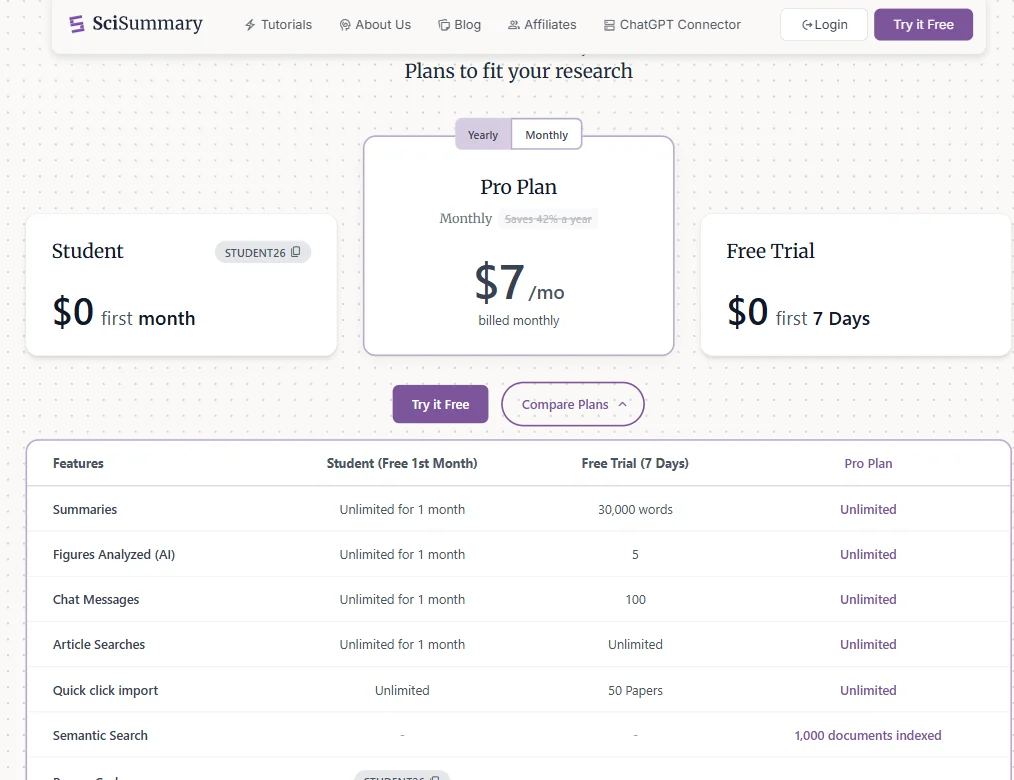
The Pro plan runs $7 per month billed monthly, or $4 per month billed annually, saving 42% on the yearly commitment. There's a seven-day free trial with 30,000 words, 5 figures analyzed by AI, and 100 chat messages included. Quick-click import is capped at 50 papers on the trial. Students get a free first month with the code STUDENT26, which includes unlimited summaries, unlimited figures, unlimited chat messages, and unlimited article searches for that initial month.
At $4 a month annually, the price argument is easy. The real question is what you're giving up by staying on the free tier. The trial is time-limited. Once the 7 days are up, you're paying or you're out.
What we couldn't confirm: the refund policy. Nothing publicly stated. That's a gap for a tool asking for annual payment upfront.
For a $48-a-year commitment, SciSummary is a reasonable bet for regular paper readers. For occasional use, the free trial probably covers it. The separately priced bulk-summarization API adds flexibility for developers or institutional users with higher volumes, though that's a different pricing conversation entirely.
SciSummary vs Scholarcy: Which AI Research Tool Is Better?
Scholarcy has been around longer. It offers flashcard-style breakdowns and a library system for managing summaries over time. Team collaboration features are more developed. Scholarcy also has clearer export documentation.
SciSummary's advantages are pricing and the ACM partnership. Scholarcy's personal plan starts higher than $4 a month. For individual researchers who just need fast structured summaries without a lot of file management, SciSummary is cheaper and arguably simpler.
Where Scholarcy pulls ahead: integrations and transparency about what formats it supports. SciSummary documents some export options but doesn't give you the full picture upfront. Fair, given the price, but still a friction point.
We'd also point researchers toward Elicit for systematic reviews. Elicit is built for pulling structured data across many papers at once, a different job than SciSummary's core use case, but one that often comes up in the same research workflow.
Who Should Use SciSummary? (And Who Shouldn't)
Grad students moving through a reading list fast. That's the clearest fit.
Independent researchers or science journalists who need to get up to speed on a field quickly will also find it useful. The $4 annual price point removes the budget conversation entirely.
Institutional teams, though? Not yet. No collaboration features, no admin layer, and you'd be running individual accounts in parallel, which defeats the purpose of a shared research workflow.
Anyone who needs complete clarity on export formats before committing should know upfront: that information isn't fully documented. Worth factoring in.
SciSummary Review Verdict
SciSummary does one thing and does it with more discipline than most general-purpose AI tools bother to apply to academic papers. The structured output format is genuinely useful. The figure chat feature is better than expected. The ACM partnership is a real credential. Zotero import works.
The weak spots are real too. Source coverage transparency is poor. The full export format picture is undocumented. Support is minimal for a 900,000-user product. The incomplete public documentation around integrations and exports is the single biggest friction point for anyone trying to evaluate this tool before committing.
At $7 a month billed monthly, or $4 billed annually, the price absorbs a lot of complaints. You're not making a big bet. But you are accepting a tool with real limits on the workflow side.
For light-to-moderate academic paper reading, it's worth the trial. For heavy systematic review work, you'll probably want to pair it with something else, or replace it with a tool that handles the full pipeline.
How SciSummary compares
SciSummary scores 4.4 out of 10 among the paper readers we rate. These two do the same job and are the closest to it, compared on what each vendor publishes.
Scholarcy
SciSummary costs $7 a month for its only paid plan; Scholarcy's equivalent plan is CA$13.99 a month. SciSummary answers back with a chat interface for asking questions of one or several uploaded papers at once, which Scholarcy does not offer, and it reads tables and figures unlimited on that same $7 plan. Scholarcy counters with things SciSummary lacks: citation classification through a Scite.ai integration, an Excel literature matrix, and RSS or email alerts.
Pick Scholarcy if you want citation classification, a literature matrix and alerts.
Pick SciSummary if you want a cheaper plan with a chat interface and figure reading.
Explainpaper
Figure and table reading inside papers, unlimited on SciSummary's $7 a month plan, is something Explainpaper's $16 a month Pro plan does not offer at all. Explainpaper counters with a Teams plan for shared access, contact us pricing, which SciSummary does not have. Both let you ask questions of an uploaded paper and see the passage an answer came from.
Pick Explainpaper if you need a shared Teams plan for your group.
Pick SciSummary if you want figure and table reading at a lower price.
Frequently Asked Questions
Is SciSummary free to use?
There's a seven-day free trial that includes 30,000 words, 5 AI-analyzed figures, and 100 chat messages. Quick-click import is capped at 50 papers during the trial. Students can get a free first month with the code STUDENT26, which removes those caps entirely for 30 days. After that, the Pro plan runs $7 per month billed monthly, or $4 per month on an annual cycle. One of the cheaper options in this category, so the barrier to entry is low.
How accurate are SciSummary's paper summaries?
Accuracy is best with papers that follow standard scientific structure. The domain-specific training helps with field terminology, which is where general-purpose AI models tend to make confident mistakes. That said, no AI summarizer is a replacement for reading the actual paper, and SciSummary doesn't include a fact-checking layer. Treat the output as a structured starting point, not a final source.
Does SciSummary work with citation managers like Zotero?
Yes, actually. Zotero integration is confirmed. Users can select "Import from Zotero" when adding articles, and SciSummary's own summarization guide lists Zotero as an import method. Mendeley isn't documented the same way. For developers or teams with higher-volume needs, there's also a separately priced bulk-summarization API, distinct from the standard subscription.


