
A highlighter and a patient explainer sitting next to you. That's the pitch. And based on what we've pulled from Reddit threads, Product Hunt comment sections, and user posts spanning 2022 through 2024, Explainpaper earns that comparison more often than not. Not all the feedback is warm. Some of it gets pointed about what the tool still can't do.
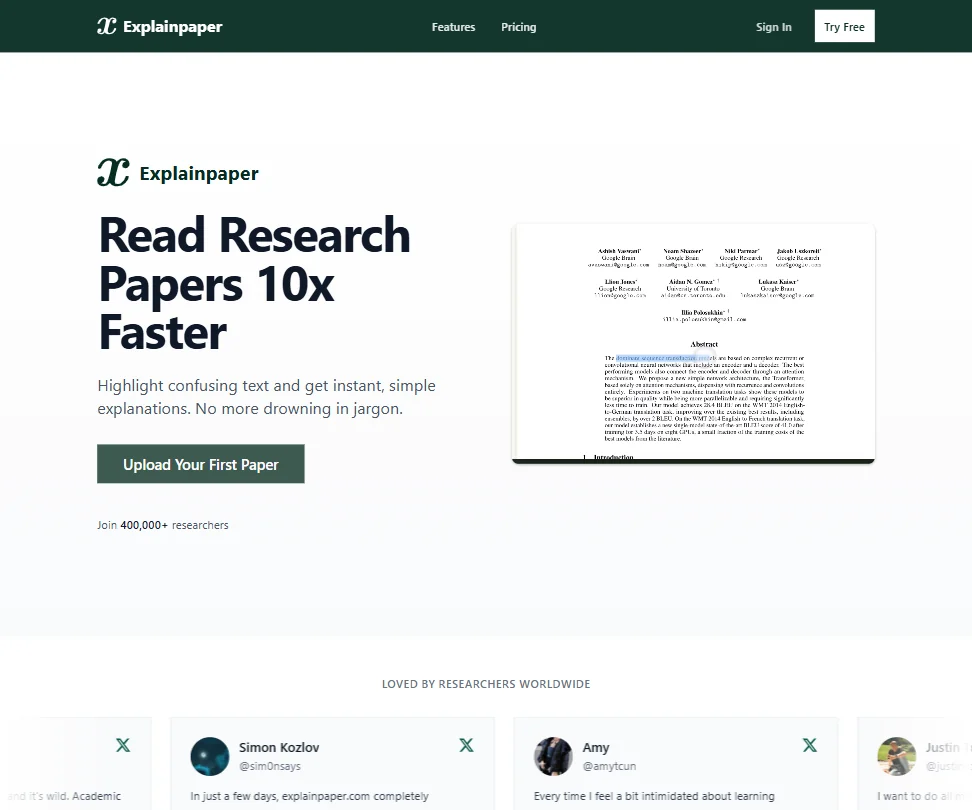
Founded in 2022, Explainpaper is narrow by design. Upload a PDF. Highlight text you don't follow. Get a plain-language explanation back. Ask follow-up questions. That's the loop. It doesn't search the web, won't pull new papers, and has no interest in anything outside the document you handed it.
What is Explainpaper?
The core mechanic is highlight-and-explain. You drag over a confusing sentence or paragraph and an LLM returns a breakdown, adjustable for complexity. That last part matters more than it sounds. A grad student grinding through a methodology section needs something different from someone just trying to get the gist on a lunch break.
Zotero integration ships on both Free and Pro, which is genuinely useful rather than a checkbox feature. Import your library, pick a paper, start reading. No separate upload step for everything already in your reference manager. That tracks for anyone already inside an academic workflow.
Teams get their own plan. No price posted. Contact sales. Honestly, we wouldn't hold our breath for anything budget-friendly there.
Explainpaper Features: Search, Synthesis & Research Capabilities

The product has expanded materially since launch. Early versions couldn't explain mathematical functions at all. That criticism showed up constantly in 2022 comments. The current feature set now includes whole-paper summaries, saved highlights and explanations, math and figure explanations via Math Explain, smart outlines, key-point extraction, and concept mapping. Meaningfully larger surface area.
What it still doesn't do is worth stating plainly. No web search. No academic database integration. No mobile app, no browser extension.
The absence of cross-paper synthesis is the biggest functional gap, and it's not a small one for anyone building a literature review. You can understand a paper deeply. You cannot compare it against five others inside the tool. Those are different things.
The Pro-tier AI summarization covers the entire paper, which saves real time on long reads. The follow-up question system is conversational, so you can push on a specific claim or ask for a concrete example. Most user accounts say that part works well.
We're skeptical of any multilingual output claim only because we couldn't find specific user reports confirming quality across non-English papers. The claim exists. The corroborating evidence in review forums doesn't.
Explainpaper Research Quality: How Accurate and Trustworthy Is It?
Accuracy here is more constrained than with tools that synthesize across sources. Explainpaper explains text that already exists in the paper you uploaded. Less room to hallucinate when you're paraphrasing a specific highlighted paragraph rather than assembling claims from memory.
What we kept seeing in user comments was that explanations for dense technical content, ML papers especially, were solid enough to be genuinely useful. Not perfect. Useful. One pattern that surfaced repeatedly on Product Hunt: users said methodology sections were handled better than expected. That tracks with the core design logic.
Fact-checking is not a feature here. Explainpaper explains the paper's claims. It doesn't validate them. That distinction matters. Comprehension help isn't verification, and anyone who needs citation-backed claim verification should be looking at Scite, which is built specifically for that job.
Explainpaper Source Coverage: What Does It Actually Search?
Short answer: nothing. You bring the paper.
No academic search. No database integration beyond Zotero. No connection to PubMed, arXiv, or anything similar. You are the discovery layer. The tool handles comprehension once you've found what you're looking for.
That's fine, actually. Just don't come in expecting Semantic Scholar functionality. These are different tools doing different jobs and shouldn't be compared as if they're competing.
Is Explainpaper Easy to Use for Researchers and Professionals?
This is where it collects the most consistent praise. The upload-and-highlight workflow has minimal friction. No configuration required. Drop a PDF and start selecting text.
Zotero import genuinely reduces friction for researchers already using it. That's not a throwaway feature. Your existing library is accessible without re-uploading every paper you want to work through.
What we don't know is data privacy. Nothing is publicly stated about how uploaded papers are stored or processed. For anyone working with pre-publication manuscripts or proprietary data, that's a real problem. The docs don't address it. We couldn't find anyone who'd gotten a clear answer in any forum, either. Not great.
Web-only. Comfortable at a desk. Less so anywhere else.
Explainpaper Pricing: Is It Worth It vs Free Alternatives?
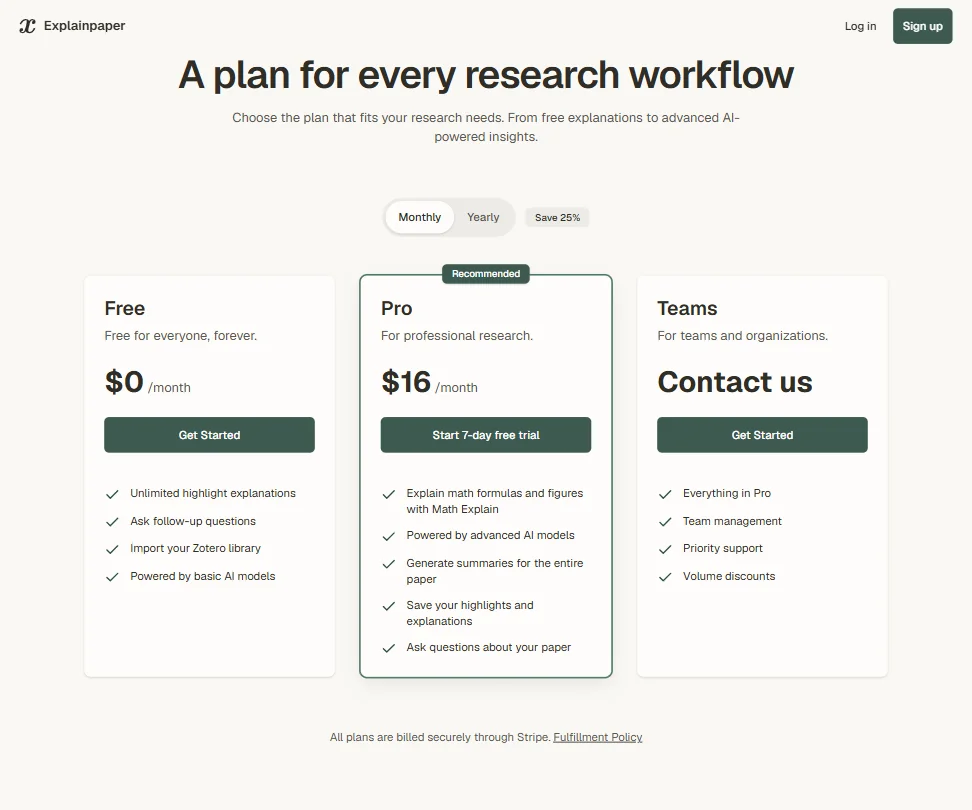
The Free plan covers unlimited highlight explanations and follow-up questions. Zotero import is included. Basic AI models. For casual or occasional use, hard to argue with.
The Pro plan sits at $16 per month, adding full-paper summarization, access to advanced AI models, saved highlights, and Math Explain for formulas and figures. A 7-day free trial is available before you commit. Separately, Explainpaper does publish a fulfillment and refund policy. Initial Pro purchases carry a 14-day money-back guarantee, provided the request goes in within that window. Renewals are excluded. Billing questions and refund requests route to founders@explainpaper.com.
The Teams plan has no posted price. Contact us. That pattern tends to mean "expensive and negotiable," which is fine for institutions and annoying for everyone else trying to figure out if it fits a budget. Teams also includes priority support, which base Pro doesn't.
$16 is reasonable for a focused tool with a clear use case. Whether it beats pasting sections directly into Claude is a fair question. The Zotero integration and purpose-built interface justify the difference for regular users. For occasional use, probably not.
Explainpaper vs Consensus: Which AI Research Tool Is Better?
These tools are barely competing. Consensus searches academic literature and synthesizes findings across papers. Explainpaper reads a specific paper you've already located. Different jobs.
If your problem is "I have this paper and I don't understand it," Explainpaper wins. If your problem is "I need to know what the research says about X," Consensus wins. Fair.
Where it gets more interesting is SciSpace, which does both to some degree. SciSpace handles highlight explanations and has its own paper discovery layer. Explainpaper's focused simplicity gives it an edge in pure reading comprehension, but SciSpace is a more complete product if you need both functions in one place.
ChatPDF is the most direct competitor. Both tools let you chat with a PDF. Explainpaper's complexity-adjustable explanations, Math Explain, and Zotero integration give it a functional edge there, at least based on what we read across the forums. It also has a longer track record specifically with the research community.
Who Should Use Explainpaper? (And Who Shouldn't)
Grad students working through dense methodology sections. Core fit. The tool exists for the experience of reading a paper that's just slightly above your current fluency, needing someone to translate without forcing you to leave the page.
ML practitioners and biotech researchers who read technical papers occasionally are a solid fit. The Free tier handles that use case without asking for a credit card.
Systematic literature reviewers. Wrong tool. No cross-paper synthesis, no search, no export pipeline. Look at Elicit or Scite for that kind of work.
Research teams with data privacy requirements also shouldn't rely on this. The documentation says nothing about data handling. Disqualifying for certain contexts. Full stop.
Explainpaper Review Verdict
Narrow by design, and mostly honest about it. The highlight-and-explain mechanic works the way you want it to, the Zotero integration is a real workflow improvement rather than a marketing bullet, and the product has grown meaningfully since 2022, adding Math Explain, concept mapping, smart outlines, and whole-paper summaries to what was originally a much simpler loop.
The gaps are real, though. No data privacy documentation is a problem, not a footnote. No mobile app. No export system. No cross-paper synthesis. For a tool heading into 2025, that's a limited surface area relative to where the category is going.
At $16 per month for Pro, it's defensible. Not exciting, defensible. The Free tier actually carries more weight here than the paid upgrade does, which is an unusual thing to say but accurate based on what the Free plan includes.
We'd tell a grad student to use the Free plan without hesitation. We'd tell a research team to think twice before putting anything sensitive through it until the privacy question gets answered somewhere in the public documentation.
How Explainpaper compares
Explainpaper scores 3.3 out of 10 among the paper readers we rate. These two do the same job and are the closest to it, compared on what each vendor publishes.
SciSummary
SciSummary costs $7 a month for its only paid plan; Explainpaper costs $16 a month for its Pro plan. That extra cost does not buy figure reading: SciSummary reads tables and figures inside papers, unlimited on its $7 plan, while Explainpaper does not offer this at all. Explainpaper answers back with a Teams plan for shared access, contact us pricing, which SciSummary does not have.
Pick SciSummary if you want figure and table reading at a lower price.
Pick Explainpaper if you need a shared Teams plan for your group.
Scholarcy
Scholarcy costs CA$13.99 a month for its only paid plan; Explainpaper's Pro plan is $16 a month. Scholarcy answers back with far more built in: it shows whether later papers support or dispute a paper through a Scite.ai integration, pulls data from many papers into an Excel literature matrix, reads tables and figures, and sends RSS or email alerts for new papers, none of which Explainpaper offers. Explainpaper's advantage is a chat style question and answer feature on a single uploaded paper.
Pick Scholarcy if you want citation classification, table extraction and paper alerts.
Pick Explainpaper if you want to chat with and ask questions of one paper.
Frequently Asked Questions
Is Explainpaper free to use?
Yes. The Free plan includes unlimited highlight explanations and follow-up questions, plus Zotero import. Basic AI models are available without paying anything. Pro at $16 per month adds full-paper summaries, Math Explain, and saved highlights, plus access to more advanced models. A 7-day trial is available before committing, and initial purchases carry a 14-day money-back guarantee provided the request reaches founders@explainpaper.com within that window. Renewals aren't covered.
Does Explainpaper work with papers in languages other than English?
The vendor claims multilingual output support. We weren't able to find user reports confirming quality across non-English papers specifically, so treat that claim with appropriate caution. English-language academic papers are clearly the core use case based on the user base and the feedback we aggregated.
Can Explainpaper search for academic papers?
No. Explainpaper is a reader, not a search tool. You upload a PDF yourself or import from Zotero. There's no connection to academic databases. It focuses entirely on helping you understand a paper you've already found, not on finding papers for you.


