Nobi keeps surfacing in Shopify-adjacent product conversations, enough that we started tracking it properly. No G2 listing. No Capterra page. Our research pulls from vendor documentation, Product Hunt threads, and what little third-party commentary exists. Thin signal, honestly. What we found anyway is a tool with a narrow enough focus to be credible, which is more than we can say for half the "AI customer service" category right now.
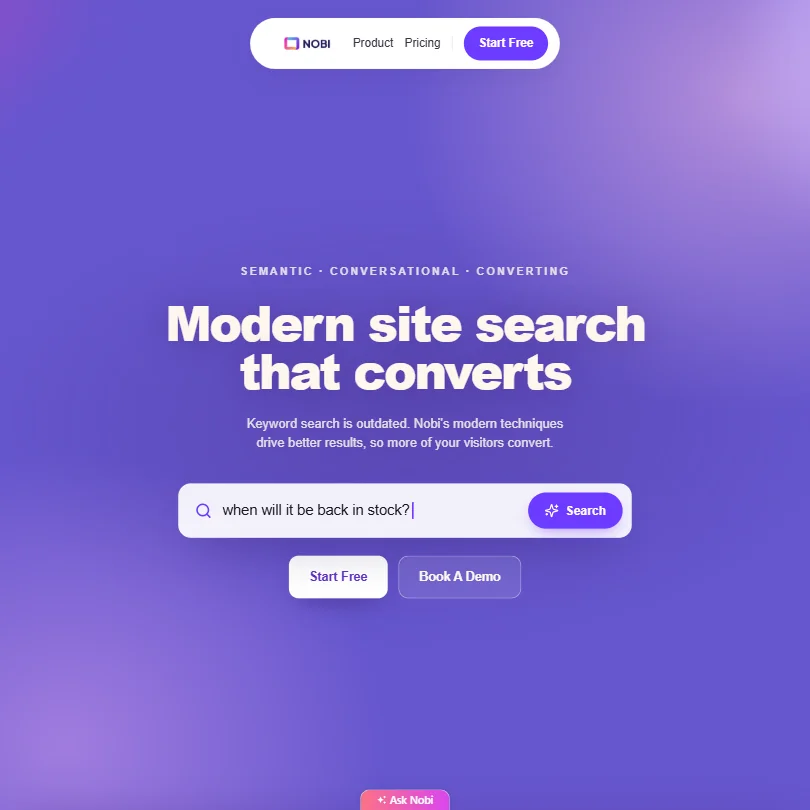
What is Nobi?
Not a helpdesk. That's the first thing to establish. Nobi is a site assistant for ecommerce, combining semantic product search, automated Q&A, and conversational lead capture into a single embeddable widget. It's not positioning against Gorgias or Zendesk, and that restraint is genuinely a point in its favor.
The Shopify native app is the primary entry point. WooCommerce and custom builds are also listed as supported. Their homepage leads with a Lucchese case study claiming over $1M in incremental revenue in year one from improved search. We treat vendor-produced case studies with appropriate suspicion. The A/B test figure from Kilte, 21.7% more conversions against Shopify's native search, at least has a methodology attached. That's more than most vendors bother with.
The angle that genuinely stands out is what Nobi calls its callable Model Context Protocol endpoint. The same deployment powering the website widget can be discovered and queried by compatible external AI agents like ChatGPT or Claude, with no second integration and no separate API configuration required. We cross-referenced this against their documentation and it holds up. Whether the average Shopify merchant has external AI agents calling their catalog today is a fair question, but the architecture is forward-looking in a way we don't see often in this category.
Nobi Features: Semantic Search, Automated Q&A & Lead Capture Breakdown

The semantic search engine is the anchor. It tries to understand intent rather than match keywords literally, so a query like "something red for a casual weekend" surfaces relevant product results instead of a dead-end page. Nobi uses that exact phrase in their positioning, and frankly, they're right that dead-end results pages are a real revenue problem for ecommerce.
Beyond search, the assistant handles repetitive support questions before they become tickets. Knowledge base content pulls from web pages and uploaded PDFs, with automatic refreshes twice daily. Custom actions let merchants trigger workflows from inside the chat window. Reasonable feature set.
No live chat, though. No documented human handover pathway. That's a gap worth flagging plainly. A shopper with a complicated return or a billing dispute will eventually need a person, and the absence of any escalation path in Nobi's documentation is something we kept coming back to. We're skeptical an AI-only flow covers every ecommerce scenario without one.
Lead capture works through conversational prompts rather than static forms. It connects to Facebook and Google Ads pixels. Specific CRM names aren't listed anywhere publicly, which is frustrating. Pixel integrations are named. CRM integrations are not. That asymmetry reads as a documentation gap, not a feature gap, but we can't be sure.
Nobi Search & Assistant Quality: How Well Does It Handle Real Shopper Queries?
No hands-on testing. No G2 or Capterra reviews to aggregate. Harder than usual, this section.
The semantic search framing is credible on its face. A conversational AI tuned specifically for product catalogs is a narrower problem than general customer service bot training, and specialists tend to outperform generalists on narrow tasks. The twice-daily knowledge base refresh is a sensible operational detail. A tool that goes stale hurts more than one that self-corrects regularly.
What we can't verify is edge case behavior. Returns, out-of-stock questions, frustrated customers mid-purchase, none of those scenarios get explicit treatment in the documentation. Without third-party reviews, we're working from inference. That's our honest concern, and we're not papering over it.
Nobi Channel Coverage: Which Store Platforms Does It Support?
Web is the primary surface. Full stop. Shopify gets a native app, which puts Nobi in the same conversation as Searchanise and Boost Commerce for ecommerce search. WooCommerce and headless custom builds are listed as supported. Slack appears in Partner Program documentation, though its role there isn't clearly defined.
No mobile app. No email. No social messaging channels. This is a site widget, and it doesn't pretend otherwise. Fair.
Brands needing omnichannel coverage across SMS and Instagram DMs should look at Gorgias instead. That product is built for exactly that kind of multi-channel ecommerce support load. Nobi isn't competing there and shouldn't be evaluated as if it is.
Is Nobi Easy to Set Up and Manage?
No credit card required to start. 100 free messages per month in the dashboard from day one. That's a genuinely low-friction entry point, lower than most tools we cover in this category.
Configuration covers brand voice settings, knowledge base document uploads, and merchandising rules. Manageable for a small ecommerce team. The Shopify native app means the install itself shouldn't require a developer. Nobi's documentation has grown considerably beyond basic setup notes, covering onboarding, product synchronization, JavaScript components, custom actions, and reporting in meaningful depth. We cross-referenced the current knowledge base and found it substantially more thorough than earlier characterizations suggested.
The callable agent endpoint is a different story. Connecting Nobi's catalog to external AI assistants requires actual API work, and the technical ceiling on that feature will exclude most Shopify merchants who aren't running developer resources. Not a criticism, just an accurate scoping of who can actually use it today.
Nobi Pricing: Is It Worth It for E-Commerce Sellers?

The Standard plan is $25 per month as a base, with 2,500 searches and 250 messages included. After that, overage runs $0.10 per message and $0.01 per search. The plan supports up to 5,000 products and 5,000 knowledge base documents, plus insights and analytics. The free tier covers 100 messages per month, enough to test the product, not enough to run it at any real volume.
Enterprise is custom pricing with volume discounts, dedicated support, custom integrations, and capacity above 5,000 products. Get in Touch, per the pricing page. That's standard for the tier.
No public refund policy. At $25 a month the financial exposure is low, but the absence of any stated terms reads as an oversight. We've seen worse from tools at this price point, but we'd want it addressed before recommending Nobi to anyone running a higher-volume operation.
Searchanise and Boost Commerce both come in cheaper for standalone search functionality, sometimes significantly. What Nobi adds on top is the bundled Q&A, lead capture, and the agent endpoint. Whether that bundle justifies the premium depends entirely on ticket deflection volume. The math works if the automated answers actually replace support contacts. It doesn't if they mostly deflect questions customers would have figured out anyway.
Nobi vs Searchie: Which AI Search Tool Is Better?
Searchie is content-search focused, built for membership sites and knowledge bases, not product catalogs. The overlap with Nobi is narrower than a direct comparison implies. Different problems.
On ecommerce-specific functionality, Nobi takes it clearly. Catalog search, conversational lead capture, and pixel integrations for ad retargeting are all native. Searchie wins if your site is organized around courses or gated content rather than a transactional product catalog.
Boost Commerce and Searchanise are the more honest comparisons in the Shopify search space. Both are cheaper. Neither bundles AI Q&A or the callable agent endpoint. If search is the only problem on the table, those tools are worth pricing out first.
Who Should Use Nobi? (And Who Shouldn't)
Small to mid-size ecommerce brands on Shopify. Especially ones losing sales to failed searches or drowning in repetitive support tickets about shipping and product details.
Brands requiring live chat with human agent handover. Nobi doesn't get you there, and Gorgias remains the more complete answer for ecommerce support operations that need that capability.
Larger operations with complex support workflows will hit the ceiling quickly. No SLA management, no ticket pipeline visibility, no named CRM integrations. Not the right fit. Not great.
Nobi Review Verdict
Nobi does a specific thing with apparent competence. Semantic product search plus automated Q&A for an ecommerce site widget is a defensible product with a coherent use case. The Kilte conversion data is the strongest third-party signal available that the core functionality delivers. We'd be meaningfully more confident if G2 or Capterra reviews existed to corroborate it.
The gaps are real and worth naming plainly. No documented human handover. No named CRM integrations. No public refund policy. The absence of any public review presence at this stage of the product's life is something we flag, not as a dealbreaker, but as context.
$25 a month is reasonable if the ticket deflection materializes. The free tier is enough to find out before spending anything. Start there.
Frequently Asked Questions
Does Nobi work with WooCommerce or only Shopify?
Both are supported, along with headless and custom-built sites. The Shopify native app is the most polished entry point. WooCommerce merchants can embed the widget, though the documentation doesn't go deep on WooCommerce-specific configuration. Expect some trial and error outside the Shopify environment.
Is there a free plan or trial for Nobi?
Both exist. The free plan includes 100 messages per month with no credit card required. That's enough to evaluate the search quality and basic assistant behavior before committing to $25 a month. Low-risk way to test whether the case study numbers translate to your catalog.
What happens when the AI can't answer a customer's question?
Nobi's documentation is quiet on this. No publicly stated human handover pathway, which means the fallback behavior isn't transparent. For brands with complex or high-stakes support interactions, that's worth pressing them on directly, ideally during the free trial before any budget is committed.