Vendor documentation, G2 threads, Reddit complaints, and third-party coverage. That's what we pulled before writing this. What came back was more specific than we expected. Hypotenuse AI isn't a general-purpose writing tool that dabbles in ecommerce. The whole product is built around product content at scale, and that focus is both its strength and its ceiling. Founded in 2021 and headquartered in Singapore, the platform claims a user base of 500,000+. A lot of those are small experimenters. The actual target is catalog-heavy ecommerce teams, not solo bloggers.

What is Hypotenuse AI?
A PIM tool that writes. Most product information management platforms store and organize data. Hypotenuse AI does that, but it also generates content from that data, enriches missing attributes by scraping the web and reading spec sheets, and pushes everything out to Shopify, Amazon, Walmart, and other channels.
Their positioning is AI-first Product Experience Management, or PXM. Mouthful. What it means practically is that a merchant with 10,000 SKUs can pull in raw product data and get descriptions, meta titles, and category pages out the other side without writing a single line manually.
There's also an image layer. Background generation, lifestyle scene placement, bulk photo standardization. That's not something you'd find in Jasper AI, which stays squarely in text territory.
Honestly, the scope here is wider than the homepage suggests on a first skim.
Hypotenuse AI Features: What You Actually Get
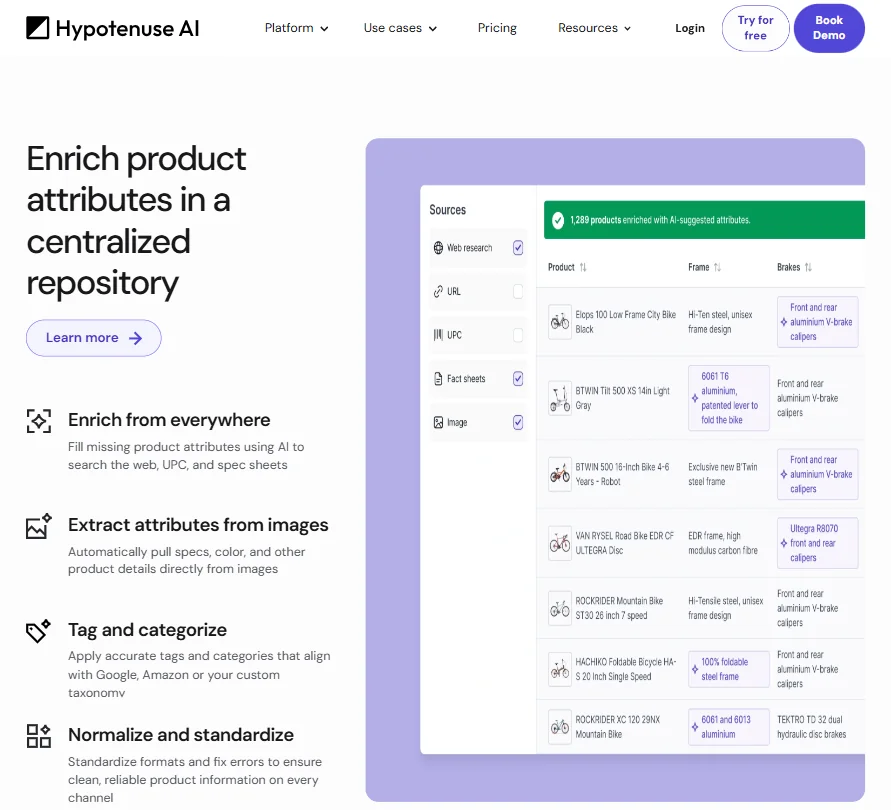
Bulk content generation is the headline act. The platform can produce thousands of unique product descriptions from a single run, and G2 reviewers from ecommerce and retail roles consistently flag this as the thing that actually saves them hours. Not a theoretical ceiling.
The brand voice system goes deeper than most competitors bother with. Custom guidelines get fed into the model and the AI applies them across the entire bulk output. Not just a tone picker. Actual rules, applied at scale, which is the part enterprise customers are actually paying for.
On the SEO side, the platform offers keyword suggestions and rank tracking across Google, Amazon, and Walmart. We cross-referenced their docs and found the rank tracking extends to AI search engines, framed as GEO monitoring. Whether that feature is mature or half-baked is hard to say without hands-on access. We're mildly skeptical of AI-search rank tracking from any vendor right now, frankly.
Then there's Content Detective. It searches the web, UPC databases, and spec sheets to fill product attributes missing from the source data. Genuinely useful for retailers inheriting messy catalogs from distributors. We kept seeing this mentioned positively in reviews from operations-side users, which tells you something.
The image tools sit under HypoArt. AI background generation and lifestyle placement are designed to replace studio photography for catalog images. Bold claim. We haven't verified output quality ourselves.
Integration coverage is solid on the commerce side, with Shopify and Amazon as the main connectors. There's also a REST API, though it's built for developers and requires integration work. The "no coding involved" wording on the homepage refers specifically to connecting supported commerce platforms, not to the API itself. Worth keeping straight. No Chrome extension confirmed, no Zapier listed.
Hypotenuse AI AI Output Quality: Is It Good Enough?
Their model is proprietary, described as a fine-tuned GPT-based system. Base capability is GPT-level, but the fine-tuning targets product copy rather than general prose. That distinction matters in bulk workflows.
The G2 pattern is what we'd focus on here. A credible number of reviews, not a manufactured handful, and not the single Capterra entry showing a perfect score. Ignore that Capterra number entirely.
What we kept seeing in those G2 reviews: complaints about repetition, insufficient detail, and glitches. Some reviewers flagged limited outline options and content that still needed extensive revision before it was usable. Pricing frustration came up more than once too. That's a consistent pattern, not just a few outliers.
Praise, when it appeared, centered on output that stays on-brand across large runs. That matters for bulk workflows, where even a 20% editing rate on 5,000 descriptions kills the time savings. Reviewers in retail and fashion specifically mentioned quality holding up across large batches, which is the real test for this kind of platform.
That tracks. Fine-tuned models optimized for consumer goods are going to struggle outside their training range.
Hypotenuse AI includes an integrated plagiarism checker on eligible plans, powered by Copyscape. It's accessible from the blog editor. Not universally available across all tiers, so check what your plan actually covers before assuming it's there.
Is Hypotenuse AI Easy to Use?
Web-only. No desktop app. Fine for a catalog workflow that runs in the background, less ideal if you want to write inline while browsing your storefront.
The bulk generation flow is reportedly straightforward. Import your product feed, map your fields, set your brand voice rules, run the batch. That's the loop. Several G2 reviewers in content manager roles described onboarding as faster than expected for a tool this complex.
Where it gets heavier is the PIM layer. Once you're enriching attributes, mapping custom fields, and setting up channel-specific outputs for Amazon versus Shopify, the complexity stacks up fast. This isn't something you hand to a freelance copywriter on day one.
There's a help center and email support. No live chat confirmed. No community forum we could find. For a platform targeting enterprise catalog teams, that support structure feels thin. That's a real concern, not a minor quibble.
Hypotenuse AI Pricing: Is It Worth the Cost?
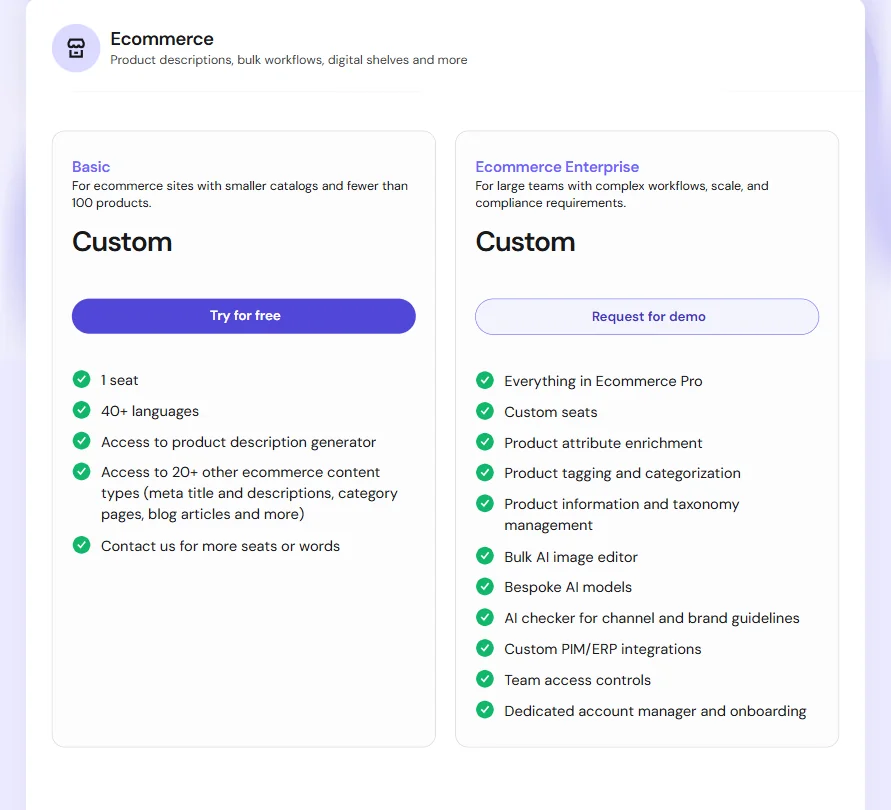
Nothing public. Seriously. No starting price, no plan tiers, no numbers anywhere on the pricing page. Enterprise requires a demo booking. Even the free trial has no stated duration.
Pricing opacity at this level is a deliberate choice. It usually means the numbers are high enough to scare off the wrong buyer before a sales conversation happens. We don't know if that's true here. We don't buy that it's purely about "customized plans" either. The lack of any public anchor price is a real friction point for buyers doing independent research, and it makes comparison shopping against flat-rate alternatives like Jasper or Writesonic genuinely harder.
The free trial exists, which is something. Use it before committing to any sales conversation. At minimum, run a sample catalog through bulk generation and evaluate the brand voice output before talking numbers.
Hypotenuse AI vs Jasper AI: Which Is Better?
These two aren't competing for the same buyer. Jasper is built for marketing teams writing campaign copy, blog content, and ads. Hypotenuse AI is built for catalog teams managing thousands of product records. Different jobs.
Jasper has more templates for ads and social content, a larger ecosystem, and, critically, published pricing. Those things matter depending on what you actually need.
Hypotenuse AI wins on product data enrichment and bulk catalog output. Not a close comparison. Jasper doesn't have Content Detective. It doesn't have a PIM layer. It doesn't push to Amazon and Walmart natively. A merchant trying to solve a catalog problem in Jasper would be building that workflow themselves, or patching it together with other tools.
For teams that want general marketing content rather than catalog copy, Jasper fits better. Fair. That's just an honest read of what each product actually is.
Who Should Use Hypotenuse AI? (And Who Shouldn't)
Ecommerce catalog teams. That's the fit, full stop. Anyone managing hundreds or thousands of SKUs across multiple channels, needing content that stays on-brand without manual editing at each step.
Retailers migrating from a legacy PIM to something that actually writes content, not just stores it. Marketplace sellers who need Amazon-formatted listings without reformatting everything by hand. Those are the obvious fits.
Content marketers writing blogs. Not the right tool. Koala AI is worth a look if long-form SEO articles are the actual problem. Hypotenuse AI's long-form output exists, but it's clearly not the reason anyone buys this.
Solo sellers on small Shopify stores. Probably not the right fit, given pricing opacity that strongly suggests this isn't priced for low-volume operations.
B2B companies with technical catalogs, unusual part numbers, complex spec sheets. Content Detective could help, but the fine-tuning skews toward consumer goods and output quality in technical categories is reportedly inconsistent across reviews.
Hypotenuse AI Review Verdict
Focused product, clear job. For catalog-heavy ecommerce teams, it does something genuinely hard, connecting product data enrichment to content generation to channel publishing in a single workflow. Not nothing.
The pricing secrecy is the biggest problem for independent research. It puts a sales relationship between the buyer and basic fit evaluation. That's a real barrier, not a minor inconvenience.
G2 patterns suggest the platform delivers on its core bulk generation promise for the right buyer, while also surfacing consistent complaints about repetition, revision burden, and glitches. Both things can be true. What we'd want before recommending this confidently is a public price anchor, clearer plan-level documentation on the plagiarism checker, and more transparency on how mature the GEO monitoring actually is.
There's a genuinely good product somewhere in here. The opacity makes it harder to say that without qualification.
Frequently Asked Questions
Does Hypotenuse AI have a free plan?
No free plan. There is a free trial, though Hypotenuse AI doesn't publicly state how long it lasts. Use it to run an actual batch of product descriptions with your own catalog data before going any further. That's the only way to evaluate output quality at your specific scale.
What ecommerce platforms does Hypotenuse AI integrate with?
Shopify and Amazon are the primary confirmed integrations, with Walmart also listed. There's a REST API for custom builds, but it's built for developers and requires integration work, not the no-code connection the homepage implies. Zapier support isn't confirmed, so verify that directly before signing anything.
Is Hypotenuse AI good for writing blog content?
It can generate blog content. That's not why people buy it. The platform is built around product data and catalog workflows, and the G2 reviews reflect that use case almost entirely. Blog writing at scale has better-suited tools. Hypotenuse AI's value is in bulk product descriptions and PIM enrichment, not editorial content.