
Two years old and already selling to procurement teams at banks. That's the short version.
We pulled together vendor documentation, third-party coverage, and whatever community threads existed when putting this together. Independent review data is nearly nonexistent for Lyzr, which tells its own story. What we kept seeing in the documentation was a company that launched in 2023, moved fast, and is pitching regulated industries on something genuinely different from the standard agent builder: a governance wrapper sitting above whatever AI infrastructure you've already built.
What is Lyzr?
The product Lyzr leads with now is the Control Plane, the governance layer that sits above agent frameworks rather than replacing them. The premise is that most large enterprises aren't short on AI tooling. They're short on ways to audit, control, and enforce policy on what that tooling does once it's running.
Agents built on LangChain or CrewAI, or on Lyzr's own stack, run through this layer. Every decision gets logged. Every output can be flagged. Policy rules determine whether an agent blocks, reroutes, or escalates a given response.
That's the pitch. We haven't tested it hands-on.
Customer support and HR are the most prominently featured use cases on the site. Banking, insurance, and procurement get dedicated landing pages. That signals where the actual enterprise sales conversations are happening, and it isn't with 10-person startups.
Lyzr Features: Workflows, AI Agents & Automation Capabilities

The named modules are Agent Studio, an Orchestration layer, a Knowledge Base module, and a Knowledge Graph for structured data handling. Agent Studio is the visual workspace for designing and deploying agents. The Knowledge Graph is the more technical layer for enterprises with complex, interconnected data.
The Control Plane sits above all of it. Configurable policies can block, flag, or reroute agent outputs based on rules you set. Immutable audit logs track every tool call and every user interaction, with timestamps. That's the piece regulated industries are presumably paying for.
Hallucination detection is built in. So is PII masking. Both are presented as native features of the governance layer, not add-ons you configure separately.
Honestly, the feature surface is large for a two-year-old company. That's either impressive engineering or a roadmap that's still catching up to the marketing. We're genuinely not sure which.
Multi-LLM support covers GPT-4o and Claude as the headline models, plus Gemini through GCP Vertex AI. Open-source options including Llama and Mistral sit behind the same picker, and a few others round out the list.
Lyzr Automation Power: How Complex Can Your Workflows Get?
Triggers come in four forms. Webhooks, API calls, scheduled runs, and event-driven execution. That covers most enterprise automation scenarios without obvious gaps.
The policy engine is where the differentiation story gets specific. Rules can be configured at the agent level, the tool level, or the data level. An agent running a loan origination workflow can be set to escalate any decision above a defined risk threshold to a human reviewer. That's the human-in-the-loop configuration they describe, and the design logic is sound. Whether that granular policy control actually holds at real production scale is the question we can't answer from the outside.
Custom stacks are supported. If your team is already running LangChain or CrewAI workflows, Lyzr claims to wrap around them rather than require a rip-and-replace. We're skeptical of that working perfectly in practice, but it makes sense as a positioning move against frameworks that don't offer a comparable governance layer.
Simulation testing is listed as part of the error handling setup. Adversarial testing before deployment. Six Sigma reliability scoring. Specific enough claims that they're worth asking a sales rep to actually demonstrate rather than taking at face value.
Lyzr AI Agent Capabilities: What Can It Actually Do Autonomously?
Pre-built templates cover sales development reps, KYC processing, claims processing, employee onboarding, and supplier sourcing, and a few others. The library is broad for a platform this young.
Multi-agent coordination is supported. Agents can hand off tasks to other agents, which matters for complex workflows where a single agent can't hold all the necessary context in one session.
The Sovereign AI and air-gapped deployment options are the most interesting and the most niche features in the stack. Regulated industries with strict data residency requirements, think government agencies and large financial institutions, need agents that never touch a shared cloud. Lyzr's positioning here is deliberate and reasonably well-developed for a company this size.
We'd like to see independent case studies documenting what these agents actually do in production. The testimonial section on their site exists. That's not the same thing. Fair, but we've seen worse evidence bases for a platform two years old.
Is Lyzr Easy to Set Up Without Code?
This is where the research gets thin. No G2 listing, no Capterra page, and nothing useful on Trustpilot. That's not unusual for an early-stage enterprise product, but it means we're working almost entirely from vendor documentation, which is an uncomfortable position for a review.
The Agent Studio visual builder is positioned as the no-code entry point for designing, building, testing, and deploying agents in a single workspace. Interface screenshots suggest a canvas-style workflow designer, familiar territory for anyone who's used a modern automation tool.
That said, the broader platform is clearly technical. Multi-environment policy enforcement, RBAC at the tool and data level. These are not features a non-technical buyer configures alone. Lyzr is not trying to be Zapier. The setup complexity is priced into the product, even where the price isn't yet publicly visible.
Someone on your team will need to own this implementation. Not a criticism. A category reality.
Lyzr Pricing: Is It Worth It vs Zapier or Make?
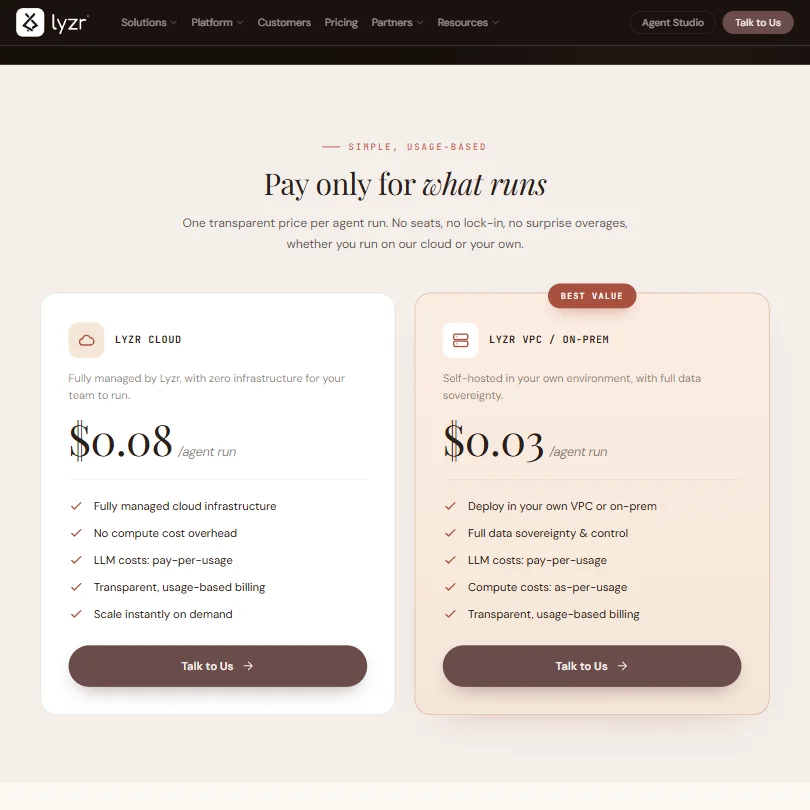
Not invisible, as it turns out. Lyzr now publishes usage-based pricing starting at $0.03 per agent run, although it also offers Agent Studio subscription tiers, including a free Community plan and a $19 Starter plan. The pricing page breaks into two options. The cloud-hosted plan runs at $0.08 per agent run, fully managed with no compute cost overhead and LLM costs billed pay-per-usage on top. The VPC or on-premises plan, tagged as best value on the page, runs at $0.03 per agent run, self-hosted in your own environment, with compute costs also billed as-per-usage.
Both options use transparent, usage-based billing. Neither shows a subscription floor or a minimum commitment.
Usage-based pricing at the agent run level is a meaningful structural choice, one that makes costs unpredictable at scale without good run volume estimates. That's the question to bring to the sales call: what does a realistic monthly run count look like for your use case, and what does that translate to in dollars.
We still can't tell you whether Lyzr costs more or less than Agentforce or Vertex AI Agents across a comparable enterprise deployment. The per-run figure is a starting point, not a budget answer.
Lyzr vs Agentforce: Which Automation Platform Wins?
Lyzr published an "Agentforce Alternative Playbook," which tells you exactly where their sales team is fishing.
The comparison is coherent. Agentforce is deeply embedded in Salesforce's CRM ecosystem. It's powerful if you're already Salesforce-native and if your AI use cases live in sales and service. Lyzr's argument is framework-agnostic governance sitting above your existing agent infrastructure, not a replacement for it. For a company already running Agentforce, Lyzr could theoretically be a layer on top rather than a competitor. Compelling integration story or confusing one, depending on your architecture.
Against LangChain, Lyzr has the better governance story. LangChain is a developer framework. It doesn't audit itself. Against Microsoft Copilot Studio, Lyzr has the cloud-agnostic argument. Azure-native shops will default to Copilot Studio. Multi-cloud shops will find Lyzr's coverage across AWS Bedrock, GCP Vertex AI, and Azure more useful.
That flexibility is real. Whether the governance layer is mature enough to justify switching or layering is harder to say without user feedback at scale. Not great on that front right now.
Who Should Use Lyzr? (And Who Shouldn't)
Regulated industries. Banking and insurance teams that need audit trails and PII masking built into agent infrastructure, not bolted on. Healthcare and government use cases where data sovereignty isn't optional.
Large enterprises already running multiple AI frameworks are the other clear target. LangChain in one business unit, CrewAI experiments in another, no unified governance layer over either. That's a real problem Lyzr is designed to address.
Small teams. Not the fit. Anyone who needs pricing transparency before booking a demo. Also not the fit. Teams whose AI use cases live entirely inside Salesforce or Microsoft's ecosystem already. Probably not worth the complexity here.
Lyzr Review Verdict
The governance problem Lyzr is solving is real. Enterprises deploying AI agents at scale genuinely need audit trails, policy enforcement, and human-in-the-loop controls, and most agent frameworks don't provide those natively.
The platform is technically deep for its age. Immutable audit logs, simulation testing, and sovereign deployment options are features most competitors haven't thought through as carefully. The multi-LLM flexibility is genuine. The per-run pricing structure is now visible, which helps.
The independent review trail is still nearly empty, and that's the real limitation at this stage. You're trusting vendor documentation more than you'd want to. The per-run pricing gives you a starting figure but not a budget answer. That's the reality right now. The product is pointed in the right direction. The evidence base needs to catch up.
Frequently Asked Questions
Does Lyzr have a free plan or free trial?
A free Community plan is listed on the site. A free trial isn't mentioned either. The pricing page shows usage-based options for cloud and VPC deployments, and Agent Studio also offers a self-serve free Community plan and a $19 Starter plan. If you need to fully evaluate the platform before talking to a rep, the current setup doesn't make that easy.
What LLMs does Lyzr support?
GPT-4o and Claude are the headline options. Gemini is supported through GCP Vertex AI. Open-source models including Llama and Mistral are available through the same multi-LLM picker, and a few others round out the roster. The multi-provider design matters for enterprises that have procurement preferences or need to optimize costs across different workloads without being locked to a single provider.
How does Lyzr handle data security and compliance?
This is where Lyzr's positioning is most specific. Sovereign deployment and air-gapped options are available for regulated industries with strict data residency requirements. PII masking and immutable audit logs are listed as native Control Plane features, not optional add-ons. Whether those features hold up under real compliance scrutiny is something your legal and security teams need to verify independently before any contract is signed. We're not in a position to assess that from the outside, and neither is any review site.