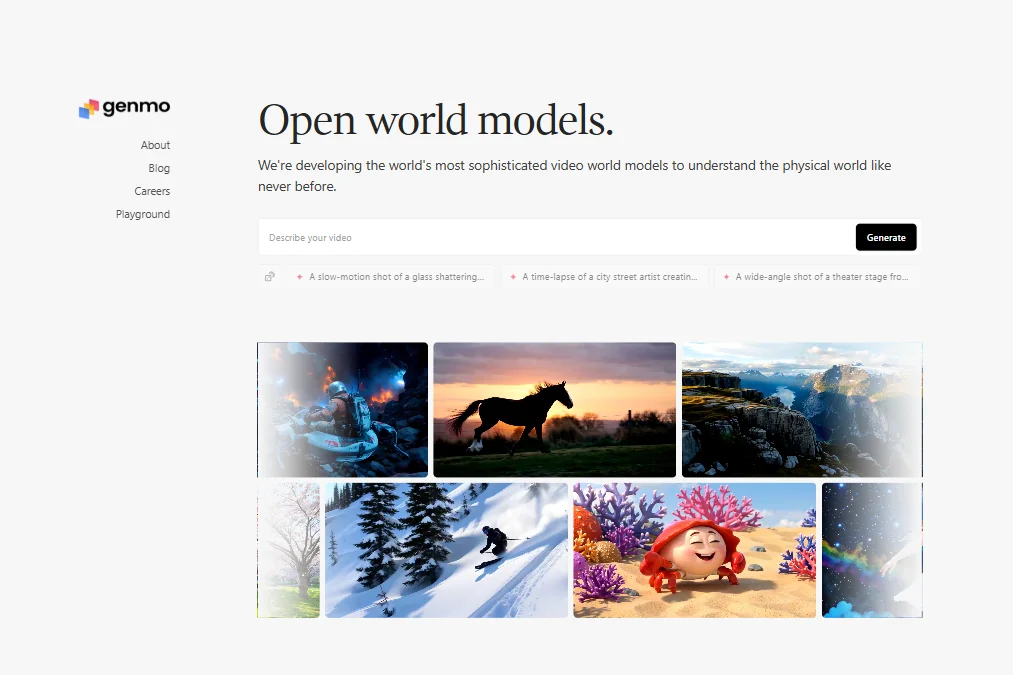
Genmo is the research lab behind Mochi 1, an open-weight text-to-video model you can either run in Genmo's web playground or download and run yourself. The playground is simple and inexpensive, but it makes short, silent clips from text alone, so it is closer to a way of trying the model than a full video tool.
What is Genmo?
Genmo builds video generation models and publishes them openly. Its one model, Mochi 1, is available two ways: as a hosted playground on genmo.ai that you sign into with Google or Discord, and as downloadable weights on GitHub and Hugging Face that developers can run locally, customise or load into ComfyUI.
Genmo's model
- Mochi 1 (latest, and the only model): open-weight text to video, clips of up to 5.4 seconds at 30 frames a second, 480p as standard with higher resolution on paid plans.
Genmo does not offer other companies' models in the playground.
What you can make with Genmo
You write a prompt and Mochi 1 returns a short clip. Genmo's help center recommends describing camera angles and movement in the prompt, and that is the main way to direct a shot. Image to video is listed as coming soon, so you cannot yet start from a picture or set a first and last frame, and there is no way to extend a clip past its length.
Mochi 1 generates video without sound, and the playground has no voiceover, captions, lip sync or editing tools. Anything beyond a single clip, such as sound, titles or cutting several clips together, happens in other software.
For developers the open weights are the main attraction: Mochi 1 can run on your own hardware with no per-clip cost and no content leaving your machines.
Genmo pricing: what each plan makes

Each Mochi clip in the playground costs 100 credits. The free plan gives 250 credits once, unlocked by adding a payment method that is not charged, which covers two clips, and they carry a Genmo watermark.
Lite costs $10 a month ($8 a month billed yearly) for 1,200 credits, about 12 clips, with no watermark, commercial use and high queue priority. Standard costs $30 a month ($25 billed yearly) for 5,000 credits, about 50 clips, with the highest queue priority and early access to new models. On both plans the balance resets to the monthly allowance each month rather than rolling over.
Because each clip is at most 5.4 seconds, a ten-second shot is not possible in a single generation on any plan.
Privacy and support
Genmo's privacy policy says it may use the prompts, images and videos you provide or generate to train and develop new models, and it describes no opt-out. Running Mochi 1 from the open weights avoids this, since nothing is sent to Genmo.
Support is by email at hi@genmo.ai, with a short help center and a Discord community.
Who Genmo suits
Genmo suits developers and researchers who want an open video model to run, study or build on, and who can use the playground to test prompts before running Mochi 1 themselves. It also works for anyone who wants a cheap way to make short silent clips from text.
It suits less well creators who need image to video, sound, clips longer than a few seconds or high resolution, all of which other generators offer in one account.
How Genmo compares
Genmo scores 4.2 out of 10 among the AI video generators we rate. These three do the same job and are the closest to it, compared on what each vendor publishes.
Runway
Genmo makes silent clips from text only, at most 5.4 seconds long, with no image upload, camera control or extend tool. Runway generates sound and speech through Veo 3.1, animates an uploaded image and extends a clip past its end through Grok Imagine. A working month of 20 ten-second clips costs $30 on Genmo's Standard plan, counting two clips per ten seconds, against $95 on Runway's Max plan.
Pick Runway if you need audio, uploaded images or clips longer than 5 seconds.
Pick Genmo if you only need short silent clips from text at the lowest cost.
Luma AI
Genmo makes silent clips from text only, at most 5.4 seconds long, with no image upload or extend tool. Luma AI's Ray3.2 animates an uploaded image, takes first and last frames and extends clips, and its Modify Video restyles footage up to 20 seconds. A working month of 20 ten-second clips costs $30 on Genmo's Standard plan, counting two clips per ten seconds, against $90 on Luma AI's Pro plan.
Pick Luma AI if you want image-to-video, longer clips or lip sync.
Pick Genmo if you only need short silent clips from text at the lowest cost.
Kling AI
Genmo makes silent clips from text only, at most 5.4 seconds long, with no image upload or camera control. Kling AI's VIDEO 3.0 generates sound and speech with the picture, animates an uploaded image and outputs up to 4K. A working month of 20 ten-second clips costs $30 on Genmo's Standard plan, counting two clips per ten seconds, against $32.56 on Kling AI's Pro plan.
Pick Kling AI if you want audio, native 4K or image-to-video at a similar price.
Pick Genmo if you only need short silent clips from text at the lowest cost.
Frequently Asked Questions
Is Genmo free?
The playground's free plan gives 250 credits once, about two watermarked clips. Mochi 1 itself is open-weight and free to download and run on your own hardware.
What is Mochi 1?
Mochi 1 is Genmo's open-weight text-to-video model. It makes clips of up to 5.4 seconds without sound and is available on GitHub and Hugging Face as well as in Genmo's playground.
Can Genmo turn an image into a video?
Not yet. Genmo lists image to video as coming soon; today the playground works from text prompts only.
How many videos do you get on Genmo's plans?
About 12 clips a month on Lite and 50 on Standard, at 100 credits a clip. The free plan covers two.