Our research into eesel AI started the usual way: vendor docs first, then the forums, then pricing page archaeology. The Sydney-based startup has been running since 2021, quiet in a way that either signals heads-down product work or a thin PR budget. Probably both. What we found was a tool that does a specific job genuinely well, priced in a way that's actually readable, with real gaps in the places you'd notice most.

What is eesel AI?
eesel AI builds autonomous AI agents. Not chatbots that hand off after two turns. Actual agents that sit inside the tools you already run, handle tickets start to finish, and escalate only when they're out of their depth. The company positions itself as an add-on layer, not a replacement for your helpdesk.
The agent ingests your existing knowledge. Confluence docs, Notion pages, past tickets, help center articles. Years of accumulated company knowledge becomes usable on day one, according to their docs. That claim tracks with what we saw in customer case studies. A logistics SaaS running 717 knowledge items through Salesforce and Slack. Ecosa handling 10,000 tickets a month across multiple markets. Smava, a German fintech and online lending company, running a fully automated German-language Zendesk agent processing more than 100,000 tickets per month. Those numbers are big enough to take seriously.
The user base sits at 1.2M+ supported users across their customer base. That's not eesel's own users. That's the end-customers their clients are serving. Worth the distinction.
eesel AI Features: Chatbot, Helpdesk & Support Automation Breakdown
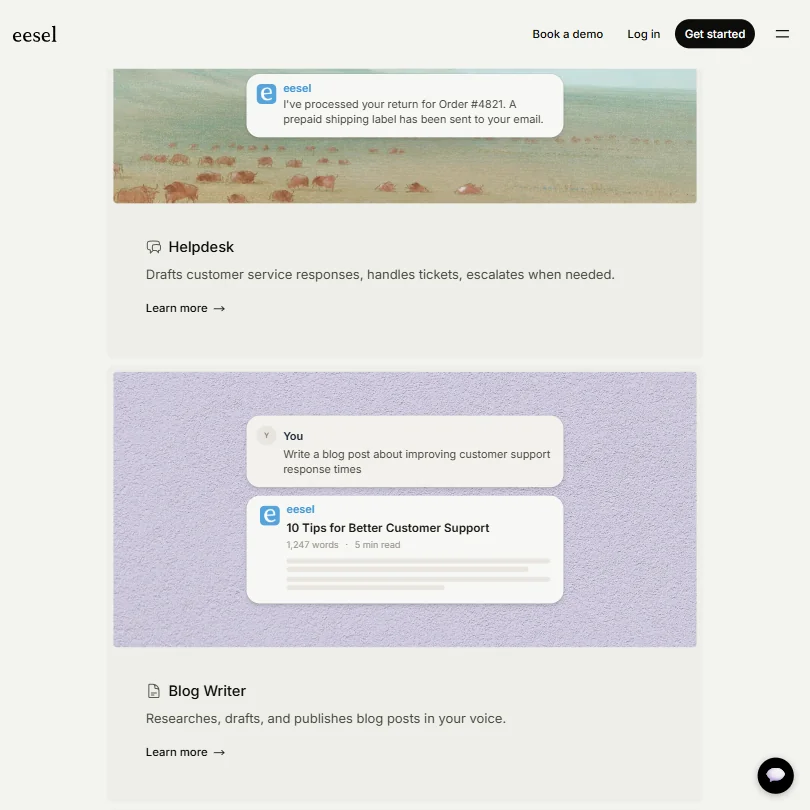
The core product is the agent. It drafts replies, resolves tickets, and sends them. No human in the loop unless confidence drops below a threshold. When it does drop, the agent either escalates or queues a draft for a human to approve. That draft mode option is the right call, and more tools should default to it.
On the knowledge side, it ingests from Confluence and Notion, Google Docs and SharePoint too. The AI can also be coached directly. You tell it your tone, your rules, how you handle refunds. It follows through. We've seen this feature described generously by vendors before and then quietly fall apart in practice, but nothing in the reviews we found contradicted eesel's claims here.
Multilingual support is automatic. The agent responds in whatever language the customer writes in. No routing rules needed. That's useful for any team with a cross-border customer base. Ecosa's case study makes this concrete: multiple markets, one setup.
Email ticket handling, Shopify integration, and an open API round out the feature set. SLA management isn't publicly documented. Sentiment analysis is included, through scheduled ticket-trend reports. Those gaps matter if you're running a team that reports on that stuff. Honestly, for most SMBs they probably don't.
eesel AI Bot Quality: How Well Does It Handle Real Customer Queries?
eesel runs on GPT-4 and Claude under the hood, with their own orchestration layer on top. The underlying models are solid. The orchestration is where the real question sits, and that's the part we can't independently verify without hands-on testing.
What we can say: the case studies point to high resolution rates. Smava's Zendesk deployment is fully automated at over 100,000 tickets a month. That's not a pilot. That's production scale. We're skeptical of case studies as a category, but the specificity here is harder to dismiss than a generic "80% resolution rate" headline.
The coaching system is the feature we'd watch closely. Being able to correct the agent's tone and inject process rules directly is what separates a useful AI from one that confidently gives wrong answers in the right font. Whether eesel's version of this actually sticks across edge cases is something we'd test in hands-on review.
eesel AI Channel Coverage: Which Platforms Does It Support?
Coverage is broad. Zendesk and Freshdesk are the obvious anchors. Intercom too. Beyond helpdesks, there's Slack and Microsoft Teams for internal use, and a few others covering IT and enterprise-adjacent workflows.
The Slack use case is worth a mention. BitGo uses eesel as an internal Slack teammate, surfacing docs and answering team questions instantly. That's a different kind of deployment than customer support, and it's genuinely useful. Two distinct use cases from one product without requiring two separate setups.
HubSpot isn't listed publicly. Zapier isn't either. The open API covers some of that gap, but teams who live in HubSpot may need to check with sales before committing. That tracks with what we'd expect from a 2021-vintage startup still building out the integration map.
Is eesel AI Easy to Set Up and Manage?
They claim under 30 minutes, no code required. We couldn't verify that from the outside, but the product's architecture makes it plausible. You connect your apps, point it at your knowledge sources, brief it like a new hire, and it runs. No custom dev work in the documented setup flow.
The "brief it like a teammate" framing is either the best onboarding concept in this category or a bit of marketing gloss. Probably both. The idea is sound. Whether a real operations manager can get a well-behaved agent out of a 30-minute briefing session depends heavily on how well-organized their existing documentation is.
Support is handled by eesel's own bot. Which is either cheeky or a confidence move, depending on your mood. There's email support and a basic docs site. No community forum. For a tool targeting SMBs and mid-market teams, that's thin when something goes sideways at 2am.
eesel AI Pricing: Is It Worth It for Support Teams?
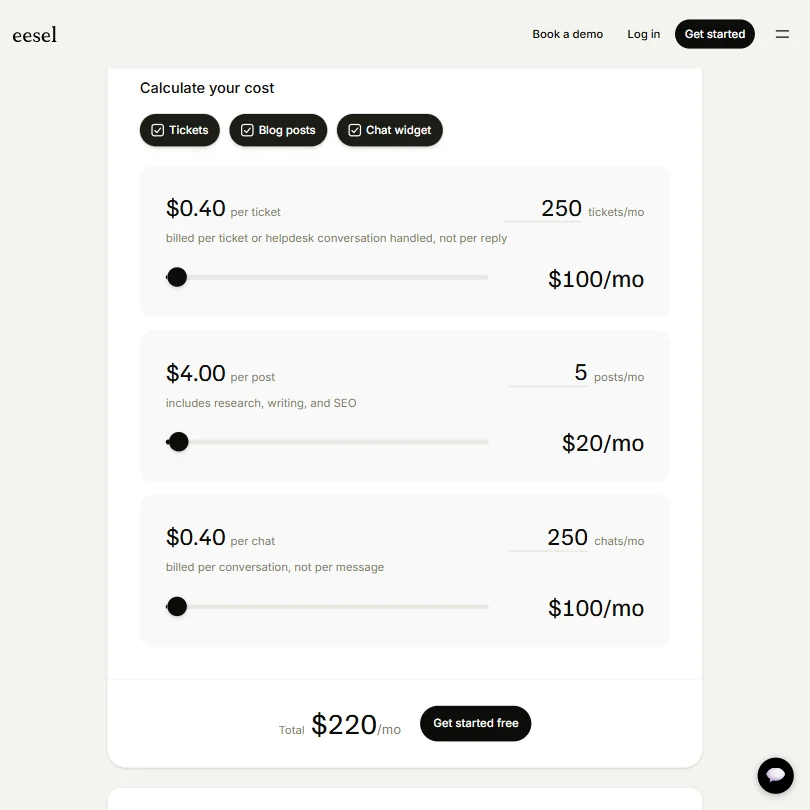
Pay-as-you-go at $0.40 per ticket, per chat conversation, with blog post generation sitting at $4.00 per post. No platform fee at the base tier. No per-seat charge. That's genuinely unusual in a category where competitors love to stack fees.
The usage credit gives you $50 and requires no credit card, with all features unlocked from day one. Not a hobbled trial. Fair. One thing to flag: eesel's Terms define the standard trial period as seven days, extendable once to a maximum of 14 days. The pricing page doesn't surface that clearly, which creates a real inconsistency between the marketing copy and the legal terms. Worth confirming before you build a testing plan around it.
At volume, an annual commit gets you 25% off from $300 a month. Enterprise adds a $1,000 monthly platform fee on top of usage. For comparison, Fin from Intercom runs on a per-resolution model that can climb fast. eesel's per-ticket structure is more predictable for teams with stable volumes, less so for teams with spiky seasonal demand where a bad month could spike costs without warning.
Refund policy isn't public. Annoying. Not unusual, but still annoying.
eesel AI vs Intercom Fin: Which Customer Service AI Wins?
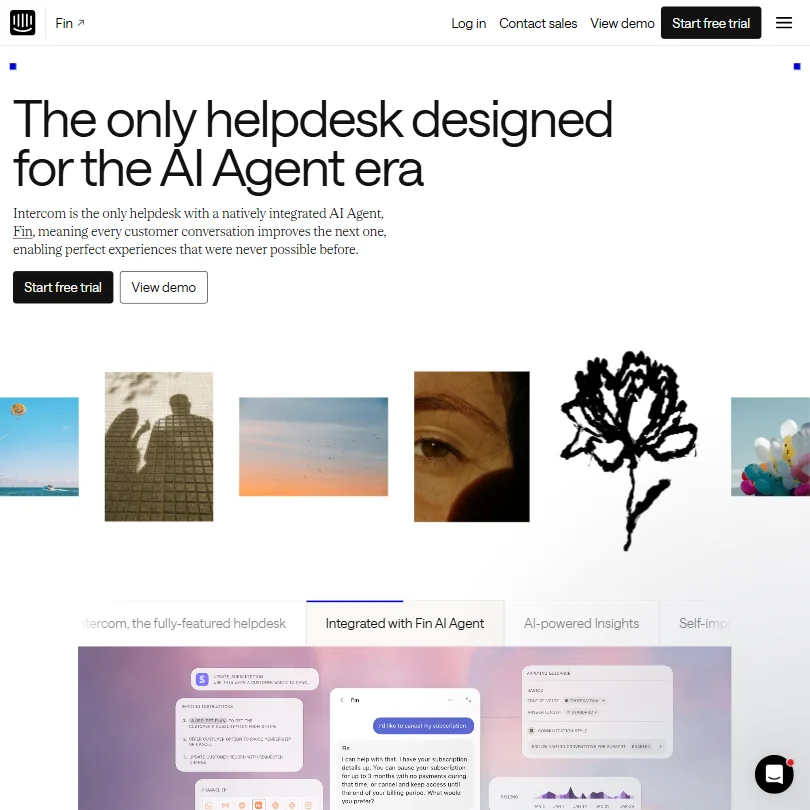
Fin is the obvious comparison. Intercom built it on top of their existing platform, which means it inherits a lot of Intercom's infrastructure. That's an advantage if you're already on Intercom. A drawback if you're not, because you're buying into a bigger system than you might need.
eesel's pitch is the opposite. It lives inside whatever you already have, Zendesk or Freshdesk or Slack, without requiring a platform migration. The pricing philosophy differs too. Fin's per-resolution model and eesel's per-ticket model look similar on the surface but behave differently at scale. Fin also carries Intercom's brand weight, which matters for procurement conversations at larger companies.
For teams not already on Intercom, eesel is a more flexible entry point. For teams inside the Intercom ecosystem, Fin probably wins on integration depth alone. That's the honest split.
Who Should Use eesel AI? (And Who Shouldn't)
SMBs and mid-market teams already running Zendesk or Freshdesk. Fast setup, no seat fees, handles ticket volume without headcount. Ecommerce teams on Shopify with multilingual customers. The Ecosa deployment makes that case better than we could.
Enterprise teams on Salesforce who want to add AI without replacing their stack. The Salesforce Service Cloud integration is real. The $1,000 platform fee at that tier is real too.
Teams that need deep analytics and SLA reporting built in. Not the right fit here. That capability isn't documented, and absence of documentation usually means absence of feature. Teams who live in HubSpot should verify integration support before starting a trial. And anyone who needs 24/7 live human support from their vendor is probably looking at the wrong tool.
eesel AI Review Verdict
eesel does what it says. Autonomous agents, reasonable pricing, real integrations, fast setup. The case studies are specific enough to be credible, and the per-ticket model is genuinely more readable than most of what this category charges.
The gaps are real too. Analytics documentation is thin. Support coverage is light for a product where something going wrong at scale would hurt. The review footprint on G2 and Capterra is essentially zero, which makes it hard to triangulate the vendor's claims against independent user experience. Not a dealbreaker. A data gap.
The pricing model alone is worth a closer look for any SMB running a helpdesk. No seat fees, no mandatory platform charge, real features on the free trial. That's a rare combination. We'd want hands-on time before recommending it over something with a longer review trail, but nothing in our research pushed us away from it either. Teams considering Botpress for a more build-it-yourself approach should know eesel sits at the opposite end of that spectrum: configured rather than coded, ready faster but with less customization ceiling.
Worth a trial. Genuinely.
Frequently Asked Questions
Does eesel AI work without replacing my existing helpdesk?
Yes. That's the core design decision. eesel sits on top of Zendesk, Freshdesk, Intercom, and others rather than replacing them. Your existing ticket system stays in place, and eesel handles the AI layer on top of it.
How does eesel AI pricing compare to paying per seat?
eesel charges $0.40 per ticket on pay-as-you-go, with no per-seat fees at the base tier. That's better for teams with variable support volumes but could get expensive during demand spikes, so it's worth modeling your average monthly ticket count before committing.
Can eesel AI handle support in languages other than English?
Yes. The agent responds in whatever language the customer writes in automatically, with 80+ languages supported. No manual routing or language-specific setup required, which makes it genuinely useful for teams serving cross-border customer bases.