We spent time pulling together what's publicly documented about Dream, cross-referencing their own feature pages with what users say on Reddit, digging through App Store reviews, and parsing the pricing structure carefully. This dream ai review draws on all of that. No hands-on testing yet. What we found is a tool that made a lot of sense in 2021 and is working hard to stay relevant now.

WOMBO launched Dream in 2021 out of Toronto, and it caught on fast. Over 10 million users. The app was everywhere for a few months. It rode the initial wave of consumer AI art curiosity better than almost anyone. That's genuinely impressive.
The question is whether it still earns a spot in the conversation.
What is Dream?
Dream is WOMBO's AI image and video generation platform. It runs on their own proprietary model, not Stable Diffusion or Midjourney's stack. You type a prompt, pick a style, and get an image. Simple loop. They've expanded that loop to include text-to-video generation and what they call image-to-video animation, where you feed a photo in and it moves.
Available on web, iOS, and Android. English only. The mobile-first approach is obvious when you use the web version, which feels like an afterthought by comparison to the apps.
Community gallery is included. You can browse what other people are generating. That social angle is real and it's one of the things that kept casual users around during the early buzz period.
Dream Image Quality: How Good Are the Results?
Honestly, this is where the review gets complicated. Dream's output is stylistically distinctive. Styles like Baroque, Whimsical, Crochet, and Anime produce results that look like Dream outputs. They have a recognizable quality to them. Whether that's a feature or a limitation depends on what you're making.
Reddit threads we found from 2023 and 2024 tell a consistent story. Users describe the art as "dreamlike" (obviously), good for personal projects, and fine for social media. Those same threads consistently note that the outputs look soft compared to what you'd pull from Midjourney on a similar prompt. Not bad. Just not sharp.
The free plan watermarks everything. Standard and Pro remove the watermark and unlock HD export. That matters if you're actually using the files for anything beyond screen sharing.
There's no inpainting, no outpainting, no ControlNet support. No LoRA fine-tuning either. For a certain type of user that's irrelevant. For anyone who's been using AI image tools seriously for more than six months, those omissions land.
Dream Features: Text-to-Image, Video & Editing Tools

The core feature is text-to-image generation with style selection. That part works. Over 100 styles on the picker, including Minimalism, Mechanical, The Cut, and Cinematic. You get aspect ratio control. 4:3 is shown in their interface docs. Prompt customization exists but there's no documented negative prompt support, which surprised us a bit.
Text-to-video is live on Standard and Pro plans. Image-to-video animation too. They apply cinematic and anime styles to video output, which is a differentiator worth flagging. Most tools at this price point are still image-only.
What's missing is worth saying plainly. No API access. No Photoshop plugin. No Canva integration. Nothing that connects Dream to a wider workflow. The tool lives in its own bubble, and that's a real constraint for anyone who wants to incorporate it into something larger.
Batch generation isn't documented. Private generations aren't mentioned anywhere on the public-facing pages. Commercial rights are unclear. That last one matters and we couldn't find a clear answer in their docs.
Is Dream Easy to Use?
Very. That's the strongest part of the product. Pick style, write prompt, generate. Three steps. The mobile apps carry most of that reputation. App Store reviews consistently describe the experience as frictionless, especially for people who aren't technical.
The community gallery adds a browsing layer that makes the app feel more alive than a bare generator. That tracks with how WOMBO positioned the product from the start: social, casual, accessible.
We didn't find significant complaints about the core generation UI. What does come up in reviews is the free tier being restrictive enough that people feel pushed toward paid plans quickly. That's a different problem, not a usability one.
Worth noting. There's no steep learning curve here. That's by design and it's the right call for their audience.
Dream Pricing: Free Plan vs Paid — Is It Worth It?
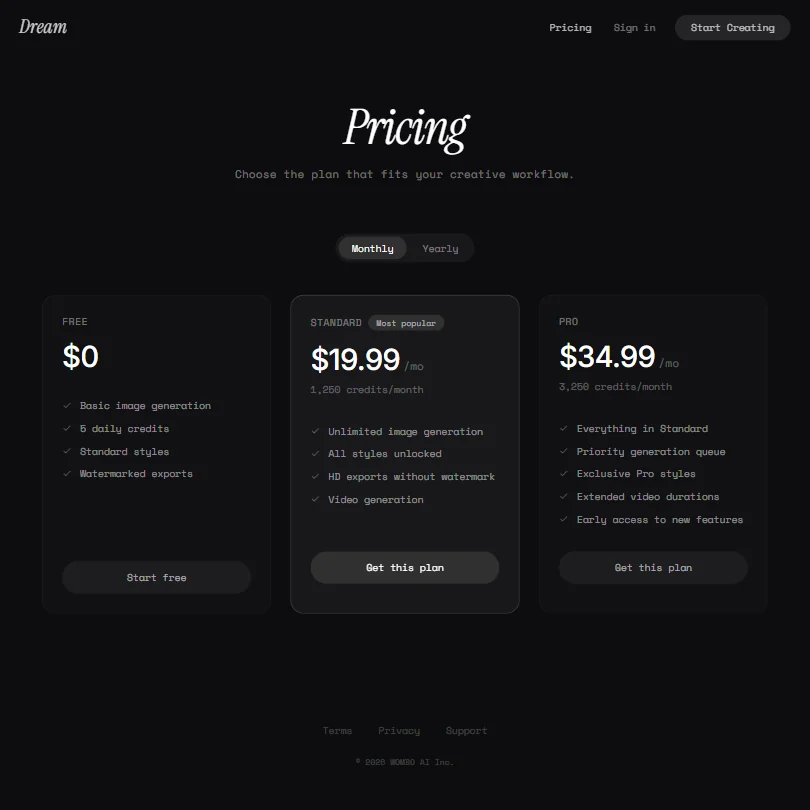
Free plan exists. It gives you access to basic generation with watermarked outputs. Once you want HD images or watermark removal, you're looking at the Standard plan.
Standard runs $8.33 per month billed annually. Pro is $16.67 per month, same billing cadence. Those are reasonable numbers on paper. There's no enterprise tier listed. Dream does publish a refund policy. Refunds are only eligible if no art has been generated using Premium Services during the subscription period, so users should check the policy before subscribing.
The $8.33 entry point competes directly with what NightCafe charges and sits below Adobe Firefly's paid tier. But you're also getting less flexibility than those tools offer on comparable plans. No integrations. No ControlNet.
We dug through the pricing page and found no clarity on commercial rights. That's a gap. A lot of users generating art for social media or small business purposes need to know whether they own what they make. Dream doesn't make that easy to answer.
Dream vs Midjourney: Which AI Image Generator Wins?
Not close. Midjourney produces consistently higher-quality outputs, has a more active development cadence, and has built a serious community of artists and designers who push the tool. Dream's outputs are softer. More illustrative. Less precise on complex prompts.
Where Dream has a genuine edge: it's easier. Midjourney still runs through Discord, which is a real barrier for non-technical users. Dream runs on a mobile app with a style picker. That's a meaningful difference for the casual end of the market.
Dream also has video generation. Midjourney has video generation but not as a core feature. That's worth something if video is part of what you need.
The honest comparison puts Dream in a different lane. If you want artistic quality and don't mind friction, Midjourney wins. If you want something you can open on your phone in 20 seconds, Dream is the better answer.
Who Should Use Dream? (And Who Shouldn't)
Hobbyists and casual social media creators. That's the fit. People who want to generate stylized art for fun, for personal posts, or for low-stakes creative projects. Dream is good at that. Fast, accessible, and the style variety covers enough ground.
Content creators who want a consistent visual style for their feed will find the style picker useful. The mobile-first approach helps if phone is your primary device.
Not the fit: anyone who needs API access, commercial clarity, or integration into an existing design stack. Creative professionals who need precision or fine-tuned control should look elsewhere. Adobe Firefly is the obvious alternative for anyone already working in Adobe's tools. It handles commercial licensing more explicitly and connects to workflows Dream simply doesn't touch.
Teams aren't the target here. There's no enterprise plan listed and no obvious collaboration layer.
Dream Review Verdict
Dream is a product that found real product-market fit in 2021 and has been trying to grow past its original audience ever since. The text-to-video addition is a genuine attempt. The style variety is real. The 10M+ user base is not a fluke.
But the gaps compound. No API means no extensibility. Unclear commercial rights means uncertainty for anyone using outputs professionally. No negative prompts. No inpainting. Support is email-only with a basic help center and no community to speak of. The refund policy is a blank.
For $8.33 a month, it's not a bad deal if you know what you're getting. Quick AI art on mobile, decent styles, video generation as a bonus. That's the product. It's fine. Just don't expect it to scale with you.