Our research on Dante-ai started in the obvious places: vendor docs, a few Reddit threads, and whatever review signals we could pull together. Spoiler on the last one. Dante-ai has no G2 listing, no Capterra page, and no Trustpilot presence, which makes this harder to ground in real user data than most reviews we write. What we could find came from Product Hunt comments and scattered forum posts. Thinner than we'd like. We'll tell you what we found.
What is Dante-ai?
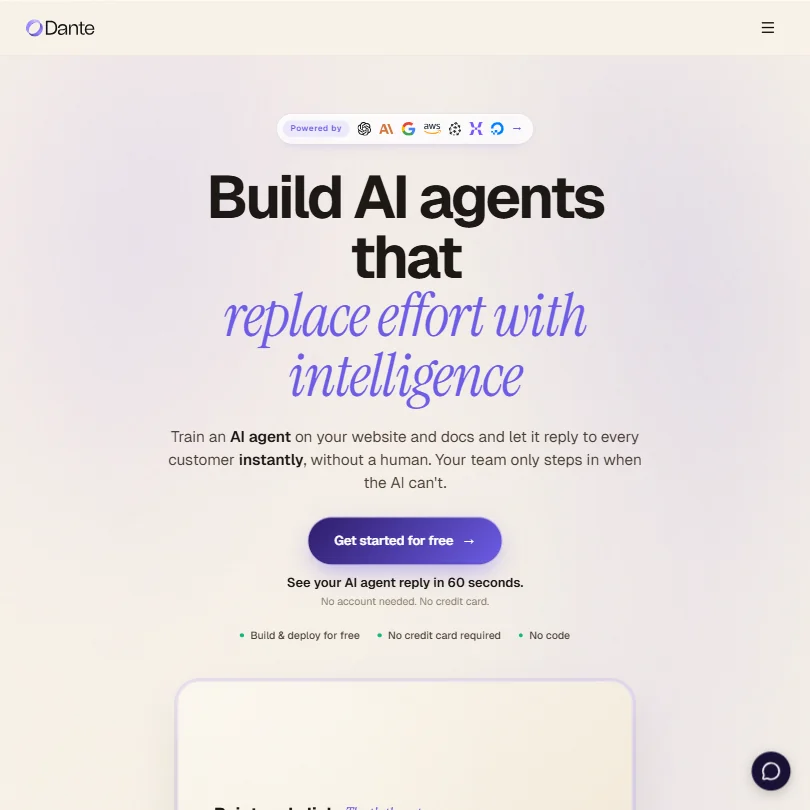
Dante-ai launched in 2023. It lets businesses build a GPT-4-powered chatbot trained on their own content, without writing a line of code. You feed it PDFs, URLs, or plain text, and it learns from that. Then you drop it onto your site or push it to WhatsApp, or reach Slack indirectly through Zapier.
The pitch is aimed squarely at small and mid-sized businesses that lack engineering resources but want something smarter than a canned FAQ widget. Chatbase and CustomGPT.ai are sitting in the same space. Dante-ai is trying to compete on ease and price.
We don't know where they're headquartered. We don't know how many users they have. That opacity is worth flagging, not because it proves anything bad, but because it makes independent verification harder than it should be.
Dante-ai Features: Chatbot, Helpdesk & Support Automation Breakdown
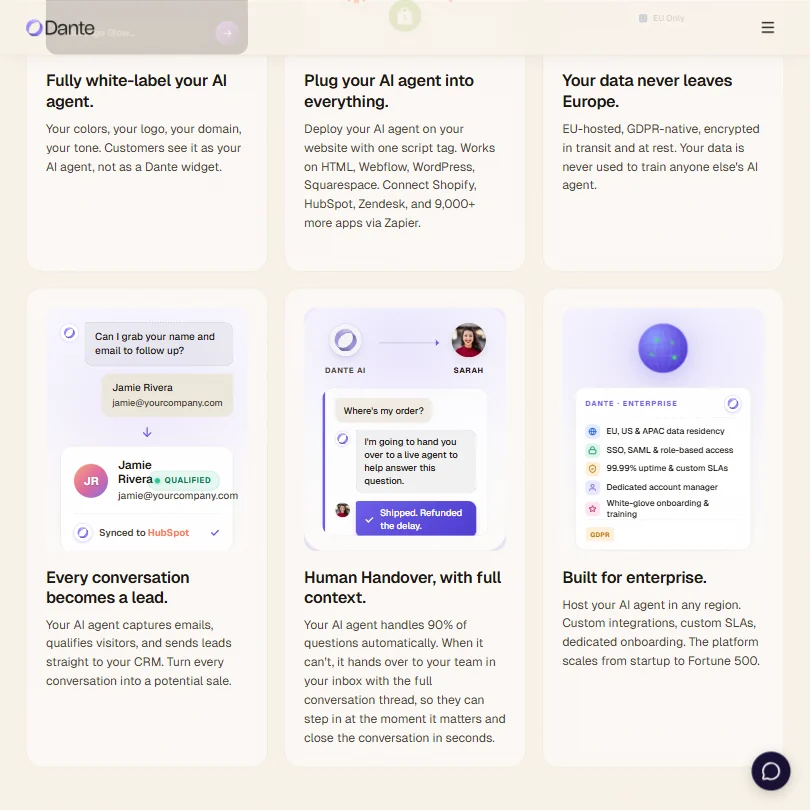
The core of what Dante-ai does is custom chatbot training on your own data sources. You supply the content, the bot stays in that lane. Human handover is also there, letting the bot escalate to a live agent when it hits its limits. That's confirmed in the docs.
What's not there is worth naming. No ticket management. No email automation, no SLA tooling. This is not a helpdesk. It's a chatbot layer you put in front of a product or website, and it stops there.
White-label is available starting on the Advanced plan at $120 a month, and that plan removes Dante branding entirely. API access opens up on Pro as well. The bot supports 95+ languages, which is genuinely broad. Honestly, that surprised us for a tool this new.
Analytics are more substantial than the sparse docs used to suggest. Current documentation covers conversation volume, resolution rate, response time, top questions, CSAT scores, thumbs-up/down feedback, and custom date ranges. There's also a workspace dashboard with per-agent analytics, and the Advanced and Pro plans surface knowledge gap detection explicitly. Whether users are actually enthusiastic about those dashboards is another question we can't answer cleanly from the limited public review sample. Fair. But the capability is there.
Dante-ai Bot Quality: How Well Does It Handle Real Customer Queries?
GPT-4 under the hood means the raw language quality is solid. That's not a Dante-ai achievement specifically, that's OpenAI's. The real question is whether the training pipeline produces accurate, on-topic responses from your own content. Based on what we read, mostly yes.
Product Hunt comments pointed to the bot staying reasonably close to its training data rather than hallucinating freely. A recurring note was that response quality dropped when the source material was messy or inconsistently formatted. That tracks. Garbage in, garbage out is still the rule.
The docs do show a concrete mechanism for correcting bad responses: identify the problem through chat history, which flags the knowledge sources behind each answer, then add a corrective Q&A pair. Not elegant, but workable. Sentiment analysis isn't mentioned anywhere. We don't buy the idea that a tool targeting customer service can ignore that indefinitely.
Dante-ai Channel Coverage: Which Platforms Does It Support?
Web embed is the primary home. Beyond that, you get WhatsApp, with Slack reachable only through Zapier. Zapier opens up connections to other tools. That's the full channel list.
No native CRM integrations. No Shopify, no confirmed HubSpot or Salesforce connections in the docs. For an e-commerce business or a sales team, that's a real gap. Zapier can paper over some of it, but Zapier connections break and require maintenance that a direct integration doesn't.
We've seen worse channel coverage from tools in this category. We've also seen better from tools at the same price point. Not great.
Is Dante-ai Easy to Set Up and Manage?
This is where Dante-ai holds up best. No-code setup is the main selling point, and from what we read, it delivers. Users described getting a working bot up in under an hour by pasting in a URL and letting it crawl the site.
The setup flow seems genuinely simple: point at your content, configure some basics, grab the embed code. Product Hunt comments were notably positive on this specific part. That's not nothing for a tool this young.
Managing the bot over time is a more interesting story than we initially expected. The docs confirm you can edit or delete knowledge sources, manually re-crawl websites, and schedule automatic knowledge updates on Advanced and Pro plans. Behavior instructions can be edited after launch. The Advanced Insights feature also surfaces knowledge gaps so you know where the bot is struggling. Whether everyday users find all of that discoverable is a different question, and one the sparse public review sample doesn't answer cleanly.
Dante-ai Pricing: Is It Worth It for Support Teams?
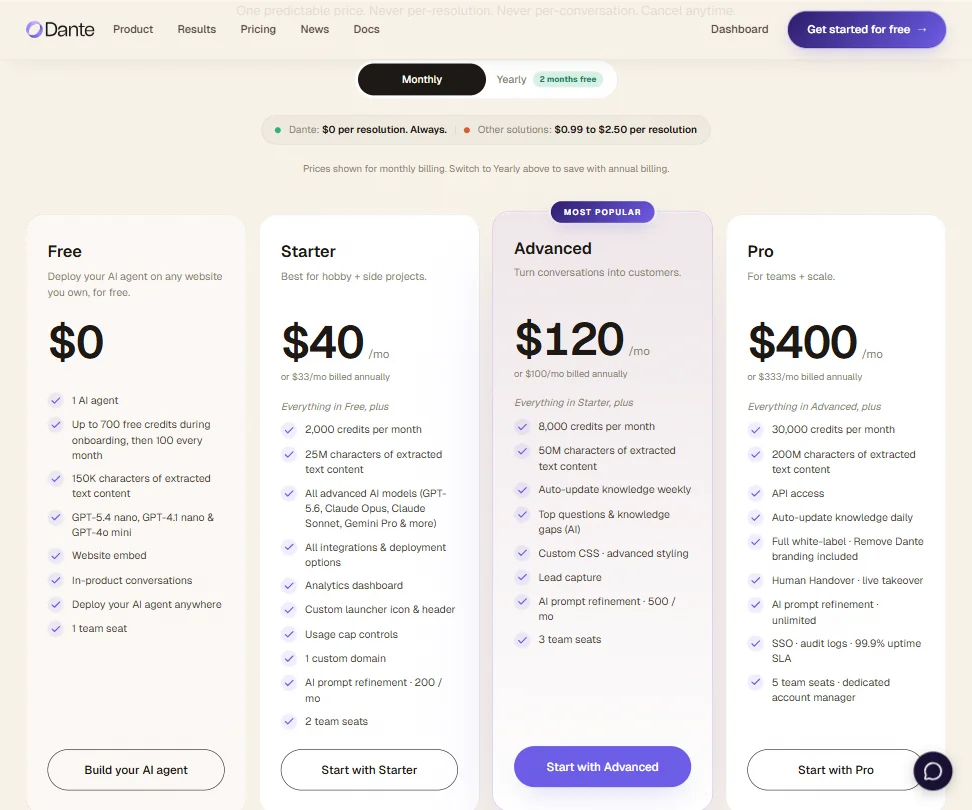
There's a free plan. One AI agent, 150K characters of extracted text content, and 100 credits per month after onboarding. The Starter plan runs $40 a month, or $33 billed annually. Advanced sits at $120 a month, or $100 annually. Pro lands at $400 a month, or $333 annually, which is where API access and a dedicated account manager live (white-label is already unlocked on Advanced).
Compared to our database of 35 reviewed tools in this category, Dante-ai's free entry point ties for cheapest in the field. The category median starting price sits around $29 a month. So $40 for the first paid tier is in the ballpark, though the jump to $120 for Advanced features like lead capture and auto-updating knowledge is a meaningful step.
The refund policy is not publicly stated. We dug through the pricing page and found nothing. That's a problem. It's 2024. You should be able to find a refund policy before you hand over a credit card number.
Worth asking whether $40 a month buys you more than Chatbase does at a similar price. Chatbase has more reviews, more user data, and a longer track record. That's where the comparison gets uncomfortable for Dante-ai.
Dante-ai vs Chatbase: Which Customer Service AI Wins?
Chatbase has been around longer and has a visible review trail. That matters for a buyer doing due diligence. Dante-ai has neither at this stage.
Feature-wise, both tools train on custom data and offer web embedding. Chatbase has a larger integration footprint based on what's publicly documented. Dante-ai's knowledge gap detection and scheduled re-crawling on higher plans are genuinely useful differentiators if your content changes often.
The GPT-4 foundation gives Dante-ai competitive bot quality, but that's table stakes now. Almost every tool in this category runs on OpenAI models. It's not a differentiator anymore. What would differentiate Dante-ai is a documented track record, deeper integrations, and users actually talking about the analytics features in public forums. Right now, none of those exist in meaningful quantity.
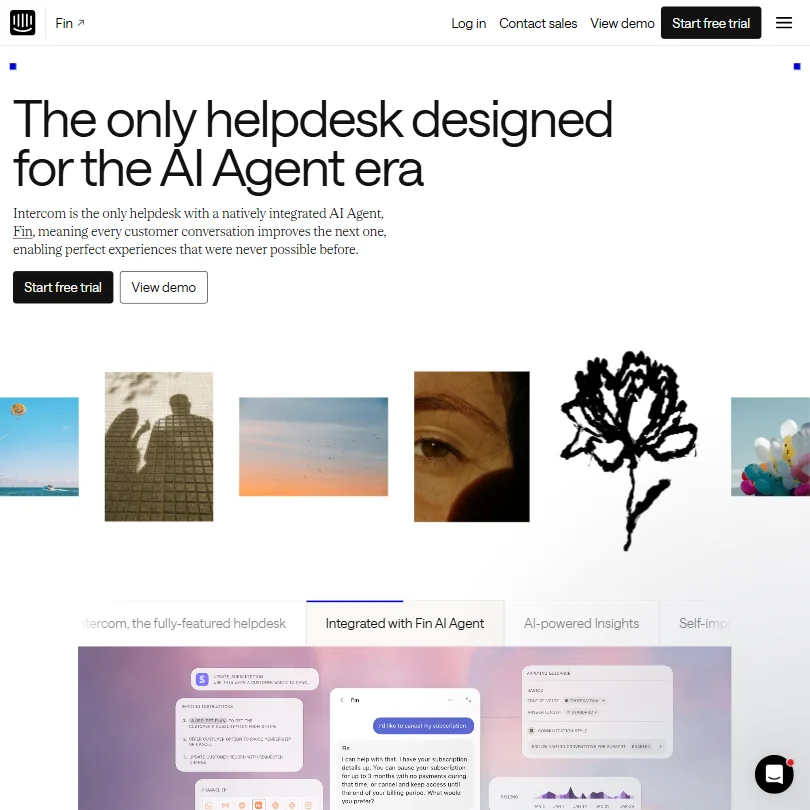
For teams that need a proper helpdesk behind the bot, neither tool is the right call. Something like Intercom covers the full stack, bot plus inbox plus tickets, though the price jumps considerably.
Who Should Use Dante-ai? (And Who Shouldn't)
Small businesses with a documentation-heavy product. That's the fit. A software startup with a help center full of articles, or a service business that answers the same twenty questions constantly, gets real value here. Quick to set up, cheap to start, no engineering needed.
Support teams that need ticketing, SLAs, or deep reporting. Look elsewhere. Dante-ai doesn't touch those things.
E-commerce brands should probably look at something built for that context. Gorgias, for example, is built around Shopify workflows. Dante-ai doesn't come close to that level of commerce integration.
Dante-ai Review Verdict
Dante-ai does the core thing it promises. You can build a working chatbot from your own content, without code, for free or close to it. The setup is fast. The language support is broader than expected. The knowledge management docs are more complete than they appear at first glance.
The problems pile up in the surrounding areas. No review presence on any major platform makes independent verification nearly impossible. The integration list is short. The refund policy is invisible. The team and company behind it are opaque in ways that shouldn't be normal by now.
This is a young tool with no public track record to speak of. That might be fine in six months when more users have posted honest feedback. Right now, it's hard to recommend committing to a paid plan without more signal. The free tier is low-risk enough to test. Beyond that, we'd want considerably more proof before moving off a tool with an actual review trail.
For teams that need more than a chatbot widget, Fin is worth a look. It's built for broader support automation and has the enterprise track record that Dante-ai is still building toward.
How Dante-ai compares
Dante-ai scores 4.9 out of 10 among the AI chatbot builders we rate. These two do the same job and are the closest to it, compared on what each vendor publishes.
Botpress
Botpress costs $189 a month at its cheapest paid plan; Dante-ai is $40 a month, and both offer a free plan first. Dante-ai's AI does not help human agents and has no email channel, only live chat, voice and WhatsApp; Botpress covers email plus Slack, Teams and more, and its AI drafts summaries for agents. Botpress also runs a hosted help center and SLA policies that Dante-ai does not offer.
Pick Botpress if you need a hosted help center and SLA policies.
Pick Dante-ai if budget is the priority and you do not need email.
Chatbase
Dante-ai and Chatbase both start at $40 a month with a free plan included. Chatbase's AI drafts replies for human agents and answers in 95 languages; Dante-ai's AI offers neither language count nor agent assistance, and has no email channel, only live chat, voice and WhatsApp. Chatbase connects to Zendesk, Freshdesk and Gorgias directly, where Dante-ai relies on Zapier to reach other tools.
Pick Chatbase if you want agent assist AI and direct helpdesk integrations.
Pick Dante-ai if you want a simpler tool at the same starting price.
Frequently Asked Questions
Does Dante-ai require coding knowledge?
No. The setup is no-code. You paste in URLs or upload documents, and the bot trains on that content without any technical configuration. That's the core use case it's designed for, and based on what we read, it holds up.
Is there a free plan for Dante-ai?
Yes. The free tier includes one AI agent, 150K characters of extracted text content, and 100 credits per month after onboarding ends. No expiry date is stated, so it appears to be a permanent free plan rather than a trial. The Starter plan at $40 a month is where you get 2,000 credits per month and the full model roster.
How does Dante-ai compare to Chatbase?
Both tools train chatbots on custom data and offer web embedding. Chatbase has more public reviews and a longer track record, which makes it easier to evaluate before buying. Dante-ai's advantages are its language support across 95+ languages and its scheduled re-crawling and knowledge gap detection on higher plans, which Chatbase doesn't document as explicitly. Whether those features justify the switch depends entirely on how often your content changes.