We spent a few weeks pulling together vendor docs, pricing comparisons, and whatever user feedback we could find on CustomGPT.ai. No G2 or Capterra profile to speak of, which is itself a data point. For a tool that's been around since 2022 and claims 10,000+ organizations as customers, the review trail is thin. That absence shaped how we read everything else.
What is CustomGPT.ai?
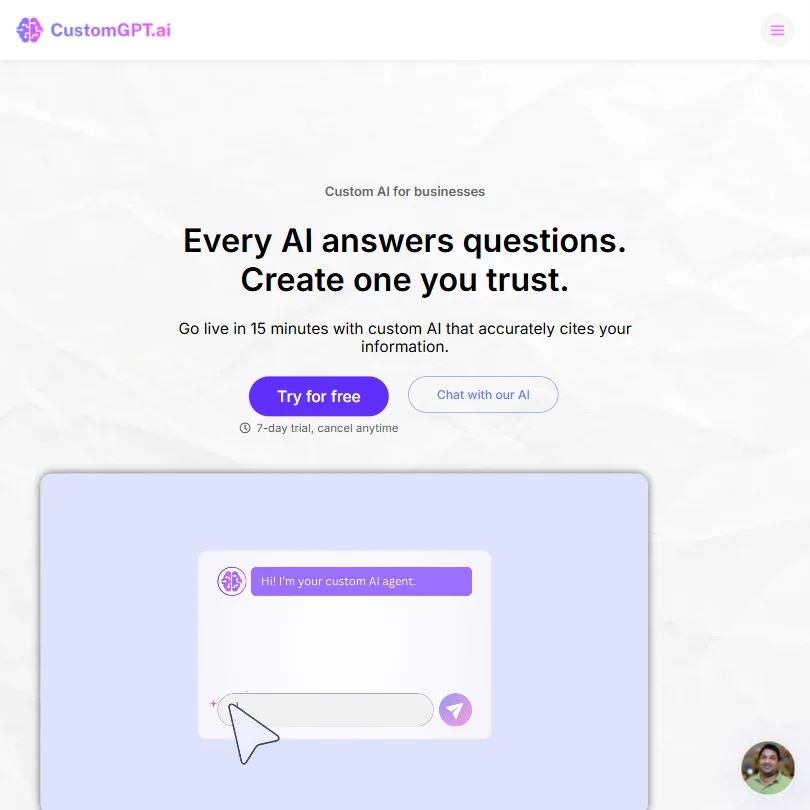
Founded in 2022 and based in Wilmington, Delaware, CustomGPT.ai sits in a specific niche: letting businesses build chatbots and AI agents trained on their own documents, without writing a line of code. Not a general-purpose chatbot. Not another wrapper around a generic GPT. An AI that only answers from your data, cites the source, and refuses to fabricate when it doesn't know.
That last part is what they push hardest. They call it an anti-hallucination layer, built on top of OpenAI's GPT models via a RAG (retrieval-augmented generation) architecture. Whether it actually holds up under pressure is something we couldn't verify ourselves, but the customer testimonials they publish, including one from a deputy assessor at Bernalillo County and another from MIT's entrepreneurship center, suggest it's not vaporware. Those aren't logos a startup buys for the homepage.
CustomGPT.ai Features: Workflows, AI Agents & Automation Capabilities
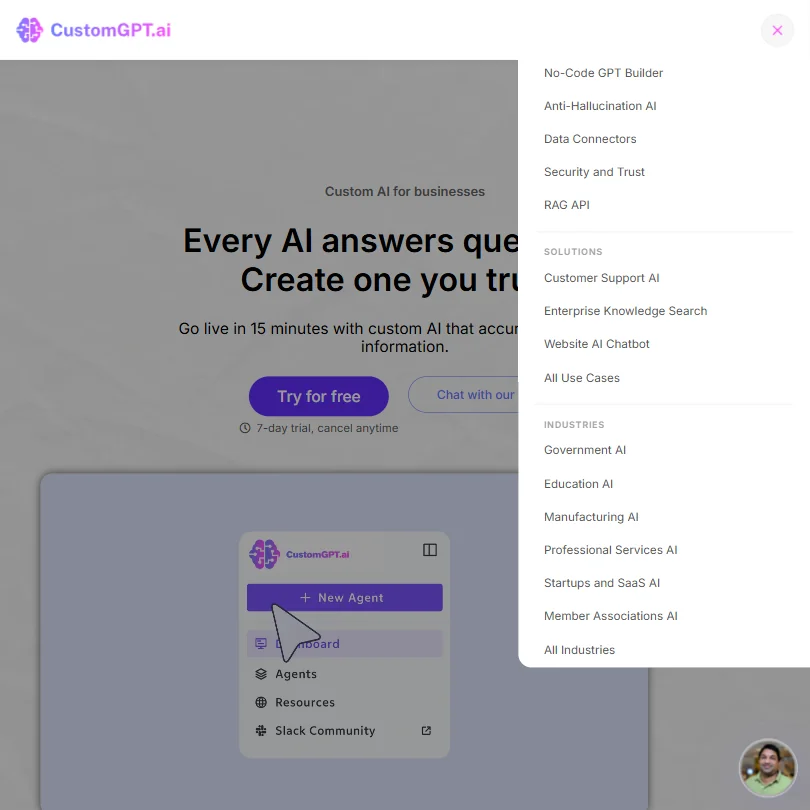
The setup process is genuinely simple on paper. Connect your data, customize the agent's behavior, deploy it. The platform supports 1,400+ file types for ingestion, which covers more ground than most competitors even pretend to. You can pull from websites and documents, plus connected integrations and a few others. On the developer side, there's a RAG API with full reference docs and an OpenAI-compatible API layer. The MCP Server is a newer addition worth knowing about.
Seat counts are honest, if not generous. Three team members at the Standard tier ($89/mo billed yearly), five at Premium ($449/mo billed yearly). RBAC is enterprise-only, which is standard across this category.
Engagement analytics are included, branded as customer intelligence reporting. That's where you'd track what users are actually asking your agent. It won't tell you whether the agent is integrating cleanly with your broader stack, though. That's a different question entirely.
CustomGPT.ai Automation Power: How Complex Can Your Workflows Get?
Not a workflow automation tool. That's the first thing to understand. CustomGPT.ai doesn't connect your CRM to your email platform in some complicated multi-step flow. That's what Zapier does. CustomGPT.ai is narrower. It builds agents that answer questions from your data and can be embedded or triggered via API.
The automation angle is mostly about keeping data fresh. Auto-sync for website content kicks in at the Premium tier. Real-time sync across all data sources is enterprise-only, full stop.
Custom conditional logic only becomes available when forward-deployed engineers from their team are involved, which means enterprise pricing territory. Drag-and-drop branching logic at the Standard tier doesn't exist. If you went in expecting that, you'll be disappointed.
We cross-referenced the docs with user reports from Reddit and Product Hunt. The pattern that surfaced most: people who wanted a solid document-grounded chatbot were pretty satisfied. People who wanted complex multi-step automations felt like they'd bought the wrong tool. Fair, honestly. They're not hiding what it is.
CustomGPT.ai AI Agent Capabilities: What Can It Actually Do Autonomously?
The agent isn't agentic in the CrewAI sense. It won't browse the web, trigger a sequence of external tools, or make decisions across systems. What it does is answer questions accurately, from your content, and tell you where the answer came from.
That's a real and useful thing. For customer support, internal knowledge bases, or compliance-sensitive industries where hallucinated answers create actual problems, that's the right shape of tool.
We're skeptical that "anti-hallucination" is as absolute as the marketing frames it. What it likely means is that the agent declines to answer when confidence is low, which is better than fabricating something. Still a different thing from being infallible.
Multilingual support comes along via the underlying GPT backbone. No special configuration needed, as far as we can tell from the docs.
Is CustomGPT.ai Easy to Set Up Without Code?
Yes, with caveats. The three-step launch process is real. Connecting data sources, customizing the persona, and dropping an embed widget into your site or app is genuinely accessible to non-technical users. The company claims you can be live in under 15 minutes. That tracks for simple use cases.
The caveats arrive when you need things the no-code layer doesn't expose. API integration, custom data pipelines, or anything beyond a basic embed requires someone who can read documentation. The docs look solid. We didn't find widespread complaints about them being confusing or incomplete.
There's a meaningful jump, though, between "I deployed a chatbot in 15 minutes" and "I built a production-grade agent integrated into our enterprise systems." That second thing takes engineers. Worth being clear-eyed about that before you sign up.
CustomGPT.ai pricing: what each plan gives
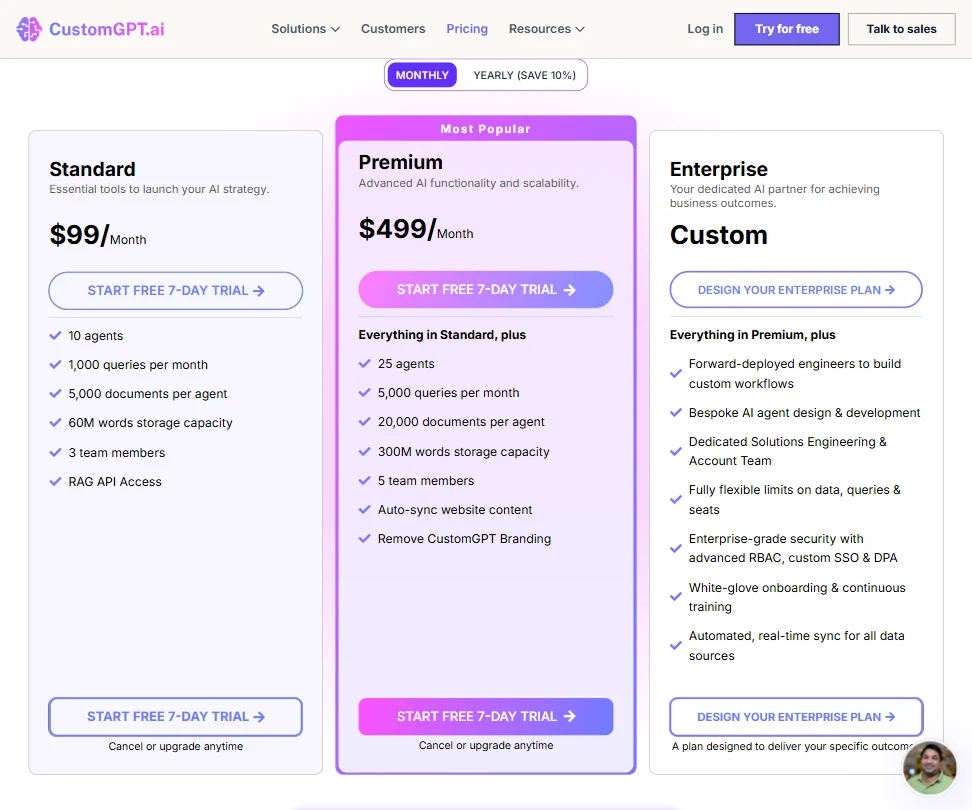
Expensive. There's no soft way to say it. The Standard plan runs $89/mo on the annual rate, saving $120 over monthly billing. Premium sits at $449/mo on the annual rate, saving $600. Those aren't typos.
No free plan. A 7-day trial, then you pay. The refund policy isn't published anywhere we could find.
The $449/mo Premium tier is a meaningful commitment for a mid-sized team. That's where auto-sync, 25 agents, and 5 team members unlock. The Standard tier gives you 10 agents and 1,000 queries per month. Enterprise is custom pricing, so the ceiling is unknown.
To be clear, this isn't a Zapier or Make comparison in any direct sense. Those are workflow automation platforms. CustomGPT.ai is a specialized chatbot builder. The pricing question is better framed against Chatbase, which starts around $32/mo on annual billing, or SiteGPT, which is similarly positioned. At $89 to $449, you're betting the anti-hallucination layer and citation system are worth the premium. For regulated industries, maybe they are.
CustomGPT.ai vs Chatbase: Which Automation Platform Wins?
Chatbase is the obvious comparison. Both take your documents, build a chatbot, let you embed it. Chatbase's paid Hobby tier runs around $32/mo billed annually. CustomGPT.ai starts at $89/mo on the same billing cadence.
Where CustomGPT.ai has a real edge: the developer story. The RAG API is more fully built out, the OpenAI-compatible layer is useful for teams already in that ecosystem, and the 1,400+ file type support is broader than what Chatbase advertises. For a company ingesting a large, messy knowledge base across mixed file formats, that matters.
Where Chatbase wins: price and accessibility. For a small team that just wants a chatbot on their site and has no intention of touching an API, the gap in monthly cost is hard to justify.
The citation and source-grounding feature is worth naming directly. Chatbase does something similar, but CustomGPT.ai's positioning around that specific capability is more aggressive. That might mean it's genuinely better. Or it might mean they've marketed it harder. We couldn't find enough independent third-party testing to say definitively. We don't buy the absolutism, either way.
Who Should Use CustomGPT.ai? (And Who Shouldn't)
Enterprise and mid-market teams in compliance-heavy industries. That's the fit. Legal, healthcare, financial services, government, any context where an AI giving a confident wrong answer causes real damage. The citation-based approach was built for that problem.
Developers building production agents on top of their company's proprietary data. The RAG API and OpenAI-compatible layer give them a solid foundation to work from, without building retrieval infrastructure from scratch.
Solo founders and small startups on tight budgets. Look elsewhere. $89/mo with no free plan and a 7-day trial is a rough entry point. Chatbase handles that use case cheaper, and tools like Dify offer more flexibility for teams who want to build something custom at lower cost.
Teams who actually need multi-step workflow automation also shouldn't start here. Different tool category, full stop.
CustomGPT.ai Review Verdict
CustomGPT.ai does what it says. The source-grounded, citation-first approach to AI agents is real and valuable for the right context. The 1,400+ file type support is genuinely impressive. The developer API is well-built.
But the price is hard to defend against the competition for most buyers, and the lack of any permanent free plan means you're committing money before you've properly stress-tested the product. The missing G2 and Capterra presence is a gap. Not a death blow, but it means there's less independent signal than we'd like for a tool at this price point.
The anti-hallucination positioning is the product's strongest argument for its price. If that's your core requirement, pay the premium. If it isn't, there are cheaper ways to put a chatbot on your site.
Not a tool we'd push away. Not one we'd recommend without knowing your specific budget and use case first.
Frequently Asked Questions
Does CustomGPT.ai have a free plan?
No. There's a 7-day free trial, and that's it. No permanent free tier exists as of our research. Given that most competitors in this space offer some kind of free option, this stands out. Actually use those 7 days before you commit.
What AI model does CustomGPT.ai use?
It runs on OpenAI's GPT models, accessed via a RAG-based architecture with a proprietary anti-hallucination layer on top. The agent pulls answers from your documents rather than from general training data. That's the whole point of the product.
Can non-technical users actually set it up?
For a basic chatbot, yes. The three-step setup is real and doesn't require coding. Where things get technical is when you want API integrations or custom data pipelines. That's where a developer becomes useful. For enterprise-level customization, CustomGPT.ai's own forward-deployed engineers get involved, which is a service tier of its own.