Tavus is a tool that's genuinely different from most of the AI video field, but different in ways that matter more to developers than to most content creators. Built in San Francisco and founded in 2020, Tavus raised a $40M Series B. That's not a distressed company. But the money doesn't automatically make it the right fit for you.
What is Tavus?
Tavus started as a personalized video platform, the kind that lets sales teams send hundreds of individually addressed videos without recording each one. That still exists in the product. But the thing they're clearly betting on now is what they call the Conversational Video Interface, or CVI. Real-time, two-way AI video conversations. Not a pre-recorded avatar reading a script. An AI that responds to you, in video, live.
The underlying models are proprietary. Phoenix-4 handles visual rendering. Raven-1 handles perception, and Sparrow-1 manages turn-taking so the conversation doesn't feel like two people talking over each other on a bad Zoom call. That's not a typical tech stack for a video tool. It's closer to what you'd build if you were making an AI phone agent, but with a face.
Their term for these AI video agents is PALs, short for Personified Application Layer. That name is a bit much. The idea behind it is solid.
Tavus Features: Video Generation, Editing & AI Capabilities

Two distinct product lines live inside Tavus. The older one is async personalized video, where you record once and the platform generates individualized versions at scale. The newer, louder one is the CVI system with real-time PALs.
On the async side, you get batch video generation, voice cloning built into custom replica creation, and 42-plus language support. Stock replicas start at 25 on the Builder plan and expand to 100-plus on Growth and above. Auto-generated conversation transcripts function roughly as subtitles. No screen recording, and no background removal that we could find in any publicly documented feature set.
The CVI side is more interesting. Also more technical. PAL Maker is the no-code path in. You configure a persona, connect a knowledge base, and wire up an LLM of your choice. Yes, you can bring your own LLM. Function calling is supported too. That combination, a real-time AI face plus your own model plus live tool calls, is genuinely rare. Honestly, we hadn't seen that packaged cleanly in one platform before.
Google Meet integration ships on higher plans, with configurations scaling from 3 on Builder up to 15 on Business. WebRTC is the protocol underneath, which means you can embed these conversations in your own app via API. Concurrent sessions follow a similar ladder: 3 on Builder, 10 on Growth, 15 on Business.
Tavus Video Quality: How Good Does the Output Actually Look?
The Phoenix-4 rendering model produces 1080p output.
Tavus's own docs acknowledge that real-time performance depends on network conditions and concurrent session load. That's honest. It's also the kind of thing that bites you at the wrong moment. Not great.
Tavus AI Avatars & Voiceover: How Realistic Are They?
Custom replicas are the core avatar feature. You record a source video, the platform builds a digital twin with your face and voice. The voice cloning is bundled in, not a separate purchase. Emotional range and facial behavior synthesis are called out in the docs.
The stock replica library is fine as a starting point. The real product is your own replica, though. That's what the pricing is structured around.
Voiceover quality in 42-plus languages leans on dynamic audio generation. Multi-language coverage at this breadth rarely performs evenly across all languages. We're skeptical that the quality floor is consistent from Spanish all the way down to whatever language sits at slot 42.
Is Tavus Easy to Use?
Depends entirely on what you're trying to do. PAL Maker is positioned as a no-code tool, and for basic persona setup it probably earns that label. Getting a live conversation agent running with a custom LLM and function calls is not a weekend project for a non-technical user. That's an engineering task dressed up in a friendly interface.
The async video side is simpler. Record, upload, generate.
The website's AI chatbot handles first-line support. Actual human support is email-based, and Discord exists for community questions. That's a reasonable setup for a developer-focused product. It'd be thin for a non-technical team expecting hand-holding. Business plan users do get priority support and a 1:1 onboarding call, which helps at that price point.
Tavus Pricing: Is It Worth It for Creators & Teams?

A free tier exists, and there's also a basic plan sitting below the paid tiers. The free tier gives you 20 minutes of Conversational Video, enough to verify the product works before you hand over a credit card. Fair.
After that, the jumps are significant. Starter runs $22 per month, with the first month at half price currently. Builder is $59 per month with pay-as-you-go overage. The Growth plan runs $397 per month, also with overage. Business lands at $975 per month. Enterprise is custom pricing with volume discounts, no public number. There's no published refund policy anywhere on the pricing page. Not a dealbreaker, but something you should ask about before committing at those numbers.
For a developer team building an AI video product into a larger application, $397 a month is defensible. You're buying an API, a rendering pipeline, and a real-time conversation layer that would cost more to build in-house. For a solo content creator who wants AI avatars for YouTube, this is the wrong product at the wrong price. HeyGen covers a lot of the same one-way avatar territory starting at a lower monthly commitment.
Tavus vs HeyGen: Which AI Video Tool Is Better?
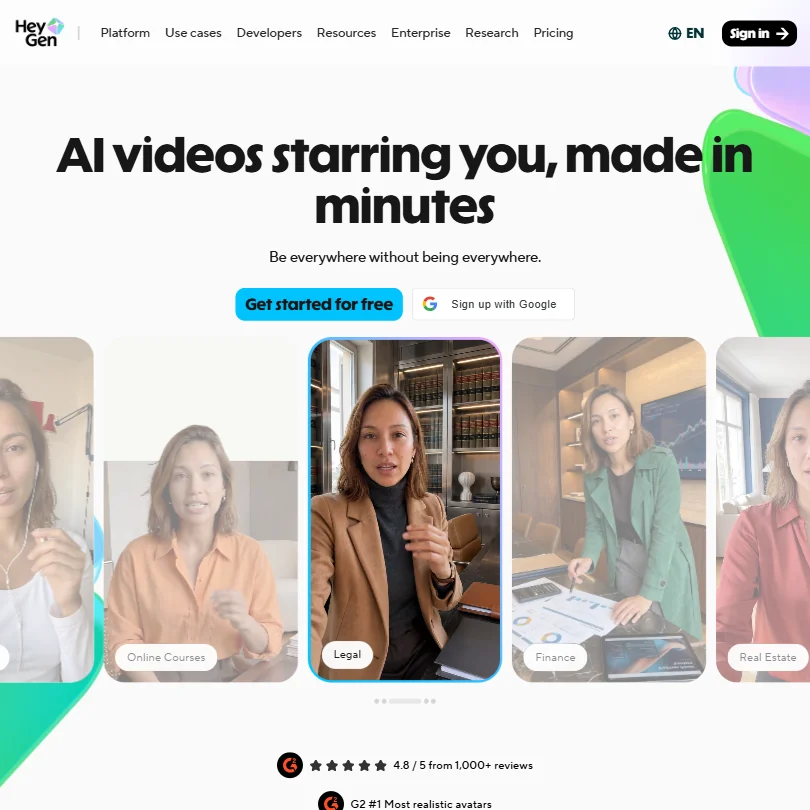
HeyGen and Tavus share some surface-level overlap: AI avatars, voice cloning, multi-language output. But they're aimed at pretty different users.
HeyGen is a content creation tool. Marketing teams use it to make training videos and localized product clips. The interface is built for that workflow. Tavus is an infrastructure product, built for teams embedding AI video conversations into their own software.
Real-time two-way conversation is where Tavus has no equivalent in HeyGen. HeyGen doesn't do that. If you need a live AI video agent sitting inside your SaaS product to onboard users or answer questions, Tavus is the serious option. If you need to produce 50 sales outreach videos with personalized intros, HeyGen is probably faster and cheaper to get running.
The pricing gap matters too. HeyGen's paid plans start lower. Tavus' free tier is more restrictive. Worth knowing before you start a trial on either.
Who Should Use Tavus? (And Who Shouldn't)
Developers building real-time AI agents with a video face. That's the core fit.
Product teams embedding customer-facing AI into a web app. Startups building AI tutors or interview prep tools. Those users get something from Tavus that they genuinely cannot get anywhere else at the same level of polish.
Solo creators and small marketing teams should look elsewhere. The pricing isn't structured for low-volume use. The no-code tools exist, but the product's logic runs on API access.
Synthesia is worth a look for L&D and enterprise training teams who want a simpler interface for producing avatar-based video at scale without touching an API.
Tavus Review Verdict
Tavus is doing something real. Real-time interactive AI video with proprietary rendering, perception, and turn-taking models is not a feature list you can fake. The $40M Series B says investors agree.
The product has a clear ceiling in terms of who it serves. It's infrastructure, not a content tool. That framing should follow you through every pricing and feature decision you make about it.
The pricing jumps are steep. No public refund policy is annoying. None of those are fatal if you're a developer team with a specific build in mind and budget to match.
We'd call it a confident recommendation for the right use case. The wrong use case, and you'll feel it on your credit card by month two.
How Tavus compares
Tavus scores 6.5 out of 10 among the AI avatar video tools we rate. These three do the same job and are the closest to it, compared on what each vendor publishes.
HeyGen
Tavus is cheaper at $22 a month against HeyGen's $29 a month, but HeyGen's avatar library runs to 700 against Tavus's 100 and HeyGen exports at 4K where Tavus caps at 1080p. HeyGen also translates a finished video into another language and includes a brand kit, both missing from Tavus. Tavus's core strength is real time conversation, letting a live avatar present a document mid conversation rather than just generate a finished clip.
Pick HeyGen if you want more avatars, 4K export and video translation.
Pick Tavus if you want a lower price and live document presentations.
Synthesia
Synthesia is more expensive at $29 a month against Tavus's $22 a month, but Synthesia's avatar library runs to 240 against Tavus's 100, and Synthesia states it does not train its AI on your videos, while Tavus's privacy policy allows using conversation data to train its own models. Tavus builds a talking avatar from a single image, something Synthesia cannot do. Both cap export resolution at 1080p and offer single sign on.
Pick Synthesia if you want a lower price and a photo based avatar.
Pick Tavus if you want more avatars and a stated no training policy.
D-ID
D-ID's cheapest paid plan is $5.90 a month against Tavus's $22 a month, though D-ID has no free plan, only a 14 day trial, while Tavus has one. D-ID translates a finished video into another language and adds a brand kit, both missing from Tavus, and covers 119 languages against Tavus's 42. Tavus adds automatic captions, a shared workspace and single sign on, none of which D-ID offers.
Pick D-ID if you want the cheapest plan and video translation.
Pick Tavus if you want a free plan, captions and single sign on.
Frequently Asked Questions
Does Tavus offer a free plan?
Yes. The free tier includes 20 minutes of Conversational Video access, enough to test the core CVI functionality before upgrading. There's also a basic plan below the paid tiers for users who want something minimal before committing to Starter at $22 per month. Once those free minutes are gone, you're looking at a paid plan to keep going.
How is Tavus different from other AI avatar tools?
Most AI avatar tools generate one-way video. You write a script, an avatar reads it, you export a file. Tavus builds real-time, two-way video conversations powered by its own rendering and perception models. That's a different product category. The comparison to HeyGen or Synthesia is fair on the surface, but the CVI system doesn't really have a direct equivalent elsewhere right now.
Is Tavus good for non-technical users?
PAL Maker exists for no-code setup, and basic persona creation is manageable without engineering help. Anything more complex, like connecting your own LLM or wiring up function calls, requires real technical work. Most of the product's depth lives behind the API. Non-technical teams wanting simple avatar video production will find the learning curve steeper than they expect.