No public review volume. That's where we start. No G2 listing, no Capterra page, no Reddit threads with any real signal. For a company founded in 2023 and pitching directly to enterprise finance and procurement teams, that's either a heads-down sales motion or a still-small install base. Probably both.

What we do have is detailed vendor documentation, a clear product architecture, and a heritage worth understanding. Sema4.ai is built on the bones of Robocorp, the Python-based automation platform that earned a genuine developer following before its acquisition. That lineage matters more than the founding year does.
What is Sema4.ai?
Back-office work. That's the target. Finance, procurement, supply chain. Not marketing automation, not sales sequences. The operational stuff that moves money and materials around large organizations, which is genuinely harder to automate well than most vendors admit.
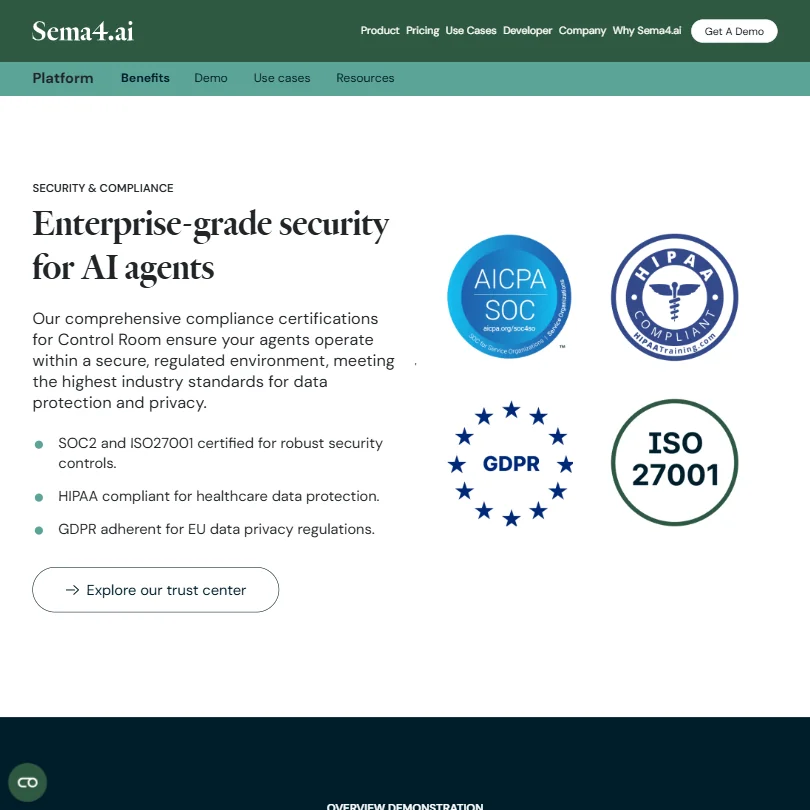
Founded in 2023, headquartered in San Francisco. The platform deploys on AWS VPC, which signals immediately where they're fishing: compliance-heavy enterprises that can't route sensitive financial data through a generic SaaS and call it acceptable. SOC2, ISO27001, and HIPAA compliance are all claimed, and for a finance automation tool that's table stakes, not a selling point. We're not dismissing it. Your legal team expects it.
The core framing is "auditable AI agents." Autonomous agents running across accounts payable, purchase order processing, and similar workflows without a human supervising every decision. But when something goes sideways, you can trace exactly what happened. That traceability is the actual differentiator, not the autonomy itself.
Sema4.ai Features: Workflows, AI Agents & Automation Capabilities
The product splits into a few clear layers. There's Agent Studio, where business users build agents using natural language Runbooks, no code required, though developers can go deeper via the Python-based tooling inherited from Robocorp.
Agents run 24/7. Triggered on a schedule, by an event, or manually. They share pre-built skills and are supposed to improve as they're used. The platform logs everything and surfaces reasoning for human review when needed. That last part matters. Human-in-the-loop is a design choice here, not a reluctant concession.
On the data side, there's a semantic layer handling dynamic data access. Honestly, that's one of the more technically thoughtful pieces of the architecture. Most agent platforms treat data as a simple input and output problem. Sema4.ai treats it as something closer to a live model of your business, with natural-language-to-SQL and multi-source analysis built in. Worth flagging: UiPath now offers native Context Grounding and a Data Fabric semantic layer through its Maestro architecture, so the gap here is narrower than it was. Sema4.ai differentiates its semantic layer through SQL-powered enterprise analysis specifically, but the claim that UiPath has no counterpart is no longer accurate.
Slack integration is confirmed. ERP and enterprise finance connectors exist, though the exact roster isn't public. Developer docs are thorough, pulling from both Sema4.ai's own portal and the Robocorp documentation base.
Sema4.ai Automation Power: How Complex Can Your Workflows Get?
This is where the Robocorp heritage pays off. Python-based custom logic means you're not capped at what a visual builder can express. Developers can write against real business rules, handle edge cases, build conditional logic that actually reflects how enterprise finance processes work. Which is messy. Lots of exceptions.
The deterministic accuracy framing is interesting. Most AI agent pitches lean into probabilistic magic. Sema4.ai is claiming reliable, auditable outputs for things like invoice matching or purchase order validation. We'd want third-party verification of that claim before betting a finance close cycle on it. The documentation supports it structurally. We haven't seen independent test results, and there are no public user reviews to cross-reference. We're skeptical of that claim until more evidence surfaces.
Error handling includes rollback and staged rollouts. Not common language in AI agent marketing. That's a good sign. Somebody on the engineering team has thought seriously about production failures, which most vendors haven't.
Sema4.ai AI Agent Capabilities: What Can It Actually Do Autonomously?
Workers, not assistants. That's the positioning. Agents complete tasks end-to-end rather than suggesting the next step. Document processing, workflow execution, business-critical task handling. Multi-LLM orchestration underneath means they're not locked to a single model's limitations, which matters when you're processing financial documents with varying formats across multiple ERPs.
Pre-built skills ship with the agents. Some domain knowledge baked in, with a learning loop designed to compound as agents handle more of your specific workflows. Plausible in theory. In practice, we have no user data confirming how fast that actually compounds or whether it degrades under edge cases.
Compared to CrewAI, which is built for developers assembling multi-agent pipelines from scratch, Sema4.ai is pushing a more packaged enterprise experience for buyers who don't want to wire their own stack together. Different tradeoff. Neither approach is wrong. They just serve different buyers.
Is Sema4.ai Easy to Set Up Without Code?
Depends entirely on who's doing the setup. Business users get the no-code Runbook builder in Agent Studio. That part looks approachable based on the docs. Natural language process definition, pre-built connectors, shared agents across teams.
But this is not a tool you spin up in an afternoon. AWS VPC deployment means IT involvement. Procurement conversations. Compliance reviews. The setup complexity is real, and anyone expecting Zapier-level onboarding is looking at the wrong product entirely.
Developer docs are solid. Robocorp had a genuine developer community, and that documentation culture carried over. Python experience on your team shortens the curve considerably.
Sema4.ai Pricing: Is It Worth It vs Zapier or Make?
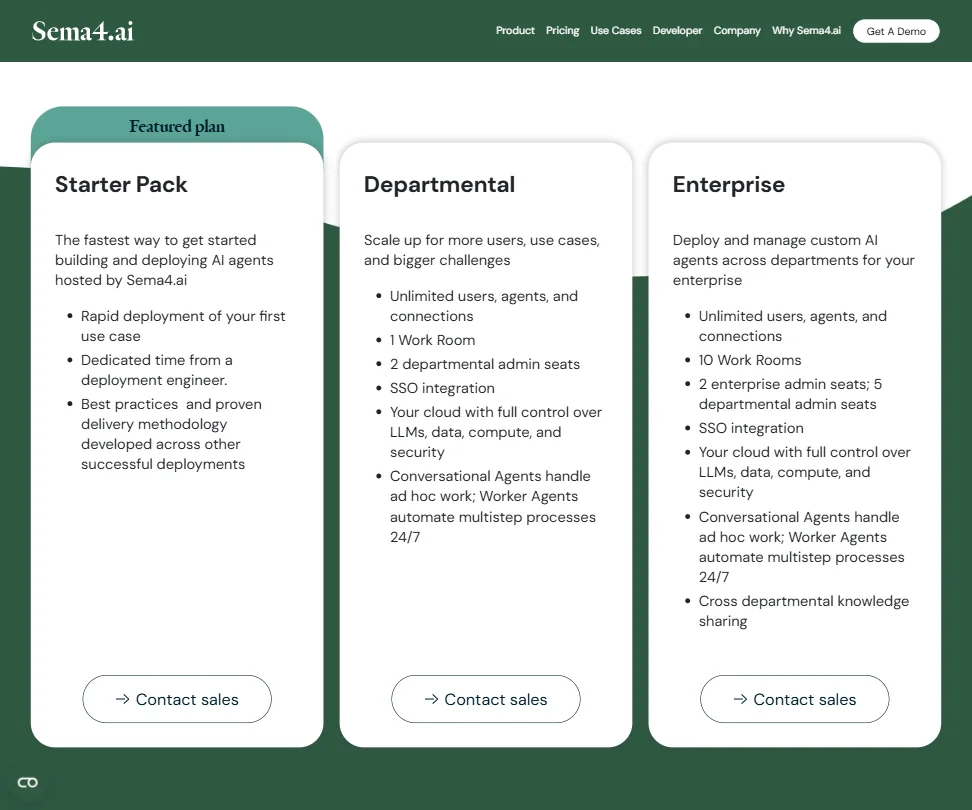
No public pricing. The pricing page lists three tiers: Starter Pack, Departmental, and Enterprise. Every single one routes to "Contact sales." No numbers anywhere.
The Departmental plan includes unlimited users, unlimited agents, one Work Room, two departmental admin seats, and SSO integration. The Enterprise plan scales that to ten Work Rooms, two enterprise admin seats plus five departmental admin seats, and adds cross-departmental knowledge sharing. Both tiers include your cloud with full control over LLMs, data, compute, and security, plus Conversational Agents for ad hoc work and Worker Agents for 24/7 multistep automation. The Starter Pack is the featured plan, positioned for rapid first-deployment with dedicated time from a deployment engineer.
Comparing this to Zapier or Make on price is nearly a category error. Those tools start free or near-free and scale to a few hundred dollars monthly for most teams. Sema4.ai is almost certainly five or six figures annually for a real deployment, before professional services. We can't verify that number, but nothing about the product positioning suggests otherwise.
No free trial mentioned. No free tier. You're starting this relationship with a demo call. Fair. That's normal for enterprise software. It just means you can't evaluate it independently before committing, which bothers us from a research standpoint.
Sema4.ai vs UiPath: Which Automation Platform Wins?
UiPath is the obvious comparison. Both are enterprise automation platforms with AI agent capabilities layered on top of traditional automation infrastructure. Both target finance and operations teams.
UiPath has a decade of production deployments. Real G2 reviews, a massive partner ecosystem, a well-documented track record in regulated industries. That's genuinely hard to compete with for a company that launched in 2023.
Where Sema4.ai might actually have an edge: the agent-first architecture feels more modern. UiPath built bots and then retrofitted AI on top. Sema4.ai was designed from the start around autonomous agents with audit trails. That said, UiPath's Maestro now includes a Data Fabric semantic layer and Context Grounding for retrieval-augmented generation, so the semantic data gap is narrower than Sema4.ai's marketing implies. Whether the agent-native architecture translates to meaningfully better outcomes in production is still the open question.
A team already running UiPath at scale. Switching cost alone probably keeps them there. A team starting fresh who wants agent-native design and strong compliance posture from day one, that's where Sema4.ai earns a serious look. Not a blind one.
Who Should Use Sema4.ai? (And Who Shouldn't)
Enterprise finance and procurement teams in regulated industries. That's the fit. Specifically organizations where audit trails are non-negotiable and back-office transaction volume is high enough to justify a sales-led, custom-priced platform.
Not great for small teams. The pricing model, the AWS VPC deployment, the sales-led motion, none of it maps to a startup or a ten-person ops team. Overkill on architecture, underserved on support economics.
Developers wanting a scrappy, open-ended agent framework should also probably look elsewhere. The Robocorp roots are present, but Sema4.ai is steering toward packaged enterprise software, not DIY tooling. Different product now.
Sema4.ai Review Verdict
Technically specific and architecturally serious. More so than most AI agent startups from the same 2023 cohort. The compliance story is real. The deterministic accuracy framing is at least structurally plausible. The Robocorp heritage gives the developer tooling genuine credibility rather than borrowed marketing.
The problems are also real. No public pricing makes independent evaluation nearly impossible. No public reviews means we're largely taking their word on production performance. The enterprise sales motion filters out anyone without significant budget and organizational patience.
The most honest thing we can say: shortlist this for finance automation AI, but don't commit without a structured pilot. The pitch is coherent. The execution is unverified. For the right organization with the right compliance requirements and budget, it deserves a serious demo. Everyone else should probably wait for more public evidence to accumulate.
Frequently Asked Questions
Does Sema4.ai have a free trial?
Nothing on their public site mentions one. The only stated entry point is a demo request, which suggests a sales-qualified process before you ever touch the product. Standard for enterprise software at this price tier. It does mean independent evaluation before buying isn't really an option, which is a real limitation for procurement teams doing their homework.
What makes Sema4.ai different from general-purpose automation tools?
The vertical focus, mainly. Most automation platforms try to serve every industry with a generic workflow builder. Sema4.ai is built specifically around finance, procurement, and supply chain back-office work, with compliance and audit trail design baked into the architecture from the start. That either fits your situation exactly or it doesn't. No middle ground.
Is Sema4.ai built on Robocorp?
The connection is real. Sema4.ai's developer documentation references Robocorp Docs directly, and the Python-based custom code tooling carries the same DNA. Robocorp was acquired and that community, along with its codebase, fed directly into what Sema4.ai is building. Existing Robocorp experience on your team shortens the learning curve considerably compared to starting from scratch with a new platform.