Fair warning: G2 and Capterra list no reviews or aggregate data for Aisera. For a company founded in 2017 targeting F1000 enterprises, that's strange. It doesn't disqualify the product. It does mean the picture rests on Aisera's own documentation, published customer case studies, and coverage of the Automation Anywhere acquisition that closed in 2025.
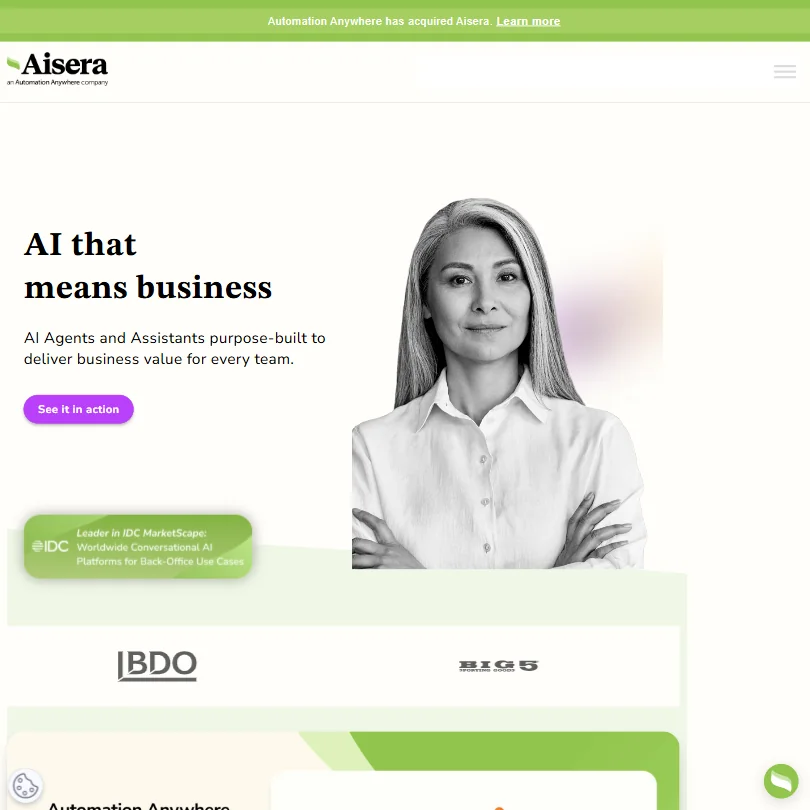
What is Aisera?
Purpose-built for internal service teams. IT support, HR, finance, procurement. Those are the lanes, and Aisera doesn't pretend otherwise. It ships with domain-specific agents for each of those verticals, connected through a single platform designed to resolve requests before a human ever touches them.
Founded in Palo Alto in 2017, the company ran independently for roughly eight years before Automation Anywhere acquired it. That deal matters. Automation Anywhere is a serious RPA player, and the combination gives the joint AI-plus-RPA architecture real depth that neither had alone. Whether buyers see that depth in practice over the next year is still an open question.
The platform runs on a proprietary model called LLM Studio and can also pull in third-party models including OpenAI. Primary deployment channels are Microsoft Teams and web chat. Slack is fully supported, with dedicated integration documentation covering Slack both as a channel and as a data source. Worth knowing before you rule anything out based on older summaries.
Aisera Features: Workflows, AI Agents & Automation Capabilities
Agent Composer is the builder interface. You describe what you want an agent to do in natural language, and it builds from there. No drag-and-drop, no code required, at least in theory. The workflow layer is called Hyperflows, which handles conditional routing and data processing. Then there's GenIQ, the analytical and reporting layer sitting on top of all of it.
Proactive incident prediction lives in the AIOps layer. That's notable. Most platforms in this space catch errors after a ticket lands. Aisera's architecture is designed to spot patterns before the ticket gets filed. User reviews are thin, so probe real-world effectiveness in a demo, but the design intent is clear from the docs.
The reporting side ships with something called Autobrief, a summary tool, alongside broader analytics through GenIQ. Human escalation is built into the resolution flow, not bolted on afterward. When the agent hits its limit, it routes to a live agent. Table stakes, yes, but it's implemented cleanly.
Aisera Automation Power: How Complex Can Your Workflows Get?
Hyperflows handles branching logic, scheduled runs, and webhook triggers. Custom code is supported through Agent Composer for teams that need it. Data transformation runs across Hyperflows and GenIQ together, which means the technical floor is reasonably high.
The integration list covers Microsoft Teams, ServiceNow, Jira, and Workday, plus a few others. Strong coverage for enterprise IT and HR contexts. Ask for the full integration list before a sales call so you can map compatibility.
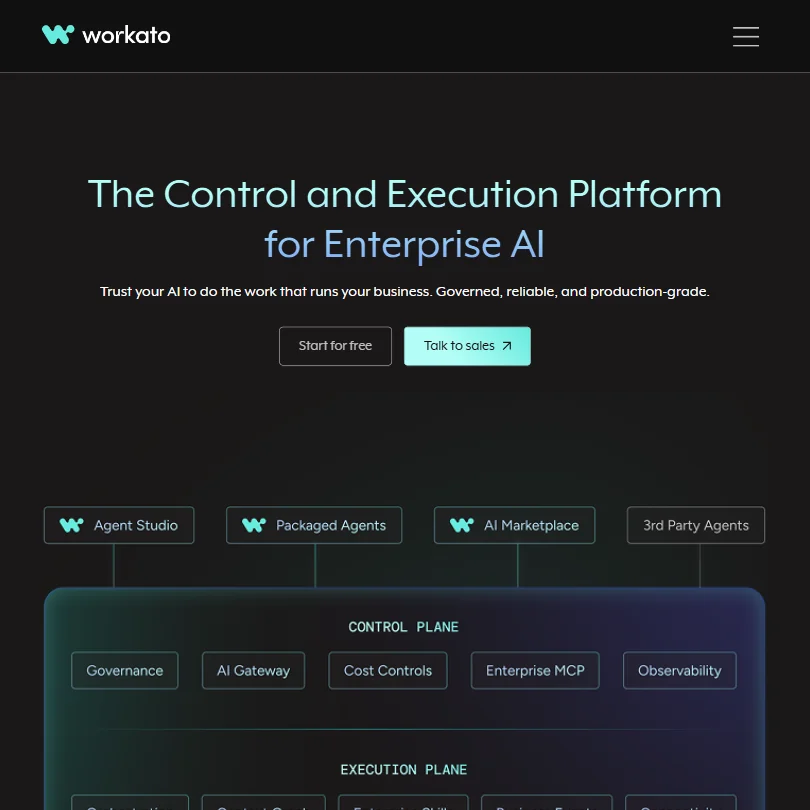
Aisera is vertical by design. The automation architecture runs deep inside ITSM and HR service management, and that's exactly where the depth pays off. But teams looking for horizontal process automation across marketing ops or finance workflows alongside IT tickets are shopping in the wrong place. Something like Workato is closer to what that description requires.
Aisera AI Agent Capabilities: What Can It Actually Do Autonomously?
This is where the platform puts most of its weight. Autonomous ticket resolution, software provisioning, password resets, policy lookups. Aisera publishes auto-resolution rates in the 65-70% range, drawn from customer case studies for companies like OmniTRAX and Lifescan. Those numbers come from Aisera's own material. Treat them accordingly.
NJ Transit reportedly saw a 60% jump in agent productivity after deploying an internal agent called Travis through Microsoft Teams. Big 5 Sporting Goods reportedly saved 24,000 user hours in a single year. BDO Canada built an agent called EVA to automate IT provisioning. We're not calling these fabricated. We're noting that every data point here originates from Aisera's own case study library, not from independent audits or third-party verification. We've seen worse sourcing. Fair.
The multi-agent architecture, combined with the Agent Assist layer for human agents working alongside the AI, is what separates Aisera from a chatbot in front of a knowledge base. It's designed to execute tasks, not just surface answers. That's a real distinction, and it's the core of the enterprise pitch.
Is Aisera Easy to Set Up Without Code?
Agent Composer emphasizes natural language setup, which sounds accessible. No-code claims in enterprise ITSM marketing are, historically, generous framing, so expect some configuration work.
No free trial. Demo only. That's standard enterprise sales practice, but it means you can't poke around without a rep involved. Not great. For any team trying to run a proof-of-concept before committing to a sales process, that's a real barrier.
The platform assumes dedicated technical resources and a structured deployment process. Based on documentation and partner implementation references, this isn't something someone configures on a Tuesday afternoon. IT and HR operations teams with proper infrastructure will get through setup. Small teams without it will struggle.
Aisera pricing: what each plan gives
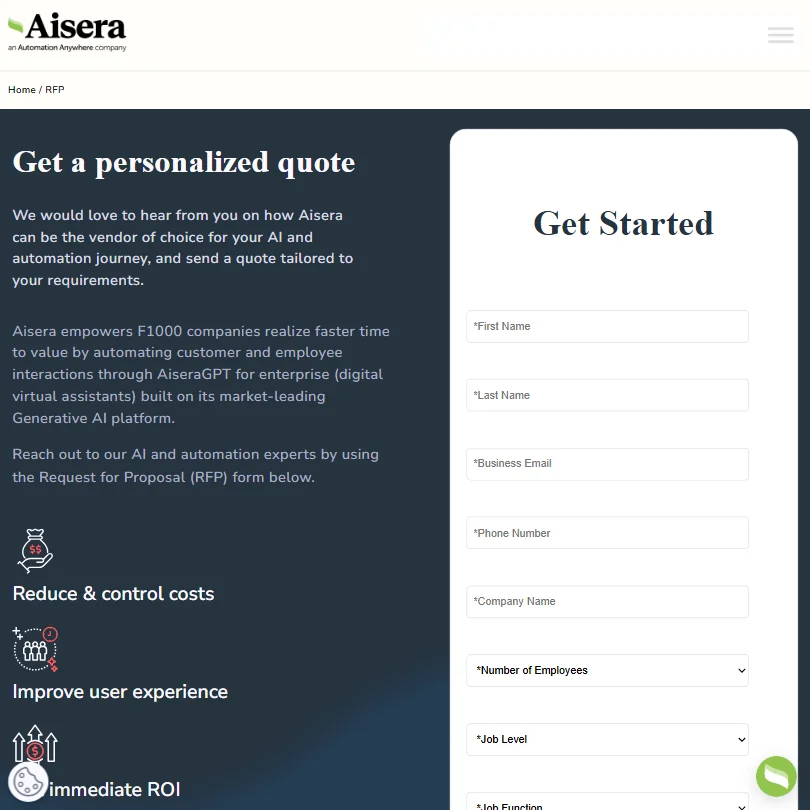
Nothing on the site. No range, no tier, no ballpark. The quote form in the vendor's RFP flow collects company name, employee count, job level, and job function before anyone talks numbers. Custom enterprise only, which is common at this tier, but still frustrating during early evaluation.
No free plan. No trial. Aisera is a completely opaque purchase decision until you're inside a sales conversation, which is a deliberate choice on their part and a genuine friction point for procurement teams doing budget forecasting.
Comparing it to Zapier, which publishes clear tier pricing and offers a free plan, isn't really the right frame. Aisera competes with ServiceNow's virtual agent product and Moveworks. Both of those also bury pricing behind enterprise sales cycles. In that context, Aisera's approach is standard. Still unhelpful, but standard.
Aisera vs ServiceNow: Which Automation Platform Wins?
Not the same product. ServiceNow has a massive installed base, deep ITSM configuration options, and decades of enterprise relationships. Aisera is younger, AI-native from the start, and now carries Automation Anywhere's RPA depth. The buyer profiles don't fully overlap.
ServiceNow wins on breadth and institutional inertia. Aisera's argument is faster time to resolution without years of configuration investment. Whether that holds depends entirely on your existing stack. Companies already running ServiceNow as a system of record probably don't rip it out. They might layer Aisera on top, or they use ServiceNow's own AI capabilities and never call Aisera.
Against Moveworks, which operates in a similar AI-for-IT-support lane, Aisera's differentiator is the RPA integration depth the Automation Anywhere deal brings. Moveworks has a stronger conversational AI reputation, at least based on what we cross-referenced across coverage and community discussion. Aisera may close that gap over the next year. That's our read, not a vendor claim.
Who Should Use Aisera? (And Who Shouldn't)
Enterprise IT and HR operations teams. That's the fit. Companies with significant ticket volume, dedicated ITSM infrastructure, and 500-plus employees where a sophisticated AI layer pays for itself. Every case study in Aisera's published library reads that way.
Small teams. Not a fit, and the sales process confirms it.
Organizations running Workday, ServiceNow, or Jira as core systems will get the most out of the integration coverage. Teams where Slack is the primary internal communication channel should know that Slack integration is fully supported, with technical documentation covering both channel deployment and data source configuration.
Aisera Review Verdict
Serious platform, specific problem. IT or HR teams drowning in tickets and carrying the infrastructure to support an enterprise deployment will find the architecture genuinely capable. The AIOps layer, autonomous agent execution, and published 65-70% auto-resolution figures are real things, assuming the case study numbers are directionally accurate and not cherry-picked.
The gaps are real too. No pricing transparency, no trial, almost no independent user reviews anywhere. The G2 and Capterra absence is strange for a company this age and this focused on enterprise buyers. Not disqualifying. But it makes due diligence harder than it should be.
The Automation Anywhere acquisition is the most interesting variable right now. That deal could meaningfully expand what Aisera delivers for buyers who also need RPA coverage. It could also create integration complexity and strategic uncertainty while the two companies figure out the combined roadmap. Watch where that product lands twelve months from now before making a long-term commitment. The core capability is there. Transparency and independent ecosystem depth are still developing.
Frequently Asked Questions
Does Aisera have a free trial?
No. No free trial, no free plan. The only way to see the product is through a demo, which means entering a sales conversation first. Standard for enterprise buyers. Slower for anyone doing early-stage research before they're ready to talk to a vendor.
What integrations does Aisera support?
Confirmed integrations include Microsoft Teams, ServiceNow, Jira, and Workday, plus a few others. Slack is supported both as a deployment channel and as a data source, with dedicated technical documentation. The total integration count isn't published, which makes broader compatibility assessment difficult without going to the vendor directly.
Is Aisera the same as Automation Anywhere after the acquisition?
Not exactly. Automation Anywhere acquired Aisera in 2025, but the platform continues operating as a distinct product as of this writing. The intent is to combine Aisera's AI-native agent capabilities with Automation Anywhere's RPA infrastructure. How that plays out on the roadmap is still developing. Buyers evaluating now should ask the vendor directly about what changes and what stays the same.