Our research into Rankability started the way it usually does. Vendor homepage, pricing page, then straight into G2 to see if reality matched the pitch. What we found is a tool that launched in March 2024 and has moved fast since. Fast doesn't always mean ready. Here, it mostly does.
What is Rankability?
Rankability is an AI SEO platform built specifically for agencies. Not "also good for agencies." Built for them. The whole workflow assumes you're managing multiple clients, reporting to stakeholders, and trying to track visibility across both Google and the AI platforms that are eating into traditional search traffic.
It's headquartered in St. Louis, Missouri, and the founder, Nathan Gotch, runs weekly mastermind calls included in every subscription. That's an unusual support model. We don't usually see it at this price point. Whether it's a genuine feature or a workaround for thin documentation is a fair question, but reviewers seem to like it.
Rankability Features: SEO & Content Tools Breakdown
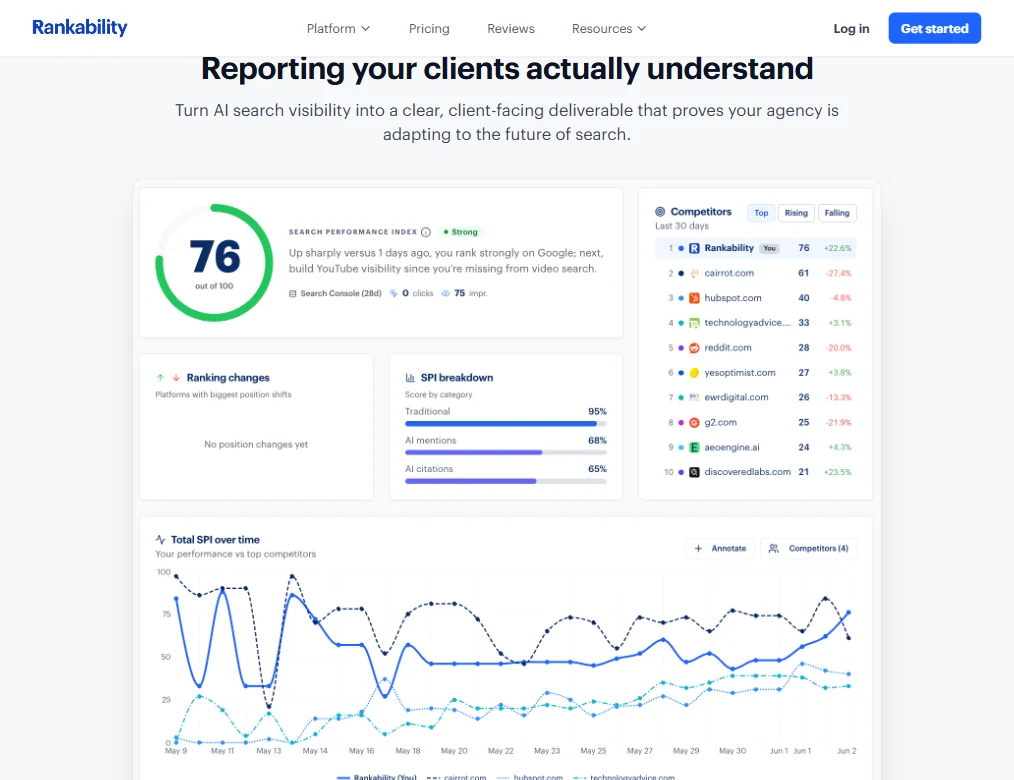
The platform breaks into four main areas. Research comes first, then Create for briefs and drafts, then a Promote module for backlink work, then tracking. That tracking layer covers Google rankings, local map results, video, and AI platform mentions across ChatGPT, Perplexity, Gemini, and a few others.
That last piece is the most differentiated thing Rankability is doing right now. Most content SEO tools still act like AI Overviews don't exist. Rankability is explicitly built around them.
There's also an AI agent called Serena. She reads your client data and tells you what to do next. Honestly, that surprised us. Shipping an autonomous advisor when the underlying data is still young is a bold call. But users don't seem to be complaining, so maybe it lands.
Rankability Keyword Research: How Deep Does It Go?
The Research module handles keyword discovery and clustering. It also prioritizes opportunities based on relevance scoring. The core loop is find keywords, group them, figure out which ones to chase first.
We cross-referenced vendor docs with G2 feedback and didn't find reviewers calling the keyword data thin or unreliable. Decent signal for a tool this young. It also connects to Google Search Console and GA4 on every plan, pulling queries, pages, clicks, impressions, CTR and average position.
Rankability Content Creation: AI Writing Quality Tested
We haven't run content through it ourselves. The workflow is well-documented though. Brief to draft to optimize. The content editor uses IBM Watson NLP for scoring and suggestions, which is a specific technical choice most competitors haven't made. Surfer SEO uses its own model. Clearscope leans on Google's NLP API. Rankability went Watson. Whether that produces better output in practice is something we'd need hands-on time to judge, and we don't have it.
G2 reviewers flag the content optimization side as the strongest part of the product. Marketing agency owners specifically. One reviewer reported moving from Surfer to Rankability, while other users praise the combined traditional and AI-search reporting together. That pattern tracks with what Rankability is pitching.
We're mildly skeptical of any tool promising SEO-optimized AI copy without caveat, but that's a category-wide concern, not a Rankability-specific one.
Is Rankability Easy to Use?
The knowledge base gets called out by name in at least one G2 review, with one reviewer specifically describing it as a game-changing feature. That kind of specific callout usually means either the tool has a real learning curve or the docs are unusually good. Probably both.
For a platform covering keyword research, content creation, backlink analysis, AI answer tracking, and client reporting across all of that, broadly positive usability feedback is meaningful. We'd still budget real onboarding time. There are a lot of modules here.
Rankability Pricing: Is It Worth It vs Free Alternatives?

Three plans are listed. Starter at $99 per month with 60 active prompts. Core at $199 with 125 prompts. Team at $399 with 250 prompts. All plans carry unlimited users, with 1, 3 and 10 workspaces respectively.
No free plan. There is a 7-day free trial on monthly billing, while annual billing starts paid. We'd want clarity on the refund policy before signing up at any tier because it isn't posted anywhere we could find.
The Starter plan is harder to justify when you're comparing against longer-established tools with more integrations. The Team plan is a different conversation. At $399 you're paying for multi-client management and AI visibility tracking that most competitors haven't built yet. That one probably earns its price for the right shop.
Rankability vs Surfer SEO: Head-to-Head Comparison
Surfer has been the category default for content optimization for years. Rankability doesn't try to beat it at that specific game. It tries to make the game bigger.
Both Rankability and Surfer now track brand visibility across ChatGPT, Perplexity, and other AI platforms, although their workflows and reporting differ. Surfer's AI Tracker monitors mentions, citations, sentiment, and prompt-level performance across those platforms too. The real fork is how each tool integrates AI tracking into the broader agency workflow. Surfer has deeper CMS connectors and a Chrome extension. Rankability has the Serena agent and a structure built around multi-client reporting from the start.
We'd also point agencies toward SearchAtlas if all-in-one breadth matters and Rankability's pricing feels steep. Different strengths, but worth a look side by side.
Who Should Use Rankability? (And Who Shouldn't)
Digital marketing agencies tracking AI search visibility for clients. The multi-client structure, the AI platform monitoring, Serena, and the weekly calls all point that direction.
Solo freelancers managing one or two sites. Probably not the fit. The pricing doesn't scale down well and the feature set assumes you're juggling more than one client at a time.
Brands needing a browser extension will also find gaps. The API is there, and drafts can publish to WordPress and Webflow.
Rankability Review Verdict
Rankability launched in March 2024 and is already doing something most older tools aren't. The AI answer engine tracking is real and, as far as we can tell from aggregate feedback, functional. The IBM Watson NLP content editor is a deliberate technical choice. The agency focus is genuine, not a marketing afterthought.
The pricing transparency problem is the most fixable issue they have. No posted refund policy. That's a table-stakes decision that any tool at $99 to $399 per month needs to resolve before asking someone to commit.
G2 has 11 reviews, all five stars. Small sample. We're not dismissing it, but we'd feel better with 50. The product is young and the review trail is thin.
For agencies specifically chasing AI search visibility alongside traditional SEO, there isn't a much cleaner package right now. Teams focused purely on content optimization might get more mileage from Clearscope, though at a higher $129 entry price. But Rankability is building toward something most competitors are still treating as a future roadmap item.
How Rankability compares
Rankability scores 7.8 out of 10 among the content optimisers we rate. These three do the same job and are the closest to it, compared on what each vendor publishes.
Surfer
Surfer costs $59 a month on Discovery against Rankability's $99 for Starter, and adds live chat support and a Chrome extension that Rankability does not have. Rankability answers with a technical site audit, backlink analysis and local SEO tracking, none of which Surfer offers at all. Rankability also gives unlimited seats on every plan, where Surfer's Standard plan caps at 3. Both write full articles and cluster keywords.
Pick Surfer if you want a lower price and live chat support.
Pick Rankability if you need technical audits and local SEO tracking.
Clearscope
Rankability costs $99 a month on Starter against Clearscope's $129 for Essentials, and adds a technical site audit, backlink analysis and local SEO tracking, none of which Clearscope offers. Both give unlimited seats on every plan and write full articles. Rankability also includes white-label client portals on every plan; Clearscope has no white-label option at any price. Clearscope counters with a real Google Docs add-on, where Rankability only exports drafts to a Docs file.
Pick Clearscope if you want a Google Docs add-on included.
Pick Rankability if you need technical audits and white-label reports.
MarketMuse
MarketMuse has a free plan with keyword research included; Rankability has no free tier, starting at $99 a month on Starter after a 7 day trial. Rankability writes full articles and runs a technical site audit, backlink analysis and local SEO tracking, none of which MarketMuse offers since it retired full-draft writing. Rankability also gives unlimited seats on every plan against MarketMuse's one seat on its cheapest paid plan, Optimize.
Pick MarketMuse if you want to try keyword research for free.
Pick Rankability if you need full AI drafts and unlimited seats.
Frequently Asked Questions
Does Rankability offer a free trial?
Yes, a 7-day free trial on monthly billing. Annual billing starts paid. The refund policy isn't posted, so get clarity on that before you sign up.
How does Rankability track AI search visibility?
The platform monitors whether your clients are mentioned or cited across AI platforms like ChatGPT, Perplexity, and Gemini, plus Google AI Overviews. This sits separately from traditional rank tracking and is the part of the product that most distinguishes it from legacy content SEO tools. Both Rankability and Surfer now cover this ground, though their reporting structures differ.
Is Rankability built for solo SEOs or agencies?
Agencies. The whole platform assumes multi-client management, and the Team plan at $399 per month is where the structure really makes sense. Solo SEOs or freelancers managing one or two sites will likely find the pricing hard to justify relative to what they actually need from it.