Thirty-day content calendars. Competitor analysis. Auto-publishing to your CMS. The Junia AI homepage is confident about what the product does. Our research started there, then moved to their docs, the pricing page, and the 86 Trustpilot entries we worked through. What we kept seeing was a product that's genuinely interesting in places and genuinely unclear in others.

What is Junia AI?
Founded in 2023, Junia AI is a web-based tool built around one idea: automated SEO content publishing. Not just writing. The whole loop. It scans your site, finds keywords you're not ranking for, builds a content calendar around topic clusters, writes full articles, and pushes them live to your CMS on a schedule.
That's the version they're selling. The AI underneath it is current, at least. As of August 2025, Junia runs on GPT-5 and Claude 4, which puts it ahead of several competitors still sitting on older model versions.
The auto-publishing workflow is the real differentiator here. Most content AI tools hand you a draft and walk away. Junia wants to own the whole pipeline, from keyword gap to live URL. That's a meaningfully different product category, and it shapes every comparison we make below.
Junia AI Features: SEO & Content Tools Breakdown

The feature list is long. Keyword research, topic clustering, and content brief generation sit at one end. Full-length article generation, automatic internal linking, and metadata handling sit at the other. Throw in schema markup, AI image generation, brand voice settings, and bulk content creation. CMS connections cover WordPress and Shopify, and a few others.
In our research, reviewers actually talked about two things: auto-publishing and article quality. The rest got mentioned occasionally. Not often.
The AI SEO Content Editor is listed as a named product feature, which suggests Junia positions it as a standalone tool inside the platform, not just a window you write in. Whether it holds up against dedicated optimization tools like Clearscope is hard to confirm without hands-on testing. From what we read, reviewers used it mostly as a cleanup layer after generation.
Honestly, the feature density is impressive for the price. Whether all of it works as advertised is a separate question entirely.
Junia AI Keyword Research: How Deep Does It Go?
Junia doesn't position itself as a keyword research tool in the traditional sense. It's not competing with Ahrefs or Semrush on data depth. What it does is scan your site, map content gaps relative to competitors, and use that to build a structured 30-day content plan.
Narrower than it sounds. The keyword layer is in service of the content calendar, not the other way around. Users looking for detailed SERP data, volume curves, or backlink analysis won't find it here. Backlink analysis isn't mentioned anywhere in the docs we reviewed.
For solo creators who just want to know what to write next, the approach probably works. For anyone running a serious keyword strategy, this isn't the right layer for that work. We don't buy the idea that it replaces a proper SEO research stack. It supplements one.
Junia AI Content Creation: AI Writing Quality Tested
We haven't tested Junia's output directly. We cross-referenced Trustpilot, G2, and Reddit threads from 2025, and the pattern was consistent enough to report on.
The output quality picture is mixed. Some reviewers recommend human review and personalization before publishing, though recurring complaints about generic written output specifically weren't clearly established across the review pool. Several reviewers praise Junia's brand-voice feature, saying it preserved their writing style or aligned content with their company voice, though the small independent-review pool makes broader conclusions difficult. Fair.
That tracks with what GPT-based tools produce in bulk mode generally. Speed is high. Distinctiveness requires work.
The better reviews mentioned that Junia's full-article generation saved hours of first-draft work, especially for topics the user already understood well. The AI handles structure and on-page SEO. The human handles voice. That's probably the realistic workflow, not the fully hands-off version the homepage implies.
We've seen worse tools at twice the price. The writing quality question is real but not unique to Junia.
Is Junia AI Easy to Use?
Web-only tool. No Chrome extension publicly confirmed, no desktop app. The workflow is meant to run in the background once you connect a CMS and configure your publishing schedule.
Reddit threads from 2025 surface occasional complaints about the setup process, particularly around CMS connections and getting auto-indexing to fire correctly with Google. Not widespread. Consistent enough to flag.
For someone technical enough to connect a WordPress site and understand what schema markup does, the learning curve is probably manageable. For a non-technical blogger who just wants to hit publish, the initial configuration may take longer than expected. That's our concern, and we didn't see Junia addressing it clearly in their onboarding docs.
Junia AI Pricing: Is It Worth It vs Free Alternatives?
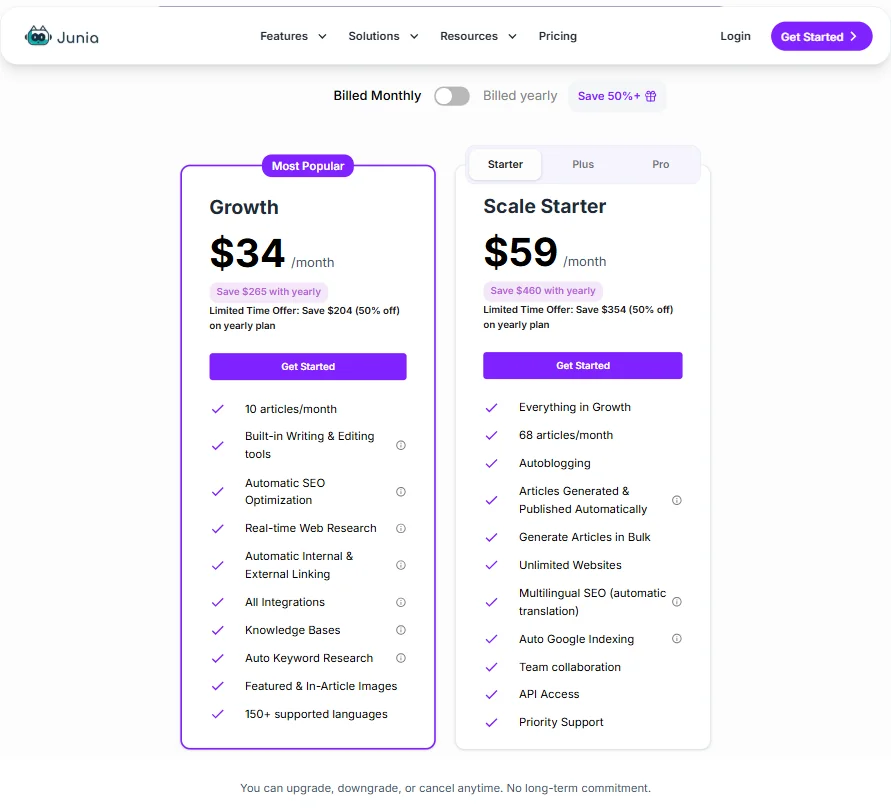
The Growth plan and the Scale Starter plan are the two tiers shown publicly. Junia offers yearly billing and currently advertises a substantial annual-plan discount, with promotional pricing bringing Growth to $17 per month and Scale Starter to $29 per month annually. Month-to-month, those sit at $34 and $59 respectively, based on what's visible on the pricing page. There's a free tier available, which is notable given the feature claims.
What's not clear: what the free tier actually includes. Hard limits aren't spelled out anywhere we could confirm. The refund policy is also not publicly stated. That's a problem. Spending $34 on a tool you can't get refunded from, without knowing the free plan ceiling, requires more trust than the current review record earns.
The Scale Starter plan, at $59 per month or $29 annually, adds API access, auto Google indexing, autoblogging with articles generated and published automatically, and team collaboration. Sixty-eight articles per month versus ten on Growth. That's a real jump in volume. The per-article economics improve significantly at the Scale Starter tier if you're actually using the full monthly allocation.
No enterprise pricing is listed publicly. At these prices, the value is real if output quality holds. That's still the variable we can't fully confirm from the outside.
Junia AI vs Surfer SEO: Head-to-Head Comparison
Surfer currently starts at $49 per month with annual billing. Its Standard plan costs $99 per month annually. It focuses on content optimization around live SERP data. It doesn't write articles for you and it doesn't auto-publish. It tells you what to write and how to structure it. You do the work.
Junia is closer to the opposite. Lower price, more automation, less precision on the SEO data side.
The core trade-off is control versus automation. Surfer gives you the levers. Junia pulls them for you. Which matters depends entirely on how much you trust the output to be ready without intervention.
Teams with an existing writing process will probably find Surfer more useful. Solo operators trying to build a content library without hiring anyone might find Junia's approach appealing, at least at first. Agencies doing content at real scale should look at something like SearchAtlas before committing to either.
Who Should Use Junia AI? (And Who Shouldn't)
Solo bloggers and small SaaS marketing teams. That's the fit. The price is low enough and the automation high enough that someone running a content program alone could get real output without hiring.
Niche site builders. Also a natural audience. The content calendar and auto-publishing workflow maps directly to what they're trying to do.
Marketing teams with editors on staff? Less obvious. The editing overhead seems real based on reviewer descriptions, and if you're paying editors anyway, the automation value shrinks. Agencies doing client work should be cautious before running Junia's output live. The content quality question matters more when a client's domain is on the line.
Anyone who needs deep keyword data or serious competitive analysis should look elsewhere for that layer. Not built for it.
Junia AI Review Verdict
Junia AI is doing something genuinely interesting at a price that's hard to argue with. The automation stack is real. The model versions are current. CMS integrations cover the platforms most people actually use.
What's less convincing: the content quality ceiling, the opaque free plan limits, and the missing refund policy. The Trustpilot score sits at 3.6 across 86 reviews, and a 3.6 with that review count means a meaningful share of users left unhappy, not a rounding error. We're not dismissing the tool over it, but we're not ignoring it either.
The promise of replacing a content team from $17 a month is marketing. The actual product is a solid first-draft and publishing tool that still needs a human eye before anything goes live. Adjusted for that reality, it's worth a look. Go in with calibrated expectations.
Frequently Asked Questions
Does Junia AI have a free plan?
Yes, Junia AI offers a free tier. The exact limits on that tier aren't clearly documented on the pricing page, so we'd recommend testing it before assuming it covers your full workflow. Monthly paid plans start at $34 for Growth, or $17 per month on the current annual promotion.
Is Junia AI good for autoblogging?
That's the core use case it's built for. The Scale Starter plan specifically lists autoblogging and articles generated and published automatically as named features. The honest caveat is that reviewers suggest the output benefits from human review before publishing, so fully hands-off autoblogging carries some real risk to content quality. Not great for anyone who can't build in a review step.
How does Junia AI compare to Jasper AI?
Jasper is primarily a writing assistant and brand voice tool with a significantly higher price point. Junia focuses on the full content pipeline: research, writing, and publishing automation in sequence. Jasper gives you more control over individual outputs. Junia gives you more automation with less granular control per piece.
Budget-conscious solo operators. That's who Junia is cheaper and probably sufficient for. Teams that need precise brand-aligned copy across multiple formats will find Jasper's approach more deliberate, if considerably more expensive.