Inkscape is a free, open-source vector editor for drawing logos, icons and illustration, with no company behind it and no account of any kind. It suits people who want a capable vector tool without paying anything, and it suits less well anyone who needs AI generation tools or native Adobe Illustrator file saving, since it has neither.
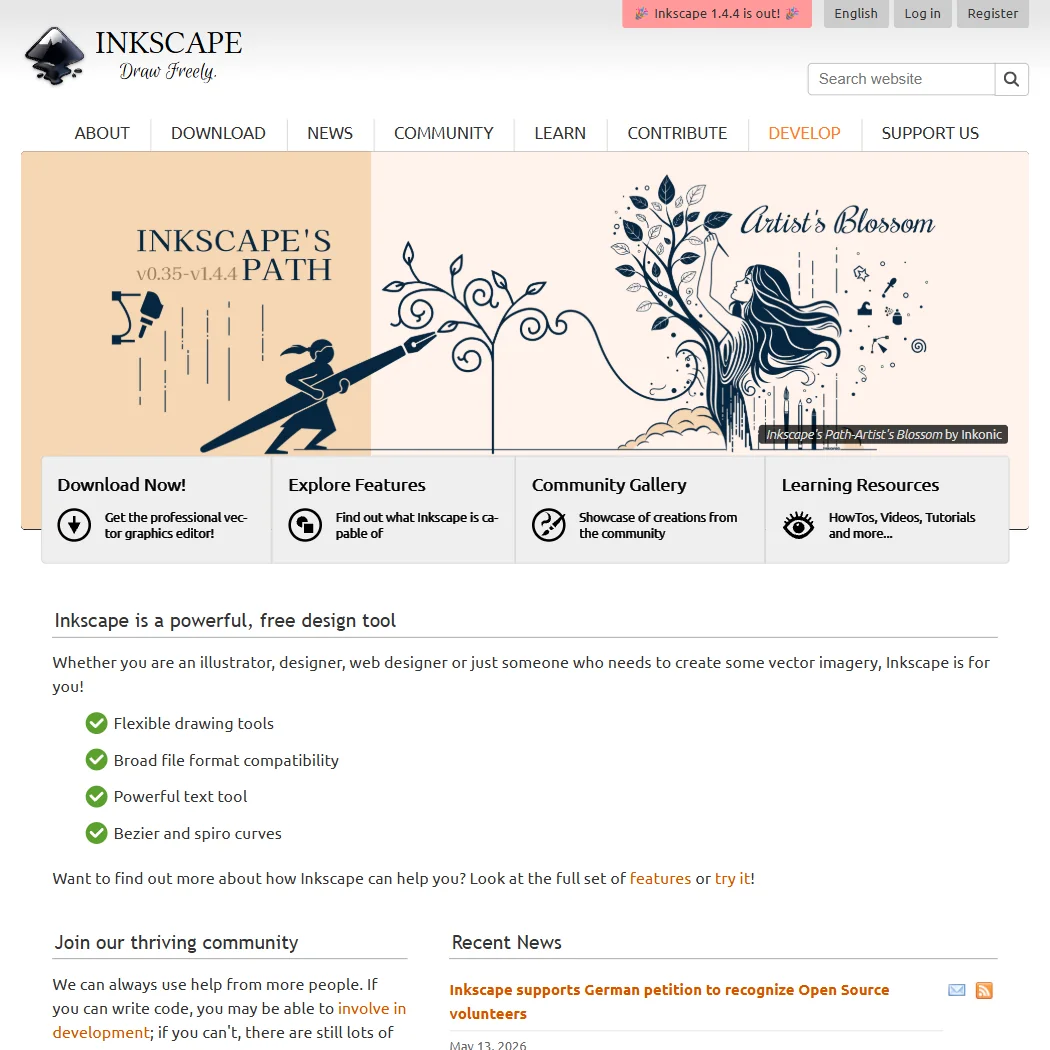
What is Inkscape?
There is no company behind Inkscape: it is an open-source project that began in 2003, forked from an earlier project called Sodipodi. It is an installed desktop application for Windows and macOS, also available on Linux, and it requires no account: nothing about your work is sent anywhere.
Drawing and editing vectors in Inkscape
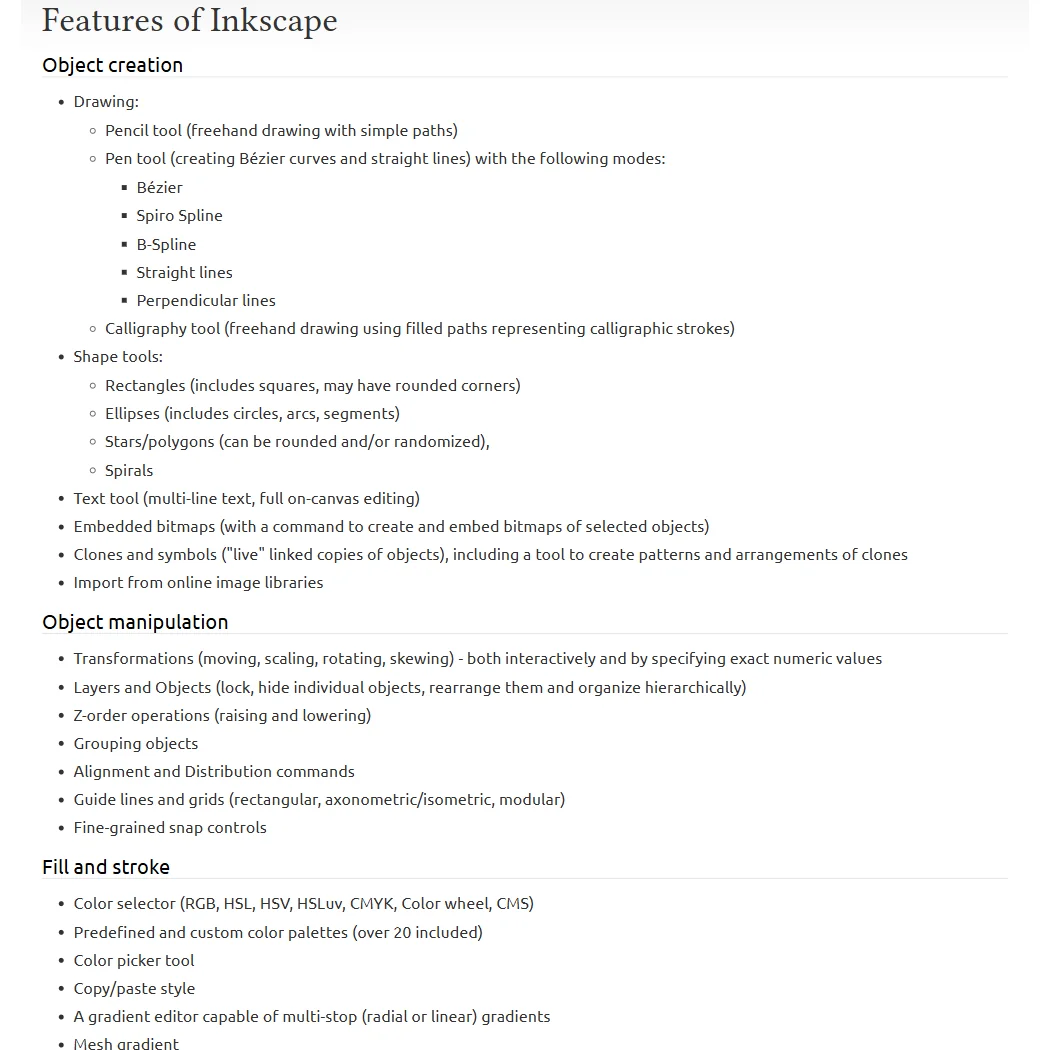
SVG is Inkscape's native format. It opens .eps and .ps files and exports to png, jpg, svg, pdf and PostScript, but it does not save out to native .ai format; Adobe Illustrator files come through the PDF or EPS-compatible route, or through a separate extension that cleans up SVG files already exported from Illustrator. Trace Bitmap converts a raster image into editable vector paths, and a dedicated boolean operations module handles combining, subtracting and intersecting overlapping paths. Inkscape supports mesh gradients, text set on a path, and pressure-sensitive tablet input for its Pencil and Eraser tools. Multi-page documents, called Pages rather than artboards, were added in version 1.2. CMYK is described as limited support, added to colour palettes and colour conversion, since the application's internal colour model is RGB. Inkscape does not support Pantone colour libraries; its palette formats are CIELAB, Adobe Color Book and Adobe Swatch Exchange. It has no AI generation, image or editing features of any kind.
Working with other people
Inkscape is built for one person editing locally: it has no real-time co-editing and no comments or review workflow. It is extensible through a documented Python extension API, and third-party or custom extensions can be installed alongside the stock ones. Support runs through the project's own bug tracker and its development wiki and documentation, rather than a company help desk.
Inkscape pricing: what it costs
Inkscape is free, with no paid tier at all. There is nothing to trial and nothing to subscribe to: the whole application is open-source software licensed under the GNU General Public License.
Privacy and support
Questions about training on your work, SOC 2 and GDPR do not really arise for Inkscape: it is installed desktop software with no account and no vendor server that your files pass through. Support is community-run, through the project's bug tracker and its wiki-based documentation.
Who Inkscape suits
Inkscape suits anyone who wants a free, full-featured vector editor with boolean path operations, mesh gradients, multi-page documents and pressure-sensitive drawing, and who is comfortable relying on a bug tracker and wiki rather than a support line. It also suits anyone who wants their files to stay off any server, since nothing requires an account.
It suits less well anyone who needs AI generation tools, since Inkscape has none, or anyone who needs to save work out to native Adobe Illustrator format, since that is not supported.
How Inkscape compares
Inkscape scores 6.7 out of 10 among the vector editors we rate. These two do the same job and are the closest to it, compared on what each vendor publishes.
Adobe Illustrator
Inkscape is free, open source software with no company behind it and no price at all. Illustrator is subscription only, at $22.99 a month, with no way to own it outright beyond a 7-day free trial. Illustrator generates vector artwork from a text prompt and works with spot colour for print; Inkscape does neither, and its CMYK support uses an internal RGB colour model. Both open Illustrator's own .ai and .eps files and support union, subtract and intersect operations on shapes.
Pick Adobe Illustrator if you need AI generation, spot colour or full CMYK support.
Pick Inkscape if you want free open source software with no subscription.
CorelDRAW
CorelDRAW generates artwork from a text prompt with its built in AI; Inkscape has no prompt based generation at all. CorelDRAW costs $22.42 a month, or a one-time purchase to own the licence outright, while Inkscape carries no price of any kind. Inkscape supports union, subtract and intersect operations on shapes, though its CMYK support runs on an internal RGB colour model. Both trace raster images into vector paths and ship a template library.
Pick CorelDRAW if you want AI generated artwork or the licence you own.
Pick Inkscape if you want it free forever with the source code open.
Frequently Asked Questions
Is Inkscape really free?
Yes. Inkscape has no paid tier of any kind: the whole application is open-source software under the GNU General Public License, with nothing to subscribe to and nothing to trial.
Does Inkscape open the files I already have?
It opens .eps and .ps files and its native format is SVG, but it does not save out to native .ai format; Illustrator files need to come through a PDF or EPS-compatible route instead.
Does Inkscape support pressure-sensitive tablets?
Yes, for its Pencil and Eraser tools, which can vary stroke and eraser width with a pressure-sensitive input device.
Does Inkscape collect or train on my files?
The question does not really apply: Inkscape is installed software with no account and no server your work passes through, so there is nothing of yours collected or sent anywhere.