Describely is an AI product description generator built for ecommerce catalog teams working in bulk, with SEO optimisation applied across a whole catalogue.

What is Describely?
Describely launched in 2022. It's headquartered in the US, and it's built around one specific problem: eCommerce catalog teams have too many products and not enough time to write decent copy for all of them. That's it. That's the whole pitch. The tool sits somewhere between a copywriting platform and a product information management layer. It generates product descriptions. It enriches sparse product data. It handles SEO titles and meta descriptions. And it does all of this at bulk scale, meaning thousands of listings at once, not just one-offs. What separates it from a general-purpose writing tool is how vertical it is. This isn't Copy.ai with a product template bolted on. The whole product is built around catalog workflows, and that focus shows in the feature set. Worth noting: the AI model underneath is proprietary but GPT-based, which tracks with the output quality users describe.Describely Features: Product Listings, Bulk & Marketplace Tools

Describely AI Writing Quality: Are the Product Descriptions Good?
Honest answer: the output quality looks solid for the use case. Users describing their experience consistently flag that first-generation accuracy is high. The 98% accuracy figure Target Australia cites is striking, though you should read that as "fits the brand's content rules" rather than "perfect prose every time." The AI Content Rules feature is relevant here. It lets teams set brand voice parameters before generation runs, so the output doesn't need heavy editing to sound right. That's a real workflow benefit. Without something like that, bulk AI copy turns into a bulk editing job, which defeats the purpose. SEO and GEO optimization is baked into the generation flow, not added as a separate step. Titles, meta descriptions, keywords, all produced alongside the listing content. GEO is the newer piece, referring to how content surfaces in AI-generated search results from tools like ChatGPT and Gemini. Describely appears to be positioning itself early on that front, and their homepage now explicitly mentions grading SKUs for AI search readiness. We're cautiously interested. That's a moving target and nobody fully has it figured out yet. The language support is worth flagging. English is the primary language and multilingual support is described as limited. That's a real constraint for any catalog team running across markets.Describely Marketplace Support: Shopify, Amazon & Beyond
The native integrations are Shopify, WooCommerce, Akeneo, Wix, and Squarespace. CSV import and export covers everything else. That's a decent spread. Amazon is the gap. No native integration. For sellers whose whole operation runs through Amazon listings, that's a problem. Etsy is also absent. The integrations reflect a platform-first approach, meaning direct-to-consumer storefronts, not marketplace selling. Akeneo support is notable because it signals that Describely is trying to sit alongside proper PIM workflows, not just solo merchants. That's a different customer than a small Shopify store. Hypotenuse AI plays in the same territory and covers some of the same PIM enrichment use cases, so it's worth comparing if you're running a larger catalog operation. We don't buy the idea that CSV covers the Amazon gap cleanly. It doesn't. It's a workaround.Is Describely Easy to Use?
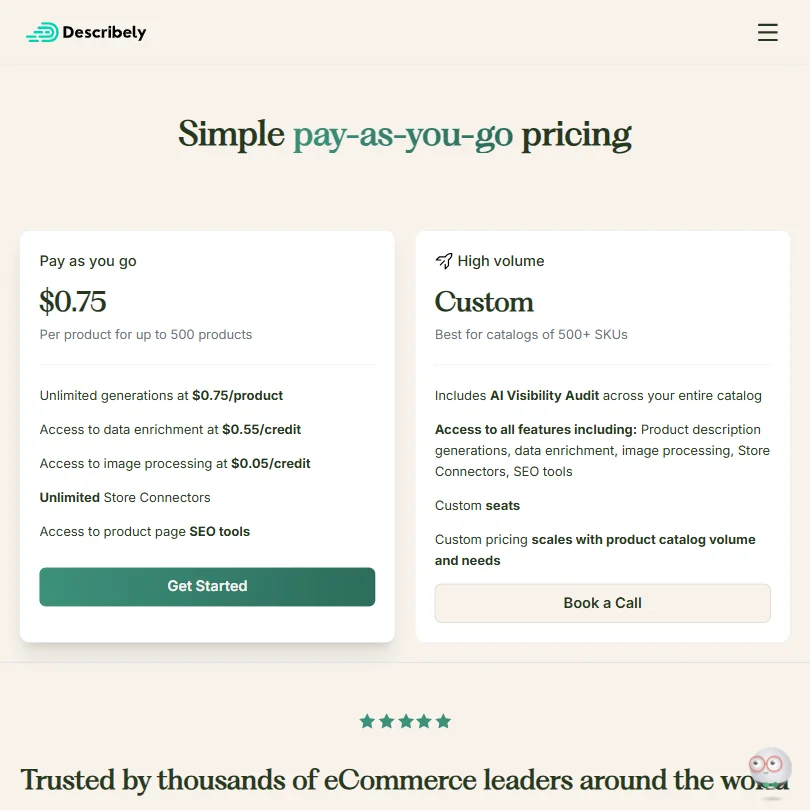
The platform is web-based only. No mobile app, no desktop client. That's fine for catalog work, which tends to happen at a desk. The onboarding docs are available through their Knowledge Base, and the getting-started guides look functional. Topics like "Write Descriptions in Bulk" and "Enrich Product Data in Bulk" are called out specifically, which suggests the docs were written with actual user questions in mind rather than just checking a box. What we couldn't confirm: live chat availability. The support page shows email contact and a Knowledge Base. No public community forum. That's a thin support layer for a tool targeting enterprise-scale catalog teams. Ease of use appears to be a genuine strength based on what users consistently say. But we'd want to see what happens when something breaks at 2am during a product launch. Email-only support isn't a confidence builder in that scenario. That's our concern.Describely Pricing: Is It Worth It for E-Commerce Sellers?
Describely vs Copy.ai: Which E-Commerce AI Tool Is Better?
Copy.ai is the most frequently cited alternative in the same breath as Describely. Fair comparison to make, though the products are doing different things. Copy.ai is a general-purpose content platform. It's built for marketing teams writing across formats. Blog copy, email, social, and product copy all live in the same tool. Describely does one thing: catalog content at scale. That focus is the whole argument. For a team writing descriptions alongside other marketing content, Copy.ai's broader scope probably wins. For a catalog team or a distributor needing to push thousands of product listings through a consistent enrichment workflow, Describely's vertical depth is harder to match. The integrations alone, Shopify and Akeneo native, are a meaningful differentiator that Copy.ai doesn't replicate. We've seen general-purpose tools used for product descriptions. The output is usually generic. Describely's category-specific training and Content Rules feature is supposed to address that directly.Who Should Use Describely? (And Who Shouldn't)
Catalog teams at mid-size retailers. That's the obvious fit. The bulk generation tools and brand controls are built for exactly that environment. Distributors dealing with messy supplier feeds should look seriously at the Product Data Enrichment feature. Getting usable listings out of incomplete supplier data is a real problem that Describely is explicitly trying to solve. Agencies managing content for multiple eCommerce clients might find the workflow useful, and Describely does call agencies out as a target segment on their site. Solo Shopify merchants. Less clear. The tool probably works, but the pricing opacity makes it hard to know if the cost makes sense for low-volume operations. There are cheaper ways to get AI product descriptions if you're writing a few dozen SKUs a month. Amazon-first sellers. Not the right tool. The missing Amazon integration is a hard stop.Describely Review Verdict
Describely is doing something genuinely specific, and it does it reasonably well. The bulk generation workflow, the Akeneo and Shopify integrations, and the Content Audit feature all point to a product that was designed by people who thought about how catalog teams actually work. The gaps are real. The pricing opacity is the single biggest friction point for anyone evaluating this seriously. No published numbers, no confirmed free trial, no visible refund policy. That's a lot of unknowns before you sign up. The support layer is thin for a tool being sold to enterprise customers. Amazon support is absent. Multilingual coverage is limited. None of those problems break the product. They just make the evaluation harder than it should be. If your team runs thousands of SKUs through Shopify or WooCommerce and description quality is the bottleneck, this is worth a closer look. Get on a demo call. Push them on pricing. The feature set justifies the conversation.Frequently Asked Questions
Does Describely work with Amazon listings?
Not natively. Amazon integration isn't listed among the supported platforms. Shopify and WooCommerce are the main direct connections. You could potentially work around this with CSV exports, but that's a manual step that undercuts the bulk workflow appeal.
Is there a free trial for Describely?
We couldn't confirm one from the available documentation or pricing page. A "Get Started" flow exists on the site, but what that leads to in terms of trial access or a free tier wasn't publicly detailed when we researched this. Worth asking directly before committing.
How does Describely compare to writing product descriptions manually?
For high-volume catalogs, the speed difference is not subtle. The Target Australia example, over a thousand descriptions per week, is the clearest illustration. The AI Content Rules system is supposed to keep output on-brand without heavy editing after generation. Manual writing at that volume requires a large team or a long timeline. Describely compresses that considerably, though you'll still want a human review layer for anything going to a high-traffic page.