The free tier is genuinely useful. That's not a common sentence around here.
What is Adobe Podcast?
Adobe launched this in 2022, quietly, as a beta, then opened it up more broadly. It lives entirely in the browser. No download, no installer. Sign in with an Adobe ID and start working.
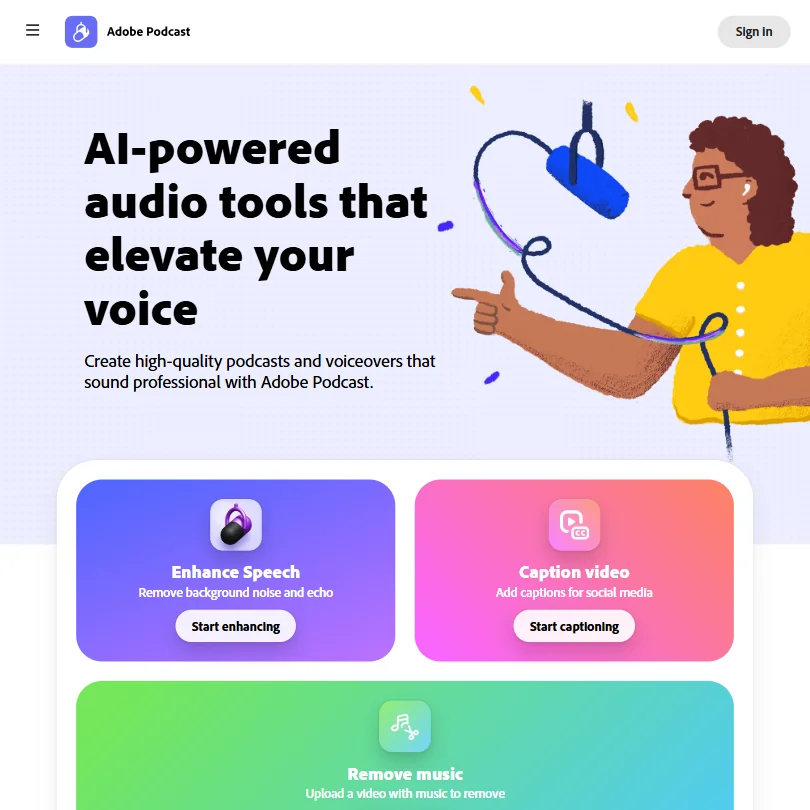
The core idea is audio cleanup without the learning curve. Enhance Speech is the headline feature: upload a voice recording and the AI scrubs out background noise, removes echo, and makes the result sound like you recorded in a padded room. One click. That's genuinely how fast it is.
Beyond that, the tool handles text-based audio editing. You edit a transcript and the audio follows. It also records remote guests with separate tracks, transcribes files, captions video, and strips music from recordings. Decent set of tools for a free product.
The Premiere Pro connection matters here. The transcription engine is shared between the two products, which is why the accuracy holds up reasonably well on clean audio. That tracks. Adobe's transcription has been solid in Premiere for years, and it shows.
Adobe Podcast Features: Voice, Music & Audio Capabilities
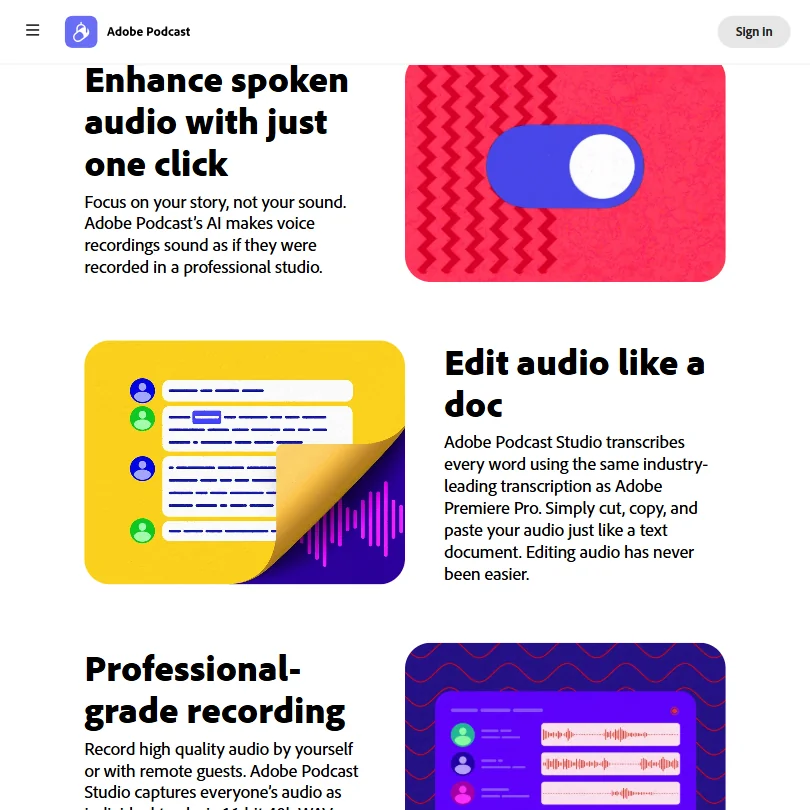
Start with what it actually does. Enhance Speech processes uploaded audio in under a minute for most files. Noise removal and echo reduction run automatically, with no controls to adjust and no EQ to tweak. That's either a relief or a limitation depending on what you need.
Text-based editing is where the workflow lives. Transcribe your recording, read through the text, delete words by deleting text. The audio follows. This is the feature that gets the most Reddit traction, and for good reason. It's genuinely faster than traditional timeline editing for dialogue-heavy content.
Recording works in the browser, capturing each participant on a separate track. Adobe provides documented multitrack-import workflows for Zoom, Restream, StreamYard, and Riverside recordings, though these are import workflows rather than direct account integrations. That's it for third-party connectivity. No API. No Zapier.
The royalty-free music library is included. Intros, outros, and a handful of transitions. Pre-edited, which means less work for solo creators. It's a nice add-on. Not a reason to choose the product.
What's missing is worth naming. No voice cloning. No text-to-speech, no mobile app. If you need any of those things, this isn't the tool.
Adobe Podcast Audio Quality: How Natural Does It Sound?
This is where Adobe Podcast earns its reputation. Honestly, the Enhance Speech results surprise people consistently. What we kept seeing across YouTube comments and Reddit threads was the same reaction: recordings made on laptop mics come out sounding noticeably cleaner, and the AI strips noise without destroying the voice.
The limitation that surfaces repeatedly in user reports is overprocessing. Push a recording through Enhance Speech and sometimes the result sounds slightly artificial. A subtle flatness. Some vocal character gets smoothed away.
The sweet spot is genuinely rough recordings. Built-in laptop mic, noisy coffee shop, busy home office. That's where the enhancement earns its reputation. For anything recorded on a decent USB mic in a quiet room, the gain is smaller and the risk of over-smoothing is higher. Not great.
Adobe publishes a seven-language transcription list covering English, French, German, Hindi, Italian, Portuguese, and Spanish, while Enhance Speech is described as language-agnostic because it improves sound rather than transcribing or translating speech. We didn't find many complaints about transcription accuracy on English audio. Accents and technical vocabulary are where it stumbles, which is not unique to Adobe.
Adobe Podcast Voice Cloning & Customization: How Deep Does It Go?
Not deep at all. Voice cloning doesn't exist here. Neither does text-to-speech.
Adobe Podcast enhances your voice. It doesn't generate one. There's no style picker, no tone control, no character selection. You record yourself and the tool cleans it up. That's the product.
Fair. That's a deliberate scope choice, not an oversight. Adobe Podcast isn't competing with ElevenLabs in voice generation. Different use case entirely. But if voice cloning or AI narration is what you need, this won't solve it.
The only customization available is what you do in the text editor after transcription. Cut words, rearrange sections, trim silences. Those are your levers. Fine for podcasters. Not enough for anyone building synthetic voice content, and we wouldn't pretend otherwise.
Is Adobe Podcast Easy to Use?
Very easy. The browser-based approach means no setup friction. Sign in, upload a file, click Enhance. It's designed to be accessible to someone who has never opened a DAW.
The editing interface follows the same logic. Transcript on one side, audio waveform below. Delete text, audio follows. There's no steep learning curve here because there's barely a curve at all.
What we noticed in user feedback is that this simplicity is also the ceiling. Experienced audio editors find the tool thin. No fine-grained controls. No multitrack mixing within the editor. No automation. If you want to get precise about EQ or compression, you'd export and take it somewhere else.
First-time podcasters. Educators recording lectures. For those users, this is close to ideal. Fast, forgiving, free.
Adobe Podcast Pricing: Is It Worth It for Creators & Businesses?
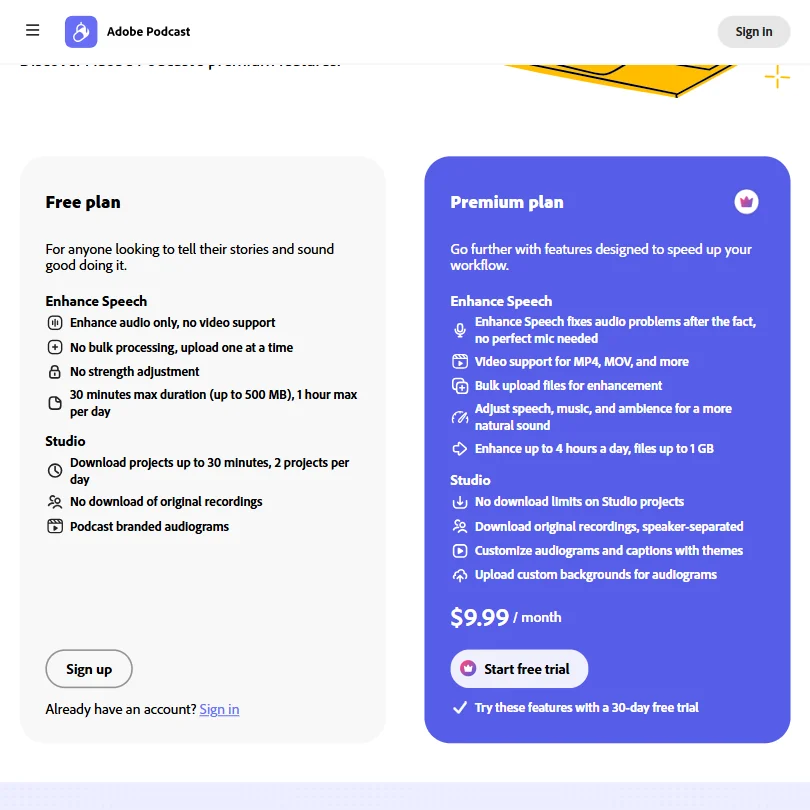
The free tier is the starting point. No trial period, no credit card required. Based on what the pricing page shows, the free plan includes Enhance Speech for audio only with no video support, no bulk processing, and a 30-minute max duration per file with a 1-hour daily cap. Studio features on the free tier cap project downloads at 30 minutes, limit you to 2 projects per day, and include podcast-branded audiograms only. That's not a demo. That's actually useful.
The Premium plan sits at $9.99 per month and comes with a 30-day free trial. It adds video support for MP4 and MOV, bulk upload for enhancement, and the ability to adjust speech, music, and ambience together. The daily enhancement limit goes up to 4 hours, and file sizes up to 1 GB are accepted. On the Studio side, Premium removes project download limits, adds speaker-separated original recording downloads, lets you customize audiograms and captions with themes, and allows custom background uploads for audiograms.
Honestly, the free-to-paid gap is real and the $9.99 price point is reasonable compared to Descript or Riverside. We're less skeptical of this pricing structure than we expected to be. For context, 19 of 29 AI audio tools in our database offer a free plan, so the free tier alone isn't a differentiator. The value is real. The question is whether $9.99 unlocks enough for your specific workflow to justify it.
Adobe Podcast vs Descript: Which AI Audio Tool Wins?
Descript is the natural comparison. Both do text-based audio editing. Both clean up recordings. Both live in a browser, roughly.
The difference is scope. Descript goes further, with screen recording, overdub, team collaboration, and video export. More surface area, more things that can go wrong, but also more tools in one place.
Adobe Podcast is faster to start and costs less upfront. The Enhance Speech feature is genuinely competitive with anything Descript offers on the noise removal side, and some users say it's better for that specific task.
Where Adobe Podcast loses is the feature ceiling. Descript gives you more options as your needs grow. Adobe Podcast doesn't grow much. Solo creator wanting clean audio and a simple edit, Adobe Podcast is probably enough. Producing anything with a team or needing overdub, Descript is the clearer call.
For podcasters focused specifically on automated audio processing rather than editing, Auphonic is another option worth considering. Different workflow, more processing controls, and a longer track record in that niche.
Who Should Use Adobe Podcast? (And Who Shouldn't)
Solo podcasters doing everything themselves. That's the fit. Fast setup, the free tier does the heavy lifting, and the AI enhancement covers a lot of recording sins.
Educators and teachers recording lectures. Same story. Clean up audio from a headset or built-in mic, add captions, done.
Not for teams that need collaboration features. Not for anyone who needs API access or downstream automation. Not for synthetic voice work.
Power users who want granular audio control will hit the ceiling fast. The tool gives you what it gives you. There's no digging deeper.
Adobe Podcast Review Verdict
Adobe Podcast does one thing exceptionally well. The AI speech enhancement is genuinely impressive, especially on rough recordings. For that use case alone, it earns a recommendation on the free tier.
The rest of the product is functional, easy, and a bit thin. At $9.99 per month, the Premium plan is priced reasonably and the feature additions, particularly bulk upload, video support, and the removal of project download limits, are practical rather than padded. The value case for Premium depends almost entirely on whether you hit the free tier's daily caps or need video support. If you don't, the free plan holds up longer than you'd expect.
Against most of the category, Adobe Podcast sits at roughly average. More tools than a basic audio cleaner, fewer tools than a full production suite. The brand gives it credibility. The browser-based workflow gives it accessibility. The scope limits how much it can be your main tool.
We wouldn't tell anyone to avoid it. Start on the free tier, use the enhancement for what it's built for, and be honest about whether the Premium additions match what you actually need.
Frequently Asked Questions
Is Adobe Podcast free to use?
Yes, there's a real free tier, not just a trial. It includes Enhance Speech for audio files, transcription, and text-based editing, with a 30-minute file cap and a 1-hour daily limit. The Premium plan at $9.99 per month unlocks video support, bulk uploads, and higher daily limits. Adobe does offer a 30-day free trial on Premium, so testing the full feature set before committing is straightforward.
Does Adobe Podcast support languages other than English?
For transcription, Adobe publishes a list covering English, French, German, Hindi, Italian, Portuguese, and Spanish. Outside those seven, results get inconsistent. Enhance Speech is a different case: Adobe describes it as language-agnostic because it processes sound rather than transcribing speech, so noise removal should function regardless of the language spoken. Worth keeping separate in your head. Two different systems, two different answers.
How does Adobe Podcast's Enhance Speech compare to other AI audio tools?
On genuinely noisy recordings, the enhancement holds up well against competitors. Users frequently flag it as one of the better one-click noise removal options available for free. The trade-off is overprocessing on cleaner source audio, which can introduce a subtle flatness. Best treated as a fix for bad recordings, not a polish pass on good ones.