Our research into Astria started with a fairly specific question: does the fine-tuning pitch actually hold up for ecommerce teams, or is this just another image generator with better marketing? We pulled vendor docs, dug through Reddit threads, and cross-referenced what we could find on forums and product communities. This astria review is the result. Astria launched in 2022 and has quietly built a niche around one thing: letting brands generate consistent model imagery without booking a shoot. That's a real problem with a real audience. Whether the execution matches the ambition is what we wanted to find out.

What is Astria?
Astria is a web-based AI image generation platform that sits on top of Flux, with its own fine-tuning layer bolted on. The core idea is that you upload reference images, train a model on them, and then generate new scenes using that trained subject. Same face, different background. Same product, different setting. That's the loop.
It's aimed squarely at fashion brands and ecommerce teams who need product photos at volume. Professional headshots are the other main use case. Both make sense given the fine-tuning architecture. You can get to it through the web app, a native Photoshop plugin, or the REST API.
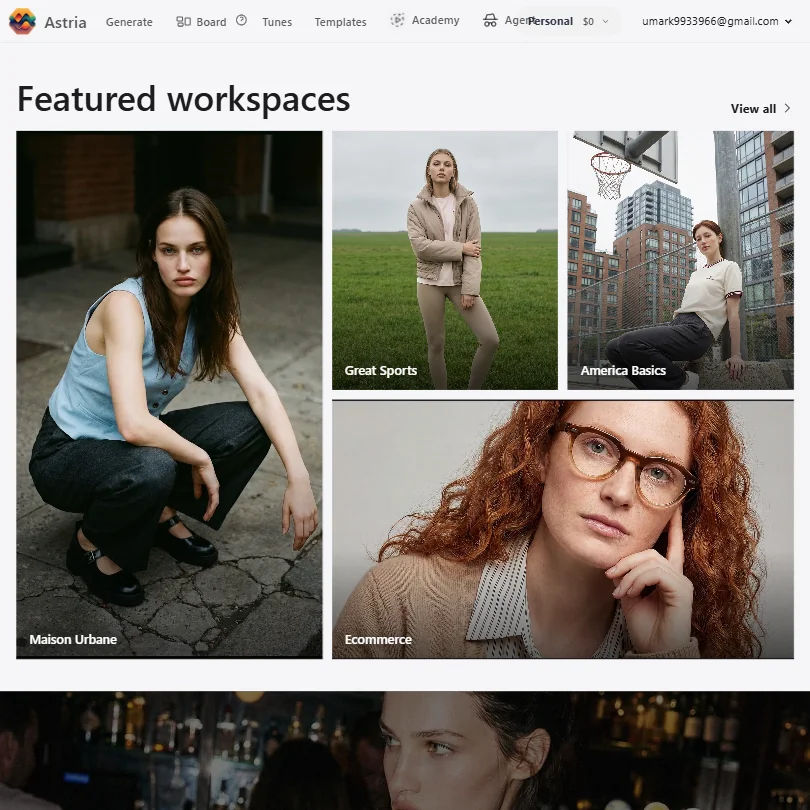
There's also a gallery and community models page, which gives it a light social layer. Not a marketplace exactly. More like a portfolio wall. Honestly, we found it more useful for understanding what the tool can do than the homepage was.
Astria Image Quality: How Good Are the Results?
This is where Astria's argument is strongest. The fine-tuning layer on top of Flux means you're not just prompting into the void. You're working with a model that has learned a specific face or product. That consistency is the whole point, and from what we saw across community outputs and user-shared examples, it genuinely delivers on it.
The lookbook and campaign-style outputs get mentioned approvingly in forum discussions. People working in fashion ecommerce seem to find the results production-usable, which is not something you'd say about most general-purpose generators. That surprised us, honestly. The bar for "usable in a real campaign" is high. Astria clears it more often than we expected.
Where things get murkier is edge cases. Multiperson generation was still in beta as of February 2025. Multi-subject scenes have historically been a weak point for fine-tuned models, and users in the community have flagged it. That's fair to call out. Single-subject, single-scene? Solid. Two people? Proceed carefully.
Astria Features: Text-to-Image, Video & Editing Tools
The feature list is focused rather than sprawling. Text-to-image with fine-tuned model support is the headline. Image-to-image follows naturally from the training workflow. Beyond that, you get ControlNet support and LoRA-based fine-tuning via the API. Flux LoRA is supported. That matters if you're building on top of this programmatically.
Batch generation is in there too, which is table stakes for ecommerce workflows. Negative prompts are supported. Multiple aspect ratios. Private workspaces. The basics are covered. What's not there: video generation, image animation, outpainting. The homepage mentions video generation in the feature list, but we couldn't confirm it as a shipped, usable feature. We'd treat that with some caution.
The API is genuinely well-documented by the standards of a small 2022-era tool. Webhooks are available. If you're an engineering team building a product photography pipeline, the API coverage looks solid. The Photoshop plugin is a real integration, not a beta toy. We don't see that often at this tier.
Is Astria Easy to Use?
This is where we'd pump the brakes a little. The fine-tuning workflow requires more setup than a standard text-to-image tool. You're uploading reference images, training a model, waiting for it to finish, then generating. That's not hard, but it's not frictionless either.
Reddit threads and forum posts from users suggest the learning curve is real, particularly around prompt construction. The tool rewards users who invest time in it. People who just want to type a sentence and get an image are probably shopping elsewhere. Ecommerce teams with a dedicated person for this workflow will adapt faster than someone picking it up occasionally.
The help documentation covers the basics. How-tos, FAQs, an articles section. Not deep. We've seen worse, but we've also seen much better from tools at a comparable stage. There's no live chat. Email support is the ceiling.
Astria Pricing: Free Plan vs Paid — Is It Worth It?

We dug through the pricing page and found essentially nothing concrete. Pay-as-you-go credits are the model. Exact prices weren't publicly listed anywhere we could scrape or navigate to. No free plan. No publicly stated free trial. No published tiers.
That's a problem. It's not a dealbreaker if the credits are reasonably priced once you're inside, but asking someone to sign up before seeing any cost is a friction point that puts Astria at a disadvantage against tools that publish their numbers. Pricing opacity is the single biggest issue we'd flag to anyone evaluating this tool. We don't buy the idea that this is intentional positioning. It just reads as an oversight that's been sitting there too long.
No refund policy stated publicly either. No enterprise tier information. For a tool aimed at brands and ecommerce teams, that's a lot of blanks.
Astria vs Midjourney: Which AI Image Generator Wins?
Wrong comparison, mostly. Midjourney is an aesthetic powerhouse aimed at artists and designers who want beautiful images. Astria is trying to solve a different problem: brand consistency for commercial shoots. They're not really fighting for the same user.
Where Midjourney wins on raw image quality and creative range, Astria wins on repeatability. You can't reliably put the same face in 50 different scenes with Midjourney. With Astria, that's the whole product. If you need campaign-ready headshots at scale, Midjourney isn't the answer. If you want to generate a stunning one-off fantasy landscape, Astria isn't either.
Photoroom is a more honest competitor for the ecommerce angle. Pebblely too. Both are more accessible and more pricing-transparent. Astria's fine-tuning depth is the edge it holds. Whether that depth justifies the opacity elsewhere is the call each team has to make.
Who Should Use Astria? (And Who Shouldn't)
Fashion and ecommerce brands. That's the clearest fit. Specifically teams generating product photos at volume who've already run into the limits of generic AI tools. The fine-tuning workflow gives them something those tools can't.
Developers building commercial photography pipelines should look at the API seriously. It's the most capable part of the product.
Solo creators or small teams without someone to manage the training workflow? Probably not the right fit. The same goes for anyone who needs transparent pricing upfront before committing. If you're looking for a broader creative tool with editing muscle baked in, Adobe Firefly is worth the comparison, particularly if you're already in the Adobe stack.
Astria Review Verdict
Astria does one thing well and builds almost everything else around it. The fine-tuned model approach for consistent commercial imagery is genuinely useful and not common at this level. The API is decent. The Photoshop plugin is a real feature. For the right team, this is a tool that earns its place.
The pricing situation is the main frustration. No published costs, no free tier, no stated trial. That alone will push budget-conscious teams toward competitors who just tell you what things cost. The support ceiling is low. Documentation is thin past the basics.
What Astria has built is a focused, technically capable product that hasn't yet grown the wrapper it needs. The core generation quality is the strongest argument for it. The opacity around everything else is the strongest argument against it. We'd watch the February 2025 multiperson beta. If that ships cleanly, the use case gets meaningfully wider.
Frequently Asked Questions
Does Astria have a free plan or free trial?
No free plan exists as of our research. A free trial isn't publicly stated on the site either. You're looking at a pay-as-you-go credit model, and the exact cost of those credits isn't published openly. We'd recommend reaching out directly before committing.
What is Astria best used for?
Commercial product photography and AI headshots are the clearest use cases. The fine-tuning workflow lets you generate consistent imagery of a specific person or product across different scenes. It's not a general-purpose creative tool. Teams who need volume and brand consistency are the ones who get the most from it.
Is Astria's API good enough for developers?
Based on what we found in the docs and developer-side forum posts, yes, it's solid for the category. ControlNet support and LoRA fine-tuning are both available via the API, and webhooks are in there too. The documentation is functional. Not exhaustive, but enough to build on.