Rodin generates textured 3D models from text, one image or several images, with PBR maps on every model, polygon counts up to 10 million, optional LODs and quad meshes. Whether it suits you depends on what happens after generation: Rodin makes rigging-ready static meshes, and rigging and animation happen in your own tools.
What is Rodin?
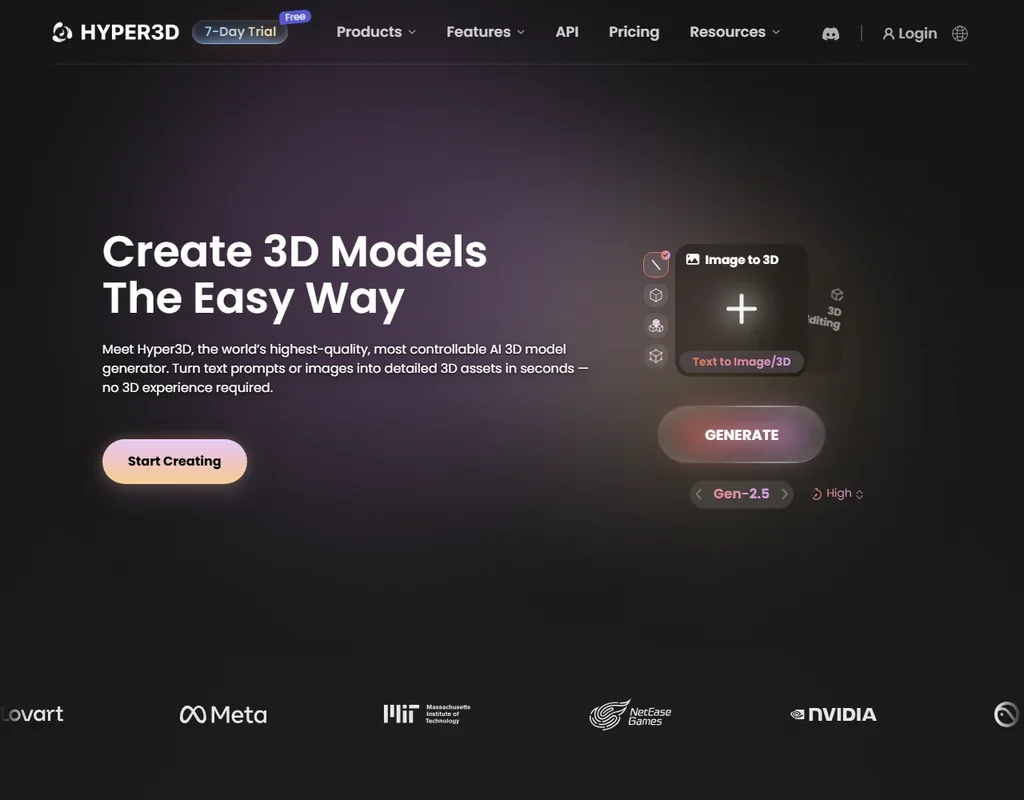
Rodin comes from Deemos, which sells it under the Hyper3D name, and is based in the United States. It runs in the browser, with plugins that bring it into 3D tools and game engines.
The same plans cover Rodin 3D generation, API access, ChatAvatar previews and OmniCraft tools. Rodin is aimed at studios and developers who want high-detail models with control over polygon count and level of detail.
Making 3D models with Rodin
Rodin builds a model from a text prompt or from an image, and one image is enough for most objects. Multi-image to 3D combines several images into one model, on Creator and above, with limited use on the free plan.
Every model includes PBR textures: albedo, roughness and metalness maps. HD Texture and Custom Texture are on Creator and above.
Polygon counts are selectable up to 10 million, with optional LOD generation, and Creator and above get more polycount options. High-Poly Quads, for quad mesh output, is on the Business plan.
Rodin does not rig or animate. It produces rigging-ready meshes, and rigging and motion are done in your own tools.
Models export as GLB, glTF, FBX, OBJ, STL, USDZ, 3MF or DXF. Plugins connect Rodin to Blender, Unreal, Unity, Godot, Maya, 3ds Max, Cinema 4D, NVIDIA Omniverse and Isaac, and ComfyUI.
Working with other people
The Business plan is built for studios, product teams and API workflows, and full API access comes with Business and above. Enterprise is custom priced and adds production support.
Rodin pricing: what each plan gives
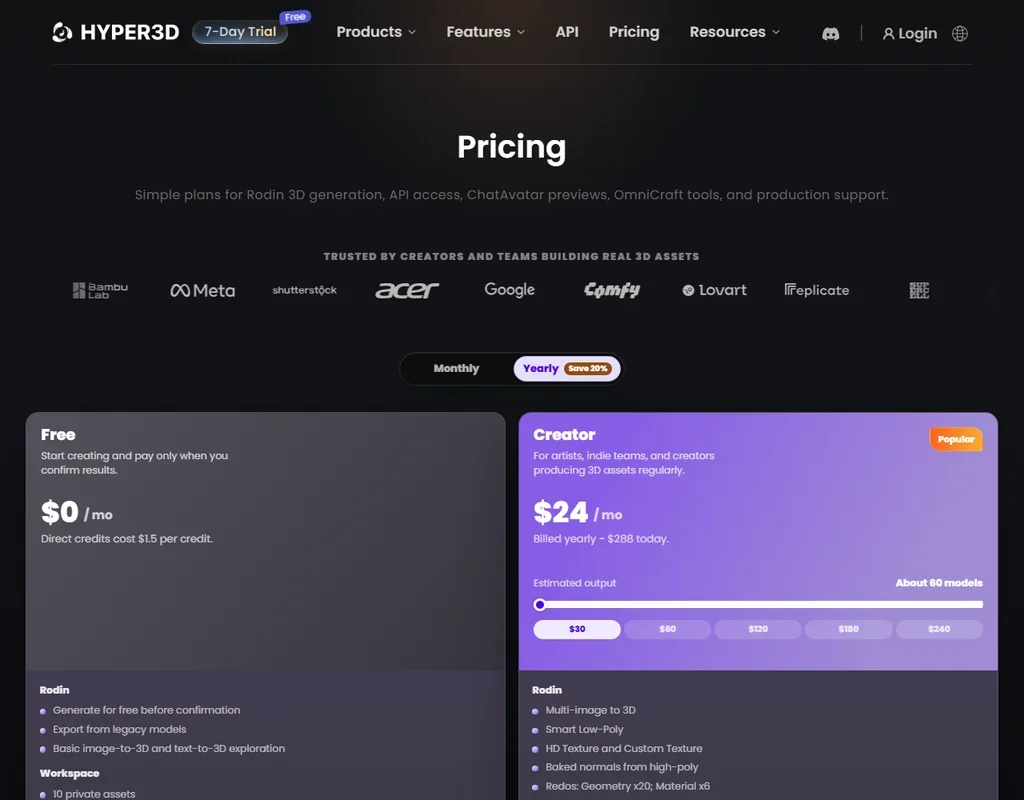
The free plan lets you generate at no cost and pay only when you confirm a result, using direct credits at $1.50 each. It includes basic image-to-3D and text-to-3D, exports from legacy models and 10 private assets.
Creator starts at $30 a month, or $24 a month billed yearly at $288, for about 60 models a month at the base tier. Higher Creator tiers cost $60, $120, $180 and $240 a month. Business starts at $120 a month, or $96 a month billed yearly at $1,152, for about 416 models a month at the base tier, with full API access and tiers up to $1,200 a month. Business also adds a ChatAvatar commercial licence. A 7-day trial is available, and Enterprise is priced on request.
Creator and Business give unlimited export and any use of what you make, and unlimited private assets. On the free plan, export is from legacy models and commercial use comes with a subscription. Publishing to the public gallery is optional on paid plans.
Support
Support runs by email at hello@deemos.com, with a help center, and Enterprise adds production support.
Who Rodin suits
Rodin suits studios and developers who want high-detail textured models with PBR maps, polygon counts up to 10 million, LODs, and an API on the Business plan. Its plugins reach Blender, Unreal, Unity, Godot and more, including Omniverse and ComfyUI.
It suits less well anyone who wants rigging or animation in the same tool, since Rodin makes static, rigging-ready models. Quad output needs Business, and the free plan charges $1.50 a credit for each confirmed result.
Frequently Asked Questions
How much does Rodin cost?
Creator starts at $30 a month, or $24 billed yearly, for about 60 models. Business starts at $120 a month, or $96 billed yearly, for about 416 models. The free plan charges $1.50 a credit for each confirmed result, and a 7-day trial is available.
Can Rodin rig or animate a model?
No. Rodin makes rigging-ready static meshes, and rigging and animation are done in your own tools.
Can I control the polygon count in Rodin?
Yes. Polygon counts are selectable up to 10 million, with optional LOD generation, and quad output is on Business.
Can I use Rodin models commercially?
Yes, on Creator and Business, which give unlimited export and any use. On the free plan, commercial use is tied to a subscription.