
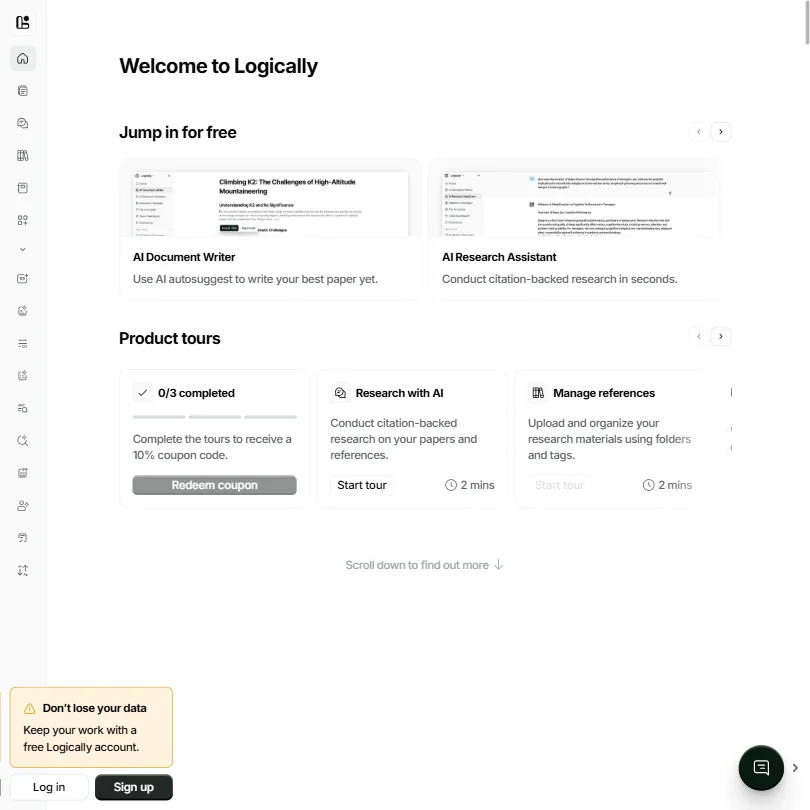
The tool has 100,000-plus claimed users, a G2 "Top Voted AI Product of the Year" badge, and a pricing page that actually makes you stop and do the math. We pulled vendor docs, Reddit threads, G2 write-ups, and the pricing screenshot. What we kept seeing was a product doing more than its category label suggests, priced at a point most competitors don't bother competing at, with one gap that keeps surfacing in user reports.
What is Logically?
Four things in one product. A document writer, a research assistant, a reference manager, and a PDF annotator. The target audience is obvious from the design choices: students, academics, anyone who writes papers and has lost count of how many browser tabs they had open at 11pm reformatting citations.
Three AI models sit inside the same workspace, Claude, Gemini, and ChatGPT, which is genuinely unusual. Most competitors pick one and call it a day. Zotero doesn't touch AI writing at all. Jenni.ai doesn't give you model choice. Logically's vendor docs confirm all three are available, though the specifics of how you switch between them, or whether the platform assigns them by task, aren't spelled out clearly. That ambiguity comes up in user feedback too.
The 100,000-plus user count is on their homepage. We can't verify it independently. The G2 badge is real, for whatever that's worth.
Logically Features: Search, Synthesis & Research Capabilities
The core loop is straightforward. You upload references, import from Zotero, or drop in a DOI. The AI Research Assistant runs citation-backed queries across those sources. You write in the Document Writer and handle PDFs in the File Annotator. Upload, research, write, cite.
Bolted on top of that are a collection of mini tools, an AI summarizer, a paraphraser, and a few others. Some feel like real utility. Others feel like SEO landing pages that got promoted to features. Honestly.
Citation generation covers over 10,000 styles with automatic bibliography building. That's a real number worth taking seriously, especially for anyone who has manually rebuilt an APA bibliography the night before a deadline. File support goes beyond the usual PDF and DOCX too. EPUB and PPTX handling is less common at this price point, and DOI or URL import works across all of it.
Logically Research Quality: How Accurate and Trustworthy Is It?
G2 reviews kept flagging the citation-backed approach as the primary reason people stay. When we cross-referenced those reports against vendor claims, the picture was mostly consistent. The AI grounds responses in your uploaded documents rather than generating from nothing, which is the baseline requirement for any academic use case.
We're cautiously positive here. Not enthusiastic. The research assistant synthesizes across what you uploaded, not necessarily from a live external academic database, and that distinction matters more than the marketing copy suggests. Users who brought their own PDFs seemed satisfied. Users who expected the tool to go find new literature for them got something more mixed.
There's a feature described in the docs as academic search, with the ability to discover citations from a research database. How deep that database actually runs, we couldn't confirm. No coverage specifics in the vendor docs. No independent confirmation across the reviews we found. We're skeptical of that.
Logically Source Coverage: What Does It Actually Search?
Unclear. That's the honest answer.
The vendor page references citation-backed research and source verification. The vendor cites a 200 million-paper Semantic Scholar-backed database, though it isn't described in terms of journal coverage, field depth, or update frequency. Tools like Scite are explicit about their corpus. Logically is not.
Reddit threads we found weren't specific about this either. That could mean users aren't pushing the discovery feature hard. Could also mean they've stopped expecting it to work. Users who treated Logically as a way to organize and query their own uploaded literature seemed happiest, and that's a meaningful signal about where the product actually delivers.
On integrations: what's publicly documented includes a Microsoft Word citation add-in and an Obsidian integration. These are software integrations, not browser extensions in the traditional sense. We found no current official Chrome extension listing. The navigation implies more than the documentation delivers.
Is Logically Easy to Use for Researchers and Professionals?
Onboarding is gentle. Three guided product tours on the dashboard, and completing them earns a 10% coupon code. Small touch. Smart one.
G2 reviews in student and academic segments consistently mentioned how quickly people got started. No serious complaints about the learning curve came up in our research. The Zotero import works, which matters because anyone with an existing reference library isn't going to rebuild it from scratch for a new tool.
The free plan is meaningfully limited, though. Five AI autosuggestions per day, five chat messages per day, five commands per day, and 100MB of reference and file storage. Not great. That daily cap will stop a real research session before it gets going. Enough to evaluate the product. Not enough to actually work in it.
Logically Pricing: Is It Worth It vs Free Alternatives?

One paid tier. The Unlimited plan costs $12 per user per month billed annually, which works out to $144 per user per year. Not $12 for the year. That distinction matters and the pricing page doesn't make it prominent. Month-to-month is $30 per user. The gap between those two numbers is real and worth planning around before you commit.
Students get an extra 50% discount on top, which the pricing page confirms. That brings annual Unlimited down to something closer to $6 per user per month, and at that price the value case becomes fairly obvious for the target audience.
The free plan exports add a PDF watermark. That watermark is a meaningful enough annoyance to push most users toward paying. The Unlimited plan comes with a 30-day money-back guarantee, and no card is required for the free tier at all.
Zotero is free and excellent at reference management. It doesn't write. Jenni.ai charges more and doesn't give you model choice. SciSpace has a free tier but gates useful features faster. At $12 per month annually, Logically's value case holds for regular users. Casual researchers might survive on the free plan, frustrations aside.
Logically vs Zotero: Which AI Research Tool Is Better?
Zotero is free, open source, and very good at organizing references. It is not an AI writing tool. It doesn't synthesize across documents or draft paragraphs with inline citations.
Logically does both of those things. For a researcher already running Zotero, Logically isn't a replacement. You'd import the Zotero library into Logically and use both. That import path exists and apparently works cleanly.
Zotero wins on reference management depth and plugin ecosystem. That's not close. Logically wins on the AI writing layer, and if you need both in the same workspace without context-switching, Logically has a real argument. Teams get a small additional advantage too: Logically offers a centralized admin portal for teams and discount pricing for multiple seats. Zotero's free plan caps group library storage quickly.
Fair.
Who Should Use Logically? (And Who Shouldn't)
Graduate students writing papers regularly. That's the clearest fit. The workflow maps directly onto that use case, the student discount brings the price down further, and there's no strong reason to look elsewhere at that combination.
Academics with existing Zotero or Mendeley libraries who want an AI writing layer on top. The import path keeps the friction low.
Professionals writing citation-heavy reports who aren't trying to run systematic literature searches from scratch.
Researchers expecting deep literature discovery from an independent academic database. They'll be disappointed. Elicit is built specifically for systematic literature reviews and is considerably more transparent about what it actually searches. Logically is not the right tool there.
No mobile app. If you're not at a desk, that's a real problem.
Logically Review Verdict
The product is genuinely useful. Not overbuilt, not trying to be everything, and at $12 per user per month annually it doesn't need to be.
What we'd change: more transparency on the academic database, clearer documentation on what the Word add-in and Obsidian integration actually cover, and a harder look at the mini tools section. A text humanizer and a title case converter don't belong in the same product suite as a serious research assistant. That section reads like feature padding.
The AI writing layer with real citation grounding is the actual reason to use this. That part works, based on what we found across G2 and user reports. Reference management is solid if not best-in-class. The $12 monthly price annually, the 30-day money-back guarantee, and the no-card-required free tier make it easy enough to try without much risk.
The source coverage question is the one thing we'd want them to answer clearly. Until they do, serious researchers have a legitimate reason to keep one foot out the door.
Frequently Asked Questions
Does Logically work with existing Zotero libraries?
Yes. Logically supports importing from Zotero and Mendeley. You don't rebuild your reference library from scratch, which is one of the more practical decisions they made. It won't replace Zotero for reference management depth. It doesn't try to.
Is the free plan actually usable?
For evaluation, yes. For daily research work, no. Five AI chat messages per day, five autosuggestions, five commands, and 100MB of storage will run out fast in a real session. Most people doing serious work will need the Unlimited plan. The 30-day money-back guarantee on that plan means the risk is low. Students should also check the 50% discount before paying full price.
Which AI model does Logically use?
Claude, Gemini, and ChatGPT are all confirmed available inside the platform. What's less clear is whether users can freely choose between them or whether the platform assigns models to specific tasks. The vendor docs don't spell that out. Worth testing during your own trial before committing to a full year at $144 per user.


