What is Lebesgue?
Lebesgue started as an attribution and customer lifetime value tool for Shopify brands. Over time it layered in competitor ad monitoring, product performance modeling, and eventually Henri, its proprietary AI. Henri is built on top of Lebesgue's own analytics engine. Lebesgue says its predictive models are trained on data from thousands of ecommerce brands and that its benchmarks draw on more than 20,000 analyzed brands. You ask it a question. It pulls from your store data, your ad account signals, and its competitor intelligence layer to give you an answer.

The framing is "AI CMO." That's ambitious. Honestly, it's also a little over-promised. But the core mechanic is real. Ask why Meta ROAS dropped last week, and Henri is supposed to pull root-cause analysis instead of just surfacing a chart you have to interpret yourself. Whether it delivers that consistently is what users debate.
It connects to Shopify natively, and Meta and Google Ads as well. TikTok is in there too. Lebesgue also integrates with Klaviyo for email and SMS performance data, which covers one gap people ask about. Lebesgue supports both Shopify and WooCommerce stores, though its deeper feature set is clearly oriented around Shopify.
Lebesgue Features: Product Listings, Bulk & Marketplace Tools

Worth being direct about what Lebesgue isn't. There are no product description generators here. No SEO title tools, no bulk upload functions, no image editing. If you landed here looking for that kind of ecommerce content tooling, this isn't it. Something like Hypotenuse AI is built for that job.
What Lebesgue actually does: competitor ad monitoring across major platforms, product performance modeling inside your store, and AI-generated strategic insights through Henri. Those three things are the real product.
The competitor intelligence is the piece users mention most. You can watch what competing brands are running in paid ads, see patterns in their creative, and get a read on estimated spend behavior. That's genuinely useful if you're running paid social and want to know what's working in your market without pure guesswork.
The ad copy generation exists, but it's narrow. Henri surfaces ad strategy suggestions based on what it's seeing in your data and your competitors' activity. It's not a blank creative canvas. More of a guided output tied to analysis.
Lebesgue AI Writing Quality: Are the Product Descriptions Good?
Lebesgue doesn't generate product descriptions. Full stop. That's not a gap in their roadmap as far as we can tell. It's just not what the tool is built for. Henri writes insight summaries and strategic recommendations. The writing quality question here is really about clarity, specifically whether Henri explains things in plain language or produces analytical mush.
From what we read across Shopify App Store reviews, the answer is mostly positive. Users mention that the explanations feel readable, not like they're decoding a report. One pattern we kept seeing was marketers saying they understood their LTV and attribution situation better after using Henri than before. That tracks for a tool benchmarking against more than 20,000 analyzed brands.
We're cautiously optimistic on this front. But we haven't tested it, so take that for what it is.
Lebesgue Marketplace Support: Shopify, Amazon & Beyond
Shopify is the foundation. Lebesgue supports both Shopify and WooCommerce, which is more than most competitors in this category bother to document clearly. Amazon and Etsy are still absent. No Zapier bridge that might help you work around those gaps either.
The integration list is short by design. Shopify and WooCommerce on the store side, then Meta and Google Ads for paid channels, TikTok, and Klaviyo for email and SMS. That's the meaningful list. A few others exist in the docs, but those are the ones that actually matter for the core use case.
Shopify-centric positioning still means a chunk of the ecommerce market is excluded, Amazon sellers in particular. For a brand running paid ads primarily through Meta and Google on a Shopify or WooCommerce store, that's probably fine. For anyone whose revenue depends on marketplace channels, it's a real constraint.
Is Lebesgue Easy to Use?
The Henri interface looks simple in demos. Ask a question, get an answer. That framing is either genuinely easy or deceptively simple depending on how well-connected your data is on day one.
From what we read in user reports, setup friction is real at the beginning. Getting Shopify, Meta, and Google Ads all properly synced and letting the tool build enough data context takes time. Users who stuck it out past that initial phase generally reported positive experiences. Users who bounced early were usually frustrated by the onboarding period.
Not unusual for analytics tools. Still worth flagging.
Lebesgue has a 4.9 rating from 119 reviews on the Shopify App Store. The company's own homepage cites 150+ reviews, which appears to aggregate counts from multiple platforms rather than reflecting the Shopify listing alone. Either way, the satisfaction signal is strong. Lebesgue isn't currently listed on G2 or Capterra, which means we can't cross-reference with those review pools. That's a gap. Honestly, we'd like to see them there.
Lebesgue Pricing: Is It Worth It for E-Commerce Sellers?
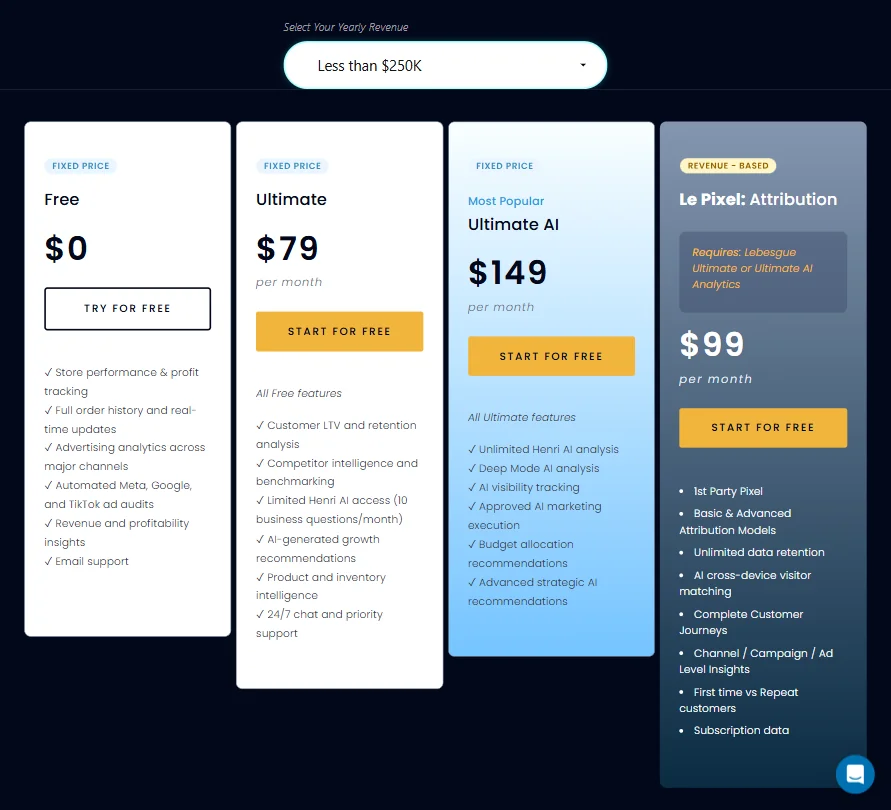
Four tiers. Free, then Ultimate at $79 per month, then Ultimate AI at $149 per month, then Le Pixel: Attribution at $99 per month as an add-on that requires either Ultimate or Ultimate AI underneath it. Lebesgue offers a free plan and a 14-day free trial for its paid plans, which is better than most tools in this category bother to offer.
The free plan covers store performance tracking, order history, advertising analytics across major channels, and automated audits for Meta, Google, and TikTok. Useful for early-stage stores. Not enough for anything serious.
The $79 Ultimate plan adds customer LTV analysis, competitor intelligence, limited Henri AI access at 10 business questions per month, and AI-generated growth recommendations. The $149 Ultimate AI tier unlocks unlimited Henri AI analysis, Deep Mode AI analysis, approved AI marketing execution, and budget allocation recommendations. That jump from 10 questions per month to unlimited is the real decision point between those two plans.
Le Pixel at $99 per month sits separately and adds first-party pixel tracking, basic and advanced attribution models, unlimited data retention, AI cross-device visitor matching, and complete customer journey mapping. It's an attribution product layered on top, not a standalone.
At $79, Lebesgue's Ultimate plan is substantially cheaper than Triple Whale's displayed $219-per-month Foundation plan, although Triple Whale also offers a free tier. That gap is large enough to matter for smaller brands. Whether the feature overlap justifies the price difference depends on which specific capabilities you actually use.
Lebesgue vs Triple Whale: Which E-Commerce AI Tool Is Better?
Triple Whale is the most common comparison. Both target Shopify brands running paid ads. Both do attribution. Both have AI features. The differences are meaningful.
Triple Whale has wider name recognition in the mid-market Shopify community and a much larger review trail, which makes independent evaluation considerably easier. Lebesgue's Henri AI is a more opinionated product. It wants to be the thing you ask questions, not just another dashboard you check. That's either appealing or annoying depending on how you work.
Lebesgue's competitor ad monitoring feels more developed than what Triple Whale offers in that specific area. That's a genuine edge if competitor creative intelligence is a priority. On pricing, Lebesgue's $79 Ultimate plan is substantially cheaper than Triple Whale's $219 Foundation plan, so the budget math favors Lebesgue for smaller operations.
Polar Analytics and Northbeam are also in this conversation. Both have stronger independent review coverage than Lebesgue currently has, which matters when you're trying to verify claims before spending money.
Who Should Use Lebesgue? (And Who Shouldn't)
Shopify and WooCommerce brands running paid social and Google Ads. That's the fit. Specifically brands frustrated by attribution guesswork and wanting something that explains results rather than just reports them. The competitor monitoring angle makes it interesting for brands in crowded niches where watching paid ad patterns from competitors is actually actionable intelligence.
Not on Shopify or WooCommerce. Not a match.
Also, early-stage stores with limited ad spend history probably won't get much out of Henri's models yet. The tool benchmarks against thousands of brands, but it still needs your own data to be meaningful. If you're running $500 a month in ads, the output will be thin.
Anyone looking for product content tools or bulk listing workflows needs to look elsewhere entirely.
Lebesgue Review Verdict
Lebesgue has built something real. The Henri AI approach, combining store data with competitor intelligence and predictive models trained on data from thousands of ecommerce brands, is more interesting than another attribution dashboard with an AI badge slapped on it. The Shopify App Store reviews suggest the product works for the audience it's built for.
The problems are real too. The lack of G2 or Capterra presence makes independent verification harder than it should be for a tool that's been around since 2019. No Amazon or marketplace support is a constraint that won't go away quietly. And the jump from $79 to $149 per month for unlimited Henri access is steep enough that the question of which plan you actually need deserves more careful thought than the pricing page currently encourages.
We'd push them hardest on two things: get listed on G2, and clarify the Le Pixel add-on requirement more prominently upfront. Both gaps create friction for buyers who are trying to evaluate the full cost before they commit.
For the right Shopify or WooCommerce brand running serious paid ad spend, this is worth the 14-day trial. For everyone else, the limitations come first.
Frequently Asked Questions
Does Lebesgue work with stores that aren't on Shopify?
Lebesgue supports both Shopify and WooCommerce stores. Amazon, Etsy, and other marketplace platforms are not currently supported, and there's no connector layer that would help non-Shopify, non-WooCommerce stores plug in. If your store runs on BigCommerce or a custom platform, this tool won't work for you right now.
What does Henri AI actually do differently from a standard analytics dashboard?
Henri is designed to answer questions in plain language rather than surface charts you have to interpret yourself. You ask something like why a metric dropped last week, and Henri is supposed to pull root-cause analysis by combining your store data with competitor benchmarks and its own predictive models. The Ultimate plan caps Henri at 10 business questions per month. Ultimate AI removes that cap entirely and adds Deep Mode analysis. Whether the output is consistently reliable is something we'd want to test hands-on, but the user feedback from the Shopify App Store leans positive on clarity.
Is Lebesgue worth it compared to Triple Whale?
Depends on what you're buying it for. Triple Whale has more public reviews and broader name recognition in the Shopify analytics space. Lebesgue's $79 Ultimate plan is substantially cheaper than Triple Whale's $219 Foundation plan, and Lebesgue's competitor ad monitoring is more developed in that specific area. If competitor creative intelligence is the priority, Lebesgue is worth a trial. If you just need clean attribution reporting and want a larger independent review trail to lean on before committing, Triple Whale is the easier evaluation.