Triple Whale is an AI ecommerce tool for DTC brands, combining multi-touch attribution, marketing mix modelling and incrementality testing in one platform.

We pulled Triple Whale's vendor documentation, cross-referenced it against Reddit threads from 2025, and read through what their site claims versus what users actually report on G2 and elsewhere. The product is ambitious. The pricing tells you exactly what kind of customer they're after. And the gap between the free tier and the first real paid plan is wide enough to give anyone pause.
Triple Whale launched in 2021 out of Columbus, Ohio. For a company that young, the numbers are hard to argue with: 60,000+ brands globally, 2,000+ agencies, and what they describe as a 55% adoption rate in marketing measurement tools. We haven't verified that last figure independently, but it keeps appearing in their materials with a June 2026 freshness date attached.
What is Triple Whale?
Pull your entire ecommerce data stack into one place, then put an AI agent on top of it. That's the short version. The agent is called Moby 2, and it's not a single-model setup. It runs on Claude, GPT-4, and Gemini depending on task. Multi-LLM by design, which is a more honest architecture than vendors who quietly bet everything on one model and don't say so.
The core pitch is attribution. Specifically, the kind that holds up when cookies are dying and last-click is lying to you. Triple Whale combines multi-touch attribution, media mix modeling, and incrementality testing. Most competitors offer one of those, sometimes two. Getting all three in a single platform is the actual differentiator here, not the AI chatbot.
The Triple Pixel is the foundation. Triple Whale's own first-party tracking pixel, doing the heavy lifting that Meta's and Google's native tracking can't do reliably anymore. Sonar, their data enrichment layer, takes those first-party signals and pushes them back to the ad platforms to improve targeting. That feedback loop matters. It's not just analytics. It's analytics feeding back into media buying.
Honestly, that's a more coherent product story than most tools in this category manage to tell.
Triple Whale Features: Product Listings, Bulk & Marketplace Tools

Moby 2 is where most of the feature expansion has happened. In research mode it answers questions about your store. In action mode it actually does things. The spread is wider than we expected.
On the content side, it drafts full Klaviyo campaigns including HTML. It writes ad copy for Meta and Google. It can build Shopify landing pages from scratch. The Klaviyo drafting and the landing page creation showed up repeatedly in user discussions as genuinely useful rather than demo-ware. The others we're less certain about until someone runs them hard.
Moby Automations is where the bulk processing lives. You can push audience updates and trigger campaign actions without touching a dashboard. Scheduled recurring reports are in there too. The automation layer sits on the Automate plan at $1,349/month, so it's not something smaller brands will be testing casually. Fair, but worth flagging.
Image and video generation is listed as a feature on the Automate plan. Triple Whale describes it as tuned to brand performance data, meaning it's supposed to surface creative ideas based on what's actually converting, not just what looks good. The creative fatigue detection piece, where Moby 2 flags when an ad is burning out before you notice it, is the kind of thing performance marketers have been asking for. Whether it works as described in practice is a different question.
Forecasting is in there. SKU-level order volume predictions for the following month. Competitive monitoring via AI search sentiment tracking. Incrementality testing including holdouts and geo-lift. That's a lot of surface area. We kept seeing user reports that praised the measurement depth but noted a steep learning curve before any of it clicks. Not great. But not unusual for a tool this complex.
Triple Whale AI Writing Quality: Are the Product Descriptions Good?
Triple Whale is not primarily a content generation tool. Calling it that would misread what it's built for. The writing capabilities exist in service of campaign execution, not catalog content.
Moby 2 generating ad copy for Meta or TikTok is useful in context because it's pulling from your actual performance data when it writes. That's different from a generic AI writing tool that knows nothing about your store. Whether the output is good enough to publish without editing, we genuinely don't know. Users don't seem to complain loudly about quality, but we also don't see detailed breakdowns comparing its copy to what a skilled performance marketer would produce.
The Klaviyo integration is more documented. Drafting a full Klaviyo campaign in HTML is one of the specific use cases Triple Whale pushes in their demos. It came up in product discussions as a real time-saver for ecommerce teams without dedicated email designers. That tracks.
Bulk product description generation across thousands of SKUs? Wrong tool. Something like Hypotenuse AI is built specifically for that problem. Triple Whale's content features are campaign-level, not catalog-level. Full stop.
Triple Whale Marketplace Support: Shopify, Amazon & Beyond
Shopify is the native home here. The Pixel installs on Shopify. The landing page builder targets Shopify. The integrations are Shopify-first in how they're documented and how users seem to actually use them.
Triple Whale advertises 60+ integrations, with Meta Ads, Google Ads, TikTok Ads, Klaviyo, and Slack as the named priorities. A data warehouse sync is available as an add-on, which matters if you're running a more complex analytics setup.
Amazon is actually documented. Triple Whale explicitly covers Amazon Seller Central and Amazon Ads integrations, including connection instructions and marketplace selection. There's a dedicated Amazon Marketplace Dashboard and Amazon advertising reporting. That's a more complete picture than their top-level marketing sometimes suggests, and it's worth knowing if you split volume between Shopify and Amazon.
WooCommerce support isn't clearly confirmed in the public docs. Retail and wholesale data integrations are mentioned more vaguely, with specific platforms beyond the named ones not spelled out clearly. When a vendor is specific about the marquee integrations and vague about everything else, the vague ones are usually thinner than the count suggests. We're skeptical of that 60+ figure until someone maps them properly.
Is Triple Whale Easy to Use?
No. And that's not really a knock on the product. This is a measurement platform for serious performance marketers. Ease of use was never the goal. Power was.
What we kept seeing in Reddit threads and user discussions from 2025 is that the onboarding period is real. Users who came from simpler dashboards found the first few weeks disorienting. At least one G2 reviewer reported a substantial initial learning curve and difficulty getting full value from the available features. Not great. But at $549/month for the Foundation tier, you're paying full price while still figuring out which dashboards matter.
The Moby 2 interface reportedly makes some of the complexity more approachable. Asking a question in plain language and getting an answer is easier than building a custom dashboard from scratch. Whether that's enough to flatten the curve meaningfully is something we'd want to test directly. We're cautiously optimistic there.
Slack integration is listed as a supported platform. Scheduled weekly reports for leadership teams delivered through Slack is a genuinely practical feature for agencies. Less useful if you're a solo operator managing your own ad spend.
Triple Whale Pricing: Is It Worth It for E-Commerce Sellers?
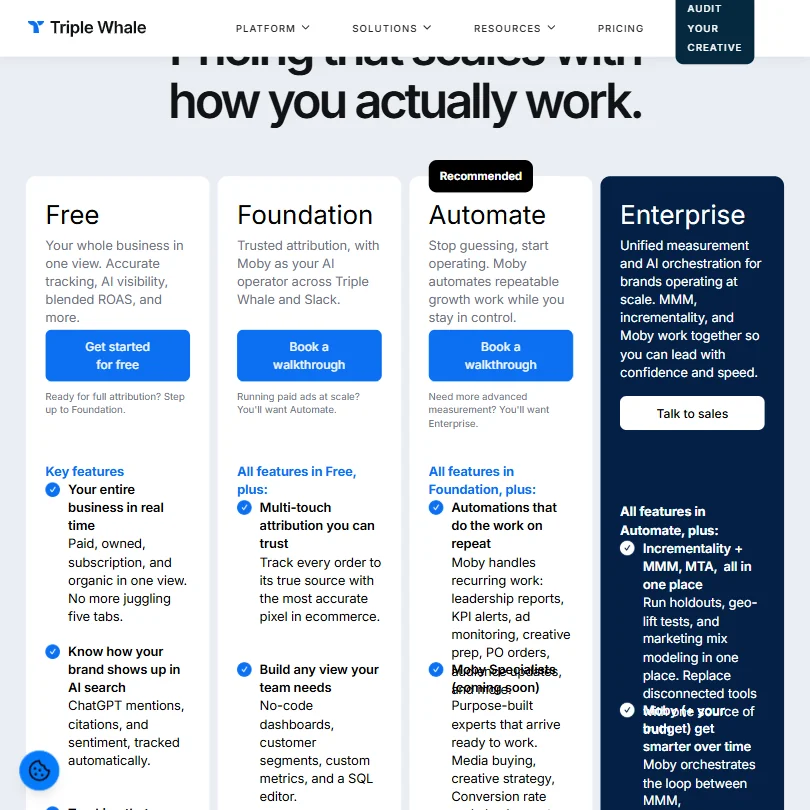
There's a free plan. Worth acknowledging because it's not nothing. The free tier includes the Triple Pixel, a blended ROAS dashboard, post-purchase survey, AI search visibility tracking, and first- and last-click attribution, all at $0/month. For a brand just getting started with measurement, that's a functional starting point.
Then the cliff arrives. $549/month for the Foundation plan. Jump to $1,349/month for Automate, which is where the bulk of the automation and creative generation features live. Enterprise is custom, contact sales.
The leap from free to paid is jarring. The leap from Foundation to Automate is jarring in its own way. There's no middle tier at, say, $800 that lets a growing brand test the automation tools before committing to $1,349. That's a gap in the packaging, and we'd be surprised if it doesn't drive some churn from mid-size brands who can't justify the jump.
Refund policy is not publicly stated anywhere we could find. For a product in this price range, that's an uncomfortable omission. A brand signing up for Foundation at $549 and finding the learning curve too steep has no obvious off-ramp documented. That concerns us more than the price itself.
The price is defensible if the platform delivers on attribution accuracy. Harder to defend if a brand spends the first month confused and then wants out with no documented path to do so.
Triple Whale vs Northbeam: Which E-Commerce AI Tool Is Better?
Northbeam is the most direct comparable. Both are attribution platforms for DTC brands. Both run their own pixels. Both have built out AI-adjacent features in the last two years.
Practical differences worth knowing: Triple Whale's free tier exists, Northbeam's doesn't. That alone shapes who kicks the tires first. Triple Whale has leaned harder into AI automation as a product layer with Moby 2. Northbeam's reputation in user discussions tends to skew toward attribution accuracy and reporting depth, without the AI agent layer being as prominent a selling point.
Incrementality testing, media mix modeling, and multi-touch attribution in one platform is Triple Whale's structural advantage. Northbeam does multi-touch attribution well. The question is whether you need all three measurement types enough to pay for the package that includes them.
Rockerbox shows up in the same conversations. More analytics-focused, less action-oriented. Elevar is in the data layer space, strong on Shopify tracking, but not competing on the AI agent side the way Triple Whale is. Neither closes the gap on the three-method measurement story.
For agencies managing multiple brand accounts, Triple Whale's infrastructure appears to scale better based on what we read. 2,000+ agencies using it is the claim. That number suggests the multi-brand management use case is working for someone.
Who Should Use Triple Whale? (And Who Shouldn't)
DTC brands spending serious money on paid media across Meta and Google. That's the core customer. If last-click attribution is telling you a story that doesn't feel right, the measurement stack here is worth a serious look.
Agencies managing multiple brand accounts. The reporting infrastructure and automated client reports show up in reviews as a genuine operational advantage, not a marketing claim.
Brands on tight budgets. Not the fit. The jump from free to $549/month is workable if the tool delivers, but without a trial period that demonstrates ROI, the price is hard to justify cold.
Solo operators running a small Shopify store with modest ad spend. The complexity is going to outrun the need. Something simpler and cheaper serves that use case better, and the free tier is there if you want to dip in without committing to anything.
Amazon-native sellers should confirm the integration depth directly with the sales team. The documented Amazon support covers Seller Central and Amazon Ads, but how cleanly it handles complex marketplace setups is worth pressing on before signing.
Triple Whale Review Verdict
Three years old and already a category leader in marketing measurement. That's not spin. That's what the adoption data suggests, and 481 verified G2 reviews at a 4.5/5 average is a real signal, not a manufactured one.
The measurement architecture is the strongest part. Combining incrementality testing, media mix modeling, and multi-touch attribution in one platform is a genuinely differentiated position. Most competitors don't come close to that on a single bill.
Moby 2 as a multi-LLM agent is interesting, though how much of the AI layer holds up under real production conditions is something we'd want to put through harder testing before endorsing fully. The free tier gives brands a low-stakes way to test the pixel and basic attribution before committing to anything. Use it.
The pricing structure is the biggest friction point. Not the price itself, but the gaps in the packaging and the absence of a clear refund policy. At $549 to $1,349 per month, buyers need more certainty about the off-ramp before signing.
Support documentation is solid. Community resources are thinner than you'd hope for at this price point. We'd recommend Triple Whale with conditions: get the pixel running on the free tier first, build a month of data, then decide if Foundation makes sense. Don't jump straight to Automate until you've proven the measurement is actually changing your decisions.
Frequently Asked Questions
Does Triple Whale have a free plan?
Yes, and it's more substantial than most free tiers in this category. The free plan includes the Triple Pixel, a blended ROAS dashboard, post-purchase survey, AI search visibility tracking, and first- and last-click attribution at no cost. It doesn't appear to expire, based on what we could find in their documentation. The main limitation is that automation features and advanced AI capabilities sit behind the paid plans starting at $549/month.
What is Moby 2 and how does it work?
Moby 2 is Triple Whale's AI agent layer. It runs on multiple underlying models, including Claude and GPT-4, switching between them depending on the task at hand. In practice it handles questions about store performance, drafts campaign content, and executes actions like audience updates or campaign changes. That last part, actually executing actions rather than just surfacing recommendations, is what separates it from a regular chatbot sitting on top of a dashboard. Whether that capability holds up consistently under daily use is the open question.
Is Triple Whale only for Shopify stores?
Shopify is clearly where the product is built around. The pixel, the landing page builder, and most of the documented integrations assume Shopify as the underlying platform. That said, Triple Whale does document Amazon Seller Central and Amazon Ads integrations, including an Amazon Marketplace Dashboard. So the Amazon picture is more complete than it sometimes appears from their top-level marketing. WooCommerce support isn't clearly confirmed in the public docs. If your brand runs significant volume outside Shopify, it's worth pressing their sales team on specifics before committing.