Kimonix surfaced in our research while we were cross-referencing Shopify merchandising tools that had moved past basic rule-based sorting. We pulled from vendor documentation, Shopify App Store reviews, and threads on Reddit and LinkedIn from merchants in fashion and apparel. We haven't run this on a live store. What we did do is read everything we could find from merchants who have, then reconcile that against the published feature set and pricing. The picture that came back is more specific than the homepage suggests.

Founded in 2020 out of Tel Aviv, Kimonix is several years into building what they describe as an agentic merchandising platform. Karl Lagerfeld reportedly runs over a hundred collections through it. Bally claims 10.7x ROI on app cost. Those are headline numbers. We'd want to see the methodology before leaning on them too hard.
What is Kimonix?
A Shopify-native app for fashion and apparel brands whose collection pages have become too complex to sort manually. The engine pulls from inventory levels, gross margin, product reviews from Yotpo or Stamped, return data via Loop, variant availability, and over a hundred other signals. Collection sorting, individual-level personalization, geo-specific merchandising through Shopify Markets, and an AI search layer round out the current feature set.
The focus is narrow on purpose. This is not a general-purpose e-commerce AI tool. It's for merchants running Shopify stores with large, complicated catalogs where collection management has already become someone's full-time problem. That specificity is a feature, not an oversight.
Kimonix Features: Product Listings, Bulk & Marketplace Tools
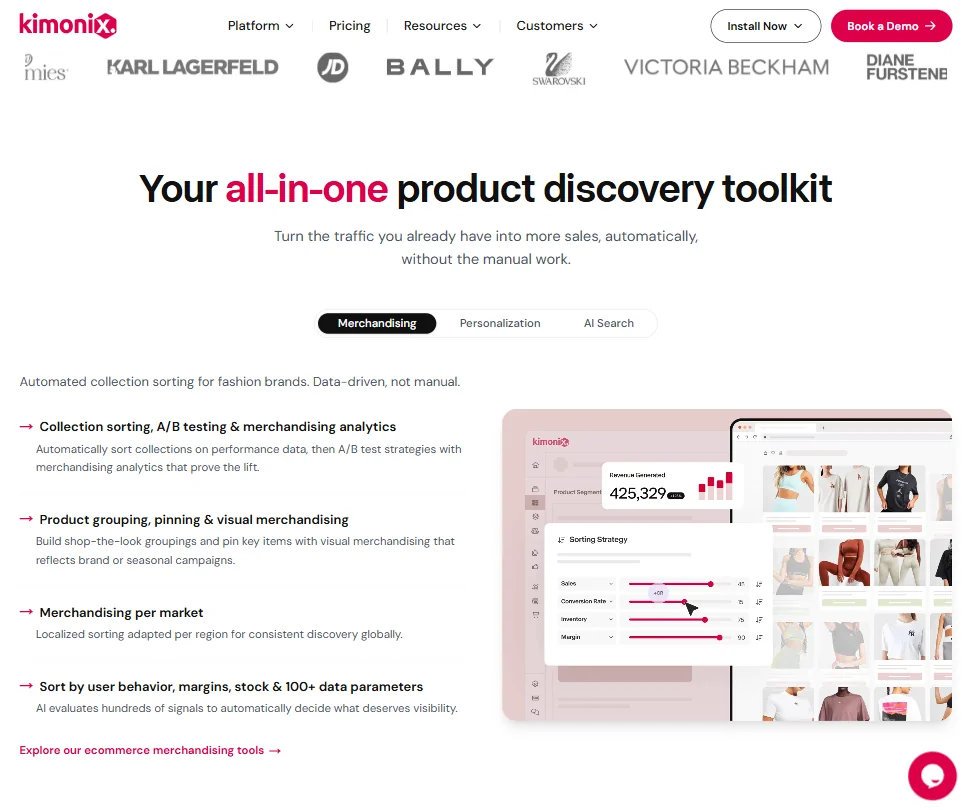
The collection sorting engine is the core product. On the Superior plan, merchants can manage up to 200 managed collections, with the AI deciding product order based on whatever parameters matter most to that brand: margin targets, stock levels, conversion data, review scores. Manual pinning and visual groupings are available when a campaign or seasonal push requires a human override.
A/B testing for sorting strategies is on the Superior plan at $299 a month. That's a real gate. Honestly, that's the feature most likely to convert a skeptical merchant, and putting it above the mid-tier feels like a deliberate upsell mechanism rather than a natural feature boundary.
Product metafields are supported across plans, which matters for fashion brands with complex product attributes. The integration list covers what most Shopify fashion merchants are already using, Klaviyo and Yotpo being the obvious anchors, with Loop Returns and Stamped filling out the returns and reviews side. No Amazon. No WooCommerce. No indication either is coming.
The Advanced plan at $79 a month adds product recommendations across three elements, cross-selling on collection pages, product grouping, and inventory location support. Starter at $19 caps at five managed collections with once-daily updates. That gap is significant. Most mid-sized fashion brands will find Starter constraining inside a month.
Kimonix AI Writing Quality: Are the Product Descriptions Good?
Kimonix doesn't do product descriptions. No AI writing tools, no SEO title generation, no ad copy. If you need bulk product content created or enriched with AI, Hypotenuse AI is purpose-built for that problem. Kimonix is not.
Not a criticism of their roadmap. They're not trying to do that. But buyers expecting an all-in-one AI content and merchandising platform should know the scope before they sign up for the trial.
Kimonix Marketplace Support: Shopify, Amazon & Beyond
Shopify only. Full stop.
There's no Amazon integration, no multi-marketplace listing management, no WooCommerce compatibility. The Shopify Markets support is genuinely useful for brands selling across regions, letting them sort collections differently per geography. Real feature. But the platform is a Shopify-only bet, and any merchant with meaningful sales volume outside that ecosystem should look at something else entirely.
Is Kimonix Easy to Use?
Shopify App Store reviews describe initial setup as manageable, particularly for brands that already have their product data organized. The sorting logic is complex under the hood, but the interface abstracts most of it. What we kept seeing in merchant feedback was friction at the configuration stage, specifically getting AI parameters tuned to match actual brand priorities rather than defaults.
The default settings sort. The well-configured settings sell. Getting from one to the other takes time.
On the support side, Kimonix provides chat-based support through links in its Help Center, alongside email and scheduled calls. Advanced, Superior, and Custom plans include an onboarding call with their Merchandising Strategists. Custom additionally adds a dedicated strategist, advanced technical support, and a private Slack channel. That's a meaningful difference at the high end.
There's no peer community or user forum, which matters for merchants who learn faster from other users than from documentation. Not a dealbreaker, but worth knowing before you're six collections deep and stuck.
Kimonix Pricing: Is It Worth It for Shopify E-Commerce Sellers?

Three public tiers based on the 0 to 100 average monthly orders bracket: Starter at $19 a month, Advanced at $79 a month, Superior at $299 a month. Custom pricing exists above that. The slider-based pricing model adjusts as order volume scales, so these numbers shift upward for higher-volume stores. A 20% discount applies on annual billing.
The 14-day free trial is the only way in without paying. No permanent free plan.
At $19, Starter is limited enough that we're skeptical most serious fashion brands stay there. Five managed collections, once-daily updates. Advanced at $79 is probably where mid-sized merchants land, and the feature set there is substantially more useful. The jump to $299 for A/B testing is steep. No publicly stated refund policy either, which we always flag.
For a brand currently paying a human to manually sort dozens of collections every week, $79 a month is close to nothing. For a smaller Shopify store still figuring out its catalog structure, the value math gets murkier fast. Fair.
Kimonix vs Nosto: Which E-Commerce AI Tool Is Better?
Nosto is the obvious comparison. Broader platform, longer history, more enterprise orientation. Nosto covers personalization, recommendations, and merchandising across a wider range of e-commerce platforms. Kimonix wins on Shopify-specific depth, particularly for fashion brands that care most about collection-level sorting and margin-aware merchandising. Nosto wins on platform breadth.
Tagalys and Depict are closer in the collection merchandising space. Algolia sits in a different weight class, better suited to stores with serious search volume and engineering resources to configure it properly. Kimonix positions itself between those extremes. For the right brand on the right platform, that positioning holds up.
Who Should Use Kimonix? (And Who Shouldn't)
Fashion and apparel brands on Shopify with 50 or more active collections. Particularly brands where merchandising decisions currently require someone's manual attention every week. That's the fit.
Brands outside Shopify. Wrong tool entirely.
Same goes for merchants looking for product content generation or SEO-focused listing tools. Small stores with simple catalogs probably won't feel the ROI quickly enough to justify anything above the Starter plan, and Starter has real limits.
Kimonix Review Verdict
Kimonix does a specific thing well. Collection merchandising automation on Shopify, with real data signals driving the sort order rather than guesswork or manual rules. The depth on inventory data, margin signals, and review scores as sorting inputs is genuinely differentiated from simpler tools. The customer list, Swarovski, Intersport, Karl Lagerfeld, and a few others, suggests it scales.
The gaps are real. No A/B testing below $299 a month is the frustration most merchants will hit first. No writing tools. No multi-platform support. The support structure, while more substantive than the homepage implies, still lacks a peer community for a platform this technically layered.
Shopify fashion brands that have already outgrown manual sorting should take a hard look. The 14-day trial exists. Use it.
Frequently Asked Questions
Does Kimonix work with platforms other than Shopify?
No. Kimonix is a Shopify-exclusive app. There's no integration with WooCommerce, Amazon, or any other e-commerce platform currently. If your brand runs on multiple platforms, you'd need a separate tool to cover the non-Shopify channels.
Does Kimonix offer a free plan?
No permanent free plan exists. There's a 14-day free trial, and that's the full extent of risk-free access. After the trial, you're on a paid plan starting at $19 a month for the Starter tier. The refund policy isn't publicly stated, so clarify that with their team before committing.
Can Kimonix generate product descriptions or SEO content?
No, and this surprises some buyers. Kimonix handles merchandising logic, collection sorting, personalization, and search. It doesn't write product descriptions, generate SEO titles, or produce marketing copy of any kind. For AI-powered product content at scale, that's a separate category of tool entirely.