Fifteen years in market shows. Our research across G2 reviews, vendor documentation, Reddit threads, and Trustpilot pulled a consistent picture of a platform that's genuinely capable and carries real friction points, particularly for teams coming in without a clear sense of what they're buying. This nosto review doesn't soften that.
What is Nosto?
Founded in Helsinki in 2011. That's not a startup anymore, and the product doesn't behave like one.
Nosto positions itself as a Commerce Experience Platform, which is their framing. What it actually does is sit on top of your ecommerce store and use behavioral signals, real-time data, and AI to shape what each shopper sees. Which products get recommended. How categories rank. What surfaces in search.
The AI layer running underneath all of this is called Experience.AI, Nosto's proprietary system. Launched in October 2025, Huginn is Nosto's central AI agent for commerce teams. It's not a customer-support chatbot handling shopper queries. It's built for merchant-side use: surfacing insights, running analysis, flagging revenue opportunities. Some capabilities are still available through beta or early-access programs rather than universally to every customer. Worth knowing before you assume it's all live on day one.
The platform organizes around a few distinct areas. Predictive product recommendations, on-site search personalization, and category merchandising are the established core. Huginn is where they're clearly planting their flag for the next few years. We're watching it. Cautiously.
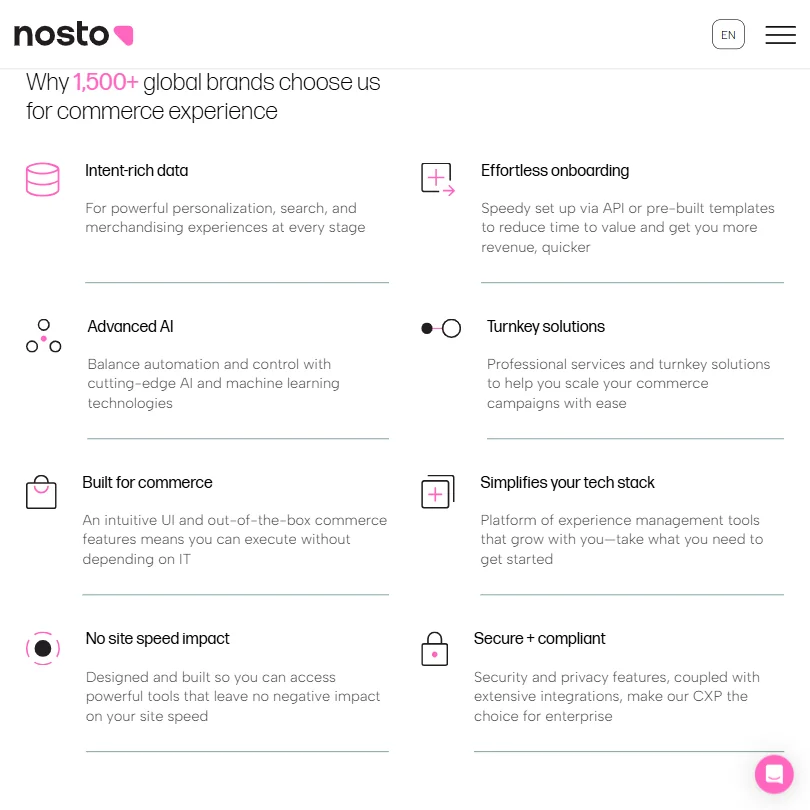
Their stated customer count is 1,500-plus global brands. Mid-market and enterprise is the sweet spot. That tracks with how they price, which is entirely custom and tied to GMV, traffic volume, and which modules you actually select.
Nosto Features: Product Listings, Bulk & Marketplace Tools
Not a product listing tool. Full stop.
There's no bulk upload here, no SEO title optimization, no product description generation. What Nosto does is operate squarely in the personalization, search, and merchandising layer, not catalog management or content creation.
What it does well, based on vendor documentation and G2 feedback consistently, is real-time product data enrichment tied to behavioral signals. The platform reads what shoppers are doing and what products are moving, then uses that to decide how content and products get surfaced. It's not writing your descriptions. It's deciding which ones get seen, and by whom.
A/B testing sits inside their Content Experience Cloud module, and G2 reviewers in marketing roles flag it repeatedly as one of the more useful parts of the platform. Being able to test content placements without pulling in a developer every time matters for mid-market teams that don't have engineering bandwidth to spare. Honestly, that's a real selling point.
On integrations: Shopify and Shopify Plus are well-documented. So are BigCommerce, Magento 2, Salesforce Commerce Cloud, and Commercetools. VTEX and Shopware round out the enterprise coverage. That's a solid list. Amazon doesn't appear anywhere in the documented integrations. Nosto's signup flow lists WooCommerce and indicates that a plugin is available, although WooCommerce is not prominently featured in its main integrations directory, so if that's your platform, get clarity before assuming full support.
Nosto AI Writing Quality: Are the Product Descriptions Good?
Wrong question for this tool.
Nosto personalizes which descriptions get shown. It doesn't write them. If you came here looking for bulk product copy generation, this is the wrong room entirely. We cross-referenced the documentation several times to make sure we weren't missing a content-generation layer. We weren't.
The Experience.AI system is making real-time decisions about what gets ranked, recommended, and surfaced to a given shopper. That's genuinely useful work. It just isn't content creation. If bulk catalog copy is what you need, something like Hypotenuse AI is built specifically for that job.
Different tool, different problem. Fair.
What the AI is actually doing here is closer to decision-making at scale. Reading behavioral signals, making calls about ranking and sequencing, adapting to what individual shoppers are doing in real time. That has real value. It's just not what the heading implies, so we wanted to be direct about it before anyone gets twelve slides into a demo expecting something else.
Nosto Marketplace Support: Shopify, Amazon & Beyond
Nosto is a web platform. That's the whole scope.
Shopify support is solid and well-documented, including Shopify Plus for enterprise-tier brands. BigCommerce and Magento 2 are there. Salesforce Commerce Cloud too. These are the environments where Nosto actually shows up and works as described.
Amazon. Not there. No mention of it anywhere in the vendor docs. If a meaningful share of your revenue runs through Amazon, Nosto does nothing for that channel.
Etsy. Also not there.
We kept seeing G2 reviewers from omnichannel backgrounds express real disappointment with this. The platform doesn't pretend to cover everything, which is fair. But it means your stack needs something else handling channels beyond your owned storefront. For nosto ecommerce ai use specifically on Shopify, the integration is well-documented and broadly praised. For anything beyond your own web presence, manage expectations accordingly.
Not great if marketplace volume is a big part of your business.
Is Nosto Easy to Use?
Easier than it used to be. Still not simple.
Our research across G2 and community threads pulled a consistent split. Marketers who've been on the platform for a while describe it as manageable. Teams newer to it, or smaller teams without a dedicated implementation resource, describe a steeper curve. The scheduling features get good marks consistently. Queuing up content changes without developer time is something G2 reviewers in marketing roles mention repeatedly as a genuine win.
Huginn, launched in October 2025, is the newest piece. It's designed for commerce teams doing analysis and strategic work, not a shopper-facing chatbot. The broader agentic capabilities, things like automated opportunity detection and merchant-side Q&A, are still rolling out. Our research suggests they're real. Early, but real.
Implementation complexity is the consistent concern across reviews, and it's not subtle. Enterprise deployments require meaningful upfront setup investment. Teams getting value from the platform have invested in it accordingly. That's not a dealbreaker. It's just something you should plan around rather than discover mid-project.
One thing that keeps surfacing positively: site speed. Nosto's documentation claims no measurable page load impact, and reviewers don't push back on that. Given how much ecommerce performance depends on load time, that's a bigger deal than it sounds.
Nosto Pricing: Is It Worth It for E-Commerce Sellers?

No numbers on the pricing page. None.
Entirely custom, built around GMV, traffic volume, and which modules you select. The modular approach makes architectural sense. You're not paying for features you're not using. But the complete absence of any public floor, ballpark, or even a tier label makes it impossible to self-qualify without sitting through a sales demo.
We dug through the pricing page expecting at least a starting range. Just a demo request form. No free plan, no trial, nothing.
Reddit threads from mid-market operators suggest the figures are not small. Several comments from ecommerce managers at brands doing sub-$10M GMV indicate they were quoted numbers that didn't make sense at their scale. That tracks exactly with Nosto's stated positioning, which is mid-market to enterprise. Small brands are probably not the target, and the pricing reflects that clearly.
The refund policy isn't publicly stated. Contract structure isn't publicly stated either. We don't love that. Get everything documented on paper before anything is signed. Seriously.
One thing in their favor: the 99.99% uptime SLA is enterprise-grade and documented. That matters when your storefront depends on it.
Nosto vs Algolia: Which E-Commerce AI Tool Is Better?
These two overlap most in the search layer. Algolia has been a dominant name in ecommerce search for years, with its own AI relevance capabilities. Nosto's search and merchandising layer pitches itself as more deeply personalized at the individual shopper level, adapting to behavioral signals in real time rather than relying primarily on catalog structure and text matching.
Algolia is modular in a different way. You can bring it into a stack without adopting an entire personalization platform, which makes it more accessible for teams that just want search to get meaningfully better. Nosto assumes you want the whole thing: recommendations, search, category merchandising, and now the agentic layer. The two aren't always competing for the same buyer.
Dynamic Yield is the closer comparison by scope. Both are full personalization platforms. Dynamic Yield was acquired by McDonald's in 2019, then sold to Mastercard in 2022, which created some market uncertainty. Nosto was still independent as of our research.
Bloomreach is broader, covering marketing automation alongside commerce search. Constructor.io is narrower, focused on search and discovery specifically. Nosto sits somewhere between all of them. More than pure search, less than a full marketing suite.
For teams where pricing transparency matters and search relevance is the primary need, Algolia or Luigi's Box are worth evaluating. Luigi's Box covers AI-powered site search and product discovery with cleaner public documentation around what's actually included.
Who Should Use Nosto? (And Who Shouldn't)
Mid-market and enterprise ecommerce brands on Shopify Plus or Salesforce Commerce Cloud. That's the core fit. Real traffic volume, a dedicated digital team, a personalization problem worth solving at scale.
Sub-$5M GMV brands. Probably oversized, and the pricing will reflect that immediately.
Brands that need content generation. Wrong tool. The platform decides what to show. It doesn't write anything.
Merchants who need Amazon as a channel should look elsewhere. That gap is real and documented. Nosto is a web-first platform and doesn't reach into marketplace-based selling at all.
Teams expecting a quick plug-in with fast visible results and minimal implementation effort. Also not the right fit. The setup investment is real, and the teams getting the most out of Nosto have invested accordingly.
There is a version of this buyer that gets a lot out of the platform. Larger brands, owned web presence, and a team that can actually act on what the data surfaces. For them, the product is genuinely strong.
Nosto Review Verdict
Fifteen years in market shows. The core personalization engine, the recommendations layer, the category merchandising. All of it is well-built, and the track record on G2 backs that up consistently. The nosto personalization capabilities are, by most accounts, the real thing.
The concerns are structural. Pricing opacity is the worst one. No trial, no free plan, no public numbers at any level. That's a significant ask before a buyer has seen anything firsthand. Implementation complexity is the second concern. Neither is unfixable, but competing platforms have done more to reduce that friction.
Huginn is interesting. Whether it delivers material value or is mostly well-packaged positioning is something we'd want to see in practice over a few months. We're cautiously optimistic. Not more than that.
The 99.99% uptime SLA is strong. Platform coverage on supported commerce stacks is solid. The Amazon and marketplace gap is real and worth flagging for any brand with meaningful off-site revenue.
At the right scale and with the right team, Nosto earns its place in a commerce stack. Below that threshold, you're paying for capabilities you won't fully use.