We came into this expecting another institutional AI wrapper with a polished demo and nothing underneath. Hebbia is more specific than that. This review pulls from vendor documentation, financial press coverage, and whatever user signals we could surface, because Hebbia isn't listed on G2 or Capterra and public reviews are genuinely thin. That absence tells you something about who the customers are, and also about how much independent validation is available.

Founded in 2020 and headquartered in New York, Hebbia targets a narrow market: investment firms, banks, law practices, and Fortune 500 finance teams doing serious document research. Their own marketing claims roughly $30 trillion in assets under management across their client base. We can't verify that independently. What we can say is the product is clearly built for someone who loses real money if the AI gets a fact wrong.
What is Hebbia?
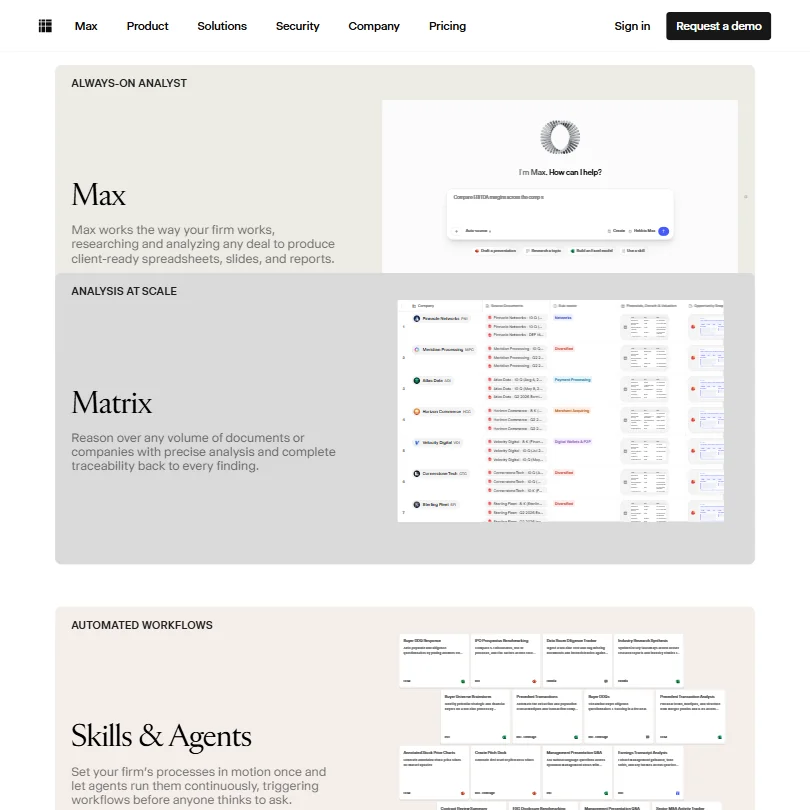
Two ideas run through everything Hebbia does. First, that institutional researchers aren't well served by generic chat tools. Second, that scale matters in a way generic tools can't handle. Their answer is Max, their proprietary AI model, paired with a feature called Matrix that's designed to run parallel research across large document libraries simultaneously.
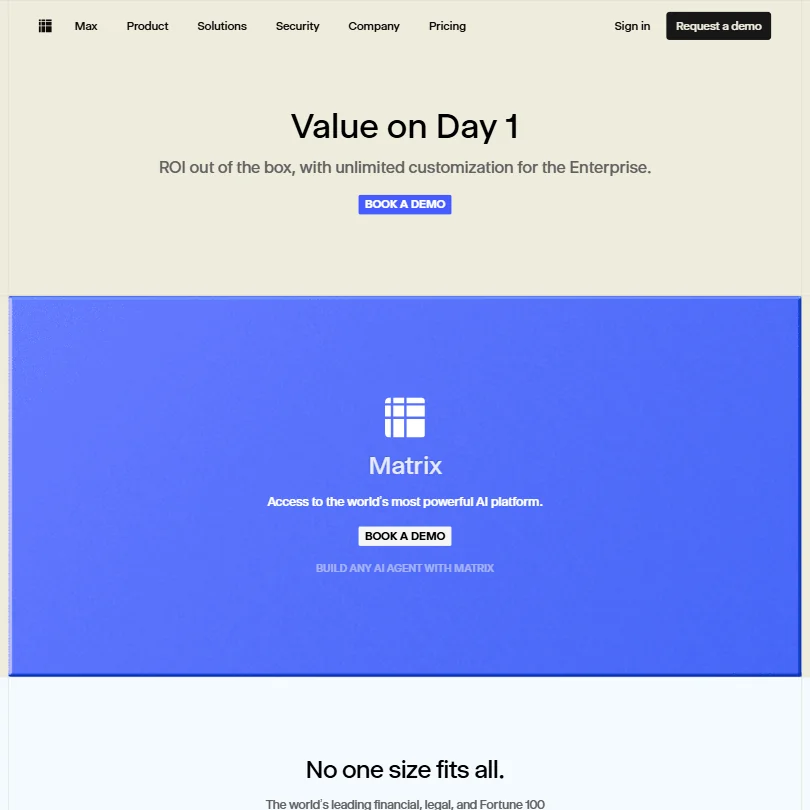
The company calls Matrix an "infinite workforce." Marketing language, obviously. What it actually does is let users run structured queries across thousands of documents at once, then organize outputs into a grid. Think less "ask a chatbot a question" and more "run a due diligence template across 500 deal files automatically." That's a meaningful distinction, and it's why Hebbia doesn't really slot into the same category as something like Glean or Vertex AI Search.
Not an academic research tool. Not a literature review product. Finance workflow infrastructure, full stop.
Hebbia Features: Search, Synthesis & Research Capabilities
The data source list is serious. On the financial data side, it connects to S&P Capital IQ and PitchBook, and a few others in the private markets and fixed income space. SEC filings are covered, along with European filings and UK Companies House records.
For internal documents, SharePoint and OneDrive are supported, as are Box and Dropbox. AWS and IntraLinks are in there too. On the more specialized side, expert network platforms Third Bridge and Guidepoint are integrated, which is not something you see in general-purpose AI tools.
The Matrix workflow is what keeps coming up in financial press coverage. It's not a summarizer. Users describe running buy-side due diligence templates across entire data rooms automatically, with outputs structured in a table they can interrogate further. That's a genuinely different category of tool. Honestly, the scope of it is legitimately impressive on paper.
Team collaboration is built in. Multiple people on a deal team can work inside shared projects simultaneously, which maps to how banks and PE firms actually operate. That's not a feature you bolt on after the fact.
Hebbia Research Quality: How Accurate and Trustworthy Is It?
Public user data on Hebbia is sparse in a way that's unusual even for enterprise tools. No G2, no Capterra, no Trustpilot presence. Reddit threads specifically about Hebbia are few. That's partly a function of who uses it, since PE analysts and M&A bankers don't typically write software reviews online.
What we did find in financial media coverage suggests the accuracy story is strong for structured document tasks. Extracting specific data points from dense filings, cross-referencing numbers across multiple sources. Those use cases come up repeatedly, and with some consistency.
The open question is hallucination rate on complex synthesis tasks. That's the central risk with any AI doing serious financial analysis, and you should ask Hebbia for benchmark data on accuracy. Be wary of any AI research platform that doesn't put numbers on accuracy claims, especially one targeting workflows where an error in a credit memo has real consequences.
Hebbia Source Coverage: What Does It Actually Search?
Broad. Genuinely broad. The financial data integrations alone cover most of what an institutional research team would need day-to-day. FactSet and ICE Market Data for market and fixed income data. PitchBook and Preqin for private markets. EMMA for municipal bonds.
Web search appears in some descriptions as a supported Matrix source, but a current first-party page doesn't present it as a standard, documented integration, so check before relying on it. Academic sources are not part of the pitch. Something like Elicit would serve that side of the work better.
The integration depth into deal room infrastructure is what separates Hebbia from general-purpose AI tools. IntraLinks native support is a meaningful signal on its own. That product is used almost exclusively in live M&A transactions. Building around it isn't accidental.
Is Hebbia Easy to Use for Researchers and Professionals?
Web-only, no mobile app, no browser extension. The interface appears built around the Matrix grid workflow and project-based organization, which is sensible for the use case.
Institutional users doing due diligence don't need a mobile app. That's not the issue. What matters for this audience is whether the tool fits existing deal workflows, and the integrations suggest Hebbia has thought about that carefully. The learning curve around Matrix is what came up in third-party coverage, though. Running a structured multi-document query isn't the same as typing into a chat interface. There's clearly setup involved in defining what you want the workforce to do.
Support infrastructure is light too. Hebbia publishes substantial product and research documentation, but ask what support is included, since no conventional public help center or live-chat support is listed. That's a fairly light footprint for a product targeting high-stakes workflows. More would be expected at this tier.
Hebbia Pricing: Is It Worth It vs Free Alternatives?
No pricing on the site. None. A demo request form collects company email, company size, and industry, then routes you into a sales conversation. No starting price, no plan tiers, no published seat cost. The form mentions Hebbia's communications consent on submission, and that's all the transactional information the public page gives you.
That's standard for this market segment. AlphaSense doesn't publish pricing. PitchBook doesn't either. The tools Hebbia competes with in institutional finance operate the same way. Fair.
Still, compared to the AI research tool category broadly, the access model stands out. 20 of the 29 tools we've reviewed in this category offer a free plan. Hebbia doesn't, and there's no free trial listed anywhere publicly. That's a real barrier for anyone trying to evaluate fit before committing budget and calendar time to a sales process. If you need to try before you buy, the current structure doesn't allow for that.
Hebbia vs Kensho: Which AI Research Tool Is Better?
Kensho is the S&P Global-owned AI analytics product, primarily used for NLP against financial data and transcripts. It's deeply embedded in the S&P data ecosystem. Hebbia connects to S&P Capital IQ as one source among many.
The difference in approach matters. Kensho is essentially a data product built on top of a data business. Hebbia is a research workflow product that aggregates across many sources, including S&P data. Neither is wrong. They solve different problems for different teams.
Quant teams wanting structured signal extraction from S&P-sourced data will gravitate toward Kensho. Deal teams that need to read across a mixed pile of documents, filings, and internal files will find the Matrix workflow more relevant. That workflow has no real equivalent in Kensho's product as publicly described. That's a genuine differentiation, not positioning language.
AlphaSense is the closer comparison in practice. Both target institutional investors, and both have deep financial document coverage. AlphaSense has stronger broker research and expert call transcript libraries. Hebbia's document processing architecture, particularly Matrix, appears to go further on running analysis across thousands of files simultaneously. Test both before making a stronger call than that.
Who Should Use Hebbia? (And Who Shouldn't)
Private equity and M&A deal teams. The IntraLinks integration and deal room architecture says everything about who built this and for whom. Large law firms doing document-heavy due diligence are a clear secondary fit.
Solo researchers and academics. Look elsewhere entirely. This wasn't built for individuals, and it wasn't built for research in the academic sense. Elicit is purpose-built for systematic literature review. For cited answers from your own document library at a more accessible entry point, something like Anara fits better.
Small teams and startups should also pass. No free trial, opaque pricing, and an obvious enterprise architecture. The product is built for firms that can absorb a significant software line item without a budget conversation. If that's not the situation, save everyone's time and start somewhere else.
Hebbia Review Verdict
Hebbia is doing something real. The Matrix architecture, the institutional data integrations, the deal room focus. None of that is window dressing, and for the audience it was built for, it's probably one of the more capable products available in this space.
The gaps matter too. No public pricing creates friction in evaluation. The support infrastructure looks light for a product targeting high-stakes workflows. No public ratings anywhere makes independent validation hard. We'd feel more confident recommending it if we could cross-reference actual user experiences the way we can with other tools in this category.
What we have is a product with serious institutional credibility and a genuine technical differentiator, sitting behind a demo request form, with almost no public review trail. That doesn't mean it's bad. It means you're largely taking the vendor's word for it until you get inside the demo. That's a real caveat at this price tier, whatever that price turns out to be.
The use case fits a narrow audience. That audience probably already knows about Hebbia. Everyone else is better served starting the evaluation somewhere more accessible.
Frequently Asked Questions
Does Hebbia offer a free trial?
No. There's no free plan and no free trial in their public documentation. Access starts with a demo request form collecting company email, company size, and industry, after which pricing is discussed directly with their sales team. That's standard for institutional enterprise software, but it does make independent evaluation difficult before you're already inside a sales process. Worth going in with specific questions ready.
What is Hebbia Matrix?
Matrix is Hebbia's core workflow feature, running structured queries across large collections of documents simultaneously and organizing outputs into a grid format. The idea is that instead of asking one question at a time, a team defines a research template and runs it across an entire data room at once. Third-party coverage and press descriptions consistently point to this as the feature most distinct from what competitors like AlphaSense or Harvey AI offer in their current products.
How does Hebbia handle data privacy?
According to their documentation, Hebbia is SOC 2 Type II certified and compliant with GDPR and CCPA. Data is encrypted using AES-256 at rest and TLS 1.2 or higher in transit. They state that user data is not used to train their models. For a product handling M&A documents and live deal data, those certifications are the baseline expectation, and Hebbia appears to meet them. That said, we'd still recommend direct confirmation with their team on data residency specifics before signing anything.