99% accuracy. Independent validation from Penn State.
Real product. Real user base. The ceiling and the floor are further apart than the marketing suggests.
What is GPTZero?
GPTZero arrived out of New York. The original pitch was simple: tell you whether text was written by a human or generated by an AI. That pitch landed hard in education, which was scrambling to figure out what to do about ChatGPT in classrooms.
It's grown since then. The product now covers AI detection, plagiarism checking, a hallucination detection feature, citation generation, and something called Writing Replay, which records how a document was composed over time. That last one is genuinely interesting. More on that below.
The platform runs on a proprietary model, not one of the major public ones. GPTZero claims their detection architecture has seven distinct components, though they don't publish much detail about what those components actually are. Reasonable trade-off for a detection product. Hard to argue with the secrecy there.
It works on the web, through a Chrome Extension, and through native integrations with Google Docs and Canvas LMS. No mobile app. The API supports 17 programming languages, which is a surprisingly wide spread.
GPTZero Features: Search, Synthesis & Research Capabilities

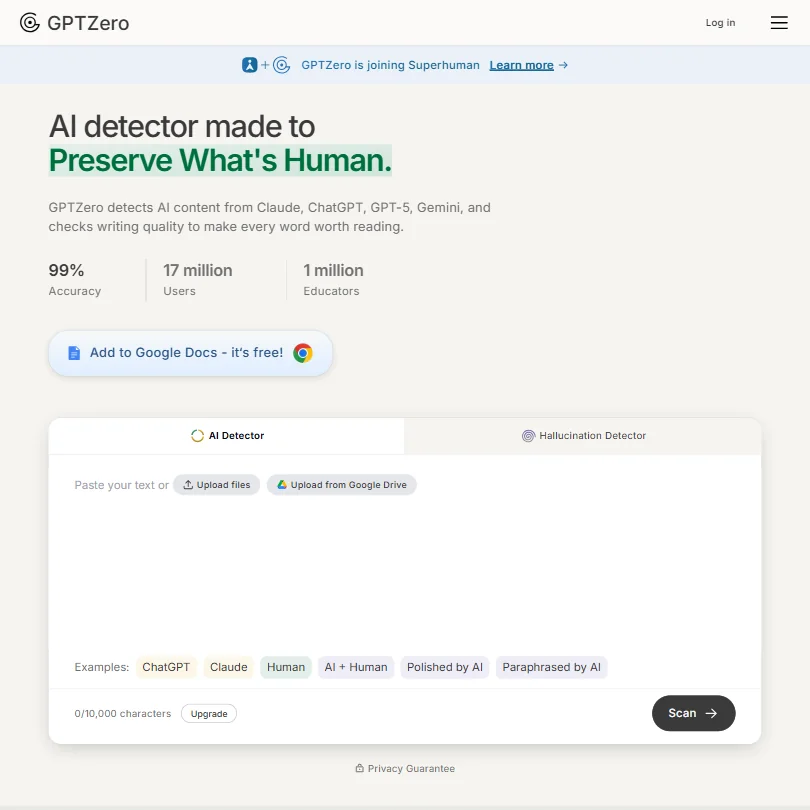
The core workflow is detection. You paste text or upload a file. GPTZero runs its model and returns a result, highlighting individual sentences it thinks were AI-generated.
File handling is decent. You can upload documents directly or pull from Google Drive. Batch uploading goes up to 250 files at once, which matters if you're grading a full class set of essays. That's the kind of feature that turns a nice-to-have into a genuine time-saver.
Writing Replay is the most interesting feature here. It works through the Google Docs add-on and captures a video record of how a document was written. An AI-generated doc pasted into Google Docs will have a very different creation pattern than something typed over an hour by a student. Honestly, that surprised us. Most detection tools don't even try to address the "what if they just paste it in" problem. This does.
On the citation side, auto-generate citations and a Find Sources feature appear on the Professional plan.
The Hallucination Detector is listed as a feature. According to GPTZero's technical documentation, it flags fabricated citations, incorrect citation details, and unsupported claims, then checks whether online sources support or contradict a given statement. GPTZero is explicit that this is not a general fact-checker and doesn't determine whether every claim is objectively true or false. It also acknowledges that a flagged citation can't always be conclusively identified as AI-generated. There's little public commentary on this feature. Either it's new, under-used, or both.
What's not here: no web search, no academic database access, no multi-source synthesis. This isn't a research assistant. It's a verification layer. Users who come in expecting something like Perplexity will be confused fast.
GPTZero Research Quality: How Accurate and Trustworthy Is It?
The 99% accuracy claim is the one you'll see most. GPTZero ties it to the RAID benchmark and to a research relationship with Penn State. The RAID benchmark is real and publicly documented, containing more than six million AI-generated passages across multiple models, domains, and adversarial attacks. That's more than most competitors offer as evidence. The Penn State connection is also verifiable: Penn State publicly announced a research collaboration involving Professor Dongwon Lee, whose university profile identifies him as a GPTZero research adviser. That confirms genuine research involvement. It does not mean every GPTZero accuracy number has been independently validated by Penn State. Worth separating those two things.
Here's the tension. The known weak points show up in edge cases: texts written by non-native English speakers that the model flags as AI-generated, or shorter documents where confidence scores are weak and inconclusive.
That false positive issue shows up repeatedly. A GPTZero result alone isn't enough to act on. It's a starting signal, not a final call. That's probably the right posture, but it's not exactly what the homepage implies.
We're skeptical of any single-number accuracy claim in this category. The difficulty of the task changes constantly as AI writing improves, as paraphrasing tools get better, and as users learn to game detectors. 99% against what baseline, in what year, on what type of text? Those questions matter and they're not answered on the marketing page.
GPTZero Source Coverage: What Does It Actually Search?
Worth clarifying upfront. GPTZero doesn't search sources the way a research tool does. It analyzes text you give it. The source coverage question is really about what types of content and what languages its detection model covers.
Languages. They've expanded. The multilingual detection model publicly covers Arabic and Korean, along with Japanese, Chinese, Italian, French, Spanish, German, and Portuguese. Nine languages total. That's a meaningful update for schools and publishers working outside English. Some pages on GPTZero's own site still list a smaller subset, so the website is inconsistent on this point. Mildly annoying.
On plagiarism checking, this is a separate feature from AI detection and it does check submitted text against external sources. GPTZero doesn't publish details about the size or composition of their plagiarism database. Turnitin, which has been doing this for decades, has a significantly larger indexed corpus. That matters if plagiarism detection is your primary use case.
For AI detection specifically, the model is trained to identify output from ChatGPT, Claude, Gemini, and a few others. They update this as new models emerge, which is table stakes in this category but still worth confirming they're doing it.
The Chrome Extension adds detection directly in the browser, which extends coverage to anything you're reading online. Genuinely useful for publishers and editors.
Is GPTZero Easy to Use for Researchers and Professionals?
The web interface gets consistent praise for being clean. Paste text, get a result, see sentence-level highlights. That loop is fast and the output is readable. No steep learning curve.
The Google Docs integration is where Writing Replay lives, and it's built into a tool teachers already use daily. Canvas LMS integration is similarly practical for that audience. Not many detection tools have bothered with LMS connectors. GPTZero has.
It works. Some users find the AI highlights useful for quick reads, and a few found it slowed down their browser. Not a dealbreaker, but worth knowing.
For teams, there's a shared credits model with unified billing and role-based provisioning. Functional. Not the most sophisticated team workspace we've seen, but it does the job.
The API is where things get interesting for developers. Seventeen programming languages supported, with ready-to-use code examples for Node.js and Python, and a few others. That's a solid offering for anyone who wants to build detection into their own pipeline. Most competitors don't offer that kind of language coverage out of the box.
Honestly, for the core use case, the tool is easy to use. Where it gets complicated is when you try to interpret results. The confidence scores and what you're supposed to do with a "likely AI-generated" flag require some judgment. That's not a UX failure. It's an inherent limitation of detection as a category.
GPTZero Pricing: Is It Worth It vs Free Alternatives?

There is a free plan. It caps you at 10,000 words per month and includes Basic AI Scan, three Advanced Scans, and five free AI highlights in the Chrome Extension. It exists, but it's thin.
The Premium plan is $23.99 per month on monthly billing and includes up to 300,000 words per month, Advanced AI Scan, multilingual AI detection, downloadable AI reports, and AI highlights in the Chrome Extension. Professional is $45.99 per month on monthly billing, bumping the word limit to 500,000, adding up to two million words of overage capacity, batch scanning up to 250 files at once, page by page scanning, and enterprise grade security with LMS integration. Both plans show an annual option that saves 45%, which pulls those prices down meaningfully. No free trial for paid tiers. The refund policy isn't publicly stated anywhere we could find. That's a problem. Not catastrophic, but we'd want to see it addressed before recommending this to budget-conscious buyers.
Team pricing involves shared credits and unified billing. Specific per-seat costs aren't published publicly. You contact sales for Enterprise. Standard practice, but it makes comparison shopping harder than it should be.
The free alternatives worth knowing: ZeroGPT is free and widely used. It's also widely criticized for unreliability. Copyleaks has a free tier for plagiarism but charges for AI detection. At $23.99 per month, GPTZero isn't expensive, but the value calculation depends heavily on volume. For high-volume institutional detection, the gap between $45.99 and Turnitin's institutional pricing is significant. Turnitin doesn't publish pricing either, but it's typically sold at the district or university level and costs considerably more.
We don't buy the framing that the free plan is enough for serious use. It's a demo, effectively.
GPTZero vs Turnitin: Which AI Research Tool Is Better?
These two aren't really chasing the same customer. Turnitin is sold to institutions. GPTZero sells to individuals, small teams, and some institutions.
Turnitin's plagiarism database is larger. Substantially. They've been indexing student work and academic papers for decades. If your primary concern is plagiarism detection at a university writing program level, Turnitin has the depth advantage.
AI detection is newer territory for both. Turnitin added AI writing detection more recently and now also highlights text it identifies as AI-generated or AI-paraphrased with sentence-level analysis. Turnitin Clarity additionally offers a writing process timeline with playback, revision history, and paste-event indicators. GPTZero was built for detection from day one and the two products implement these features differently, but Turnitin is no longer without comparable functionality. Fair.
Writing Replay is still the clearest differentiator. The behavioral capture approach is genuinely distinct and we haven't seen another tool in this category attempt it in quite the same way.
Price is where this gets blunt. Individual educators can't afford institutional Turnitin contracts. GPTZero at $23.99 a month is accessible. That's not a minor distinction. A lot of the GPTZero user base is solo teachers or small schools who simply couldn't use Turnitin's product even if they wanted to.
Copyleaks and Winston AI are the other main names in the space. Copyleaks has solid multilingual support. Neither has the user base or feature depth GPTZero now has.
Who Should Use GPTZero? (And Who Shouldn't)
Educators. That's the fit. Teachers grading written assignments at middle school, high school, or university level are the core user and the product is built around their workflow.
Publishers and editors reviewing submitted content. The Chrome Extension and batch uploads serve them well, and the 250-file batch limit on Professional is a practical number for editorial teams moving volume.
Developers building detection into their own products should look at the API tier. Seventeen programming languages and solid documentation make this a reasonable choice.
Who shouldn't bother. Researchers looking for academic literature tools are in the wrong place. Try Scite instead. GPTZero doesn't search databases, doesn't synthesize sources, and doesn't generate research output.
Anyone who needs rock-solid plagiarism checking at institutional scale should stay with Turnitin. GPTZero's plagiarism feature is a supporting act, not the headline.
And anyone expecting the false positive rate to be zero should recalibrate. It won't be. Not a GPTZero problem specifically. It's a category-wide reality.
GPTZero Review Verdict
GPTZero is a focused tool that does what it's built to do reasonably well. AI detection with sentence-level output. Writing Replay for behavioral verification. Batch processing up to 250 files. LMS integrations that most competitors skipped.
The accuracy claims deserve scrutiny. The 99% figure looks good on the homepage and weaker given how false positives show up in practice. We don't think GPTZero is uniquely bad here. We think the category has a credibility problem that all the players share.
The missing refund policy is the thing that bothers us most practically. Not publishing one creates friction for anyone who wants to try the paid tier without committing. Fix that and the buying decision gets easier.
Pricing is fair for individuals and small teams. The free plan is thin. Premium at $23.99 monthly, or less annually, is the honest starting point for real use.
The product is improving. A recent update brought real multilingual expansion across nine languages. The API is genuinely developer-friendly. Writing Replay is creative and the behavioral capture angle is not something we've seen meaningfully replicated elsewhere.
What it's not: a research assistant, an academic search tool, or a definitive fraud detector. It's a signal generator. A useful one, for the right audience.
Frequently Asked Questions
How accurate is GPTZero at detecting AI-written content?
GPTZero claims 99% accuracy, tied to the RAID benchmark and a research relationship with Penn State professor Dongwon Lee. The RAID benchmark is real and publicly documented. The Penn State relationship is verifiable. Neither confirms that every accuracy number on the marketing page has been independently validated. False positives are the recurring issue, particularly with text written by non-native English speakers. Treat a GPTZero result as one data point. Not a final verdict.
Does GPTZero have a free plan?
Yes. The free plan caps at 10,000 words per month, includes Basic AI Scan, three Advanced Scans, and five AI highlights in the Chrome Extension. Impractical for anything beyond occasional spot-checking. The Premium plan at $23.99 per month is where usable volume starts. No free trial for paid tiers, though a general billing refund/cancellation policy is listed in the support center. That's a frustrating combination for anyone who wants to test before committing.
Can GPTZero detect AI content in languages other than English?
Yes. GPTZero updated their detection model to cover nine languages publicly, including Arabic, Korean, Japanese, Chinese, and Spanish, along with French, German, Italian, and Portuguese. Not great: some pages on GPTZero's own site still list a smaller subset, so the documentation is inconsistent. If your primary use case involves a specific non-English language, test with the free plan before committing to a paid tier.