Content Harmony came out of a Seattle content agency, founded in 2012, and that origin story shows up in how the product is built. We pulled their documentation, pricing pages, G2 and Capterra reviews, and a handful of Reddit threads. Review volume is low. But the signal was consistent, and consistency across a small sample tells you something.
What is Content Harmony?
Not an AI writer. That distinction matters more here than it would with most tools.
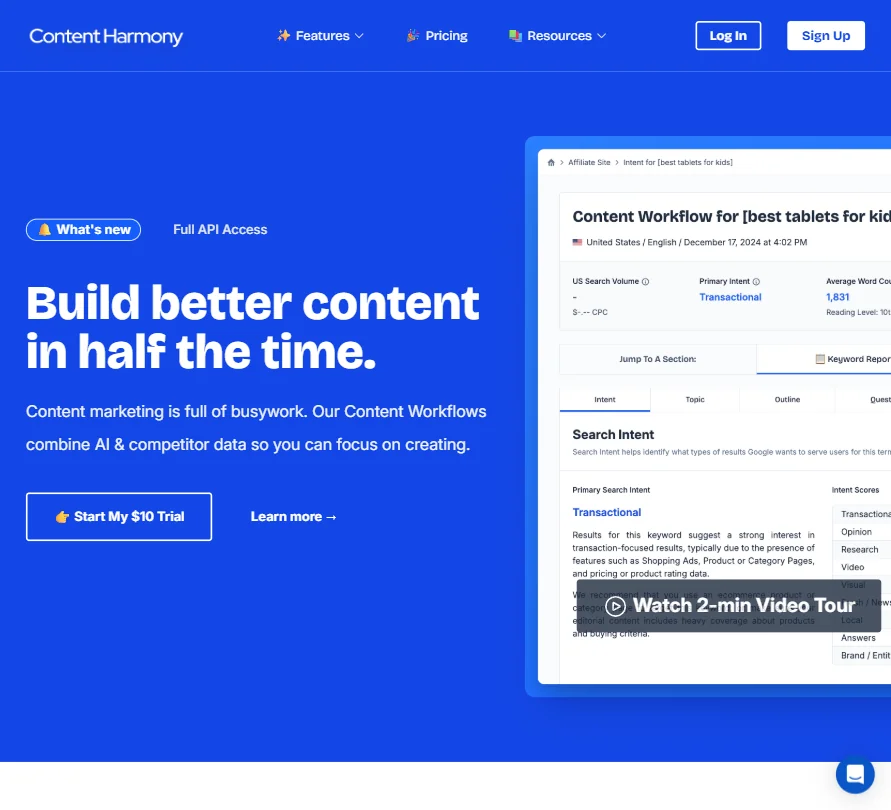
What it actually does: keyword research, competitor content analysis, topic modeling, and content grading, wrapped into one repeatable workflow. You start with a keyword, build a structured brief, and grade your draft before publishing. One loop. Done.
The product is built around the brief and the grade, not the draft. Teams that already have writers, whether in-house or freelance, will find that a workable trade. Teams expecting something closer to Jasper-style paragraph generation will hit a wall immediately and probably be annoyed they didn't read further before signing up.
Content Harmony Features: SEO & Content Tools Breakdown

Tighter feature set than Clearscope or MarketMuse. That's not a knock. Tight focus tends to produce better execution, and the reviews back that up.
The Content Grader is what users keep coming back to. It measures a draft against a topic model built from SERP data, flagging gaps in entity coverage and question handling. G2 reviewers in agency roles called it the most useful part of the product, and not just useful, consistently useful. Not the brief generation. The grader specifically.
Briefs include question analysis and authoritative source suggestions. That last feature is something we don't see often. Most brief tools stop at headings and target keywords. Pointing writers toward credible sources is a genuinely practical addition, not a marketing bullet point.
The UI relaunched in February 2025. New sidebar, new navigation. Users who'd been around before the update had mixed feelings about the transition. Nothing alarming, just the usual friction when a familiar layout changes.
Content Harmony Keyword Research: How Deep Does It Go?
Deep enough for its purpose. Keyword reports include search intent classification, competitor data, and question clustering. International research is supported across 9 countries. Non-English workflows are listed as "coming soon" in their docs. Honest, at least.
The topic model here is built around overlapping keywords and entities for a single keyword. It doesn't group a keyword list into clusters. It won't replace a dedicated tool like Ahrefs for backlink analysis or rank tracking, and it doesn't pretend otherwise. For understanding what a SERP expects topically, it does solid work.
We're skeptical of any tool that bills itself as an all-in-one SEO suite. Content Harmony doesn't. Good call.
Content Harmony Content Creation: AI Writing Quality Tested
Nothing to test here in the traditional sense. No AI writing output. Content Harmony is explicit about this, and we're not going to hold that against them.
The AI produces the topic model and the grader output. Both rely on a proprietary model, not a third-party layer like GPT-4. The grader's accuracy is what users actually care about, and across the reviews we read, the feedback is largely positive. Capterra sits at 4.9 out of 5 across 16 reviews. G2 at 4.8 out of 5 across 21. Small sample. Almost no noise. That's a signal worth taking seriously, even if the volume's low.
Teams expecting a draft at the end of the workflow should look elsewhere before paying the trial fee. Worth knowing upfront.
Is Content Harmony Easy to Use?
Mostly yes. The workflow is deliberately structured: keyword report, then brief, then grader. The tool keeps you in the path. There's not a lot of wandering around figuring out where to start.
The Google Docs integration comes up in reviews. Not warmly. A few users described it as limited. When we cross-referenced their documentation with those user reports, the integration looks functional but not deep. That tracks.
Honestly, the workflow simplicity is probably one of the real selling points here. The February 2025 UI relaunch appears to have reduced friction for new users, based on what surfaced in recent reviews. Nothing steep. Nothing alarming.
Content Harmony Pricing: Is It Worth It vs Free Alternatives?
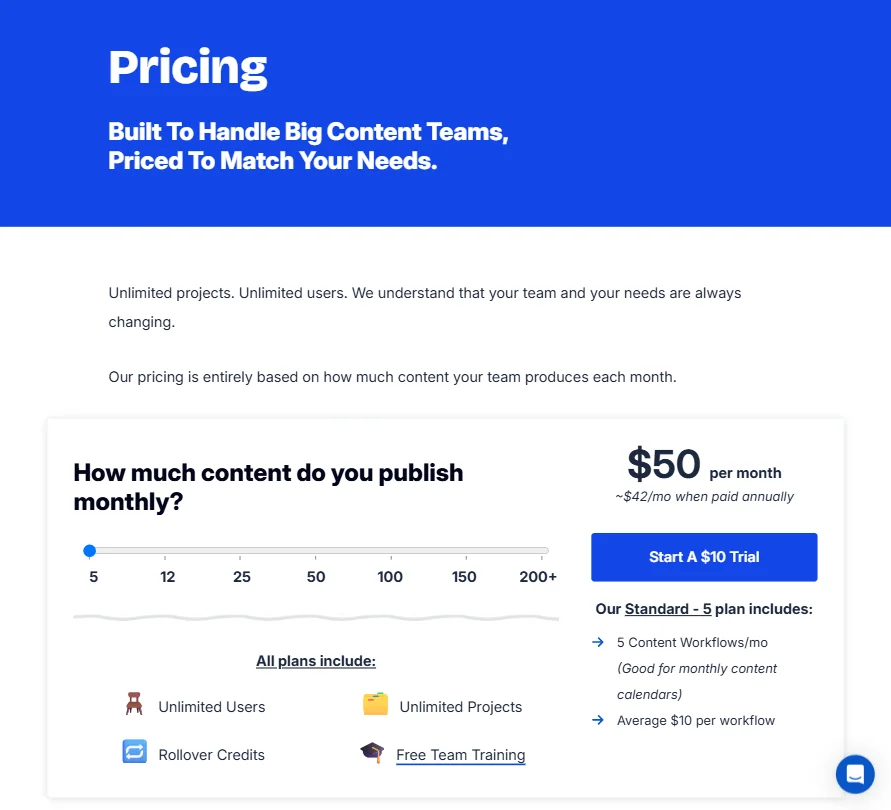
The trial is $10 for 10 Content Workflow credits. No auto-renewal. Fair.
Standard plans scale by workflow volume. The entry point is $50 per month for 5 workflows. The Standard 12 plan, which seems to be their most commonly referenced tier, runs $99 per month, or roughly $89 per month on annual billing. Larger teams can move up to 25 workflows at $199 per month, 50 at $299, or 100 at $599. The top standard tier is 150 workflows at $799 per month. Enterprise starts at $1,000 per month and covers 200 or more workflows on custom terms.
All plans include unlimited users and unlimited projects. At $99 per month for unlimited users, the math works in your favor faster than Clearscope, which also includes unlimited users but starts at $129 per month.
Free alternatives? Not real ones for this specific workflow. Frase and Scalenut don't have free tiers either.
Content Harmony vs Clearscope: Head-to-Head Comparison
Clearscope is the name that comes up most often in the same conversation. Both tools grade content against a topic model and both pull SERP data. That's roughly where the overlap ends.
Clearscope leans harder into the content editor experience. Content Harmony leans into the brief. Two different philosophies about where the bottleneck actually lives in a content operation.
Both tools include unlimited users, so seat count doesn't separate them. Clearscope has a longer review trail to evaluate, which matters when you're trying to assess reliability over time. We don't dismiss that.
The content brief workflow in Content Harmony is more structured than what Clearscope offers. If brief creation is the actual bottleneck in your process, that's the deciding factor and probably the only one you need.
Who Should Use Content Harmony? (And Who Shouldn't)
SEO agencies. Clearest fit, full stop. Unlimited users, per-workflow pricing, structured briefs built for handoff to writers who aren't in the room when the brief gets made.
Freelance writers who run their own research. The grader alone justifies the trial cost for that use case.
Teams expecting AI-generated drafts should look elsewhere. The tool doesn't do that, and it's not going to. Teams needing rank tracking or deep backlink data have the same problem. This is not a full SEO platform and doesn't try to be.
Content Harmony Review Verdict
Specific tool. Does a specific thing. Does it well.
The brief-to-grade workflow is genuinely well-designed, and the per-workflow pricing with unlimited users is a smarter structure than most competitors have bothered to figure out. The grader is what users keep coming back to, across every review platform we read.
The gaps are real but predictable. No AI writing. Limited integrations. No rank tracking. These aren't oversights. They're choices made by people who ran a content agency and knew exactly which problem they were trying to solve.
For agencies running content at scale with in-house or freelance writers, the $10 trial is a low enough bar that there's no real reason to skip it. Start there.
How Content Harmony compares
Content Harmony scores 3.4 out of 10 among the content optimisers we rate. These three do the same job and are the closest to it, compared on what each vendor publishes.
Clearscope
Content Harmony starts at $50 a month, well under Clearscope's $129 a month Essentials plan, but it does not write full articles, only heading and question suggestions inside a brief. Clearscope drafts complete articles and publishes straight to WordPress, a plugin Content Harmony does not have. Both give unlimited seats on every plan and both include a Google Docs add-on. Content Harmony adds live chat support; Clearscope's support is ticket only.
Pick Clearscope if you need full AI drafts and WordPress publishing.
Pick Content Harmony if you want lower cost and live chat support.
Frase
Frase and Content Harmony price close together, $49 against $50 a month to start, but Frase writes full articles and runs a technical site audit on every plan, neither of which Content Harmony offers. Content Harmony sticks to content briefs and a grader that scores drafts against the SERP topic model. Frase also connects to Google Search Console and clusters keywords; Content Harmony does neither. Both give a Google Docs add-on and an API.
Pick Frase if you want full drafts and a technical audit.
Pick Content Harmony if you already have a writer and just need briefs.
MarketMuse
MarketMuse has a genuine free plan, 10 queries a month with keyword and SERP tools included; Content Harmony has no free tier, starting at $50 a month. Content Harmony gives unlimited seats on every paid plan, while MarketMuse's cheapest paid plan, Optimize, includes just one. Neither tool writes full articles: MarketMuse retired full-draft generation and Content Harmony only ever offered heading suggestions. MarketMuse does cluster keywords into topics, a feature Content Harmony lacks.
Pick MarketMuse if you want a free plan and keyword clustering.
Pick Content Harmony if your whole team needs seats without extra cost.
Frequently Asked Questions
Does Content Harmony have a free plan?
No free plan. There's a $10 paid trial with 10 Content Workflow credits and no auto-renewal. Honestly, that's a better arrangement than a crippled free tier. You get enough to run real workflows and make an actual decision.
Can Content Harmony write content for me?
It can't, and that's deliberate. The AI handles research, topic modeling, and grading. Actual draft writing stays with you or your writers. Teams who need AI writing output built into the same tool will need to add something else to their stack, whether that's a dedicated AI writer or a hybrid tool like Frase.
How does Content Harmony pricing work for teams?
All plans include unlimited users and unlimited projects. You pay based on the number of Content Workflows you run per month, not per seat. Plans run from $50 per month for 5 workflows up to $799 per month for 150. Enterprise pricing requires a direct conversation and covers 200 or more workflows per month. For agencies with multiple writers, the unlimited-user structure is meaningfully more cost-effective than per-seat competitors, particularly MarketMuse, which scales cost with headcount.