Pricing page first, as always. Then G2. What we kept seeing with Scalenut was a tool trying to do something genuinely different from the standard AI content pile, and mostly pulling it off, with a few gaps worth naming before you hand over a credit card number.

What is Scalenut?
Founded in 2020, San Francisco. Scalenut pitches itself as a full-cycle content platform, but the angle they're pushing hardest right now is GEO, generative engine optimization, tracking where and how often your brand surfaces inside AI-generated search results from ChatGPT, Google AIO, and Perplexity. That's a genuine differentiator. Most competitors are still building almost entirely around Google.
The platform covers keyword research, content briefs, long-form writing, on-page optimization, and backlink tools, plus that AI visibility layer sitting on top. One platform, a lot of moving parts. Honestly, that scope raises an eyebrow. Tools that try to do everything sometimes do none of it particularly well. But the G2 review patterns we cross-referenced don't read like brand-managed noise, so we kept going.
They claim over a million users. No breakdown. Just a number on the homepage.
Scalenut Features: SEO & Content Tools Breakdown

The feature list is long. What stood out in our research is how tightly the pieces are supposed to connect. You run keyword research, build a cluster, generate a brief through what they call Cruise Mode, write in the built-in editor, optimize with NLP-based suggestions, then track performance across both Google and AI search engines.
That loop mostly holds together, based on what we cross-referenced across vendor docs and G2 reviews from content managers and agency owners. Friction tends to show up at the edges, not in the core cycle.
The GEO tracking layer lets you monitor up to 10 prompts per week on Starter, 25 on Plus, and 100 on Professional, all with weekly refresh cycles. The content article limits run 5 per month on Starter, 30 on Plus, and 75 on Professional, covering both creation and optimization. Worth noting as a planning constraint before you pick a tier.
The backlinks marketplace is newer and gets almost no mention in user reviews. We'd take that as a sign it's either underused or still maturing. Fair.
Scalenut Keyword Research: How Deep Does It Go?
The keyword planner focuses on high-intent discovery with SERP-based filtering. Not unusual in 2025. What's more interesting is the cluster builder, which groups related keywords from a seed topic into logical content groups, and it gets flagged often in positive G2 reviews from content strategy roles as one of the more useful parts of the platform.
The depth question is harder to answer without hands-on testing. What we kept seeing in user reports is that the keyword data works well for content planning but probably doesn't replace a dedicated SEO data tool. One Reddit thread from late 2024 described Scalenut's keyword module as "good enough for content teams, not enough for technical SEO leads." That tracks with how the platform positions itself.
Google Search Console does connect, feeding the Traffic Analyzer, but only from the Plus plan up. For a content platform at this maturity level, keeping it off Starter is a gap worth flagging and we're not going to wave it away.
Scalenut Content Creation: AI Writing Quality Tested
We haven't run Scalenut's long-form writer through our own tests. What we have is a consistent pattern across G2 and Capterra. The AI output is described as readable and structured, with the GEO framing meaning content is written to answer questions directly, the way AI search engines tend to pull from sources. Smart angle.
Cruise Mode is the feature that comes up most in positive reviews, automating the brief-to-draft pipeline and pulling competitor SERP data into the content structure before you've written a word. Agency owners mention it. Solo content creators mention it. That's a wide range of happy users for one feature, which we find mildly encouraging.
The critical reviews are more specific. Some users flag that AI output still needs meaningful editing before publication. A recurring complaint pattern on G2 involves the AI going generic on technical topics. That's a fair criticism of most GPT-based writing tools right now, not unique to Scalenut, but worth saying plainly rather than burying.
Is Scalenut Easy to Use?
There's a gap between what the homepage implies and what onboarding actually involves. The platform has a lot of features. That creates a learning curve. G2 reviewers mention the help center, live webinars, and the bootcamp Scalenut offers as genuinely useful resources. Good. It also means you'll probably need them.
New users tend to take several sessions before the Cruise Mode workflow feels natural, based on the review patterns we saw. Not a dealbreaker. But if you're expecting a finished article in ten minutes from a URL, that's not what this is. Scalenut is a workflow tool. It rewards users who invest time in learning it.
Web-based interface, plus a Chrome writing extension that also works inside Google Docs. There's no dedicated Google Docs add-on, which limits where the tool fits into some teams' existing setups, and we'd want that gap closed before calling the product fully mature.
Scalenut Pricing: Is It Worth It vs Free Alternatives?
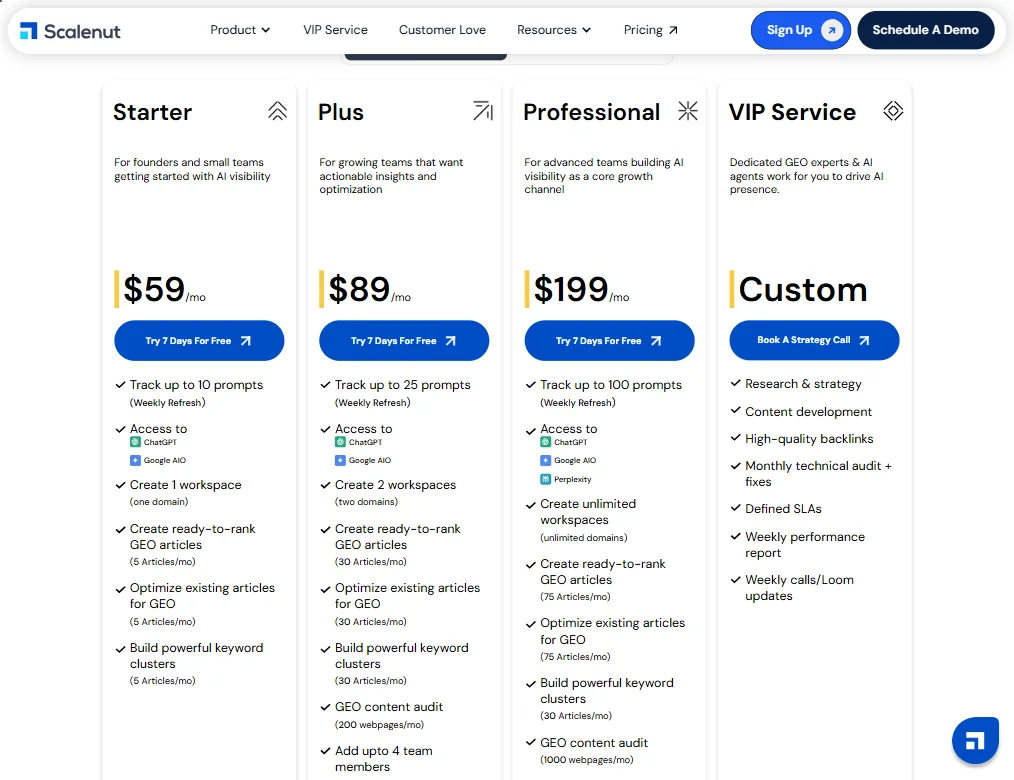
Three self-serve tiers on monthly billing. Starter at $59 per month, Plus at $89, Professional at $199. A limited-time 60% off offer on annual billing drops those substantially, Starter comes down to $24 per month while it runs, which is the more defensible entry point. The monthly-to-annual gap on Starter is $35 a month. That's not nothing if you're testing before committing.
The VIP Service plan is custom-priced, no public details. Standard practice and still frustrating. It bundles research, content development, high-quality backlinks, and monthly technical audits, along with defined SLAs and weekly performance calls.
No free plan. A 7-day free trial exists and is clearly disclosed on the pricing page, though the specific usage limits during the trial period aren't consolidated anywhere obvious. We dug through the pricing page and help docs looking for refund policy language. The refund policy help doc is clear: no refund after the trial period.
At $24 per month on the current annual offer, Scalenut is competitive. Frase currently starts at $39 per month on annual billing, or $49 month to month, and it now covers research, writing, SEO and GEO optimization, AI visibility, site audits, and content monitoring, so the "narrower feature set" framing we sometimes see in vendor comparisons requires more precision than it usually gets. The honest comparison is feature-by-feature, not a blanket statement. NEURONwriter covers similar on-page optimization ground at a lower price point, though it doesn't have the AI visibility tracking angle. The value here depends entirely on whether that GEO layer matters to your strategy.
Scalenut vs SurferSEO: Head-to-Head Comparison
SurferSEO is the obvious comparison. Both tools combine content editing with SEO optimization and both are trying to be the platform you live in, not just a feature you run occasionally. The difference is where they've placed their bets.
SurferSEO has built deeper integration with Google-based SEO workflows and broader third-party connections. Scalenut has gone harder on the GEO angle, tracking AI engine visibility across ChatGPT, Google AIO, and Perplexity alongside traditional search performance. That's a meaningful distinction as AI search grows.
In our research across user reviews, SurferSEO pulls stronger reactions from technical SEO practitioners. Scalenut gets more positive mentions from content teams focused on volume and workflow speed. Neither is objectively better. Oriented differently.
If AI visibility tracking matters to your strategy, Scalenut is the more interesting option right now. SurferSEO doesn't offer anything comparable to the prompt discovery and AI mention monitoring Scalenut is building toward. If you need deeper backlink analysis and broader data integrations, Ahrefs is operating at a different level than either of these tools.
Who Should Use Scalenut? (And Who Shouldn't)
Growing content teams and agencies producing articles at volume. That's the fit. Teams that need a workflow covering brief to draft to optimization without jumping between five tools will find the most to like here.
Founders running content-led SEO strategies. The price is accessible and the workflow is designed to reduce the manual parts of the process.
Solo technical SEO practitioners should look elsewhere. The platform doesn't go deep enough on the data side to replace a proper SEO toolkit. Teams that need a dedicated Google Docs add-on in their daily workflow will hit friction, since Docs access runs through the Chrome extension.
English-only support is a firm limit, full stop. Multilingual teams are out entirely, and there's no ambiguity on that point.
Scalenut Review Verdict
The GEO tracking angle is real and it's ahead of most competitors. The core content workflow, keyword clustering through Cruise Mode through the built-in editor, is well thought out and the review patterns back it up. The prompt tracking limits across tiers, 10 prompts per week on Starter up to 100 on Professional, give you something concrete to size against your actual usage before picking a plan.
What gives us slight pause is the surface area. A few features, the backlinks marketplace most notably, haven't built up enough user evidence yet for us to call them proven. The no-refund-after-trial policy and keeping the Google Search Console integration off Starter are genuinely annoying gaps for a tool at this maturity level. We're not going to pretend otherwise.
At $24 per month on the current annual Starter offer, the floor is reasonable. The Professional plan at $199 monthly, or $80 a month on the annual offer, covers most teams' needs without hitting enterprise pricing. For a content-focused team that wants one platform for the full cycle and cares about AI search visibility, Scalenut is worth the 7-day trial. Not perfect. But the direction is right.
How Scalenut compares
Scalenut scores 5.5 out of 10 among the content optimisers we rate. These three do the same job and are the closest to it, compared on what each vendor publishes.
MarketMuse
Scalenut's Cruise Mode writes full articles from a keyword, 5 a month on its Starter plan; MarketMuse has no full-draft generation, working section by section with tools like Expand a Concept and Make Longer instead. MarketMuse does offer a free plan with 10 queries a month, which Scalenut does not have; Scalenut's cheapest paid plan is $59 a month with a 7 day trial. Scalenut writes in English only, and MarketMuse names 2 languages for its editor.
Pick MarketMuse if you want to try it free before paying anything.
Pick Scalenut if you want one tool that drafts full articles too.
Frase
Frase undercuts Scalenut on price, $49 a month against $59, and Frase's Starter plan bundles in a technical site audit up to 50 pages plus backlink analysis; Scalenut holds its technical audit back for the Plus plan and has no backlink analysis at all. Scalenut offers live chat support on every plan including Starter; Frase's support is email only. Frase writes in 70 languages, Scalenut in English only.
Pick Frase if you need a technical audit or backlink analysis from day one.
Pick Scalenut if you want live human support included on the cheapest plan.
Content Harmony
Content Harmony and Scalenut sit close on price, $50 a month against $59, but Content Harmony has no full-draft writer: its AI suggestions cover headings, questions and images, while Scalenut's Cruise Mode writes complete articles from a keyword. Scalenut also offers keyword clustering from Starter; Content Harmony groups nothing into clusters. Content Harmony ships a real Google Docs add-on, where Scalenut's Google Docs support works only through its Chrome extension.
Pick Content Harmony if you want a real Google Docs add-on, not an extension.
Pick Scalenut if you want a tool that writes full drafts and clusters keywords.
Frequently Asked Questions
Does Scalenut have a free plan?
No free plan exists. A 7-day free trial is clearly disclosed on the pricing page, though the specific usage limits during that trial period aren't consolidated or explained in one place. Start there before committing to annual billing, especially since the refund policy rules out refunds once the trial period ends.
How does Scalenut's GEO tracking actually work?
The platform monitors how often and where your brand appears in AI-generated search results across ChatGPT, Google AIO, and Perplexity. It tracks prompt coverage and brand visibility on a weekly refresh cycle, which is a different metric than keyword ranking. Scalenut is one of the few tools building this into a full content workflow rather than offering it as a standalone dashboard. Whether that integration is mature enough to act on is a separate question, but the architecture is there.
Is Scalenut better than SurferSEO?
Depends on what you're optimizing for. SurferSEO has a stronger reputation with technical SEO practitioners and connects to more third-party tools. Scalenut is ahead on AI visibility tracking and tends to work better for content teams focused on production volume. Neither beats the other cleanly. Pick based on which gap actually costs you time right now.